RockStarCV NarratorIntroduction
What does a strong Data Scientist interview sound like? Let us step inside the conversation and listen for the decisions that make each answer credible.
RockStarCV NarratorMeet Marcus Lee and Victor Chen
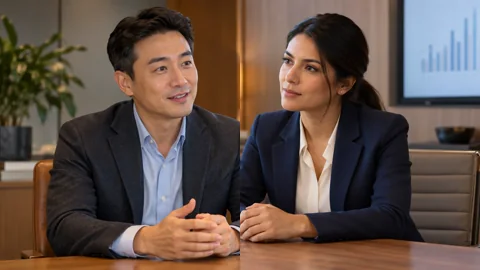
Your interviewer is Marcus Lee, a Director of Data Science who tests whether a candidate connects models to decisions and validates honestly. Your candidate is Victor Chen, an experienced data scientist presenting the strong-candidate path. After the interview, we will turn his examples into a practical preparation framework.
Marcus LeeWelcome
Hi, Victor. Thanks for coming in. How are you today?
Victor ChenWelcome
Hi, Marcus. I am doing well, thank you. I appreciate the time, and I have been looking forward to this.
Marcus LeeWelcome
Great. We have about half an hour. I will start with your background, then talk through how you approach a problem, how you validate a model, and how you communicate results. I will leave time for your questions. Sound good?
Victor ChenWelcome
That sounds good.
Marcus LeeCareer story
Let us start with your background. Tell me about your experience as a data scientist.
Victor ChenCareer story
I have about six years in data science, mostly in business-to-consumer companies. I work end to end: framing the problem with stakeholders, cleaning and exploring the data, building and validating models, and getting the result into a decision or a product. Recently I led a customer-churn model that the retention team actually uses to prioritize outreach, which cut avoidable churn in that segment by a few points.
Victor ChenCareer story
What I care most about is that a model has to change a decision to be worth anything. Plenty of accurate models sit on a shelf because no one trusted them or could act on them. I am looking for a role where data science is close to real decisions and held to honest standards, which is how you described this team.
Marcus LeeCareer story
On that churn model, how did you make sure the retention team actually used it?
Victor ChenCareer story
I involved them from the start, so it answered their question, not mine. I made the output something they could act on, a ranked list with the few reasons a customer was flagged, not just a probability. And I was honest about its limits, so they trusted it. A model people understand and can act on beats a more accurate one they ignore.
Marcus LeeMotivation
Why are you interested in this data-scientist role specifically?
Victor ChenMotivation
Two reasons. First, you framed the role around business impact and rigor, not just building models for their own sake, and that is how I work. Second, you have real data and real decisions at stake, which is where data science earns its keep. I would rather ship a careful model that changes a decision than a clever one that never leaves a notebook.
Marcus LeeProblem framing
Let us talk about how you work. When a stakeholder brings you a request, how do you start?
Victor ChenProblem framing
I start with the decision, not the data. I ask what they are trying to decide, what action they would take differently depending on the answer, and how we would know it worked. Often the request as stated is not the real question. Someone asks to predict churn, but the real goal is to reduce it, which is a different and more useful problem. Framing that well up front saves weeks of elegant work on the wrong thing.
Victor ChenProblem framing
I also ask what a good-enough answer looks like and when they need it. Sometimes a simple analysis this week beats a sophisticated model next quarter. Matching the method to the decision, including its timeline and stakes, is part of the job, not a compromise of it.
Marcus LeeProblem framing
How do you handle a stakeholder who asks for a model when the problem does not really need one?
Victor ChenProblem framing
I take the underlying goal seriously and propose the simplest thing that meets it. If a clear dashboard or a cohort analysis answers the question, I say so, even though a model would be more impressive to build. Reaching for the fanciest technique when a simple one works is ego, not science. I would rather be trusted for solving the problem than admired for the complexity.
Marcus LeeValidation
Let us go technical. How do you know a model is genuinely good and not just good on paper?
Victor ChenValidation
I never trust performance measured on the data the model was trained on. I evaluate on held-out data, or with cross-validation, and where time matters I split by time so I am testing on the future, not a shuffled past. And I pick a metric that matches the decision. For an imbalanced churn problem, accuracy is misleading because predicting nobody churns can look ninety-five percent accurate; I care about precision and recall at the threshold the business will actually act on.
Victor ChenValidation
The failure I watch for most is data leakage: a feature that would not be available at prediction time, or that secretly encodes the answer. A model that looks too good is usually leaking. On one project a feature quietly included post-outcome information, and the stellar results evaporated once I removed it. Catching that before it ships is far cheaper than explaining later why a perfect model failed in production.
Marcus LeeValidation
What do you do when your model's offline metrics are great but you are not sure it will hold up live?
Victor ChenValidation
I treat offline metrics as a necessary but not sufficient check, and I push to test it live in a controlled way, ideally an experiment or a staged rollout, measuring the business outcome, not just the model metric. I also monitor it after launch, because data drifts and a model that was good last quarter can quietly degrade. A model is not done when it ships; it is done when it keeps working and someone is watching it.
Marcus LeeData quality
People underestimate the data side. How do you think about data quality?
Victor ChenData quality
Most of the work, honestly. Garbage in, garbage out is not a cliche; it is the main risk. Before I model anything, I understand how the data was generated, check for missingness and how it arose, look for duplicates and outliers, and confirm the labels actually mean what I think. A model built on data I do not understand is a confident guess, and a confident wrong answer is worse than no answer.
Victor ChenData quality
I also check for bias in the data itself, because a model learns the patterns in its training data, including the unfair ones. If the historical data reflects a biased process, the model will reproduce it unless I catch it. That is a data-quality question as much as an ethics one.
Marcus LeeCommunication
How do you present a modeling result to a non-technical executive?
Victor ChenCommunication
I lead with the decision and the recommendation, not the method. Something like: here is what we found, here is what I recommend, and here is how confident I am and why. I keep the algorithm in the appendix. Executives do not need to know it is a gradient-boosted model; they need to know what to do and how much to trust it.
Victor ChenCommunication
And I am honest about uncertainty. I give a range rather than false precision, I am clear about what the model does not know, and I say plainly when the data cannot answer a question. Overstating confidence is how data science loses credibility the first time a prediction is wrong. A result stakeholders understand and appropriately trust is the one that changes a decision.
Marcus LeeResponsible ML
Suppose your model performs well overall but you find it is less accurate for one group, or the business wants to deploy something you cannot really explain. What do you do?
Victor ChenResponsible ML
I treat that as a stop-and-examine moment, not a detail. If a model is systematically worse for one group, or would make a decision that unfairly harms people, I do not ship it just because the overall number is good. I measure the disparity, understand its source, and either fix it or escalate it. The NIST risk framework and basic responsibility both point the same way: a model has to be valid, explainable enough for its use, and fair, not just accurate on average.
Victor ChenResponsible ML
On explainability, I match the requirement to the stakes. For a low-risk recommendation, a black box with good monitoring may be fine. For a decision that materially affects someone, I want a model I can explain and defend, or I use a simpler, interpretable one. I would rather give up a little accuracy than deploy something I cannot stand behind if it is challenged.
Marcus LeeResponsible ML
How do you know whether you have been successful in this role?
Victor ChenResponsible ML
On three levels. First, impact: my work changed decisions and the business outcome moved, not just a model metric. Second, rigor: my results hold up because the validation was honest and the data was understood, so I am not quietly wrong. Third, trust: stakeholders act on my work because I have been clear about both what it shows and what it cannot, and I have never oversold a result.
Victor ChenResponsible ML
The simplest test is whether a decision-maker would both use my model and be comfortable defending how it was built. If both are true consistently, I am doing the job well.
Marcus LeeCandidate questions
Thank you. Those are my questions. What would you like to ask me?
Victor ChenCandidate questions
What would make the person in this role clearly successful in the first year? I am interested in the decisions you want to improve, not just the models you expect.
Marcus LeeCandidate questions
By a year in, I would want a couple of models genuinely in use and trusted, better rigor around validation and monitoring, and stakeholders who bring us real decisions early rather than asking for a model after the fact.
Victor ChenCandidate questions
That is helpful. My second question is about how models get into production and monitored here. A lot of value is lost between a good notebook and a reliable production system, so I would want to understand that path.
Marcus LeeCandidate questions
That is a telling question. Our path to production is improving but not fully mature, and strengthening it, including monitoring, would be part of this role.
Victor ChenCandidate questions
Thank you. That is exactly the kind of work that makes data science actually matter.
Marcus LeeClose
We are finishing first conversations this week and will follow up early next week. Is there anything else you would like us to know?
Victor ChenClose
Only that the way you frame the role, rigor in service of real decisions, is exactly how I work. Thank you for your time, Marcus.
Marcus LeeClose
Thank you, Victor. It was a pleasure. We will be in touch soon. Goodbye.
RockStarCV NarratorOutro 1 · Verdict
The verdict is clear. Victor's interview worked because he connected technical rigor to real decisions. He did not talk about fancy algorithms. He talked about framing the problem, validating honestly, catching leakage, communicating uncertainty, and refusing to ship a biased or unexplainable model.
RockStarCV NarratorOutro 2 · Evidence
First, Victor replaced adjectives with evidence. A churn model the retention team actually uses showed impact. Catching a data-leakage bug showed rigor. And stating uncertainty plainly showed the honesty that earns trust.
RockStarCV NarratorOutro 2 · Evidence
Across the interview, four signals stayed easy to inspect. Victor framed from the decision, validated on held-out data, communicated uncertainty plainly, and managed bias and explainability responsibly.
RockStarCV NarratorOutro 2 · Evidence
Those examples created four credibility signals. He framed from the decision. He validated on unseen data and hunted leakage. He led with the recommendation and the uncertainty. And he kept models fair, explainable, and monitored.
RockStarCV NarratorOutro 3 · Framework
Use the same five-part structure in your own answers. Name the decision, how you checked the data, how you validated honestly, how you communicated uncertainty, and how you handled fairness and explainability.
RockStarCV NarratorOutro 3 · Framework
For example, do not stop at, I built a churn model with high accuracy. Name the decision it changed. State how you validated it on held-out data, the leakage you ruled out, and how confident you were when you handed it over.
RockStarCV NarratorOutro 4 · Practice
Now make the framework yours. Choose one real project you worked on. Write the five short lines, then practise explaining them naturally, as a conversation rather than a memorized speech.
RockStarCV NarratorOutro 4 · Practice
Prepare with evidence. Interview with confidence. Continue your preparation at Rock Star C V dot com.