Skip to interview
RockStarCV.com
Toggle Navigation

Data Analyst Mock Interview: The Strong Candidate

Watch a complete Data Analyst interview where Elena makes problem framing, data quality, metric governance, experiment economics, privacy judgment, and recommendations visible.

Strong candidate pathInteractive simulation16 chapters
Elena Torres, the fictional Data Analyst candidate, seated on the right and facing toward the article center
Elena TorresData Analyst candidate

Watch and practise

Run the complete interview

Complete transcript

RockStarCV NarratorIntroduction

What does a strong Data Analyst interview sound like? Let’s step inside the conversation and listen for the decisions that make each analytical answer credible.

RockStarCV NarratorMeet Jordan and Elena

Listen for how each answer connects the business decision, population, metric, data-quality checks, trade-off and recommendation.

RockStarCV NarratorMeet Jordan and Elena

Elena Torres is a Data Analyst with five years of retail and subscription analytics experience. She is interviewing for a Senior Data Analyst role focused on customer growth and retention.

RockStarCV NarratorMeet Jordan and Elena

Jordan Lee is Northline Market’s Director of Analytics. Jordan is evaluating technical depth, decision framing, data quality, business judgment, communication and privacy awareness.

Jordan LeeThe room

Hi, Elena. Thanks for joining. How has your day been?

Elena TorresThe room

It has been good, thank you. I reviewed the role again this morning, so I am looking forward to the conversation.

Jordan LeeThe room

Great. We will spend about forty minutes on your background, a few practical analytics situations, and your questions for me. Does that plan work?

Elena TorresThe room

Yes, absolutely.

Jordan LeeCareer story

Tell me about your experience as a Data Analyst and how your analysis has influenced decisions.

Elena TorresCareer story

I currently support customer growth at Cedar & Finch, a fictional Chicago-based online retailer. My work sits between Marketing, Product and Finance. I use SQL in Snowflake, dbt for tested transformations, Looker for governed reporting, and Python when the analysis needs more than SQL can comfortably provide.

Elena TorresCareer story

The common thread is turning an uncertain business question into a decision someone can own. Last year I rebuilt our repeat-purchase metric after finding that returns and late orders were being handled differently across reports. I also designed the readout for two retention experiments and added quality checks that stopped incomplete weekly data from reaching executives.

Jordan LeeCareer story

What changed in your own role as you took on that work?

Elena TorresCareer story

I moved from answering requests to shaping them. I now ask what decision is due, which population matters, what could change the recommendation, and who owns the action. I also review metric definitions and SQL with two analysts, so maintainability and interpretation are part of delivery, not cleanup after delivery.

Jordan LeeCareer story

Why is this role the right next step?

Elena TorresCareer story

The role owns retention measurement across stores and digital channels, which is a larger decision surface than my current scope. I am ready to lead the metric contract, analysis plan and recommendation, while still being close enough to the data to challenge grain, assumptions and quality.

Jordan LeeProblem framing

Imagine our VP of Marketing says, “We need to improve retention.” How would you turn that into an analysis plan?

Elena TorresProblem framing

I would not begin with a dashboard. I would first identify the decision and the deadline. Are we choosing an audience for an offer, diagnosing a recent decline, or setting a quarterly target? Those lead to different cohorts, methods and evidence.

Jordan LeeProblem framing

Assume the decision is whether to fund a ninety-day retention offer for recent first-time buyers.

Elena TorresProblem framing

Then I would define eligible first-time buyers, the exposure date, the ninety-day observation window, and what counts as a repeat purchase. I would confirm how cancellations, returns, guest checkout and cross-channel identity are handled. The primary outcome could be ninety-day repeat-purchase rate, with contribution margin per eligible customer as a guardrail.

Elena TorresProblem framing

I would profile the baseline by acquisition channel and customer value before recommending randomization. I would agree the minimum effect worth funding, sample-size assumptions, stop conditions, and the owner of the rollout decision. The analysis plan would be versioned before results are visible.

Jordan LeeProblem framing

What would your first deliverable look like?

Elena TorresProblem framing

A one-page decision brief: decision due, population, metric formula, guardrails, exclusions, data sources, quality checks, analysis method, decision owner and known limitations. Code and dashboards follow that contract.

Jordan LeeData quality

A ninety-day repeat-purchase rate drops immediately after a pipeline change. Walk me through your investigation.

Elena TorresData quality

First I would pause any decision that depends on the metric and reproduce the change. I would compare the last trusted run with the first affected run: row counts, freshness, nulls, distinct customers, order totals and the distribution by source. That tells me whether the movement is broad, isolated or simply incomplete.

Elena TorresData quality

Next I would trace the model lineage and check grain at every join. A customer-level denominator joined to order-line detail can multiply rows. A new inner join can silently remove guest orders. I would inspect dbt test results, compiled SQL and the Git diff rather than guessing from the chart.

Jordan LeeData quality

Suppose the ecommerce feed is arriving twelve hours late.

Elena TorresData quality

I would reconcile the warehouse count to the source control total and label the current window incomplete. If the executive meeting cannot move, I would show the last complete period and a separate provisional indicator, not blend partial data into the trend. Then I would backfill, rerun downstream models and document the affected reports.

Jordan LeeData quality

How would you stop the same failure reaching users again?

Elena TorresData quality

I would add freshness and volume thresholds by source, a relationship test on customer and order keys, and a release check that compares the metric with the source control total. Alerts need an owner and a response rule; a failed test that everybody ignores is not a control.

Jordan LeeData quality

Where does Python fit?

Elena TorresData quality

SQL is my first choice for warehouse reconciliation because it keeps the logic close to the modeled data. I use Python for profiling distributions, repeatable anomaly analysis or simulations. The tool should make the reasoning inspectable, not make the answer look more sophisticated.

Jordan LeeMetric governance

Marketing uses a sixty-day repeat-purchase definition. Finance uses ninety days and excludes fully returned orders. Both want one executive dashboard tomorrow. What do you do?

Elena TorresMetric governance

I would treat that as a metric-governance decision, not a visualization dispute. I would put both formulas side by side: cohort entry, observation window, numerator, denominator, exclusions, refresh timing and intended decision. Then I would show where the values diverge and why.

Jordan LeeMetric governance

The executive sponsor still wants a dashboard tomorrow.

Elena TorresMetric governance

I would publish a clearly labeled provisional view with both definitions, a reconciliation note and named owners. I would not silently choose one. For the durable metric, Finance, Marketing and Analytics would sign a metric contract that records the canonical definition, approved variants and change process.

Elena TorresMetric governance

I used that approach at Cedar & Finch. It reduced the Monday reconciliation from about two hours to fifteen minutes, and the same semantic definition fed the Looker dashboard and the Finance extract. The result was not just a cleaner chart; it was one decision language.

Jordan LeeMetric governance

Who owns the metric?

Elena TorresMetric governance

The business owner owns the meaning and decision use. Analytics owns faithful implementation, validation, lineage and clear limitations. Changes need both, because a technically correct query can still encode the wrong business rule.

Jordan LeeExperiment judgment

Here is a fictional test. We randomized forty-two thousand eligible customers per arm. Ninety-day repeat purchase was 18.4 percent in control and 20.1 percent in treatment. The offer was a twenty-dollar credit. Average order value was eighty-six dollars. Contribution margin per repeat order was 24 dollars and 10 cents in control and 21 dollars and 30 cents in treatment. How do you read that result?

Elena TorresExperiment judgment

The absolute lift is 1.7 percentage points. The relative lift is about 9.2 percent, and I would keep those labels distinct. With forty-two thousand customers in each arm, a rough ninety-five percent interval for the rate difference is about 1.2 to 2.2 points, assuming clean randomization and the planned analysis.

Elena TorresExperiment judgment

Before recommending action I would verify sample-ratio balance, exposure, exclusions, missing outcomes and whether the ninety-day window is complete. I would also check the pre-specified guardrails. Statistical evidence does not answer whether the economics matter.

Jordan LeeExperiment judgment

What do the economics suggest?

Elena TorresExperiment judgment

The test produces about seven hundred fourteen incremental repeat purchasers in the treatment arm, but the lower contribution per order matters across all repeat purchases. Using the provided order-level assumptions, estimated repeat-order contribution is roughly six thousand four hundred dollars lower than the control counterfactual for forty-two thousand exposed customers. I would have Finance validate that model, including redemption, fulfillment and repeat-order assumptions.

Jordan LeeExperiment judgment

Would you stop the offer?

Elena TorresExperiment judgment

I would not roll it out broadly. I would inspect the pre-declared segment of customers with two prior purchases. In the fictional readout, twelve thousand customers per arm in that segment showed a 3.4-point lift, with an interval of roughly 2.3 to 4.5 points, and Finance estimated positive contribution of 3 dollars and 80 cents per exposed customer after redemption and variable fulfillment.

Elena TorresExperiment judgment

My recommendation would be a time-boxed rollout to that pre-defined segment, with holdout measurement, a contribution floor, opt-out monitoring and a stop rule. I would present the broad result, the segment evidence, the economics and the assumptions together so the sponsor can see what changes the decision.

Jordan LeeData privacy

An external agency asks for a customer-level CSV with email address and purchase history so it can act on your findings next week. How do you respond?

Elena TorresData privacy

I would clarify the action and the minimum data needed. The analysis result does not automatically authorize a raw export. I would check the approved purpose, contract, consent or policy basis, access method, retention period and the privacy and security owners who must approve the processing.

Jordan LeeData privacy

The campaign is urgent. What could you provide without stalling the decision?

Elena TorresData privacy

For planning, I could provide aggregated segment counts and expected economics with no direct identifiers. If activation is approved, I would prefer an approved audience-transfer process using scoped identifiers, access expiry and an audit trail rather than emailing a CSV. The data should be minimized to the authorized purpose.

Jordan LeeCommunicating the recommendation

How would you present your final recommendation?

Elena TorresCommunicating the recommendation

I would lead with the decision: do not roll out broadly; run a measured segment rollout if Finance and privacy controls are satisfied. Then I would show lift, uncertainty, contribution, guardrails and limitations. I would state what is known, what is assumed, and what we will monitor after the decision.

Jordan LeeCandidate questions

Those are all my planned questions. What would you like to ask me?

Elena TorresCandidate questions

What are the first two decisions this person is expected to improve, and how will you know the analysis changed those decisions rather than only producing more reporting?

Jordan LeeCandidate questions

Retention investment is the first. The second is channel allocation. We need clearer recommendations, agreed guardrails and follow-through after a dashboard is delivered.

Elena TorresCandidate questions

How are metric definitions and data-quality ownership divided today between Analytics Engineering, analysts and business owners?

Jordan LeeCandidate questions

Engineering owns platform reliability, analysts own model validation and interpretation, and business owners should own meaning. The gap is that those responsibilities are not always explicit.

Elena TorresCandidate questions

That is helpful. Making those handoffs explicit is work I enjoy and have done before.

Jordan LeeClosing the interview

We are finishing first-round interviews this week. Selected candidates will receive a take-home analysis brief, followed by a panel conversation. Is there anything else you would like us to know?

Elena TorresClosing the interview

The conversation reinforced my interest. The combination of technical depth, metric ownership and decision influence is exactly what I am looking for. Thank you for your time, Jordan.

Jordan LeeClosing the interview

Thank you, Elena. It was a pleasure meeting you. We will be in touch soon.

Elena TorresClosing the interview

Thank you. Goodbye.

RockStarCV NarratorOutro 1 · Verdict

The verdict: Elena made the analysis inspectable. She did not hide behind tools or broad claims. She showed how a question becomes a decision, how a metric can fail, and what evidence would change her recommendation.

RockStarCV NarratorOutro 2 · Evidence

Her scoping answer began with the decision, population, metric and guardrail. That prevented the available data from quietly redefining the business question.

RockStarCV NarratorOutro 2 · Evidence

Her quality answer moved from freshness and counts to grain, joins, lineage, reconciliation and monitoring. Each check had a purpose and an owner.

RockStarCV NarratorOutro 2 · Evidence

Her governance answer separated business ownership of meaning from Analytics ownership of faithful implementation and limitations. That is stronger than choosing the loudest stakeholder’s definition.

RockStarCV NarratorOutro 3 · Framework

On the experiment, she distinguished a 1.7-point absolute lift from a 9.2-percent relative lift, checked uncertainty, and refused to confuse statistical evidence with profitable action.

RockStarCV NarratorOutro 3 · Framework

On privacy, she treated customer-level access as a separate authorized decision. Aggregation, minimization, scoped transfer and expiry were practical controls, not slogans.

RockStarCV NarratorOutro 4 · Practice

Use this six-part rehearsal frame: decision, population, metric, data checks, trade-off, and recommendation. Then add the limitation that could change your answer.

RockStarCV NarratorOutro 4 · Practice

Prepare with evidence. Interview with confidence. Then rehearse until your reasoning sounds as natural as the work itself.

Use Play to hear the conversation, move one slide at a time, or jump directly to a chapter. Captions follow the active speaker.

What to expect

How the interview is likely to unfold

A senior data analyst interview usually moves from your career story into evidence of judgment, then closes with your questions.

  1. Welcome and framing

    Expect concise rapport, a clear interview agenda, and an opening that establishes the business context for the analysis.

  2. Your analytical story

    Connect your progression to the decisions, stakeholders, datasets, metrics, and recommendations you actually owned.

  3. Problem and data quality

    Define the decision before the query, then show how you test grain, joins, freshness, reconciliation, and lineage.

  4. Metric governance

    Make formula, population, time window, exclusions, owner, and interpretation explicit before presenting a dashboard result.

  5. Experiment and privacy judgment

    Separate relative from absolute lift, explain uncertainty and economics, and minimize any sensitive data shared.

  6. Recommendation and close

    Translate the evidence into a bounded recommendation, state the trade-off, ask decision-oriented questions, and close professionally.

Who might interview you

Different people are testing different things

Listen to the role behind the question. The same example may need a different emphasis for each interviewer.

Recruiter or talent partner

Their purpose
Confirm communication, motivation, level, and practical fit for the analytics environment.
They look for
A coherent analytical story, credible motivation, and clear communication without unsupported certainty.

Analytics manager

Their purpose
Decide whether you can frame a decision, inspect data quality, govern metrics, and communicate a recommendation.
They look for
Explicit grain, definitions, validation steps, uncertainty, trade-offs, and accountable follow-through.

Business or product leader

Their purpose
Understand whether your analysis changes a real operating, customer, or investment decision.
They look for
Decision context, practical significance, contribution economics, and a recommendation that acknowledges limitations.

Data engineering, privacy, or governance partner

Their purpose
Test how you handle lineage, access, minimization, sensitive exports, and authority boundaries.
They look for
Traceable inputs, approved access, minimum necessary data, documented limitations, and clean escalation.

What they are assessing

Make your judgment easy to see

What interviewers need to learn

  • Can you state the business decision, population, metric, guardrail, and owner before describing tools or queries?
  • Can you debug a suspicious result by checking grain, joins, freshness, reconciliation, and lineage?
  • Can you define a durable metric contract that different teams can interpret consistently?
  • Can you distinguish statistical evidence from practical value and make a privacy-aware recommendation?

Accentuate

  • The decision the analysis supported, the relevant population, the period, and your own contribution.
  • The exact quality checks, comparison source, failure mode, and evidence that restored confidence in the result.
  • The metric formula, denominator, exclusions, time window, owner, limitations, and intended use.
  • Absolute and relative lift, uncertainty, contribution economics, guardrails, privacy boundary, and recommended next action.

Leave out

  • A list of SQL, Python, Tableau, Power BI, Excel, or Snowflake without the decision those tools supported.
  • A dashboard result without its population, denominator, period, definition, or comparison source.
  • A statistically significant result presented as automatically valuable, causal, or ready to scale.
  • A customer-level export accepted without purpose, authorization, minimization, retention, or access controls.

Difficult questions

Prepare the evidence, not a script

Use these prompts to choose a truthful example and reconstruct the decision. Your delivery should still sound like you.

Marketing asks you to improve retention. How do you turn that request into an analysis plan?

Why they ask: They are testing whether you define the decision before reaching for data or tools.

Prepare: Decision, population, primary metric, guardrail, time window, owner, and action threshold.

A repeat-purchase metric drops immediately after a pipeline change. How do you investigate?

Why they ask: They need a disciplined quality investigation rather than a premature business conclusion.

Prepare: Grain, joins, duplicate and null checks, freshness, reconciliation, lineage, and downstream impact.

Marketing and Finance use different definitions of repeat purchase. What do you do?

Why they ask: They are testing metric governance and whether you can preserve legitimate differences without creating hidden inconsistency.

Prepare: Use case, formula, denominator, exclusions, time window, owner, version, and documented limitations.

How would you evaluate a retention-offer experiment and recommend what happens next?

Why they ask: They want statistical judgment connected to economics and a decision.

Prepare: Assignment, sample, absolute and relative lift, interval, contribution margin, guardrails, and recommendation.

An external agency asks for a customer-level export to act on your findings. How do you respond?

Why they ask: They need purpose limitation, authorization, minimization, and a safe alternative.

Prepare: Business purpose, minimum fields, aggregation or tokenization, approved transfer, access, retention, and privacy owner.

What questions do you have for us?

Why they ask: Your questions reveal whether you evaluate decision rights, metric ownership, data quality, and analytical impact.

Prepare: First-six-month decisions, metric governance, quality ownership, stakeholder conflicts, and recommendation expectations.
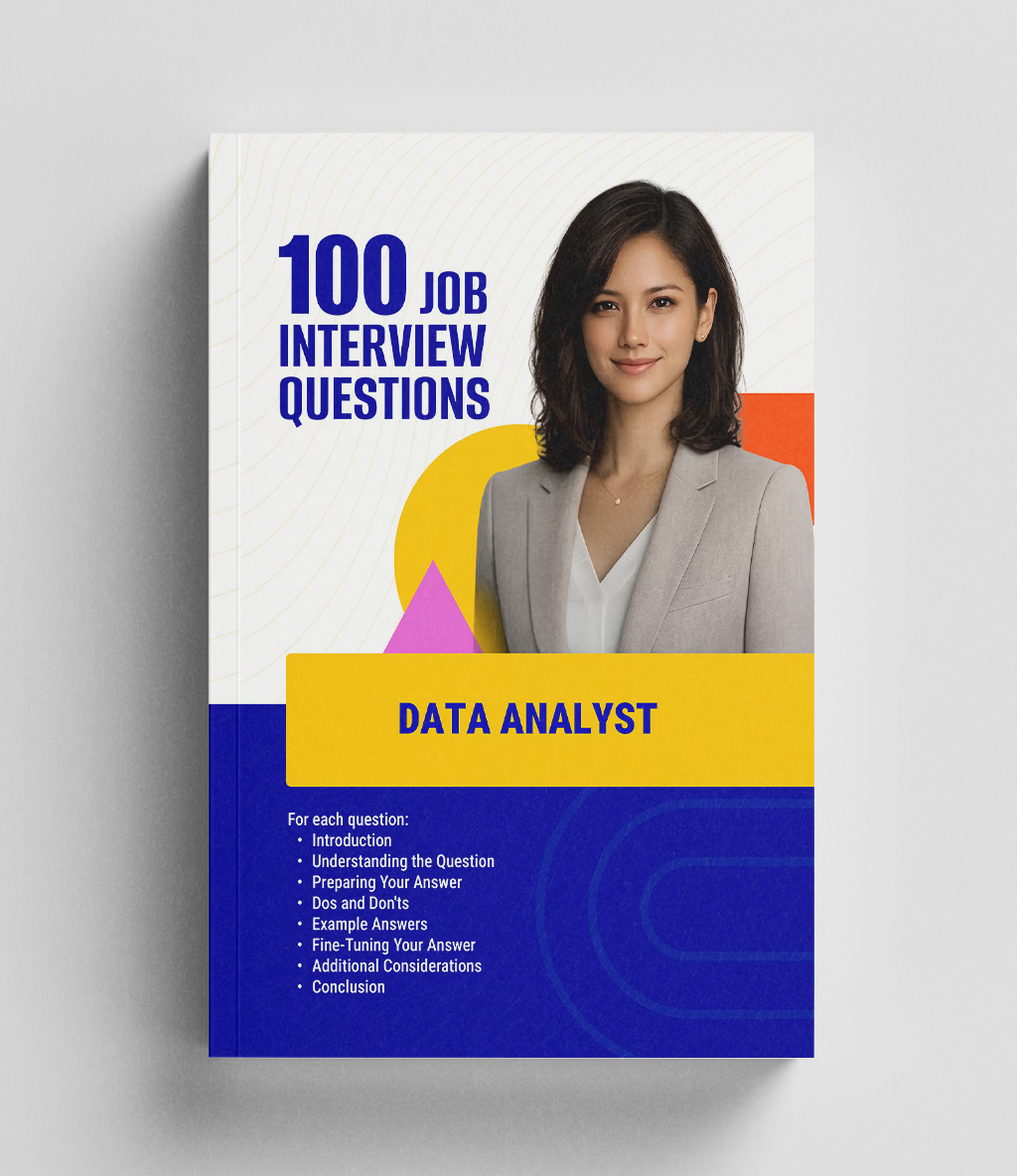
100 interview questions

Data Analyst Interview Questions: 100 Answers

Keep preparing with the complete question book created for Data Analyst interviews.

View the question book
Front-facing 3D book mockup of Data Analyst 100 Job Interview Questions, an interview question book from RockStarCV.com.

How to use this simulation

Listen for decisions, not polished phrases

Pause after each question and form your own answer before Elena Torres responds. Then compare the evidence provided: the constraint, the decision, the personal contribution, the trade-off, and the result.

Jordan Lee and Elena Torres are fictional composite characters. Their employers, data analyst examples, figures, and outcomes were created for teaching purposes.

Take the interview with you

Your data analyst interview playbook

Use the printable framework to prepare examples, test your evidence, and rehearse stronger answers away from the screen.

  • Question prompts
  • Evidence checklist
  • Practice notes
Download the PDF playbook

What to notice

A practical viewing checklist

  1. 01

    Notice how Elena defines the business decision before describing the query, dashboard, or tool.

  2. 02

    Track the quality investigation across grain, joins, freshness, reconciliation, lineage, and downstream impact.

  3. 03

    Listen for metric contracts that name formula, population, period, owner, limitations, and intended use.

  4. 04

    Compare experiment and privacy answers by their uncertainty, economics, minimization, and explicit recommendation.

Interviewer scorecard

The signals behind a credible answer

Decision framing
Elena names the decision, population, measure, guardrail, owner, and action threshold before analysis begins.
Data trust
Suspicious results trigger a traceable quality investigation instead of an immediate business story.
Recommendation
Evidence, uncertainty, economics, privacy boundaries, and next action remain connected.

Research foundation

Sources behind the teaching principles

The sources support the interview guidance, not the fictional candidate’s invented employers, budgets, dates, or outcomes.

Similar interviews

Explore related mock interviews

More from RockStarCV

Build your complete career toolkit