Chapter 01
Introduction
The interviewer wants proof that your past work will transfer to their immediate needs.
Relevance depends on the employer's problem, not just a matching job title. Choose the professional starting point that makes this answer useful now. Name the work, responsibility, or transition before adding background, so the interviewer can understand why the detail belongs in your response.
The employer is comparing the posted requirements with evidence you can defend, not simply counting years. Fit is not established by shared nouns in a job description. A strong match shows the task, environment, constraints, and result closely enough that the employer can judge how much learning remains. Test the evidence against the vacancy. Keep the facts you can explain in a follow-up, remove biography that does not help the decision, and make the final sentence point toward the role in front of you.
- 01Set the direction
The interviewer wants proof that your past work will transfer to their immediate needs.
- 02Choose the proof
Relevance depends on the employer's problem, not just a matching job title.
- 03Connect it to the role
Choose the professional starting point that makes this answer useful now.
Chapter 02
Understanding the Question
They may be testing readiness on day one, but also how quickly an adjacent skill transfers.
Be exact about the difference. Read the question as an assessment, not only a request for information. Decide which judgment, risk, working habit, or motivation the interviewer needs to see, then make that purpose visible through one concrete detail.
If you claim a close match, expect to explain the tools, scale, or decisions that were actually involved. If the role asks for a platform you have not used, distinguish the domain process you know from the tool you would learn. That distinction is more useful than either pretending equivalence or apologizing excessively. Prepare for the next question as well as this one. If you mention a result, transition, conflict, or constraint, keep the context and your exact contribution ready so the interviewer can test the claim without weakening it.
- 01What they are testing
They may be testing readiness on day one, but also how quickly an adjacent skill transfers.
- 02Prepare the follow-up
Read the question as an assessment, not only a request for information.
- 03Keep the evidence ready
Decide which judgment, risk, working habit, or motivation the interviewer needs to see, then make that purpose visible through one concrete detail.
Chapter 03
Preparing Your Answer
Choose two requirements from the posting and pair each with a result you can explain.
Prepare a requirement-by-requirement note: direct evidence, transferable evidence, and one gap you can address. Highlight two requirements and record the strongest example for each. Build a small evidence bank before rehearsing. Write the setting, the decision you owned, the action you took, and the observable result. That gives you facts to select instead of forcing you to invent polished language under pressure.
Mark any gap before the interviewer discovers it. Create a two-column note: requirement and evidence. For each of the two most important requirements, choose a decision you made, the people affected, and what the outcome demonstrated. Mark a gap honestly. Arrange the answer so the listener never has to guess why a detail matters. Put the strongest evidence near the claim it supports, keep your role precise, and finish with the lesson or relevance to this position.
- 01Build your evidence
Choose two requirements from the posting and pair each with a result you can explain.
- 02Shape the sequence
Prepare a requirement-by-requirement note: direct evidence, transferable evidence, and one gap you can address.
- 03Keep the evidence ready
Highlight two requirements and record the strongest example for each.
Chapter 04
Dos and Don’ts
What to do: Translate your experience into the employer's language.
Do
- Translate your experience into the employer's language.
- Do separate work you led from work you observed or supported.
Don’t
- Do not claim a tool or sector is identical if it is only adjacent.
- Do not claim full readiness on an unfamiliar system simply because the underlying process is similar.
- Do not answer only with years of service.
- Two years with direct ownership can be more relevant than a decade of adjacent exposure.
Chapter 05
Example Answers
The examples illustrate direct reporting work, transfer from a different inventory system, and cross-team launch coordination.
They show three legitimate kinds of fit; none requires claiming to know the employer's exact environment. Compare the examples by structure rather than memorizing their wording. Notice where each candidate sets the context, states personal ownership, and closes with a result, lesson, or reason the experience matters to the employer.
“The role calls for stakeholder communication and accurate reporting. I managed a weekly service dashboard and met team leads to resolve data disagreements before publication. That reduced last-minute corrections and made the report useful in their planning meetings.”
Why it works: Treat this first example as a model for sequence. Replace its workplace, task, people, and result with truthful details of your own while keeping the connection between the claim and the supporting evidence.
“I have not used your exact inventory platform, but I have managed stock reconciliations and learned two systems during a warehouse transition. The underlying work, tracing discrepancies and documenting adjustments, is familiar to me.”
Why it works: Use the second example to explore a different route to the same competency. Your version can come from paid work, study, volunteering, or a project, provided you state the context and do not overstate your responsibility.
“This position involves coordinating multiple contributors. In my last role I kept a launch schedule across design, legal, and sales, surfaced late approvals early, and helped the team hit the announced date. I would bring that same visibility here.”
Why it works: Use the third example to test whether your answer sounds recognisably yours. Keep the useful structure, then change every borrowed fact.
Chapter 06
Fine-Tuning Your Answer
Separate direct experience from transferable capability; both can be valuable when described honestly.
Do not stretch a near match into an identical one. Explain the learning curve instead. Fine-tuning is mainly subtraction and precision. Move the strongest fact earlier, replace labels with actions, and check that the ending answers the question rather than drifting into a second example or an unrelated career summary.
Replace broad 'relevant experience' language with the task, constraint, and result that make it relevant. Replace phrases such as 'strong communicator' with a moment when communication changed a decision or prevented a mistake. If the result is not measurable, describe the observable change without manufacturing a figure. Record one practice version and listen for the first useful fact. If it arrives late, shorten the setup. Then check every result, number, and claim so the final wording remains accurate when the interviewer asks for detail.
- 01Make it sharper
Separate direct experience from transferable capability; both can be valuable when described honestly.
- 02Test the wording
Do not stretch a near match into an identical one.
- 03Keep the evidence ready
Fine-tuning is mainly subtraction and precision.
Chapter 07
Additional Considerations
If the posting is broad, ask which responsibility is most urgent before choosing your proof point.
Adapt the structure to your circumstances without hiding them. Career changes, gaps, early-career evidence, senior scope, confidentiality, and reasonable boundaries may change the example, but they do not remove the need for relevance and honest ownership.
A transferable example needs one sentence on how you would learn the employer-specific part safely. Some employers weight one requirement more heavily than the posting suggests. Ask which capability would matter most in the first months, then give the example that genuinely addresses it. Protect credibility where context is sensitive. Use the level of detail you can share, separate team results from your contribution, and explain constraints without disclosing private information or blaming people who are not present.
- 01Adapt the answer
If the posting is broad, ask which responsibility is most urgent before choosing your proof point.
- 02Keep it credible
Adapt the structure to your circumstances without hiding them.
- 03Keep the evidence ready
Career changes, gaps, early-career evidence, senior scope, confidentiality, and reasonable boundaries may change the example, but they do not remove the need for relevance and honest ownership.
Chapter 08
Conclusion
Leave the interviewer with two capabilities they can connect to the work they described.
Be precise about what transfers and candid about what is new. Bring the answer back to one clear message. The interviewer should be able to repeat your main claim, the evidence supporting it, and why it matters to the role without reconstructing the meaning from several disconnected points.
Close by naming the contribution you can make immediately and the employer-specific knowledge you would need to acquire. That combination sounds prepared rather than overconfident. End deliberately. Stop when the question has been answered, the evidence is credible, and the relevance is clear. A concise landing invites a useful follow-up and leaves the listener with the professional judgment you intended to show.
A concise landing invites a useful follow-up and leaves the listener with the professional judgment you intended to show.
Source & adaptation
Built from the RockStarCV interview-question library
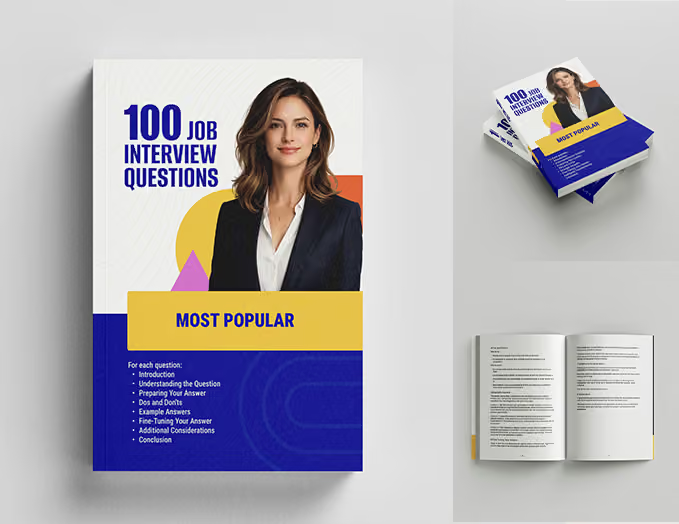
Adapted from the RockStarCV guide 100 Most Popular Job Interview Questions and its long-form narration. The structure and examples have been edited for a practical web reading experience.
Book reference: Question 3