Chapter 01
Introduction
This asks how the role fits into a longer development path.
Long-term goals become credible when the next step teaches something essential. Choose the professional starting point that makes this answer useful now. Name the work, responsibility, or transition before adding background, so the interviewer can understand why the detail belongs in your response.
Long-term goals become more credible when a present skill gap is visible. Long-term goals reveal what you value about work, but a useful answer still belongs in this interview. Choose a direction that makes your interest in the current position easier to understand. Test the evidence against the vacancy. Keep the facts you can explain in a follow-up, remove biography that does not help the decision, and make the final sentence point toward the role in front of you.
- 01Set the direction
This asks how the role fits into a longer development path.
- 02Choose the proof
Long-term goals become credible when the next step teaches something essential.
- 03Connect it to the role
Choose the professional starting point that makes this answer useful now.
Chapter 02
Understanding the Question
They are asking whether this job is a coherent part of your development.
A follow-up may ask which experience in this position would teach that capability. Read the question as an assessment, not only a request for information. Decide which judgment, risk, working habit, or motivation the interviewer needs to see, then make that purpose visible through one concrete detail.
The interviewer may be asking whether the role can sustain your motivation and whether you can think beyond the next job offer. A broad goal is acceptable if the steps toward it are concrete. Prepare for the next question as well as this one. If you mention a result, transition, conflict, or constraint, keep the context and your exact contribution ready so the interviewer can test the claim without weakening it.
- 01What they are testing
They are asking whether this job is a coherent part of your development.
- 02Prepare the follow-up
A follow-up may ask which experience in this position would teach that capability.
- 03Keep the evidence ready
Read the question as an assessment, not only a request for information.
Chapter 03
Preparing Your Answer
Choose a direction that the advertised work can genuinely support.
Identify the capability you still lack and how this role could build it. Describe the responsibility you want to master before claiming readiness for the later role. Build a small evidence bank before rehearsing. Write the setting, the decision you owned, the action you took, and the observable result. That gives you facts to select instead of forcing you to invent polished language under pressure.
Describe the area you want to master, the scope of responsibility you hope to earn, and one or two experiences this job could provide. Be prepared to explain how you would contribute before seeking the next opportunity. Arrange the answer so the listener never has to guess why a detail matters. Put the strongest evidence near the claim it supports, keep your role precise, and finish with the lesson or relevance to this position.
- 01Build your evidence
Choose a direction that the advertised work can genuinely support.
- 02Shape the sequence
Identify the capability you still lack and how this role could build it.
- 03Keep the evidence ready
Describe the responsibility you want to master before claiming readiness for the later role.
Chapter 04
Dos and Don’ts
What to do: Connect today's work to tomorrow's capability.
Do
- Connect today's work to tomorrow's capability.
- Do make today's contribution sound worthwhile in itself.
Don’t
- Do not promise to stay forever or announce a conflicting plan.
- Do not present this vacancy as a brief stopover on a fixed ladder.
- Be ambitious without treating the role as a disposable rung.
- Do not recite a generic desire to 'grow with the company' unless you can say what growth would mean in practice.
Chapter 05
Example Answers
A strong answer may connect a recurring problem you enjoy solving with a broader impact you want to have.
That is more durable than naming a title alone. Compare the examples by structure rather than memorizing their wording. Notice where each candidate sets the context, states personal ownership, and closes with a result, lesson, or reason the experience matters to the employer.
“Long term, I want to lead service improvement work. To do that well, I need deeper experience measuring outcomes and working across teams. The responsibilities here would develop both while letting me contribute immediately.”
Why it works: Treat this first example as a model for sequence. Replace its workplace, task, people, and result with truthful details of your own while keeping the connection between the claim and the supporting evidence.
“I would like to become a specialist in reliable reporting for operational decisions. My next step is a role with stronger exposure to data definitions and the users of those reports, which is why this position interests me.”
Why it works: Use the second example to explore a different route to the same competency. Your version can come from paid work, study, volunteering, or a project, provided you state the context and do not overstate your responsibility.
“I hope to manage projects with both client and technical stakeholders. For now I want to become excellent at coordination, risk tracking, and clear communication in a team that handles meaningful complexity.”
Why it works: Use the third example to test whether your answer sounds recognisably yours. Keep the useful structure, then change every borrowed fact.
Chapter 06
Fine-Tuning Your Answer
Goals can evolve; explain the reasoning behind your current direction.
Avoid a distant ambition that makes the vacancy sound like a temporary convenience. Fine-tuning is mainly subtraction and precision. Move the strongest fact earlier, replace labels with actions, and check that the ending answers the question rather than drifting into a second example or an unrelated career summary.
If the organization may not offer that path, ask rather than assume. If you are changing fields, show how your existing strengths support the transition and what capability you still need to build. Acknowledge the learning curve honestly. Record one practice version and listen for the first useful fact. If it arrives late, shorten the setup. Then check every result, number, and claim so the final wording remains accurate when the interviewer asks for detail.
- 01Make it sharper
Goals can evolve; explain the reasoning behind your current direction.
- 02Test the wording
Avoid a distant ambition that makes the vacancy sound like a temporary convenience.
- 03Keep the evidence ready
Fine-tuning is mainly subtraction and precision.
Chapter 07
Additional Considerations
Ask whether the organization offers the exposure you need rather than assuming it does.
Adapt the structure to your circumstances without hiding them. Career changes, gaps, early-career evidence, senior scope, confidentiality, and reasonable boundaries may change the example, but they do not remove the need for relevance and honest ownership.
State the goal as a direction supported by evidence, not a guaranteed title. Some employers may not offer the exact future path you imagine. Keep the goal authentic and discuss transferable skills rather than assuming a promised promotion. Protect credibility where context is sensitive. Use the level of detail you can share, separate team results from your contribution, and explain constraints without disclosing private information or blaming people who are not present.
- 01Adapt the answer
Ask whether the organization offers the exposure you need rather than assuming it does.
- 02Keep it credible
Adapt the structure to your circumstances without hiding them.
- 03Keep the evidence ready
Career changes, gaps, early-career evidence, senior scope, confidentiality, and reasonable boundaries may change the example, but they do not remove the need for relevance and honest ownership.
Chapter 08
Conclusion
Describe the path in skills and contribution, not only titles.
A career goal is stronger when this role teaches an essential capability. Bring the answer back to one clear message. The interviewer should be able to repeat your main claim, the evidence supporting it, and why it matters to the role without reconstructing the meaning from several disconnected points.
Close with the fit between the long view and the present job. The answer should make the next step feel intentional, not opportunistic. End deliberately. Stop when the question has been answered, the evidence is credible, and the relevance is clear. A concise landing invites a useful follow-up and leaves the listener with the professional judgment you intended to show.
A concise landing invites a useful follow-up and leaves the listener with the professional judgment you intended to show.
Source & adaptation
Built from the RockStarCV interview-question library
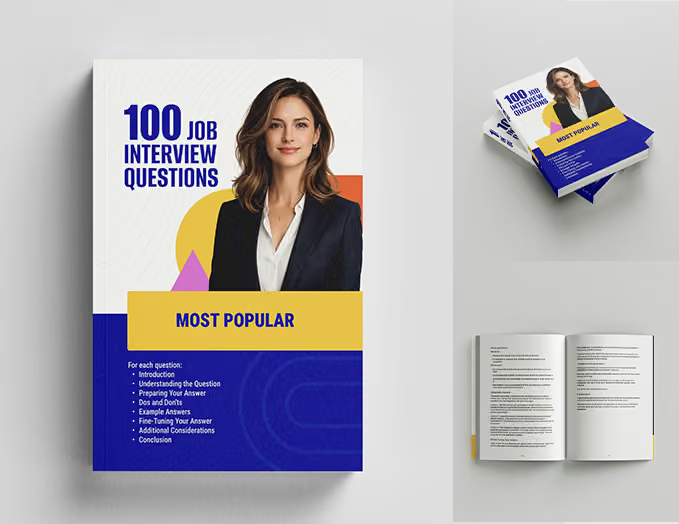
Adapted from the RockStarCV guide 100 Most Popular Job Interview Questions and its long-form narration. The structure and examples have been edited for a practical web reading experience.
Book reference: Question 92