Chapter 01
Introduction
This asks for strengths that matter in this job, demonstrated through behaviour.
Strengths matter here only when they show up in work the employer needs. Choose the professional starting point that makes this answer useful now. Name the work, responsibility, or transition before adding background, so the interviewer can understand why the detail belongs in your response.
A strength should be something another person has experienced, not only something you admire about yourself. Strengths need to earn their place by helping with this job's actual demands. The interviewer is not asking for every quality you value in yourself. Test the evidence against the vacancy. Keep the facts you can explain in a follow-up, remove biography that does not help the decision, and make the final sentence point toward the role in front of you.
- 01Set the direction
This asks for strengths that matter in this job, demonstrated through behaviour.
- 02Choose the proof
Strengths matter here only when they show up in work the employer needs.
- 03Connect it to the role
Choose the professional starting point that makes this answer useful now.
Chapter 02
Understanding the Question
They are testing whether you can identify your own useful patterns without overselling them.
Read the question as an assessment, not only a request for information. Decide which judgment, risk, working habit, or motivation the interviewer needs to see, then make that purpose visible through one concrete detail.
The interviewer may ask when that strength was tested under pressure rather than in ideal conditions. A follow-up may ask how the strength holds up when circumstances are uncomfortable. Choose evidence from a pressured or ambiguous setting, not only a routine day. Prepare for the next question as well as this one. If you mention a result, transition, conflict, or constraint, keep the context and your exact contribution ready so the interviewer can test the claim without weakening it.
- 01What they are testing
They are testing whether you can identify your own useful patterns without overselling them.
- 02Prepare the follow-up
Read the question as an assessment, not only a request for information.
- 03Keep the evidence ready
Decide which judgment, risk, working habit, or motivation the interviewer needs to see, then make that purpose visible through one concrete detail.
Chapter 03
Preparing Your Answer
Choose two strengths and find a separate example for each.
Prepare two distinct examples so one story does not carry every claimed quality. Build a small evidence bank before rehearsing. Write the setting, the decision you owned, the action you took, and the observable result. That gives you facts to select instead of forcing you to invent polished language under pressure.
Choose two strengths that answer different requirements, and write one concise case for each. Pick two strengths that answer different requirements. For each, write the action you took, a person affected, and the observable result. Then decide which to lead with. Arrange the answer so the listener never has to guess why a detail matters. Put the strongest evidence near the claim it supports, keep your role precise, and finish with the lesson or relevance to this position.
- 01Build your evidence
Choose two strengths and find a separate example for each.
- 02Shape the sequence
Prepare two distinct examples so one story does not carry every claimed quality.
- 03Keep the evidence ready
Build a small evidence bank before rehearsing.
Chapter 04
Dos and Don’ts
What to do: Use a situation and result rather than a label alone.
Do
- Use a situation and result rather than a label alone.
- Do include the effect your strength had on a teammate, customer, or decision.
Don’t
- Do not list every positive quality you can think of.
- Do not offer five qualities when two supported ones will be easier to remember.
- Avoid a list of polished adjectives.
- A strength becomes credible when the listener can imagine a colleague describing the same behaviour without prompting.
Chapter 05
Example Answers
The samples show pattern detection, calm deadline communication, and fast process learning.
Notice that none depends on claiming an inborn trait; each is shown through work. Compare the examples by structure rather than memorizing their wording. Notice where each candidate sets the context, states personal ownership, and closes with a result, lesson, or reason the experience matters to the employer.
“One strength is spotting patterns in messy feedback. I grouped repeat complaints by the step where customers got stuck, then helped simplify the form. The number of clarification calls fell over the following month.”
Why it works: Treat this first example as a model for sequence. Replace its workplace, task, people, and result with truthful details of your own while keeping the connection between the claim and the supporting evidence.
“I am strong at making deadlines visible without making the team defensive. On a launch with several late inputs, I separated blocked tasks from work we could still finish. We kept momentum and reset the final date with evidence.”
Why it works: Use the second example to explore a different route to the same competency. Your version can come from paid work, study, volunteering, or a project, provided you state the context and do not overstate your responsibility.
“I learn unfamiliar processes quickly. When I inherited a supplier reconciliation, I spent my first week tracing exceptions with the people who handled them. By month-end I could complete the cycle and explain its weak points.”
Why it works: Use the third example to test whether your answer sounds recognisably yours. Keep the useful structure, then change every borrowed fact.
Chapter 06
Fine-Tuning Your Answer
A strength is more credible when you name its limits.
If the strength sounds like a personality label, replace it with a repeatable action. Fine-tuning is mainly subtraction and precision. Move the strongest fact earlier, replace labels with actions, and check that the ending answers the question rather than drifting into a second example or an unrelated career summary.
If the claim sounds generic, name the action you took when the easy route was unavailable. Remove filler such as 'very' and 'extremely'. Add a limitation only if it clarifies how you apply the strength without overusing it. Record one practice version and listen for the first useful fact. If it arrives late, shorten the setup. Then check every result, number, and claim so the final wording remains accurate when the interviewer asks for detail.
- 01Make it sharper
A strength is more credible when you name its limits.
- 02Test the wording
If the strength sounds like a personality label, replace it with a repeatable action.
- 03Keep the evidence ready
Fine-tuning is mainly subtraction and precision.
Chapter 07
Additional Considerations
Some strengths can become excesses; briefly show how you keep yours proportionate.
Adapt the structure to your circumstances without hiding them. Career changes, gaps, early-career evidence, senior scope, confidentiality, and reasonable boundaries may change the example, but they do not remove the need for relevance and honest ownership.
A strength can create a tradeoff; explain how you avoid letting it become excess. A technical strength may be less relevant than collaboration in a stakeholder-heavy role. Let the vacancy and conversation determine which evidence deserves emphasis. Protect credibility where context is sensitive. Use the level of detail you can share, separate team results from your contribution, and explain constraints without disclosing private information or blaming people who are not present.
- 01Adapt the answer
Some strengths can become excesses; briefly show how you keep yours proportionate.
- 02Keep it credible
Adapt the structure to your circumstances without hiding them.
- 03Keep the evidence ready
Career changes, gaps, early-career evidence, senior scope, confidentiality, and reasonable boundaries may change the example, but they do not remove the need for relevance and honest ownership.
Chapter 08
Conclusion
Choose evidence that would make a former colleague nod in recognition.
Bring the answer back to one clear message. The interviewer should be able to repeat your main claim, the evidence supporting it, and why it matters to the role without reconstructing the meaning from several disconnected points.
The strength should be visible in someone else's experience of your work. Finish with the impact of the strength rather than announcing it again. The example should make the label almost unnecessary. End deliberately. Stop when the question has been answered, the evidence is credible, and the relevance is clear. A concise landing invites a useful follow-up and leaves the listener with the professional judgment you intended to show.
A concise landing invites a useful follow-up and leaves the listener with the professional judgment you intended to show.
Source & adaptation
Built from the RockStarCV interview-question library
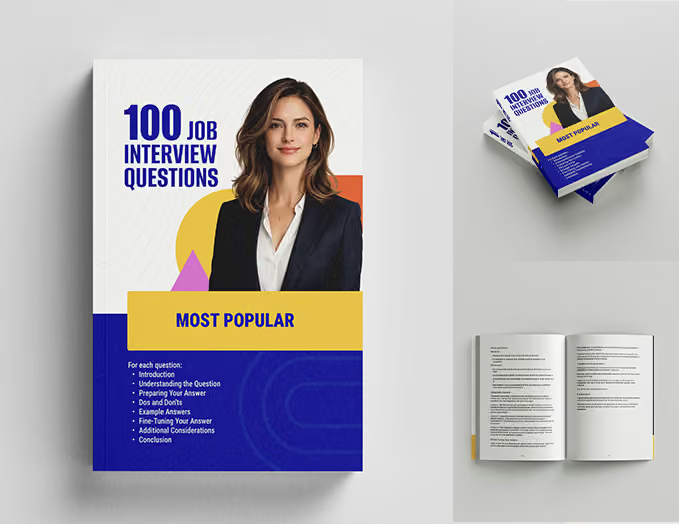
Adapted from the RockStarCV guide 100 Most Popular Job Interview Questions and its long-form narration. The structure and examples have been edited for a practical web reading experience.
Book reference: Question 21