Chapter 01
Introduction
The interviewer wants clarity without distortion.
Clarity is a decision about what the audience needs first. Clear communication protects the audience from both jargon and false simplicity. Choose the professional starting point that makes this answer useful now. Name the work, responsibility, or transition before adding background, so the interviewer can understand why the detail belongs in your response.
Explaining complexity simply is an exercise in selecting, not diluting. Choose a subject you genuinely understand, then show how you preserved the decision-critical facts while removing jargon that did not help the audience act. Test the evidence against the vacancy. Keep the facts you can explain in a follow-up, remove biography that does not help the decision, and make the final sentence point toward the role in front of you.
- 01Set the direction
The interviewer wants clarity without distortion.
- 02Choose the proof
Clarity is a decision about what the audience needs first.
- 03Connect it to the role
Clear communication protects the audience from both jargon and false simplicity.
Chapter 02
Understanding the Question
They are checking whether you preserve essential caveats while removing jargon.
The interviewer may ask what detail you kept because removing it would mislead. Read the question as an assessment, not only a request for information. Decide which judgment, risk, working habit, or motivation the interviewer needs to see, then make that purpose visible through one concrete detail.
The interviewer is probing audience awareness and technical command at the same time. A clear explanation names the question the listener needed answered, the distinction they might miss, and the limits of the simplified version. Prepare for the next question as well as this one. If you mention a result, transition, conflict, or constraint, keep the context and your exact contribution ready so the interviewer can test the claim without weakening it.
- 01What they are testing
They are checking whether you preserve essential caveats while removing jargon.
- 02Prepare the follow-up
The interviewer may ask what detail you kept because removing it would mislead.
- 03Keep the evidence ready
Read the question as an assessment, not only a request for information.
Chapter 03
Preparing Your Answer
Prepare an example with an audience that did not share your vocabulary.
Prepare the original concept, the audience's task, and the simpler representation you used. Identify the decision the audience needed to make and the minimum facts required for it. Build a small evidence bank before rehearsing. Write the setting, the decision you owned, the action you took, and the observable result. That gives you facts to select instead of forcing you to invent polished language under pressure.
Prepare a real explanation you gave to a non-specialist. Recall the audience's starting point, the analogy or visual you chose, the question they asked, and the action they could take afterward. Be ready to restate the concept briefly during the interview. Arrange the answer so the listener never has to guess why a detail matters. Put the strongest evidence near the claim it supports, keep your role precise, and finish with the lesson or relevance to this position.
- 01Build your evidence
Prepare an example with an audience that did not share your vocabulary.
- 02Shape the sequence
Prepare the original concept, the audience's task, and the simpler representation you used.
- 03Keep the evidence ready
Identify the decision the audience needed to make and the minimum facts required for it.
Chapter 04
Dos and Don’ts
What to do: Start with the decision, then layer in necessary detail.
Do
- Start with the decision, then layer in necessary detail.
- Do test the explanation with someone who did not build the underlying work.
Don’t
- Do not remove a caveat that changes the meaning.
- Do not hide an uncertainty that changes the recommendation.
- Use an example tied to a decision rather than a generic definition.
- Avoid replacing technical terms with cute metaphors that introduce a new misunderstanding.
Chapter 05
Example Answers
A practical answer might contrast two outcomes or show one short example before naming the formal concept.
The interview answer itself should be clear enough to demonstrate the skill it describes. Compare the examples by structure rather than memorizing their wording. Notice where each candidate sets the context, states personal ownership, and closes with a result, lesson, or reason the experience matters to the employer.
“A forecasting model had several uncertain inputs. For managers, I showed three possible staffing ranges and the signal that would move us between them. I kept the formulas available, but the meeting focused on the decision.”
Why it works: Treat this first example as a model for sequence. Replace its workplace, task, people, and result with truthful details of your own while keeping the connection between the claim and the supporting evidence.
“I had to explain a policy change to frontline colleagues. I used three common customer scenarios and one exception, then asked a colleague to try the guide. Their questions revealed a missing step before rollout.”
Why it works: Use the second example to explore a different route to the same competency. Your version can come from paid work, study, volunteering, or a project, provided you state the context and do not overstate your responsibility.
“A technical incident affected clients differently. I wrote a plain-language update stating what was affected, what was not yet known, and when we would report back. It reduced speculation without pretending the issue was resolved.”
Why it works: Use the third example to test whether your answer sounds recognisably yours. Keep the useful structure, then change every borrowed fact.
Chapter 06
Fine-Tuning Your Answer
Simple language is not the same as false certainty.
Avoid stripping uncertainty merely to sound confident. Fine-tuning is mainly subtraction and precision. Move the strongest fact earlier, replace labels with actions, and check that the ending answers the question rather than drifting into a second example or an unrelated career summary.
Use an example where the audience acted differently because the message was clearer. If the audience included experts and novices, explain how you layered the message: a short plain-language conclusion first, supporting detail available for people who needed to inspect it. Record one practice version and listen for the first useful fact. If it arrives late, shorten the setup. Then check every result, number, and claim so the final wording remains accurate when the interviewer asks for detail.
- 01Make it sharper
Simple language is not the same as false certainty.
- 02Test the wording
Avoid stripping uncertainty merely to sound confident.
- 03Keep the evidence ready
Fine-tuning is mainly subtraction and precision.
Chapter 07
Additional Considerations
Ask someone from the audience to test whether your explanation supports action.
A plain-language summary can coexist with technical evidence available for deeper review. Adapt the structure to your circumstances without hiding them. Career changes, gaps, early-career evidence, senior scope, confidentiality, and reasonable boundaries may change the example, but they do not remove the need for relevance and honest ownership.
Some concepts cannot be simplified without an important caveat. State the caveat in ordinary language and tell the listener what would change your conclusion; that preserves accuracy without recreating the entire technical report. Protect credibility where context is sensitive. Use the level of detail you can share, separate team results from your contribution, and explain constraints without disclosing private information or blaming people who are not present.
- 01Adapt the answer
Ask someone from the audience to test whether your explanation supports action.
- 02Keep it credible
A plain-language summary can coexist with technical evidence available for deeper review.
- 03Keep the evidence ready
Adapt the structure to your circumstances without hiding them.
Chapter 08
Conclusion
Make the example demonstrate understanding, not just shorter sentences.
Clarity means the audience can act without being misled. Bring the answer back to one clear message. The interviewer should be able to repeat your main claim, the evidence supporting it, and why it matters to the role without reconstructing the meaning from several disconnected points.
Close on the decision or behavior your explanation enabled. The best proof of clarity is that the other person knew what to do next and why. End deliberately. Stop when the question has been answered, the evidence is credible, and the relevance is clear. A concise landing invites a useful follow-up and leaves the listener with the professional judgment you intended to show.
A concise landing invites a useful follow-up and leaves the listener with the professional judgment you intended to show.
Source & adaptation
Built from the RockStarCV interview-question library
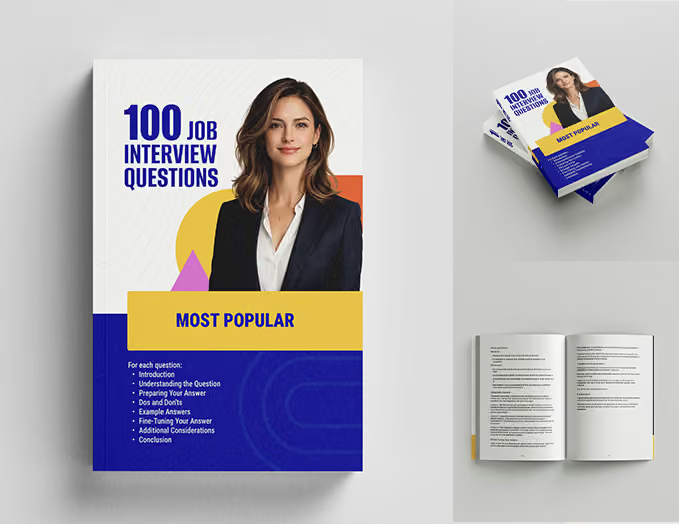
Adapted from the RockStarCV guide 100 Most Popular Job Interview Questions and its long-form narration. The structure and examples have been edited for a practical web reading experience.
Book reference: Question 55