RockStarCV NarratorIntroduction
What does a strong Sales Manager interview sound like? Let us step inside the conversation and listen for the decisions that make each answer credible.
RockStarCV NarratorMeet Julian Brooks and Daniel Reed
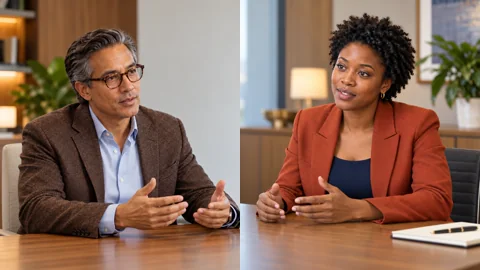
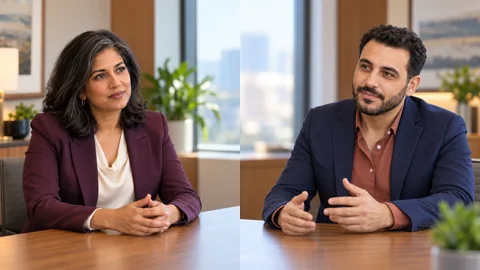
Your interviewer is Julian Brooks, a VP of Sales who tests whether a candidate can build and coach a team rather than just sell. Your candidate is Daniel Reed, an experienced sales manager presenting the strong-candidate path. After the interview, we will turn his examples into a practical preparation framework.
Julian BrooksWelcome
Hi, Daniel. Thanks for coming in. How are you today?
Daniel ReedWelcome
Hi, Julian. I am doing well, thank you. I appreciate the time, and I have been looking forward to this.
Julian BrooksWelcome
Great. We have about half an hour. I will start with your background, then talk through how you coach a team, how you run your pipeline and forecast, and how you handle pressure on a number. I will leave time for your questions. Sound good?
Daniel ReedWelcome
That sounds good.
Julian BrooksCareer story
Let us start with your background. Tell me about your experience leading a sales team.
Daniel ReedCareer story
I sold for about six years and then moved into management four years ago. I currently lead a team of eight account executives selling a business-to-business product, carrying a team quota of around twelve million dollars a year. I own our forecast, our pipeline reviews, coaching and ramp for new reps, and I partner with marketing on lead quality and with operations on territories and comp.
Daniel ReedCareer story
The biggest lesson in my move from rep to manager was that my job is no longer to close deals; it is to build a team that closes deals. Last year we hit about a hundred and six percent of quota, but what I am proudest of is that two of my reps were promoted and our ramp time for new hires dropped by roughly a third. I am looking for a role where coaching and building a durable team are valued, not just this quarter's number.
Julian BrooksCareer story
You were clearly a strong seller. How do you resist the urge to just jump in and close deals yourself?
Daniel ReedCareer story
It is a real urge, and early on I gave in to it. The problem is that every deal I close for a rep is a deal they did not learn to close, and I do not scale. Now I join deals to coach, not to take over. I will model a tough call or help with strategy, but the rep runs it, and we debrief afterward so the skill stays with them. The one exception is a genuinely critical deal where the company needs the win, and even then I bring the rep in so they learn.
Julian BrooksMotivation
Why are you interested in this sales-manager role specifically?
Daniel ReedMotivation
Two reasons. First, you described the role as building and developing a team, not just carrying a number, and that is where I do my best work. Second, you have a product with a real value story, which means I can coach consultative selling rather than pressure. I would rather lead a team that wins because it sells well than one that hits a number by pushing.
Julian BrooksCoaching
Let us talk coaching. One of your reps is consistently missing quota. How do you handle it?
Daniel ReedCoaching
I do not start with the number, because the number is the outcome, not the thing I can coach. I look at the activities behind it. I pull their pipeline and their calls and find where it is actually breaking: is it not enough pipeline, weak discovery, poor qualification, or deals stalling at a particular stage? The number tells me there is a problem; the activity tells me what the problem is.
Daniel ReedCoaching
Say the issue is discovery; their demos are strong but they pitch before they understand the customer. Then we work specifically on discovery: I listen to calls, we role-play, I give them a question framework, and I watch for the behavior to change over a few weeks. I coach the one or two behaviors that will move the most, not everything at once, and I make the goal a change I can see, not just try harder.
Julian BrooksCoaching
What if you coach and the performance still does not improve?
Daniel ReedCoaching
Then I am honest and fair. I set clear expectations with a realistic timeline and specific, observable goals, I document our conversations, and I keep supporting them. If it still does not improve, a formal performance plan is the humane and honest next step, done with HR and consistently with how I treat others. Keeping someone in a role they are failing in is not kindness. But I owe them real coaching and a fair chance first, not a surprise.
Julian BrooksPipeline and forecast
Let us talk forecasting. How do you build a forecast you can stand behind?
Daniel ReedPipeline and forecast
I inspect deals, I do not just collect rep optimism. In our pipeline reviews I ask for evidence, not feelings: who is the economic buyer, what is the compelling reason to act, what is the next step and its date, and what could kill the deal. A deal without a real next step is not a committed deal, however confident the rep is. My forecast is what I believe will close based on that evidence, not the sum of everyone's hopes.
Daniel ReedPipeline and forecast
I also call risk early. If the quarter is going to be short, I would rather tell leadership in week three with a plan than surprise them at the end. An honest forecast that leadership can plan on is worth far more than an impressive one that misses. Reps learn quickly whether their manager wants the truth or wants to feel good, and I make it safe to bring me bad news early.
Julian BrooksPipeline and forecast
How do you handle a rep who sandbags, hiding deals to beat a low number, or one who always inflates?
Daniel ReedPipeline and forecast
Both distort the forecast, so I address both. With a sandbagger, I make clear that an accurate forecast is the job and that hiding deals to look good hurts the team's planning; I also check the quota is fair, because chronic sandbagging is sometimes a sign the target or territory is off. With an inflator, I hold them to evidence in every review until the forecast and reality line up. Consistent inspection makes both behaviors hard to sustain.
Julian BrooksTerritories and incentives
How do you think about designing quotas, territories, and incentives?
Daniel ReedTerritories and incentives
The rule I live by is that people do what they are paid and measured to do, so a plan that rewards the wrong thing will reliably produce the wrong thing. I aim for territories that are balanced enough to be fair, quotas that are challenging but achievable, and incentives that reward the behavior we actually want, not just raw revenue if that would push bad-fit deals or discounting. If I see reps gaming a plan, I assume the plan is the problem before I assume the people are.
Daniel ReedTerritories and incentives
And I involve the team in the parts I can. Reps accept a stretch quota far more readily when the territory is fair and the logic is transparent than when a number lands on them from nowhere. Fairness is not softness; it is what keeps a team motivated and keeps my best people from leaving.
Julian BrooksEthical selling
Quarter end, you are short, and there is pressure to close a deal you know is a poor fit for the customer. What do you do?
Daniel ReedEthical selling
I do not push a bad-fit deal or let my reps misrepresent the product to close one. A deal won by overselling churns, generates a bad reference, and often costs more in support and refunds than it ever brought in. I would rather be short this quarter and explain why than book revenue that reverses and damages trust. I protect both the customer and the company by holding that line.
Daniel ReedEthical selling
What I will do is get creative honestly: find deals that are real but need a push, offer legitimate incentives to pull a good-fit deal forward, and be transparent with leadership about the gap and the plan. There is a big difference between urgency and deception, and I coach my team to know it. The reps watch what I reward, so if I ever rewarded a deceptive deal, I would be training the whole team to sell that way.
Julian BrooksSuccess
How do you know whether you have been successful in this role?
Daniel ReedSuccess
On three levels. First, results: the team hits its number consistently and sustainably, not with one hero quarter followed by a cliff. Second, people: reps are growing, ramping faster, and getting promoted, and I am not the bottleneck on every deal. Third, integrity: we win by selling well, my forecast is trusted, and I would be comfortable with how every deal was closed.
Daniel ReedSuccess
The simplest test is whether the team would perform well if I were out for a month. If the system, the coaching, and the culture hold without me closing deals, I have built something durable rather than carried it.
Julian BrooksCandidate questions
Thank you. Those are my questions. What would you like to ask me?
Daniel ReedCandidate questions
What would make the person in this role clearly successful in the first year? I am interested in the outcomes you want, not just the quota.
Julian BrooksCandidate questions
By a year in, I would want the team hitting its number more predictably, a couple of reps clearly developing, ramp time down, and a forecast I can trust. A hero number from the manager personally closing everything is not what I am after.
Daniel ReedCandidate questions
That is helpful. My second question is about how quota and territory are set here. A lot of team problems come from an unfair plan, so I would want to understand how balanced and transparent that process is.
Julian BrooksCandidate questions
That is a telling question, and it is an area we want to improve. The process is partly top-down today, and making it fairer and more transparent would be part of this role.
Daniel ReedCandidate questions
Thank you. That is exactly the kind of foundational work I enjoy, because fair plans prevent a lot of downstream problems.
Julian BrooksClose
We are finishing first conversations this week and will follow up early next week. Is there anything else you would like us to know?
Daniel ReedClose
Only that the way you frame the role, building a team that wins the right way, is exactly how I lead. Thank you for your time, Julian.
Julian BrooksClose
Thank you, Daniel. It was a pleasure. We will be in touch soon. Goodbye.
RockStarCV NarratorOutro 1 · Verdict
The verdict is clear. Daniel's interview worked because he showed he leads a team rather than carrying it. He did not talk about how much he personally closes. He talked about coaching behaviors, inspecting the pipeline honestly, designing fair plans, and refusing to win by deception.
RockStarCV NarratorOutro 2 · Evidence
First, Daniel replaced adjectives with evidence. A hundred and six percent of team quota showed results. Ramp time down a third showed coaching that worked. And two promoted reps showed he builds people, not just numbers.
RockStarCV NarratorOutro 2 · Evidence
Across the interview, four signals stayed easy to inspect. Daniel coached behaviors, inspected the forecast for evidence, designed fair plans, and refused to win a bad-fit deal by deception.
RockStarCV NarratorOutro 2 · Evidence
Those examples created four credibility signals. He coached the behavior behind the number. He forecast on evidence. He designed fair plans. And he held an ethical line under quarter-end pressure.
RockStarCV NarratorOutro 3 · Framework
Use the same five-part structure in your own answers. Name what you built beyond your own selling, the behavior you coached, how you inspected the forecast, where you held the line, and the result that held up.
RockStarCV NarratorOutro 3 · Framework
For example, do not stop at, I stepped in and closed the deal. Show how you coached the rep to close it. Name the behavior you worked on, how you measured the change, and the result that stayed with the rep.
RockStarCV NarratorOutro 4 · Practice
Now make the framework yours. Choose one rep you coached, or one forecast you called honestly. Write the five short lines, then practise explaining them naturally, as a conversation rather than a memorized speech.
RockStarCV NarratorOutro 4 · Practice
Prepare with evidence. Interview with confidence. Continue your preparation at Rock Star C V dot com.