Skip to interview
RockStarCV.com
Toggle Navigation

Registered Nurse Mock Interview: The Strong Candidate

Watch a complete Registered Nurse interview where Elena makes assessment, prioritization, escalation, medication safety, advocacy, and continuity inspectable.

Strong candidate pathInteractive simulation16 chapters
Elena Martinez, BSN, RN, the fictional Registered Nurse candidate, seated on the right and facing toward the article center
Elena Martinez, BSN, RNRegistered Nurse candidate

Watch and practise

Run the complete interview

Complete transcript

RockStarCV NarratorIntroduction

What does a strong Registered Nurse interview sound like? Let’s step inside the conversation and listen for the clinical decisions that make each answer credible.

RockStarCV NarratorMeet Naomi and Elena

Listen for how Elena prioritizes care, reassesses risk, escalates concerns, and closes the loop across the shift.

Naomi Brooks, MSN, RNThe room

Hi, Elena. I'm Naomi Brooks, the nurse manager for the medical-surgical telemetry unit. It's good to meet you.

Elena Martinez, BSN, RNThe room

It's good to meet you too. Thank you for having me.

Naomi Brooks, MSN, RNThe room

We'll spend about thirty minutes on your background, clinical judgment, teamwork, and continuity of care. I'll leave time for your questions. Does that sound all right?

Elena Martinez, BSN, RNThe room

Yes, that sounds great.

Naomi Brooks, MSN, RNClinical experience

Tell me about your experience as a registered nurse and what prepares you for this RN Two position.

Elena Martinez, BSN, RNClinical experience

I've spent five years in medical-surgical and telemetry nursing at a U.S. community hospital. My usual work has included assessment and reassessment, medication administration, care coordination, patient and family education, and electronic documentation across a mixed adult population.

Elena Martinez, BSN, RNClinical experience

Over the last two years, I've also served as relief charge nurse several times each month. That doesn't change my scope, but it has strengthened how I scan unit acuity, assign resources with the charge team, and help colleagues escalate concerns early.

Elena Martinez, BSN, RNClinical experience

In this fictional scenario, I hold an active Ohio RN license with current BLS and ACLS certifications. What interests me about RN Two is the expectation that I can manage a complex assignment while contributing to safer handoffs and coaching newer nurses.

Naomi Brooks, MSN, RNClinical experience

What kind of assignment has stretched you most?

Elena Martinez, BSN, RNClinical experience

A mixed assignment with a fresh postoperative patient, a patient receiving telemetry monitoring, and someone preparing for discharge. The challenge is not the number alone. It is how quickly the risk profile can change, so I keep reassessing instead of treating the first plan as fixed.

Naomi Brooks, MSN, RNWhy this nursing role

Why this unit and why now?

Elena Martinez, BSN, RNWhy this nursing role

I want to stay close to bedside care while taking on more responsibility for coordination and learning. Your unit's public description emphasizes interdisciplinary rounds, transition planning, and professional development. Those are areas where I can contribute now and still grow.

Naomi Brooks, MSN, RNWhy this nursing role

Thank you. Let's move into a shift scenario.

Naomi Brooks, MSN, RNPrioritization

You have a full assignment. A postoperative patient's blood pressure is trending down, an antibiotic is due soon, a discharge is waiting for teaching, and a new admission is arriving. Walk me through your priorities.

Elena Martinez, BSN, RNPrioritization

I would start with the changed condition because it may represent the greatest immediate risk. I would go to the bedside, confirm the trend, perform a focused assessment, and compare it with the patient's baseline and recent treatment rather than acting on one number alone.

Elena Martinez, BSN, RNPrioritization

At the same time, I would tell the charge nurse what is changing and what else is time-sensitive. If the assessment meets our rapid-response criteria, I would activate that process. Otherwise, I would contact the appropriate clinician with a concise situation, background, assessment, and recommendation, then reassess while the plan is clarified.

Elena Martinez, BSN, RNPrioritization

I would not silently let the other work disappear. I would ask a qualified colleague to accept the due medication or another defined task only if the patient's condition, the person's competence, state law, and hospital policy support it. I keep accountability for my assessment and confirm the handoff was understood.

Elena Martinez, BSN, RNPrioritization

The discharge teaching and new admission can be resequenced with the charge nurse and bed-flow team. I would update the patient waiting for discharge, give a realistic time, and document the change in condition, notifications, response, and follow-up assessment.

Naomi Brooks, MSN, RNPrioritization

Would you ever delegate the assessment itself to an unlicensed assistive person?

Elena Martinez, BSN, RNPrioritization

No. I can request specific observations or tasks that policy allows, but clinical assessment, interpretation, and nursing judgment remain with the RN. I would also change the plan if the patient became less stable or the delegatee needed support.

Naomi Brooks, MSN, RNPrioritization

Good. Give me a real example of early escalation.

Naomi Brooks, MSN, RNPatient deterioration

Tell me about a time you recognized deterioration and escalated care.

Elena Martinez, BSN, RNPatient deterioration

During a night shift, an older adult admitted with pneumonia became newly confused. The respiratory rate had risen, oxygen saturation was lower than earlier, and the patient looked more fatigued. None of those observations alone told the whole story, but the trend was concerning.

Elena Martinez, BSN, RNPatient deterioration

I repeated the vital signs, completed a focused respiratory and neurologic assessment, verified the monitoring equipment, and asked a colleague to notify the charge nurse while I stayed with the patient. I followed the unit's oxygen and escalation protocols rather than improvising treatment.

Elena Martinez, BSN, RNPatient deterioration

I called the rapid-response team within four minutes of confirming the change. In my SBAR, I named the new findings, the baseline, the recent treatments, and my concern that the patient needed immediate review. I also stated what I had already checked and what I needed from the team.

Naomi Brooks, MSN, RNPatient deterioration

What happened next?

Elena Martinez, BSN, RNPatient deterioration

The team evaluated the patient and transferred care to a higher-acuity setting. My role was to continue monitoring, prepare an accurate handoff, support the patient and family, and document the sequence and response. I did not wait for a diagnosis before escalating a meaningful change.

Naomi Brooks, MSN, RNPatient deterioration

How do you know that example went well?

Elena Martinez, BSN, RNPatient deterioration

The strongest evidence is process evidence: I recognized a trend, activated the hospital's response pathway within four minutes, communicated the uncertainty clearly, and transferred responsibility without a gap. That four-minute result is an illustrative outcome from one fictional case, not a clinical benchmark.

Naomi Brooks, MSN, RNPatient deterioration

I appreciate that distinction.

Naomi Brooks, MSN, RNMedication safety

Describe a medication-safety near miss and what you did.

Elena Martinez, BSN, RNMedication safety

I once scanned an IV medication and received a mismatch between the product and the active medication record. The patient had not received it. I stopped, kept the medication separate, confirmed the patient's identity and allergy information, and rechecked the order rather than overriding the alert.

Elena Martinez, BSN, RNMedication safety

I notified the charge nurse and contacted pharmacy and the ordering clinician through the hospital's process. We confirmed that an outdated order had remained visible after a transition. The order was corrected before administration, and I reassessed the patient and documented the relevant facts.

Elena Martinez, BSN, RNMedication safety

After the immediate risk was controlled, I submitted a safety report according to policy. In the review, we focused on why two order states could appear during a transfer, not on finding someone to blame. The unit added a transition check to the next four weeks of medication-safety huddles.

Naomi Brooks, MSN, RNMedication safety

What did you personally learn?

Elena Martinez, BSN, RNMedication safety

That an alert is a prompt to think, not proof by itself. The safety sequence was patient first, pause and verify, notify through the right channel, document facts, report the event, and help examine the system.

Naomi Brooks, MSN, RNMedication safety

Would your response change if the medication had already been given?

Elena Martinez, BSN, RNMedication safety

The immediate priority would still be the patient. I would assess and monitor, obtain urgent help as the condition required, notify the appropriate clinician and charge nurse, follow the organization's disclosure and reporting policies, document factual care, and support the review. I would not conceal the event or make legal conclusions.

Naomi Brooks, MSN, RNMedication safety

Thank you. Let's talk about advocacy.

Naomi Brooks, MSN, RNPatient advocacy

Tell me about a time you had to influence someone who saw the plan differently.

Elena Martinez, BSN, RNPatient advocacy

A patient was preparing for discharge with a new anticoagulant schedule. The medical plan was complete, but during teach-back the patient could not explain when to take the medication or which warning signs required a call. A family member was also translating some details, although the patient preferred a qualified interpreter.

Elena Martinez, BSN, RNPatient advocacy

I told the clinician that my concern was not general nervousness. It was specific evidence that the patient could not yet carry out a high-risk part of the plan. I requested the interpreter and pharmacist, and I asked that we pause discharge until we could repeat teach-back with the corrected medication list.

Naomi Brooks, MSN, RNPatient advocacy

How did the clinician respond?

Elena Martinez, BSN, RNPatient advocacy

At first, they were concerned about delaying the bed. I acknowledged that pressure, showed exactly what the patient could and could not explain, and proposed a bounded next step. We completed the interpreter-supported review, the pharmacist clarified the schedule, and the patient then explained the plan correctly in their own words.

Elena Martinez, BSN, RNPatient advocacy

The discharge happened about two hours later. I would not claim that the delay prevented a readmission. The defensible outcome is that the patient left with an accurate medication list, demonstrated understanding, and clear return precautions.

Naomi Brooks, MSN, RNPatient advocacy

What if the clinician still wanted to proceed?

Elena Martinez, BSN, RNPatient advocacy

I would restate the patient-safety concern, use the chain of command required by policy, and continue to support the patient. Advocacy should be respectful and specific, but it also has to persist when a material risk remains.

Naomi Brooks, MSN, RNPatient advocacy

That is clear.

Naomi Brooks, MSN, RNHandoff and continuity

How do you make a safe handoff and confirm that discharge teaching worked?

Elena Martinez, BSN, RNHandoff and continuity

For handoff, I use the hospital's standardized format and make the transfer of responsibility explicit. I include the reason for admission, current status, recent changes, response to treatment, medications and lines that matter, unresolved uncertainty, what to watch for, and the contingency plan. I leave room for questions and read-back when needed.

Elena Martinez, BSN, RNHandoff and continuity

For discharge, I reconcile the instructions with the active plan, use plain language and a qualified interpreter when needed, and ask the patient to explain or demonstrate the critical steps. Teach-back tests my explanation; it is not a test of the patient.

Elena Martinez, BSN, RNHandoff and continuity

On a fictional four-week pilot involving twenty discharges, our team documented teach-back for all twenty and improved completion of a locally defined discharge checklist from seventy-two percent to eighty-six percent. Those figures describe a small local process sample, not a claim that teach-back alone caused better clinical outcomes.

Naomi Brooks, MSN, RNHandoff and continuity

What belongs in a strong contingency statement?

Elena Martinez, BSN, RNHandoff and continuity

What change to watch for, what action to take, who to contact, and when the response should be urgent. The receiving nurse or patient should not have to guess which finding changes the plan.

Naomi Brooks, MSN, RNHandoff and continuity

How do you protect infection prevention when the unit is busy?

Elena Martinez, BSN, RNHandoff and continuity

I treat hand hygiene, standard precautions, and aseptic steps as part of the care itself, not optional tasks after the urgent work. If workload threatens safe practice, I raise the risk and ask for support instead of normalizing a shortcut.

Naomi Brooks, MSN, RNCandidate questions

Those are all my questions. What would you like to ask me?

Elena Martinez, BSN, RNCandidate questions

What clinical and teamwork signals distinguish an RN Two who is doing well after six months?

Naomi Brooks, MSN, RNCandidate questions

Consistent reassessment, timely escalation, reliable documentation, and the ability to help the team without taking over. We also look at how the nurse learns from feedback.

Elena Martinez, BSN, RNCandidate questions

How does the unit review near misses and changes in patient condition so staff can learn without losing accountability?

Naomi Brooks, MSN, RNCandidate questions

We use daily safety huddles, event review, and monthly quality discussions. A just culture doesn't remove accountability; it helps us distinguish human error, risky workarounds, and reckless choices.

Elena Martinez, BSN, RNCandidate questions

That's helpful. Thank you.

Naomi Brooks, MSN, RNClosing the interview

Thank you, Elena. Our recruiter will contact you after the panel finishes this week.

Elena Martinez, BSN, RNClosing the interview

Thank you for the conversation. I appreciate the chance to learn more about the unit.

RockStarCV NarratorOutro 1 · Verdict

Elena's strongest signal was disciplined judgment.

RockStarCV NarratorOutro 2 · Evidence

She assessed before assuming, escalated through defined pathways, and made the transfer of responsibility visible.

RockStarCV NarratorOutro 2 · Evidence

Notice the safety boundaries. Delegation depended on the patient, the task, competence, state law, and policy. The interview never treated one staffing ratio or one rapid-response time as a universal rule.

RockStarCV NarratorOutro 2 · Evidence

Her examples also separated process outcomes from clinical claims. An intercepted near miss showed a working safety behavior. It did not prove that one person prevented every possible harm.

RockStarCV NarratorOutro 3 · Framework

Use five anchors in your own answers: assessment, priority, communication, follow-through, and learning.

RockStarCV NarratorOutro 3 · Framework

Then add a specific result whose meaning and limits you can explain.

RockStarCV NarratorOutro 4 · Practice

Prepare one prioritization story, one escalation story, one safety or near-miss story, one advocacy story, and one continuity-of-care example.

RockStarCV NarratorOutro 4 · Practice

Prepare with evidence. Interview with confidence. Continue your practice at Rock Star C V dot com.

Use Play to hear the conversation, move one slide at a time, or jump directly to a chapter. Captions follow the active speaker.

What to expect

How the interview is likely to unfold

A senior registered nurse interview usually moves from your career story into evidence of judgment, then closes with your questions.

  1. Welcome and framing

    Expect concise rapport, a clear agenda, and an opening that establishes the unit and patient-care context.

  2. Your Registered Nurse story

    Connect your progression to the patient population, clinical scope, teamwork, and accountable decisions you personally owned.

  3. Prioritization and deterioration

    Show reassessment, changed condition, risk-based priority, escalation, communication, and follow-through.

  4. Medication safety and advocacy

    Protect the patient first, verify independently, follow policy, document facts, and make the patient-specific concern visible.

  5. Handoff and continuity

    Transfer responsibility with recent changes, uncertainty, response, contingencies, questions, and confirmation by the next owner.

  6. Candidate questions and close

    Ask about unit support, orientation, escalation, teamwork, and safe-care expectations, then close professionally.

Who might interview you

Different people are testing different things

Listen to the role behind the question. The same example may need a different emphasis for each interviewer.

Recruiter or talent partner

Their purpose
Confirm communication, motivation, credentials, availability, and practical fit.
They look for
A coherent clinical story, verified requirements, and clear communication without inflated ownership.

Nurse manager

Their purpose
Decide whether you recognize risk, prioritize safely, escalate appropriately, and close the loop.
They look for
Patient-specific assessment, explicit decisions, policy-aware boundaries, and accountable follow-through.

Clinical educator or charge nurse

Their purpose
Understand how you learn, communicate, delegate, and work through changing conditions.
They look for
Structured assessment, bounded delegation, teach-back, handoff quality, and respectful escalation.

Interdisciplinary partner

Their purpose
Test whether you communicate concerns clearly while respecting roles, scope, and decision authority.
They look for
Situation, background, assessment, recommendation, confirmation, and continuity of responsibility.

What they are assessing

Make your judgment easy to see

What interviewers need to learn

  • Can you name the changed condition, focused assessment, decision, escalation path, and reassessment?
  • Can you prioritize competing needs without treating a task list as a safety plan?
  • Can you discuss medication safety without blame, concealment, or unsupported legal conclusions?
  • Can you transfer responsibility with recent changes, uncertainty, contingencies, and confirmation?

Accentuate

  • The patient context, change from baseline, focused assessment, risk, and action you personally owned.
  • The policy, scope, competence, supervision, and patient-condition boundaries around delegation and escalation.
  • The concern, structured communication, request, response, reassessment, and transfer of responsibility.
  • The denominator, time window, source, and limitation behind any local fictional result.

Leave out

  • A list of tasks or technical skills without the patient condition and clinical decision they supported.
  • Universal staffing ratios, medication rules, or delegation claims detached from state law and employer policy.
  • A deterioration story that ends with calling someone but never states the concern, request, response, or reassessment.
  • A claim that you saved a patient or prevented harm when the evidence supports only a bounded process result.

Difficult questions

Prepare the evidence, not a script

Use these prompts to choose a truthful example and reconstruct the decision. Your delivery should still sound like you.

Several patient needs compete. What moves first?

Why they ask: They are testing reassessment, risk-based priority, coordination, bounded delegation, and follow-up.

Prepare: Changed condition, focused assessment, time-sensitive care, charge-nurse communication, safe delegation, documentation, and reassessment.

Tell me about recognizing deterioration.

Why they ask: They need to hear how you act on a meaningful trend without waiting for diagnostic certainty.

Prepare: Baseline, change, focused assessment, hospital pathway, structured concern and request, response, reassessment, and transfer.

Describe a medication near miss or error.

Why they ask: They are testing patient protection, verification, transparency, policy use, and system learning.

Prepare: Immediate safety, independent check, notification, factual documentation, reporting, and the process change that followed.

Tell me about advocating when someone saw the plan differently.

Why they ask: They want patient-specific evidence and respectful escalation rather than conflict or borrowed authority.

Prepare: Patient concern, preferences, communication support, bounded request, response, and escalation route.

How do you hand off safely?

Why they ask: They are testing whether responsibility and uncertainty transfer—not merely whether facts are recited.

Prepare: Current condition, recent change, response, outstanding work, contingency, questions, and confirmation by the next owner.

What questions do you have for us?

Why they ask: Your questions reveal how seriously you evaluate support, safety culture, escalation, and development.

Prepare: Orientation, unit support, escalation, learning from near misses, teamwork, and success after six months.
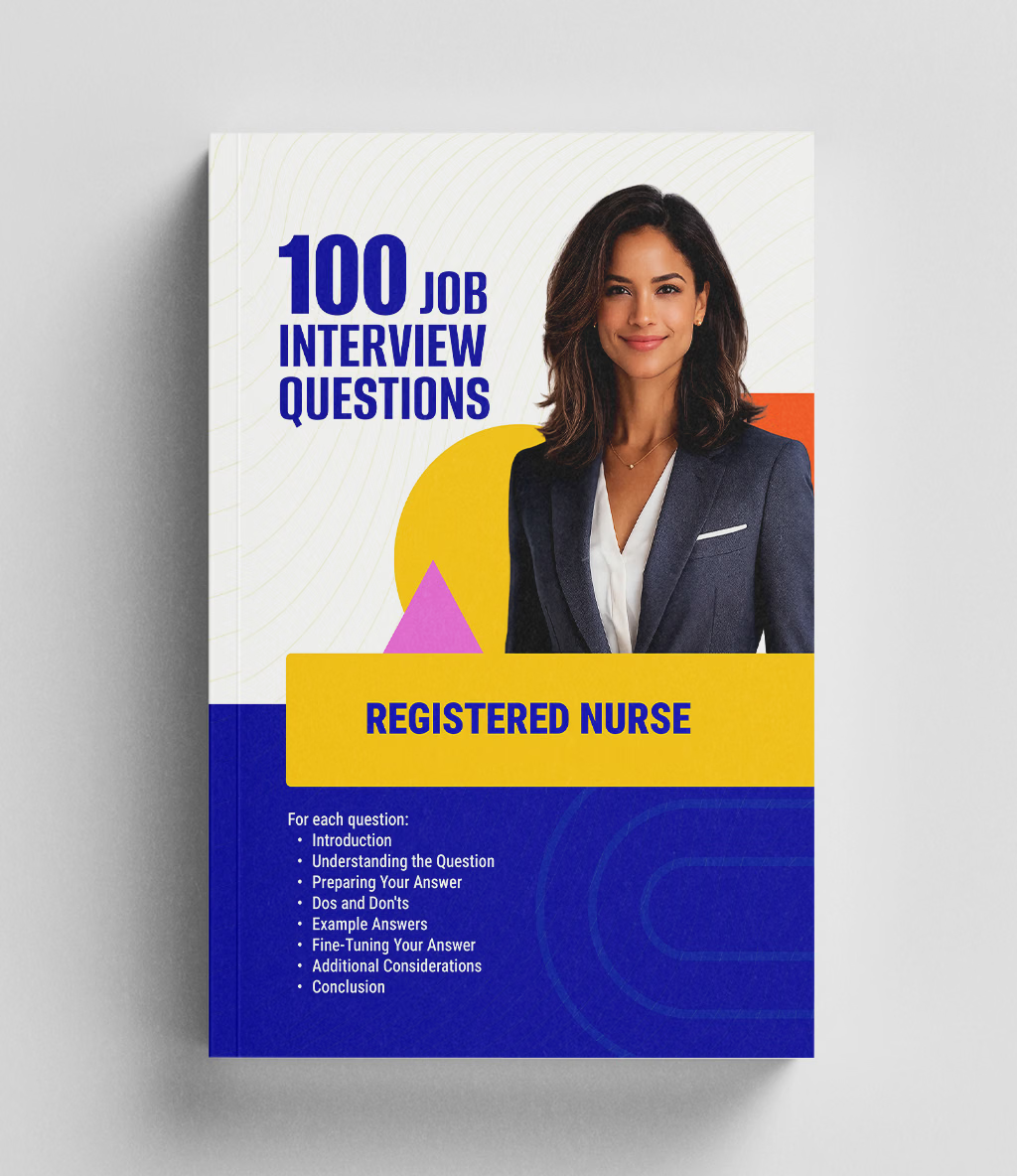
100 interview questions

Registered Nurse Interview Questions: 100 Answers

Keep preparing with the complete question book created for Registered Nurse interviews.

View the question book
Front-facing 3D book mockup of Registered Nurse 100 Job Interview Questions, an interview question book from RockStarCV.com.

How to use this simulation

Listen for decisions, not polished phrases

Pause after each question and form your own answer before Elena Martinez, BSN, RN responds. Then compare the evidence provided: the constraint, the decision, the personal contribution, the trade-off, and the result.

Naomi Brooks, MSN, RN and Elena Martinez, BSN, RN are fictional composite characters. Their employers, registered nurse examples, figures, and outcomes were created for teaching purposes.

Take the interview with you

Your registered nurse interview playbook

Use the printable framework to prepare examples, test your evidence, and rehearse stronger answers away from the screen.

  • Question prompts
  • Evidence checklist
  • Practice notes
Download the PDF playbook

What to notice

A practical viewing checklist

  1. 01

    Notice how Elena begins with the changed condition and focused assessment before describing action.

  2. 02

    Track how prioritization, delegation, escalation, and reassessment stay bounded by patient need, scope, competence, and policy.

  3. 03

    Listen for medication-safety answers that protect the patient, verify facts, report transparently, and support learning.

  4. 04

    Compare handoff answers by whether responsibility, uncertainty, contingencies, and confirmation transfer cleanly.

Interviewer scorecard

The signals behind a credible answer

Assessment
Elena names the patient context, change from baseline, focused assessment, and risk.
Escalation
The concern, request, pathway, response, and reassessment form a closed loop.
Continuity
Responsibility transfers with recent changes, uncertainty, contingencies, and confirmation.

Research foundation

Sources behind the teaching principles

The sources support the interview guidance, not the fictional candidate’s invented employers, budgets, dates, or outcomes.

Similar interviews

Explore related mock interviews

More from RockStarCV

Build your complete career toolkit