Skip to interview
RockStarCV.com
Toggle Navigation

Clinical Operations Manager Mock Interview: The Strong Candidate

Hear a complete Clinical Operations Manager interview in which Victor Chen makes judgment, boundaries, and results inspectable.

Strong candidate pathInteractive simulation16 chapters
Victor Chen, fictional Clinical Operations Manager candidate, seated on the right and facing toward the article center
Victor ChenClinical Operations Manager candidate

Watch and practise

Run the complete interview

Complete transcript

RockStarCV NarratorIntroduction

What does a Clinical Operations Manager interview sound like? Let us step inside the conversation and listen for the decisions that make each answer credible.

RockStarCV NarratorMeet Rebecca Stein and Victor Chen

Your interviewer is Rebecca Stein, Vice President of Clinical Operations. Your candidate is Victor Chen, presenting the strong-candidate path. After the conversation, we will turn the evidence into a practical preparation framework.

Rebecca SteinWelcome

Hi, Victor. Thank you for making the time. How is your day going?

Victor ChenWelcome

It is going well, thank you. I appreciate the chance to speak with you.

Rebecca SteinWelcome

We will spend about half an hour on your background and several clinical operations manager scenarios, then leave time for your questions. Does that work for you?

Victor ChenWelcome

Yes, that sounds good.

Rebecca SteinCareer story

Walk me through your experience as a Clinical Operations Manager.

Victor ChenCareer story

I have built my experience around clinical operations, staffing, access, quality systems, regulatory readiness, incident learning, budgets, and cross-functional leadership. My recent work has required both dependable execution and clear judgment when the normal path no longer fit.

Rebecca SteinCareer story

What scope did you personally own?

Victor ChenCareer story

I personally owned the record, decision path, and follow-through inside my role. I used capacity data, quality measures, staffing plans, incident reviews, and operating dashboards so another person could inspect what I knew, what I decided, and where I escalated.

Rebecca SteinCareer story

Which result best represents your approach?

Victor ChenCareer story

The result I value most is a more reliable operating loop: fewer ownerless handoffs, earlier risk visibility, and evidence that the intended outcome was actually reached.

Rebecca SteinMotivation

Why are you interested in this Clinical Operations Manager role?

Victor ChenMotivation

I am interested because I want to build care operations that make safety, capacity, and accountability visible before problems reach patients. The role combines practical execution with judgment, and that is the responsibility I have been building toward.

Rebecca SteinMotivation

What about this operating environment matters to you?

Victor ChenMotivation

I am especially drawn to an environment where use acuity competence and contingency standards rather than volume alone. That makes the quality of the decision as important as the amount of activity.

Rebecca SteinMotivation

What would you learn first?

Victor ChenMotivation

I would first learn the approved decision rights, the systems of record, the most consequential failure modes, and how this team verifies success before I suggest changes.

Rebecca SteinCapacity

Tell me about a time you had to respond to demand beyond safe staffing.

Victor ChenCapacity

In a fictional US employer example, I had to respond to demand beyond safe staffing while the team was under normal operating pressure. I first clarified the affected people, the consequence of delay, and the decision that actually belonged to my role.

Rebecca SteinCapacity

What decision did you personally make, and what evidence did you use?

Victor ChenCapacity

I used capacity data to verify the condition, documented the trade-off, and made the next owner explicit. I also use acuity competence and contingency standards rather than volume alone, so the work moved without creating a promise or decision outside my authority.

Rebecca SteinCapacity

How did you respect your authority boundary and verify the outcome?

Victor ChenCapacity

I closed the loop by confirming that leaders activated a documented service plan. The useful evidence was the completed handoff and reviewed operating result, not simply that the team had been busy.

Rebecca SteinQuality

Tell me about a time you had to address a recurring patient-safety signal.

Victor ChenQuality

In a fictional US employer example, I had to address a recurring patient-safety signal while the team was under normal operating pressure. I first clarified the affected people, the consequence of delay, and the decision that actually belonged to my role.

Rebecca SteinQuality

What decision did you personally make, and what evidence did you use?

Victor ChenQuality

I used quality measures to verify the condition, documented the trade-off, and made the next owner explicit. I also separate immediate containment from systemic correction, so the work moved without creating a promise or decision outside my authority.

Rebecca SteinQuality

How did you respect your authority boundary and verify the outcome?

Victor ChenQuality

I closed the loop by confirming that actions were verified against repeat events. The useful evidence was the completed handoff and reviewed operating result, not simply that the team had been busy.

Rebecca SteinWorkflow

Tell me about a time you had to redesign a delayed clinical handoff.

Victor ChenWorkflow

In a fictional US employer example, I had to redesign a delayed clinical handoff while the team was under normal operating pressure. I first clarified the affected people, the consequence of delay, and the decision that actually belonged to my role.

Rebecca SteinWorkflow

What decision did you personally make, and what evidence did you use?

Victor ChenWorkflow

I used staffing plans to verify the condition, documented the trade-off, and made the next owner explicit. I also retain licensed decisions and clear ownership, so the work moved without creating a promise or decision outside my authority.

Rebecca SteinWorkflow

How did you respect your authority boundary and verify the outcome?

Victor ChenWorkflow

I closed the loop by confirming that turnaround improved without lost escalation. The useful evidence was the completed handoff and reviewed operating result, not simply that the team had been busy.

Rebecca SteinRegulatory readiness

Tell me about a time you had to find incomplete compliance evidence.

Victor ChenRegulatory readiness

In a fictional US employer example, I had to find incomplete compliance evidence while the team was under normal operating pressure. I first clarified the affected people, the consequence of delay, and the decision that actually belonged to my role.

Rebecca SteinRegulatory readiness

What decision did you personally make, and what evidence did you use?

Victor ChenRegulatory readiness

I used incident reviews to verify the condition, documented the trade-off, and made the next owner explicit. I also correct the system rather than stage a one-time clean-up, so the work moved without creating a promise or decision outside my authority.

Rebecca SteinRegulatory readiness

How did you respect your authority boundary and verify the outcome?

Victor ChenRegulatory readiness

I closed the loop by confirming that required records remained current after review. The useful evidence was the completed handoff and reviewed operating result, not simply that the team had been busy.

Rebecca SteinLeadership

Tell me about a time you had to communicate an operational miss.

Victor ChenLeadership

In a fictional US employer example, I had to communicate an operational miss while the team was under normal operating pressure. I first clarified the affected people, the consequence of delay, and the decision that actually belonged to my role.

Rebecca SteinLeadership

What decision did you personally make, and what evidence did you use?

Victor ChenLeadership

I used operating dashboards to verify the condition, documented the trade-off, and made the next owner explicit. I also state patient impact known facts and recovery ownership, so the work moved without creating a promise or decision outside my authority.
Rebecca SteinLeadership

How did you respect your authority boundary and verify the outcome?

Victor ChenLeadership

I closed the loop by confirming that staff and leaders understood the next checkpoint. The useful evidence was the completed handoff and reviewed operating result, not simply that the team had been busy.

Rebecca SteinCandidate questions

What questions would you like to ask us?

Victor ChenCandidate questions

What would make someone in this role demonstrably successful after six months?

Rebecca SteinCandidate questions

Success means reliable judgment, clear ownership, and evidence that the work improves the customer or patient outcome. We would agree the exact measures during onboarding.

Victor ChenCandidate questions

Which decisions would I own, and which should I escalate?

Rebecca SteinCandidate questions

You would own routine decisions inside the role and use documented escalation paths when risk, scope, or authority changes. We value early escalation with a clear recommendation.

Victor ChenCandidate questions

Thank you. That is helpful.

Rebecca SteinClose

Those are all my questions. Thank you, Victor. We will follow up after the remaining interviews.

Victor ChenClose

Thank you for the conversation. I appreciate your time.

RockStarCV NarratorOutro 1 · Verdict

Victor Chen made judgment visible instead of asking the interviewer to infer it. The answers connected a constraint, a personal decision, and a verifiable result.

RockStarCV NarratorOutro 2 · Evidence

Strong does not mean perfect. It means the interviewer can inspect how the candidate thought and what changed.

RockStarCV NarratorOutro 2 · Evidence

The recurring evidence was respond to demand beyond safe staffing, address a recurring patient-safety signal, retain licensed decisions and clear ownership, and required records remained current after review.

RockStarCV NarratorOutro 2 · Evidence

Notice that the examples are fictional composites. The teaching principles come from the cited occupation and practice sources, not from invented outcomes.

RockStarCV NarratorOutro 3 · Framework

Prepare your own answer with five lines: context, evidence, decision, boundary, verification.

RockStarCV NarratorOutro 3 · Framework

Keep each line short enough to say naturally, then let the interviewer decide where to probe.

RockStarCV NarratorOutro 4 · Practice

Pause here and rehearse one real clinical operations manager example. Replace team language with the decision you personally owned, and do not claim an outcome you cannot verify.

RockStarCV NarratorOutro 4 · Practice

Prepare with evidence. Interview with confidence.

Use Play to hear the conversation, move one slide at a time, or jump directly to a chapter. Captions follow the active speaker.

What to expect

How the interview is likely to unfold

A senior clinical operations manager interview usually moves from your career story into evidence of judgment, then closes with your questions.

  1. Career story

    Walk me through your experience as a Clinical Operations Manager.

  2. Motivation

    Why are you interested in this Clinical Operations Manager role?

  3. Capacity

    Tell me about a time you had to respond to demand beyond safe staffing.

  4. Quality

    Tell me about a time you had to address a recurring patient-safety signal.

  5. Workflow

    Tell me about a time you had to redesign a delayed clinical handoff.

  6. Regulatory readiness

    Tell me about a time you had to find incomplete compliance evidence.

  7. Leadership

    Tell me about a time you had to communicate an operational miss.

Who might interview you

Different people are testing different things

Listen to the role behind the question. The same example may need a different emphasis for each interviewer.

Vice President of Clinical Operations

Their purpose
Evaluate role judgment, ownership, boundaries, and evidence.
They look for
respond to demand beyond safe staffing, address a recurring patient-safety signal, retain licensed decisions and clear ownership

Cross-functional partner

Their purpose
Understand collaboration and escalation.
They look for
A clear decision path and honest operating boundary.

Senior peer

Their purpose
Test realistic execution detail.
They look for
Specific examples and verification.

What they are assessing

Make your judgment easy to see

What interviewers need to learn

  • Do you make respond to demand beyond safe staffing visible?
  • Do you make address a recurring patient-safety signal visible?
  • Do you make retain licensed decisions and clear ownership visible?
  • Do you make required records remained current after review visible?
  • Do you make communicate an operational miss visible?

Accentuate

  • Context: Define the affected people, system, and consequence in Clinical Operations Manager work.
  • Evidence: Use capacity data, quality measures, staffing plans, incident reviews, and operating dashboards to verify the condition before acting.
  • Decision: Name the decision you personally owned and the trade-off you accepted.
  • Boundary: State what required approval, licensed judgment, or accountable escalation.
  • Verification: Close with the reviewed result, denominator, or completed handoff.

Leave out

  • Unbounded team language with no personal decision.
  • Activity presented as an outcome.
  • A promise outside your authority.
  • A number you cannot verify.

Difficult questions

Prepare the evidence, not a script

Use these prompts to choose a truthful example and reconstruct the decision. Your delivery should still sound like you.

Tell me about a time you had to respond to demand beyond safe staffing.

Why they ask: They are testing capacity judgment.

Prepare: I used capacity data to verify the condition, documented the trade-off, and made the next owner explicit. I also use acuity competence and contingency standards rather than volume alone, so the work moved without creating a promise or decision outside my authority.

Tell me about a time you had to address a recurring patient-safety signal.

Why they ask: They are testing quality judgment.

Prepare: I used quality measures to verify the condition, documented the trade-off, and made the next owner explicit. I also separate immediate containment from systemic correction, so the work moved without creating a promise or decision outside my authority.

Tell me about a time you had to redesign a delayed clinical handoff.

Why they ask: They are testing workflow judgment.

Prepare: I used staffing plans to verify the condition, documented the trade-off, and made the next owner explicit. I also retain licensed decisions and clear ownership, so the work moved without creating a promise or decision outside my authority.

Tell me about a time you had to find incomplete compliance evidence.

Why they ask: They are testing regulatory readiness judgment.

Prepare: I used incident reviews to verify the condition, documented the trade-off, and made the next owner explicit. I also correct the system rather than stage a one-time clean-up, so the work moved without creating a promise or decision outside my authority.

Tell me about a time you had to communicate an operational miss.

Why they ask: They are testing leadership judgment.

Prepare: I used operating dashboards to verify the condition, documented the trade-off, and made the next owner explicit. I also state patient impact known facts and recovery ownership, so the work moved without creating a promise or decision outside my authority.

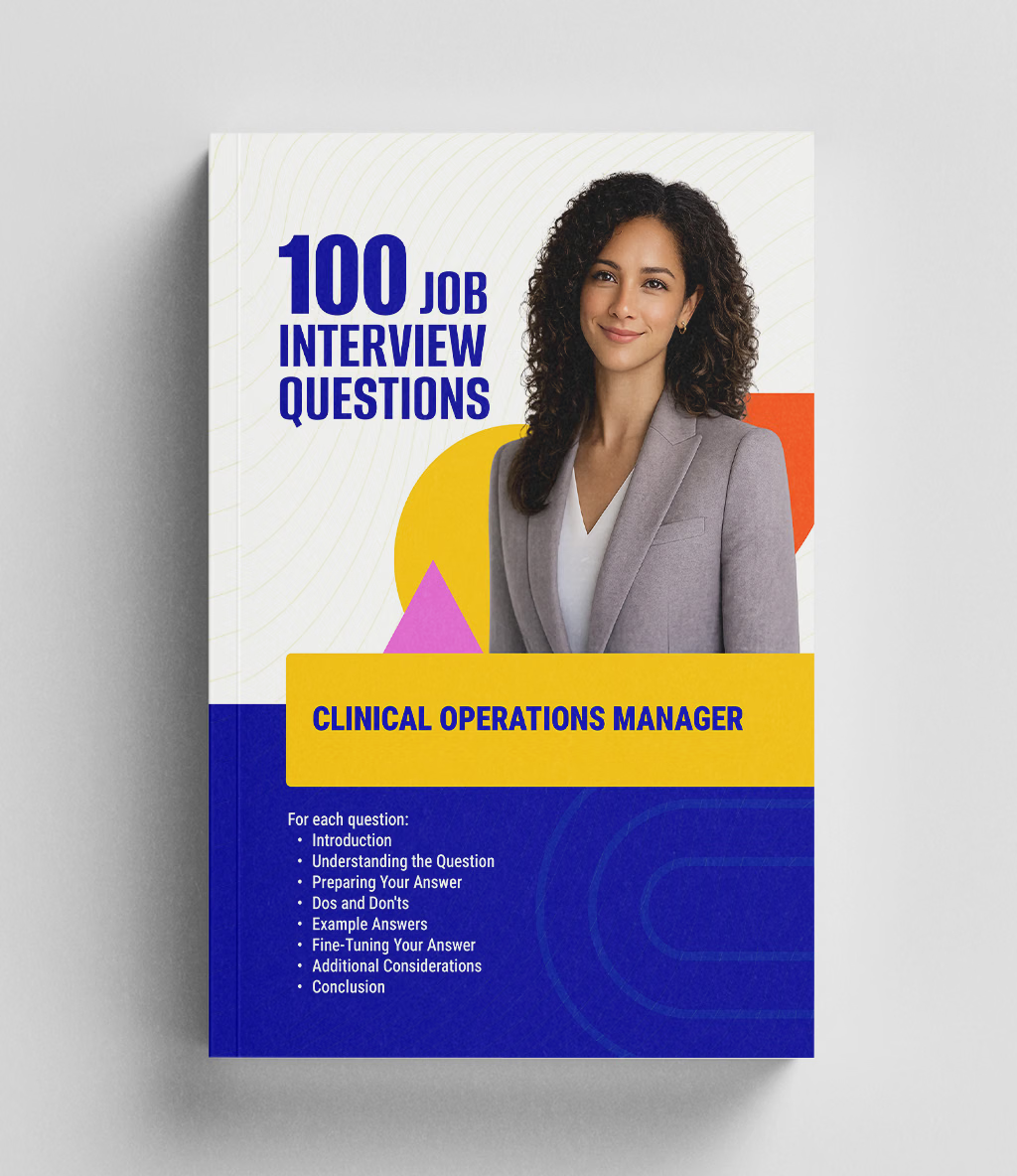
100 interview questions

Clinical Operations Manager Interview Questions: 100 Answers

Keep preparing with the complete question book created for Clinical Operations Manager interviews.

View the question book
Front-facing 3D book mockup of Clinical Operations Manager 100 Job Interview Questions, an interview question book from RockStarCV.com.

How to use this simulation

Listen for decisions, not polished phrases

Pause after each question and form your own answer before Victor Chen responds. Then compare the evidence provided: the constraint, the decision, the personal contribution, the trade-off, and the result.

Rebecca Stein and Victor Chen are fictional composite characters. Their employers, clinical operations manager examples, figures, and outcomes were created for teaching purposes.

Take the interview with you

Your clinical operations manager interview playbook

Use the printable framework to prepare examples, test your evidence, and rehearse stronger answers away from the screen.

  • Question prompts
  • Evidence checklist
  • Practice notes
Download the PDF playbook

What to notice

A practical viewing checklist

  1. 01

    Listen for respond to demand beyond safe staffing.

  2. 02

    Listen for address a recurring patient-safety signal.

  3. 03

    Listen for retain licensed decisions and clear ownership.

  4. 04

    Listen for required records remained current after review.

  5. 05

    Listen for communicate an operational miss.

Interviewer scorecard

The signals behind a credible answer

Research foundation

Sources behind the teaching principles

The sources support the interview guidance, not the fictional candidate’s invented employers, budgets, dates, or outcomes.

Similar interviews

Explore related mock interviews

More from RockStarCV

Build your complete career toolkit