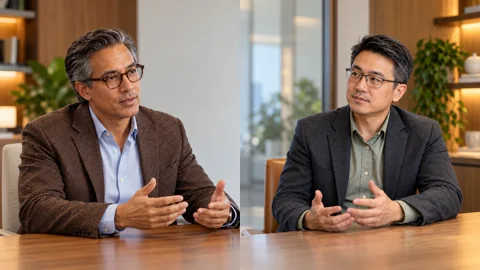
Database Administrator Mock Interview: The Developing Candidate
Watch a credible Database Administrator candidate whose answers need clearer decisions, ownership, and verification.

Watch and practise
Run the complete interview
Use Play to hear the conversation, move one slide at a time, or jump directly to a chapter. Captions follow the active speaker.
What to expect
How the interview is likely to unfold
A senior database administrator interview usually moves from your career story into evidence of judgment, then closes with your questions.
Career story
Walk me through your experience as a Database Administrator.
Motivation
Why are you interested in this Database Administrator role?
Performance
Tell me about a time you had to diagnose a production query slowdown.
Migration
Tell me about a time you had to change a high-volume table.
Recovery
Tell me about a time you had to respond to suspected data loss.
Access
Tell me about a time you had to review privileged database access.
Capacity
Tell me about a time you had to forecast storage and throughput.
Who might interview you
Different people are testing different things
Listen to the role behind the question. The same example may need a different emphasis for each interviewer.
Data Platform Manager
- Their purpose
- Evaluate role judgment, ownership, boundaries, and evidence.
- They look for
- diagnose a production query slowdown, change a high-volume table, protect evidence and follow the recovery objective
Cross-functional partner
- Their purpose
- Understand collaboration and escalation.
- They look for
- A clear decision path and honest operating boundary.
Senior peer
- Their purpose
- Test realistic execution detail.
- They look for
- Specific examples and verification.
What they are assessing
Make your judgment easy to see
What interviewers need to learn
- Do you make diagnose a production query slowdown visible?
- Do you make change a high-volume table visible?
- Do you make protect evidence and follow the recovery objective visible?
- Do you make administrative access matched operational need visible?
- Do you make forecast storage and throughput visible?
Accentuate
- Context: Define the affected people, system, and consequence in Database Administrator work.
- Evidence: Use database telemetry, query plans, migration tooling, backup verification, and access audits to verify the condition before acting.
- Decision: Name the decision you personally owned and the trade-off you accepted.
- Boundary: State what required approval, licensed judgment, or accountable escalation.
- Verification: Close with the reviewed result, denominator, or completed handoff.
Leave out
- Unbounded team language with no personal decision.
- Activity presented as an outcome.
- A promise outside your authority.
- A number you cannot verify.
Difficult questions
Prepare the evidence, not a script
Use these prompts to choose a truthful example and reconstruct the decision. Your delivery should still sound like you.
Tell me about a time you had to diagnose a production query slowdown.
Why they ask: They are testing performance judgment.
Prepare: I used database telemetry to verify the condition, documented the trade-off, and made the next owner explicit. I also measure workload and plan changes before adding capacity, so the work moved without creating a promise or decision outside my authority.
Tell me about a time you had to change a high-volume table.
Why they ask: They are testing migration judgment.
Prepare: I used query plans to verify the condition, documented the trade-off, and made the next owner explicit. I also use compatible rollout and reconciliation, so the work moved without creating a promise or decision outside my authority.
Tell me about a time you had to respond to suspected data loss.
Why they ask: They are testing recovery judgment.
Prepare: I used migration tooling to verify the condition, documented the trade-off, and made the next owner explicit. I also protect evidence and follow the recovery objective, so the work moved without creating a promise or decision outside my authority.
Tell me about a time you had to review privileged database access.
Why they ask: They are testing access judgment.
Prepare: I used backup verification to verify the condition, documented the trade-off, and made the next owner explicit. I also use least privilege and time-bounded elevation, so the work moved without creating a promise or decision outside my authority.
Tell me about a time you had to forecast storage and throughput.
Why they ask: They are testing capacity judgment.
Prepare: I used access audits to verify the condition, documented the trade-off, and made the next owner explicit. I also state workload assumptions and review triggers, so the work moved without creating a promise or decision outside my authority.

How to use this simulation
Listen for decisions, not polished phrases
Pause after each question and form your own answer before Victor Chen responds. Then compare the evidence provided: the constraint, the decision, the personal contribution, the trade-off, and the result.
Samuel Okoye and Victor Chen are fictional composite characters. Their employers, database administrator examples, figures, and outcomes were created for teaching purposes.
Take the interview with you
Your database administrator interview playbook
Use the printable framework to prepare examples, test your evidence, and rehearse stronger answers away from the screen.
- Question prompts
- Evidence checklist
- Practice notes
What to notice
A practical viewing checklist
- 01
Notice where activity replaces evidence.
- 02
Add the decision rule and personal action.
- 03
State the boundary you respected.
- 04
Verify what changed.
Interviewer scorecard
The signals behind a credible answer
- Context
- Define the affected people, system, and consequence in Database Administrator work.
- Evidence
- Use database telemetry, query plans, migration tooling, backup verification, and access audits to verify the condition before acting.
- Decision
- Name the decision you personally owned and the trade-off you accepted.
Research foundation
Sources behind the teaching principles
The sources support the interview guidance, not the fictional candidate’s invented employers, budgets, dates, or outcomes.
- Database Administrator — Occupational Outlook HandbookU.S. Bureau of Labor Statistics
- Database Administrator — O*NET SummaryO*NET OnLine, U.S. Department of Labor sponsored
- Cybersecurity Framework 2.0National Institute of Standards and Technology
Similar interviews