Business Development Representative Mock Interview: The Developing Candidate
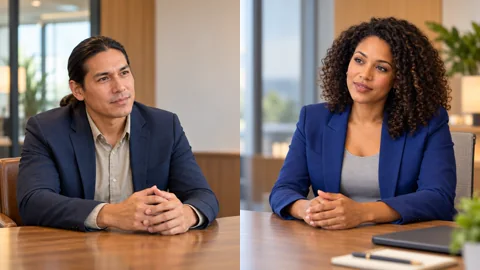
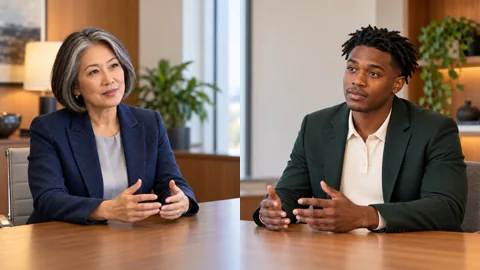
Watch a credible Business Development Representative candidate whose answers need clearer decisions, ownership, and verification.

Watch and practise
Run the complete interview
Use Play to hear the conversation, move one slide at a time, or jump directly to a chapter. Captions follow the active speaker.
What to expect
How the interview is likely to unfold
A senior business development representative interview usually moves from your career story into evidence of judgment, then closes with your questions.
Career story
Walk me through your experience in business development.
Motivation
Why this BDR role, and why now?
Account research
How do you decide which accounts deserve attention?
Qualification
Tell me about a prospect you chose not to advance.
Objections
How do you respond when a prospect says they are not interested?
Measurement
How do you measure success beyond raw activity?
Who might interview you
Different people are testing different things
Listen to the role behind the question. The same example may need a different emphasis for each interviewer.
Director of Business Development
- Their purpose
- Evaluate role judgment, ownership, boundaries, and evidence.
- They look for
- research before outreach, qualify genuine fit, handle objections with permission
Cross-functional partner
- Their purpose
- Understand collaboration and escalation.
- They look for
- A clear decision path and honest operating boundary.
Senior peer
- Their purpose
- Test realistic execution detail.
- They look for
- Specific examples and verification.
What they are assessing
Make your judgment easy to see
What interviewers need to learn
- Do you make research before outreach visible?
- Do you make qualify genuine fit visible?
- Do you make handle objections with permission visible?
- Do you make measure accepted pipeline visible?
- Do you make stay honest and compliant visible?
Accentuate
- Research: Show why this account and person belong in the sequence.
- Relevance: Lead with a plausible problem, not a feature dump.
- Qualification: Test fit honestly and disqualify weak opportunities early.
- Cadence: Use purposeful follow-up instead of repetitive pressure.
- Evidence: Connect activity to qualified pipeline and accepted meetings.
Leave out
- Unbounded team language with no personal decision.
- Activity presented as an outcome.
- A promise outside your authority.
- A number you cannot verify.
Difficult questions
Prepare the evidence, not a script
Use these prompts to choose a truthful example and reconstruct the decision. Your delivery should still sound like you.
How do you decide which accounts deserve attention?
Why they ask: They are testing account research judgment.
Prepare: A strong signal raises priority only if it connects to a problem we can credibly help with. I document the hypothesis in the CRM, so the first message and the later discovery have a visible reason behind them.
Tell me about a prospect you chose not to advance.
Why they ask: They are testing qualification judgment.
Prepare: I was transparent about the mismatch, shared a lighter resource, and asked permission to reconnect if their operating model changed. I recorded the reason instead of forcing an account executive to rediscover it.
How do you respond when a prospect says they are not interested?
Why they ask: They are testing objections judgment.
Prepare: I might say, “Understood. Before I step back, is this not a priority at all, or is the timing wrong this quarter?” That gives them control and may clarify whether a future conversation is useful.
How do you measure success beyond raw activity?
Why they ask: They are testing measurement judgment.
Prepare: A low positive-reply rate by segment tells me quickly that the problem hypothesis or audience is wrong. A high meeting rate with poor acceptance tells me qualification is weak. Those are different problems and need different fixes.

How to use this simulation
Listen for decisions, not polished phrases
Pause after each question and form your own answer before Sofia Alvarez responds. Then compare the evidence provided: the constraint, the decision, the personal contribution, the trade-off, and the result.
Grace Kim and Sofia Alvarez are fictional composite characters. Their employers, business development representative examples, figures, and outcomes were created for teaching purposes.
Take the interview with you
Your business development representative interview playbook
Use the printable framework to prepare examples, test your evidence, and rehearse stronger answers away from the screen.
- Question prompts
- Evidence checklist
- Practice notes
What to notice
A practical viewing checklist
- 01
Notice where activity replaces evidence.
- 02
Add the decision rule and personal action.
- 03
State the boundary you respected.
- 04
Verify what changed.
Interviewer scorecard
The signals behind a credible answer
- Research
- Show why this account and person belong in the sequence.
- Relevance
- Lead with a plausible problem, not a feature dump.
- Qualification
- Test fit honestly and disqualify weak opportunities early.
Research foundation
Sources behind the teaching principles
The sources support the interview guidance, not the fictional candidate’s invented employers, budgets, dates, or outcomes.
- Wholesale and Manufacturing Sales Representatives — Occupational Outlook HandbookU.S. Bureau of Labor Statistics
- Sales Representatives, Wholesale and Manufacturing (41-4012.00) — Summary ReportO*NET OnLine (U.S. Department of Labor)
- CAN-SPAM Act: A Compliance Guide for BusinessU.S. Federal Trade Commission
Similar interviews