Skip to interview
RockStarCV.com
Toggle Navigation

Accountant Mock Interview: The Developing Candidate

Watch a realistic Accountant interview where credible experience is weakened by vague scope, manager-led conclusions, implicit controls, and results that are hard to verify.

Developing candidate pathInteractive simulation16 chapters
Jordan Blake, the fictional Accountant candidate, seated on the right and facing toward the article center
Jordan BlakeAccountant candidate

Watch and practise

Run the complete interview

Complete transcript

RockStarCV NarratorIntroduction

What makes a capable Accountant answer harder to trust? Let’s step inside the conversation and listen for where stronger evidence would help.

RockStarCV NarratorMeet Marcus and the candidate

Jordan is capable and employable. The debrief will show how to make his control thinking and review evidence easier to evaluate.

Marcus ChenThe room

Hi, Jordan. It is good to meet you. How has your morning been?

Jordan BlakeThe room

Good, thanks. I left early because I was not sure about traffic, so I had time to grab a coffee nearby.

Marcus ChenThe room

Smart choice. We have about thirty minutes. I will ask about your close work, discrepancies, judgment, and how you communicate financial information. I will leave time for your questions at the end.

Jordan BlakeThe room

That sounds good.

Marcus ChenCareer scope

Walk me through your accounting experience and the scope you own today.

Jordan BlakeCareer scope

I have been in accounting for about four years. I started with accounts payable and moved into a Staff Accountant role at Lakeview Equipment Services. I do journal entries, reconciliations, some fixed assets, and whatever else is needed during the close. I use our accounting system and Excel every day.

Marcus ChenCareer scope

How many entities do you support, and which reconciliations are yours from preparation through review?

Jordan BlakeCareer scope

We have a few entities. I mainly work on the operating company, although I help with the others. Cash and prepaid expenses are usually mine, and sometimes accruals if someone is out.

Marcus ChenCareer scope

What would your manager say you can be trusted to own without reminders?

Jordan BlakeCareer scope

Probably cash. I get the reconciliations done, follow up on old checks, and let her know if something looks unusual. I am dependable, and I do not mind helping when the team is busy.

Marcus ChenWhy this accounting role

Why are you interested in this position?

Jordan BlakeWhy this accounting role

I want to keep growing and work for a larger organization. Northline seems like a place where there would be more opportunity and more kinds of accounting work.

Marcus ChenWhy this accounting role

All right. Let us talk about one close in detail.

Marcus ChenClose under pressure

Tell me about a close when a critical subledger arrived late. What did you do without weakening the review?

Jordan BlakeClose under pressure

Our billing report was late earlier this year. Everyone was under pressure because management wanted the numbers. We stayed late, divided up the work, and kept checking with the billing team until the report was ready.

Marcus ChenClose under pressure

What was waiting on that report, and what could you complete independently?

Jordan BlakeClose under pressure

Revenue and accounts receivable were waiting. I worked on cash and prepaids first. When the file came, I tied the total to the system and finished the entry. My manager reviewed it the next morning.

Marcus ChenClose under pressure

Were there unresolved items, or did you use an estimate while you waited?

Jordan BlakeClose under pressure

There were a couple of invoices we were still checking. I think they were small. We used the final report, not an estimate, and put questions in the review notes. We did finish the close on time.

Marcus ChenClose under pressure

What did the team change afterward?

Jordan BlakeClose under pressure

Billing said they would send the report earlier. I also started reminding them a day before we needed it. It has mostly been better since then.

Marcus ChenClose under pressure

Thank you. There is useful experience there. I am going to ask you for similar detail on the next example.

Marcus ChenDiscrepancy and control

Describe a discrepancy you found and how you resolved it.

Jordan BlakeDiscrepancy and control

I once found that a prepaid insurance balance was too high. The monthly expense had not posted for a while, so I calculated the missing amount and corrected it.

Marcus ChenDiscrepancy and control

How did you confirm the service period and the amount?

Jordan BlakeDiscrepancy and control

I checked the invoice and the policy dates, then compared them with the spreadsheet. I prepared a catch-up entry and gave it to my manager. It was around thirty thousand dollars, although I do not remember the exact amount.

Marcus ChenDiscrepancy and control

What caused the posting to stop?

Jordan BlakeDiscrepancy and control

I believe a formula was overwritten when the schedule was copied. I fixed the formula. We did not have the same issue the next month.

Marcus ChenDiscrepancy and control

Did you add any check that would catch a missing amortization line before review?

Jordan BlakeDiscrepancy and control

Not a formal check. I look at the total more closely now, and my manager reviews the schedule.

Marcus ChenTechnical judgment

Tell me about a time business pressure conflicted with the accounting support available.

Jordan BlakeTechnical judgment

A department manager wanted us to accrue a large vendor rebate before quarter-end. The paperwork was not final, but he was confident we would receive it. I asked my manager what to do because I did not want to make the decision alone.

Marcus ChenTechnical judgment

What information did you gather before you went to your manager?

Jordan BlakeTechnical judgment

I had the email from the department manager and the prior-year rebate agreement. I explained that the new agreement was still being negotiated. My manager decided not to book it, so I told the department we needed the signed document.

Marcus ChenTechnical judgment

Did you document why the earlier agreement was not enough or research the accounting conclusion?

Jordan BlakeTechnical judgment

Not separately. I included the email in our close folder, but my manager handled the technical side. I followed the decision and did not post the entry.

Marcus ChenTechnical judgment

That was a reasonable escalation. For this role, I would also want to hear how you formed and documented your own view before escalating.

Marcus ChenVariance communication

How have you explained a material variance to a nonfinance leader?

Jordan BlakeVariance communication

I send department managers a monthly expense report. One manager was about fifteen percent over budget, so I highlighted the variance and asked whether there were invoices that belonged in a different period.

Marcus ChenVariance communication

What was driving the fifteen percent?

Jordan BlakeVariance communication

It was mostly temporary labor and repair costs. The manager said they had an equipment issue and needed extra people. I updated the comments and sent the report back.

Marcus ChenVariance communication

What decision did your analysis support?

Jordan BlakeVariance communication

I am not sure there was a specific decision. They knew they were over budget and said the next month should be better. Finance updated the forecast later.

Marcus ChenProcess improvement

What recurring accounting process have you improved?

Jordan BlakeProcess improvement

I cleaned up our cash-reconciliation spreadsheet. It had a lot of tabs and old formulas, so I simplified it, added conditional formatting, and made the outstanding-check section easier to read.

Marcus ChenProcess improvement

How did you test the revised file before the team relied on it?

Jordan BlakeProcess improvement

I compared the ending balance with the old file and sent it to my manager. She liked the layout, so we started using it the next month.

Marcus ChenProcess improvement

Did it reduce preparation time or review exceptions?

Jordan BlakeProcess improvement

It feels faster, and it is definitely easier to follow. I have not measured the time or review notes, though.

Marcus ChenProcess improvement

If you repeated that improvement here, what would you add?

Jordan BlakeProcess improvement

I would run the old and new files together for a month, document the formulas, and ask a reviewer to test the exception cases. I would also record the preparation time and how many items came back.

Marcus ChenCandidate questions

Good. What questions do you have for me?

Jordan BlakeCandidate questions

What is the culture like on the accounting team?

Marcus ChenCandidate questions

It is collaborative, but expectations are documented. People help each other, and each preparer still owns the quality and timing of assigned work.

Jordan BlakeCandidate questions

How soon could someone take on senior-level work?

Marcus ChenCandidate questions

That depends on consistent evidence. Someone who closes assigned accounts reliably, resolves exceptions, and communicates early can expand quickly. We do not tie it to a fixed number of months.

Jordan BlakeCandidate questions

That makes sense. Thank you.

Marcus ChenClosing the interview

Thank you, Jordan. Our next step is to finish first-round interviews this week. We will contact candidates early next week.

Jordan BlakeClosing the interview

I appreciate your time. It was good to learn more about the role.

RockStarCV NarratorOutro 1 · Verdict

Jordan did not give a disastrous interview. He showed real close experience, sensible caution, and a willingness to improve. The problem was that Marcus repeatedly had to search for scope, personal judgment, review evidence, and results.

RockStarCV NarratorOutro 2 · Evidence

Jordan's phrases reveal the repair points. A few entities did not establish scope.

RockStarCV NarratorOutro 2 · Evidence

About thirty thousand dollars lacked a confirmed figure and control result. Feels faster did not measure improvement.

RockStarCV NarratorOutro 2 · Evidence

Four gaps repeated. Scale stayed unclear. Control evidence was partial. Jordan often handed the conclusion to his manager before explaining his own analysis. Outcomes were mostly unmeasured.

RockStarCV NarratorOutro 3 · Framework

The repair is practical.

RockStarCV NarratorOutro 3 · Framework

Name the account or process, state the risk, show the evidence you traced, give your own conclusion, identify the review point, and measure what changed.

RockStarCV NarratorOutro 4 · Practice

Take one of your own vague phrases, such as we got it done or it was faster. Replace it with the account, evidence, decision, reviewer, and measured result.

RockStarCV NarratorOutro 4 · Practice

Prepare with evidence. Interview with confidence. Continue your preparation at Rock Star C V dot com.

Use Play to hear the conversation, move one slide at a time, or jump directly to a chapter. Captions follow the active speaker.

What to expect

How the interview is likely to unfold

A senior accountant interview usually moves from your career story into evidence of judgment, then closes with your questions.

  1. Welcome and framing

    Expect concise rapport, a clear agenda, and an opening that establishes the accounting environment and close responsibilities.

  2. Your accounting scope

    Connect your progression to entities, accounts, systems, review points, and decisions you personally owned.

  3. Close and control judgment

    Show how you preserve source-to-ledger ties, visible exceptions, review, and segregation while working under deadline pressure.

  4. Discrepancy and technical judgment

    Trace anomalies to source evidence, document the conclusion, apply authoritative guidance, and respect the approval boundary.

  5. Variance and process improvement

    Explain operating drivers, limitations, decision implications, safeguards, and a bounded comparison window.

  6. Candidate questions and close

    Ask about close ownership, review standards, systems, decision rights, and team expectations, then close professionally.

Who might interview you

Different people are testing different things

Listen to the role behind the question. The same example may need a different emphasis for each interviewer.

Recruiter or talent partner

Their purpose
Confirm communication, motivation, credentials, availability, and practical fit.
They look for
A coherent accounting story, verified requirements, and clear communication without inflated ownership.

Controller

Their purpose
Decide whether you protect controls, trace evidence, document judgment, and close reliably.
They look for
Bounded scope, source evidence, explicit conclusions, review points, and measurable follow-through.

Accounting manager

Their purpose
Understand how you prioritize, reconcile, escalate, and work through exceptions during close.
They look for
A clear account-risk-evidence-conclusion-review-result trail.

Finance or operations partner

Their purpose
Test whether you translate variances into operating drivers and decision-ready implications.
They look for
Clear numbers, evidence, limitations, owners, and actions without overstating certainty.

What they are assessing

Make your judgment easy to see

What interviewers need to learn

  • Can you name the account, risk, source evidence, conclusion, reviewer, and bounded result?
  • Can you protect controls and review points when a deadline or operating pressure increases?
  • Can you separate the analysis you owned from a manager's approval or posting authority?
  • Can you explain a variance or process change with a denominator, time window, source, and limitation?

Accentuate

  • The entity, account, reconciliation, close responsibility, and review point you personally owned.
  • The source evidence, exception, conclusion, correction, approval boundary, and recurrence control.
  • The authoritative guidance consulted, documented facts, assumptions, reviewer, and final decision owner.
  • The baseline, denominator, comparison window, source, and limitation behind any fictional result.

Leave out

  • A list of accounting systems or tasks without the account risk and decision they supported.
  • A close story that treats speed as more important than reconciliation, evidence, or review.
  • A discrepancy story that ends with handing it to a manager but never states your analysis or recommendation.
  • A process-improvement claim without the safeguard, reconciliation test, comparison window, or measurable result.

Difficult questions

Prepare the evidence, not a script

Use these prompts to choose a truthful example and reconstruct the decision. Your delivery should still sound like you.

Tell me about a close under pressure.

Why they ask: They are testing deadline judgment, account risk, review discipline, and whether controls remain visible.

Prepare: Dependency, exposure, work resequenced, evidence preserved, reviewer informed, and final outcome.

Describe a discrepancy you found.

Why they ask: They need to hear a traceable path from anomaly to source evidence, conclusion, correction, and prevention.

Prepare: Amount, account, source records, test performed, conclusion, correcting entry, reviewer, and recurrence check.

Tell me about a technical accounting judgment.

Why they ask: They are testing research discipline and whether you know where your authority ends.

Prepare: Question, authoritative source, relevant facts, documented conclusion, assumption, and review boundary.

How do you explain a variance?

Why they ask: They want a number connected to operating drivers, confidence limits, and a decision.

Prepare: Variance, driver, evidence, limitation, implication, owner, and action.

What process have you improved?

Why they ask: They are testing whether efficiency gains preserve data integrity and controls.

Prepare: Failure mode, baseline, change, test, reconciliation, safeguard, and comparison window.

What questions do you have for us?

Why they ask: Your questions reveal how seriously you evaluate ownership, review, systems, and team expectations.

Prepare: Close calendar, account ownership, review standards, exception handling, systems, and success after six months.
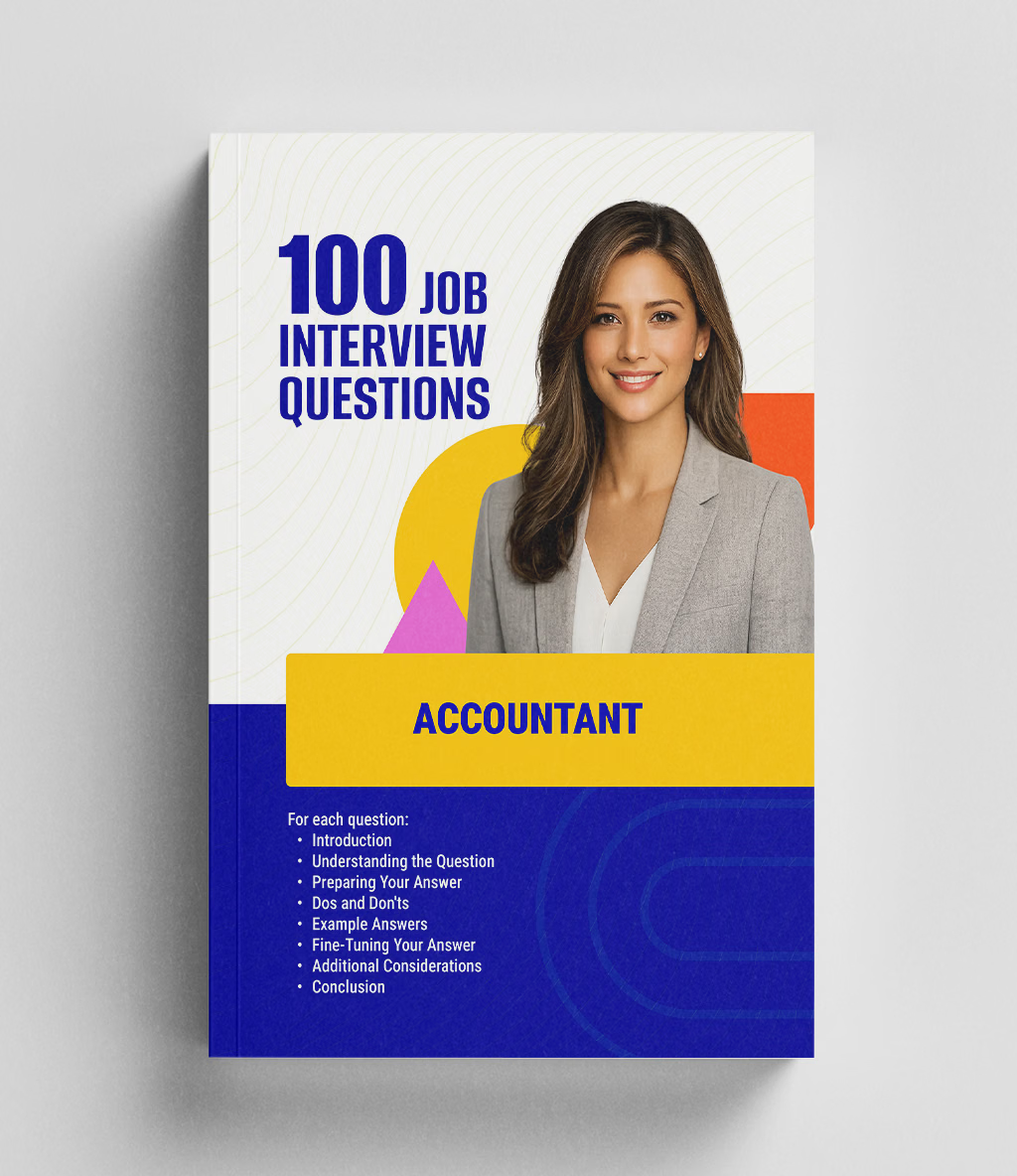
100 interview questions

Accountant Interview Questions: 100 Answers

Keep preparing with the complete question book created for Accountant interviews.

View the question book
Front-facing 3D book mockup of Accountant 100 Job Interview Questions, an interview question book from RockStarCV.com.

How to use this simulation

Listen for decisions, not polished phrases

Pause after each question and form your own answer before Jordan Blake responds. Then compare the evidence provided: the constraint, the decision, the personal contribution, the trade-off, and the result.

Marcus Chen and Jordan Blake are fictional composite characters. Their employers, accountant examples, figures, and outcomes were created for teaching purposes.

Take the interview with you

Your accountant interview playbook

Use the printable framework to prepare examples, test your evidence, and rehearse stronger answers away from the screen.

  • Question prompts
  • Evidence checklist
  • Practice notes
Download the PDF playbook

What to notice

A practical viewing checklist

  1. 01

    Identify where Jordan describes activity before naming the account, risk, and source evidence.

  2. 02

    Notice when a manager appears as the decision-maker before Jordan explains his own analysis and recommendation.

  3. 03

    Listen for controls that need a clearer reviewer, approval point, or reconciliation safeguard.

  4. 04

    Pause after each result and add the denominator, time window, source, and limitation.

Interviewer scorecard

The signals behind a credible answer

Scope first
Replace broad close activity with entities, accounts, ownership, and review points.
Decision trail
State the evidence traced, conclusion recommended, and authority boundary.
Bounded result
Name the baseline, eligible group, comparison window, source, and limitation.

Research foundation

Sources behind the teaching principles

The sources support the interview guidance, not the fictional candidate’s invented employers, budgets, dates, or outcomes.

Similar interviews

Explore related mock interviews

More from RockStarCV

Build your complete career toolkit