Frontend Engineer Resume Examples & Guide
Landing a Frontend Engineer position can be tough. Applicant Tracking Systems (ATS) filter resumes, and the competition is fierce. This guide provides Frontend Engineer resume examples tailored for every experience level, from students to seasoned professionals, to help you stand out.
- Quantify Achievements: Use numbers and metrics to showcase the impact of your work.
- Highlight Relevant Skills: Emphasize skills in navigation, software proficiency, and problem-solving.
- Tailor to Job Description: Customize your resume to match the specific requirements of each job.
- Optimize for ATS: Use keywords from the job description to ensure your resume passes ATS scans.
- Use Action Verbs: Start your bullet points with strong action verbs to demonstrate your accomplishments.
Let’s dive into some Frontend Engineer resume examples to inspire your own.
Explore editable Frontend Engineer resume examples by career stage. Each sample opens in the RockStarCV builder so you can study the structure and make your own version. Every example includes role-relevant education, skills, credentials, and work history—not just a matching headline. As you compare them, look for truthful evidence of accessibility, web performance, and frontend testing at the seniority level shown.
Entry-Level Front End Engineer Resume (0-2 Years Experience)
Use these entry-level examples to compare the scope, evidence, and language expected for Frontend Engineer roles at this stage.
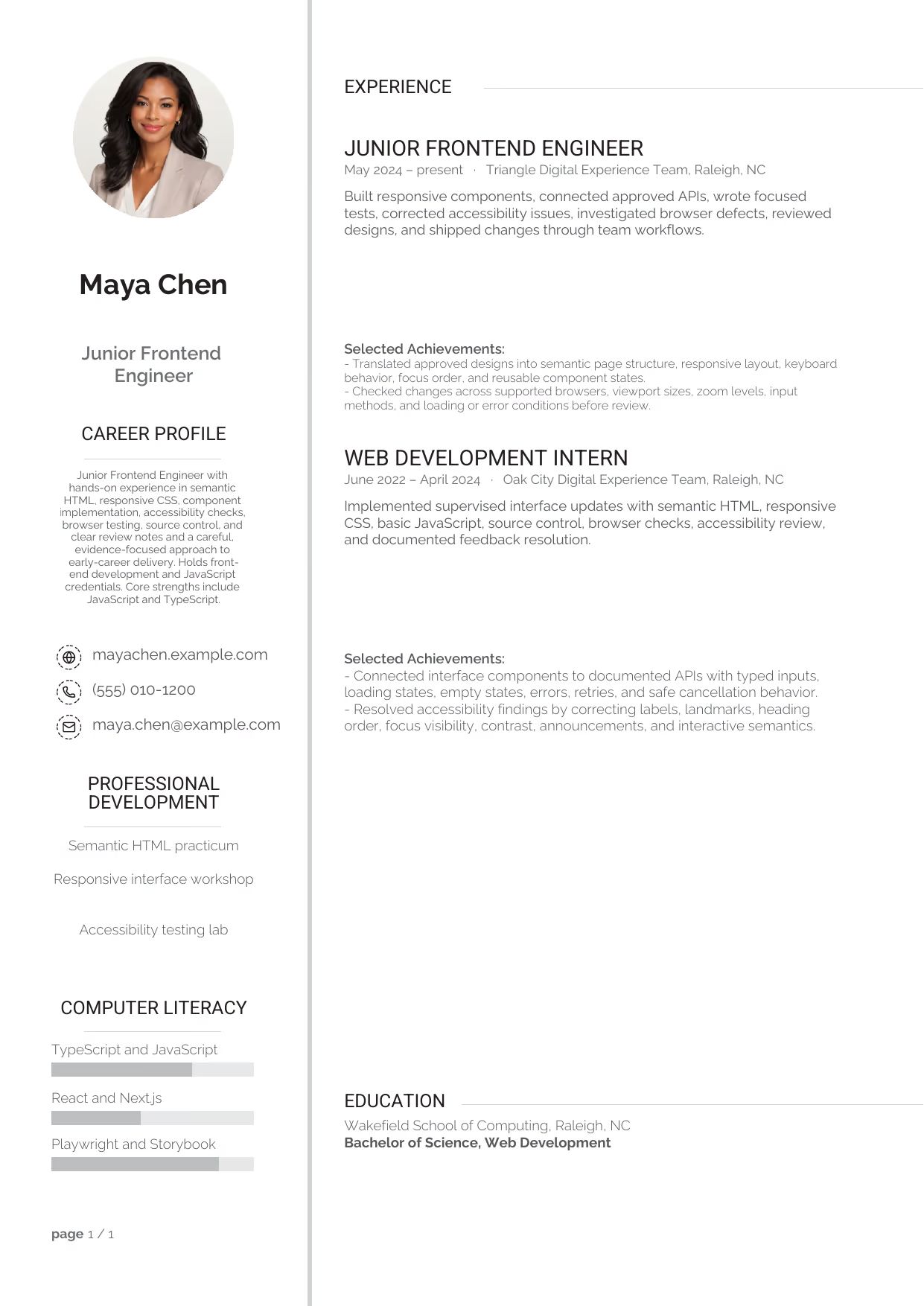
Junior Frontend Engineer
A builder-ready entry-level Frontend Engineer example in the Synnove template, showing stage-appropriate evidence in a focused, editable resume format.
- Editable role positioning in the Synnove layout
- Role-specific evidence and delivery context
- Review the Synnove structure with a clean visual hierarchy
View this resume
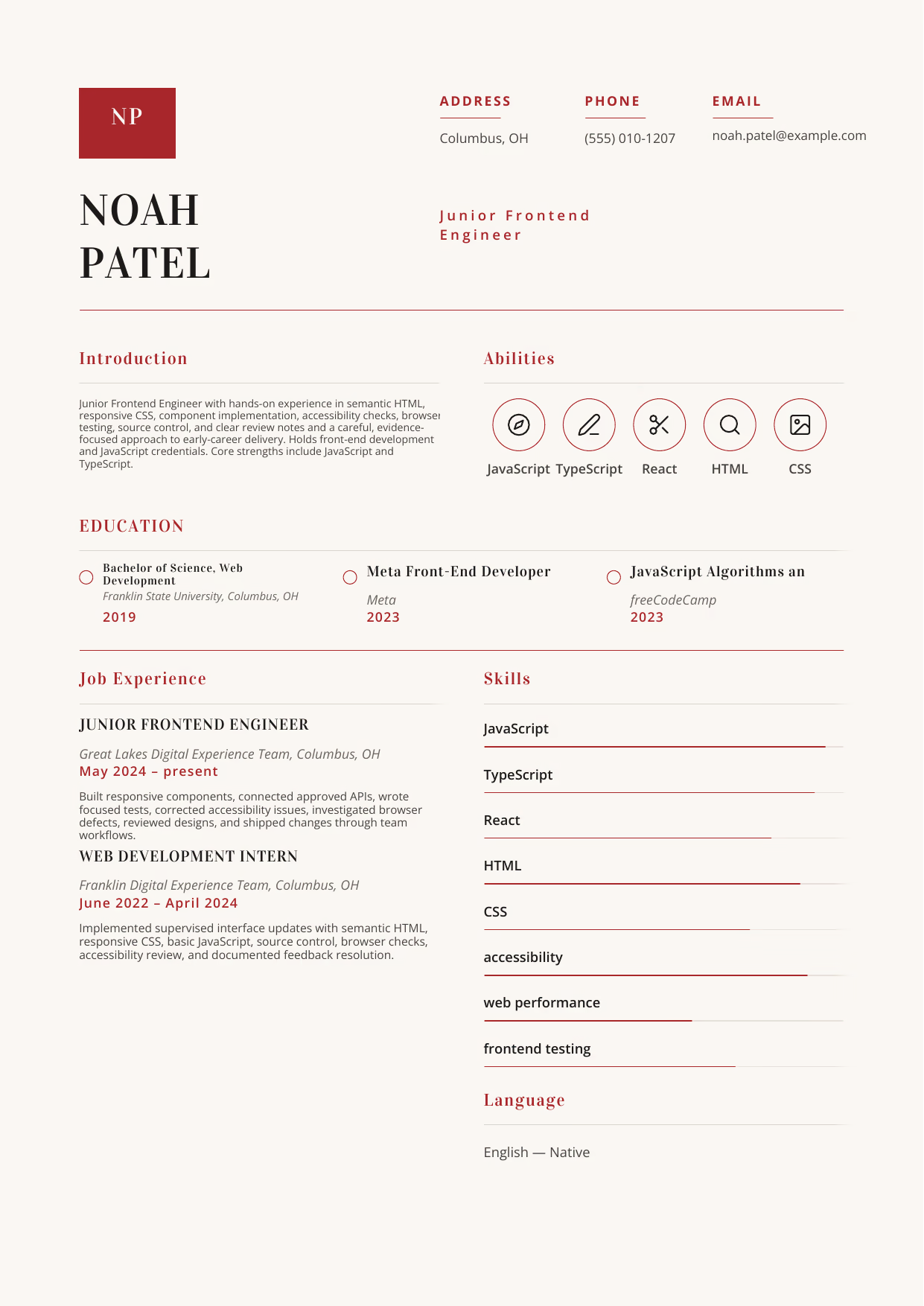
Junior Frontend Engineer
A builder-ready entry-level Frontend Engineer example in the Delphinus template, showing stage-appropriate evidence in a focused, editable resume format.
- Editable role positioning in the Delphinus layout
- Role-specific evidence and delivery context
- Review the Delphinus structure with a clean visual hierarchy
View this resume

Junior Frontend Engineer
A builder-ready entry-level Frontend Engineer example in the Hydra template, showing stage-appropriate evidence in a focused, editable resume format.
- Editable role positioning in the Hydra layout
- Role-specific evidence and delivery context
- Review the Hydra structure with a clean visual hierarchy
View this resume
Mid-Level Front End Engineer Resume (3-7 Years Experience)
Use these mid-level examples to compare the scope, evidence, and language expected for Frontend Engineer roles at this stage.
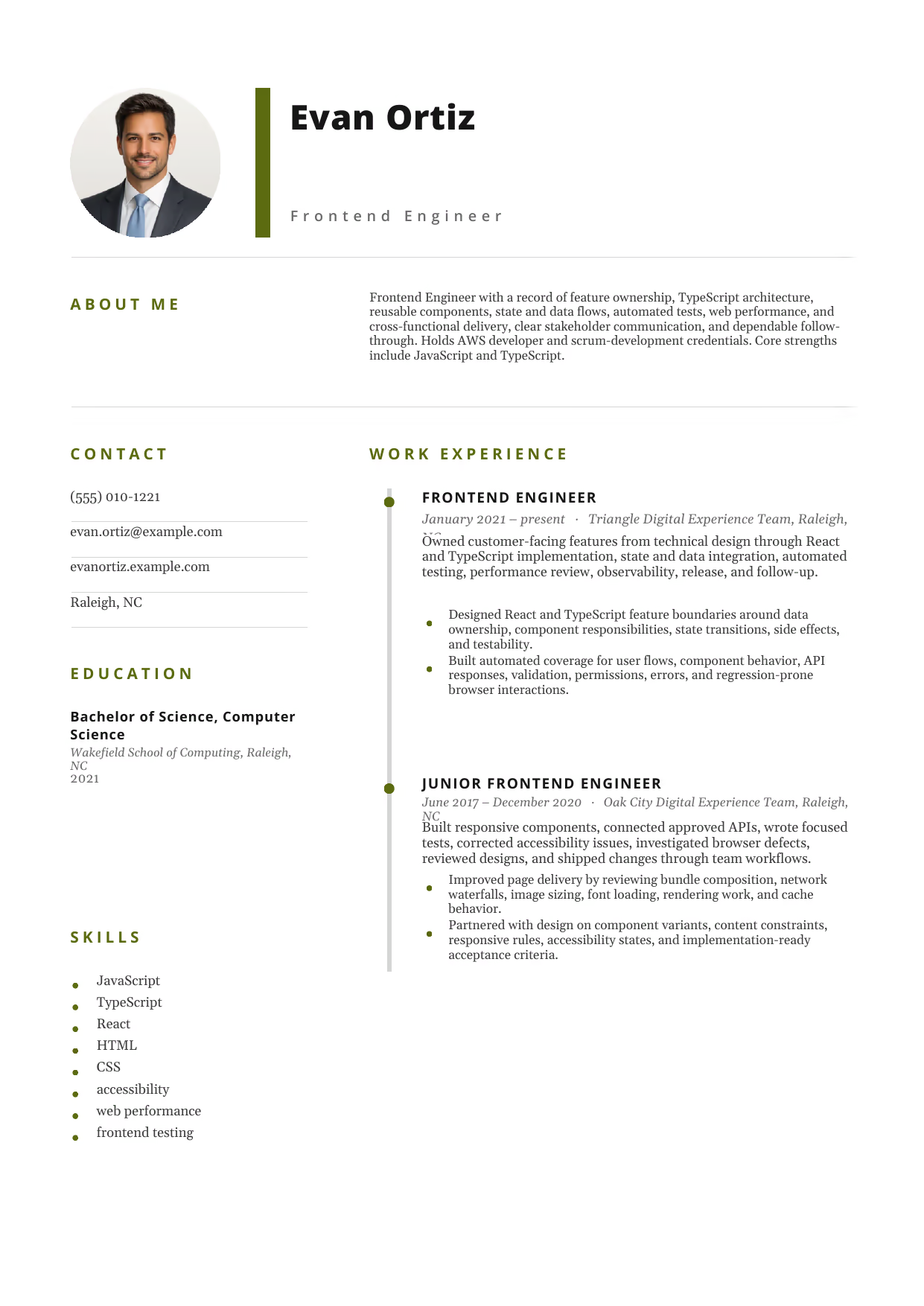
Frontend Engineer
A builder-ready mid-level Frontend Engineer example in the Pegasus template, showing stage-appropriate evidence in a focused, editable resume format.
- Editable role positioning in the Pegasus layout
- Role-specific evidence and delivery context
- Review the Pegasus structure with a clean visual hierarchy
View this resume

Frontend Engineer
A builder-ready mid-level Frontend Engineer example in the Achernar template, showing stage-appropriate evidence in a focused, editable resume format.
- Editable role positioning in the Achernar layout
- Role-specific evidence and delivery context
- Review the Achernar structure with a clean visual hierarchy
View this resume
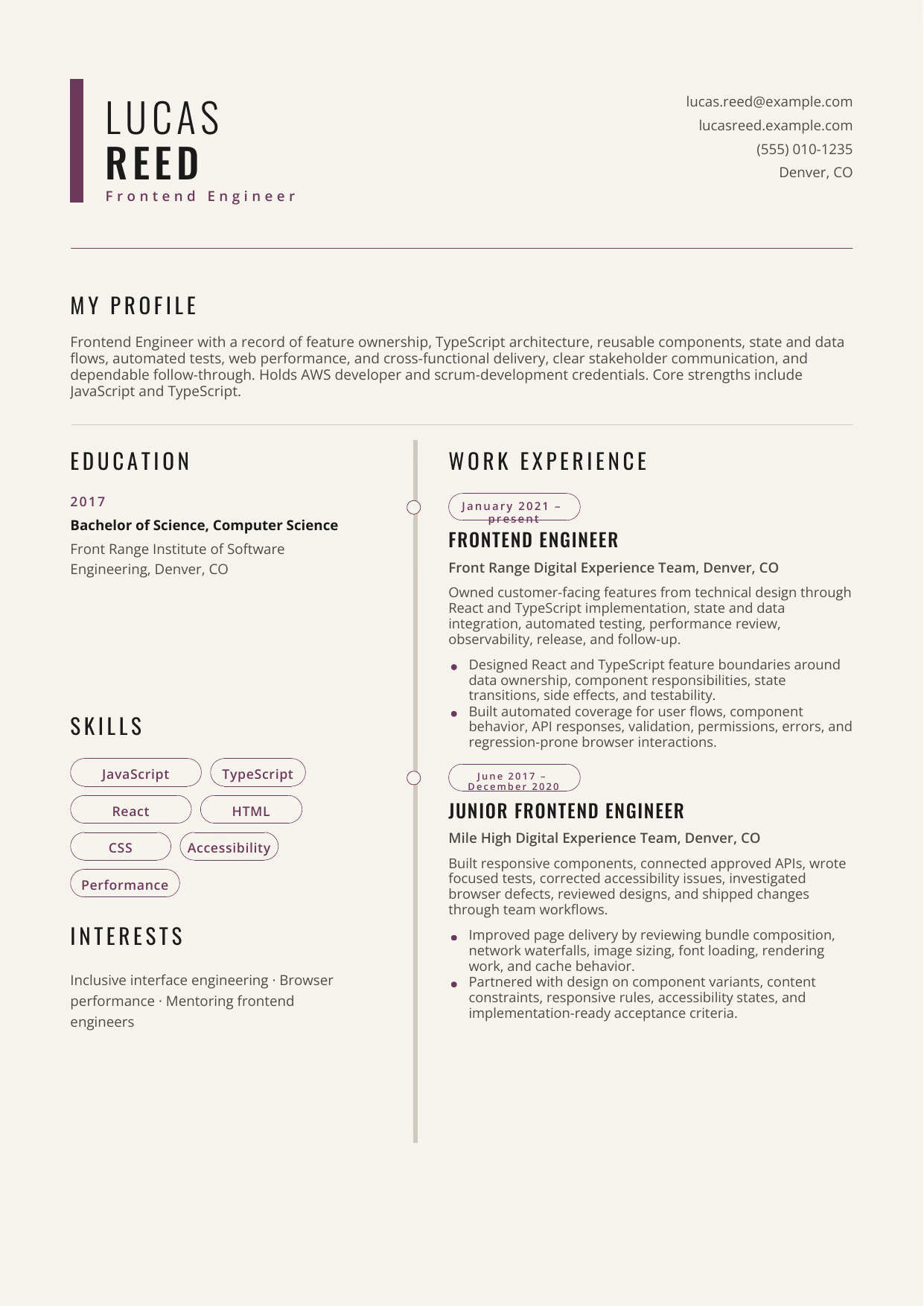
Frontend Engineer
A builder-ready mid-level Frontend Engineer example in the Caelum template, showing stage-appropriate evidence in a focused, editable resume format.
- Editable role positioning in the Caelum layout
- Role-specific evidence and delivery context
- Review the Caelum structure with a clean visual hierarchy
View this resume
Senior Front End Engineer Resume (8+ Years / Management)
Use these advanced examples to compare the scope, evidence, and language expected for Frontend Engineer roles at this stage.
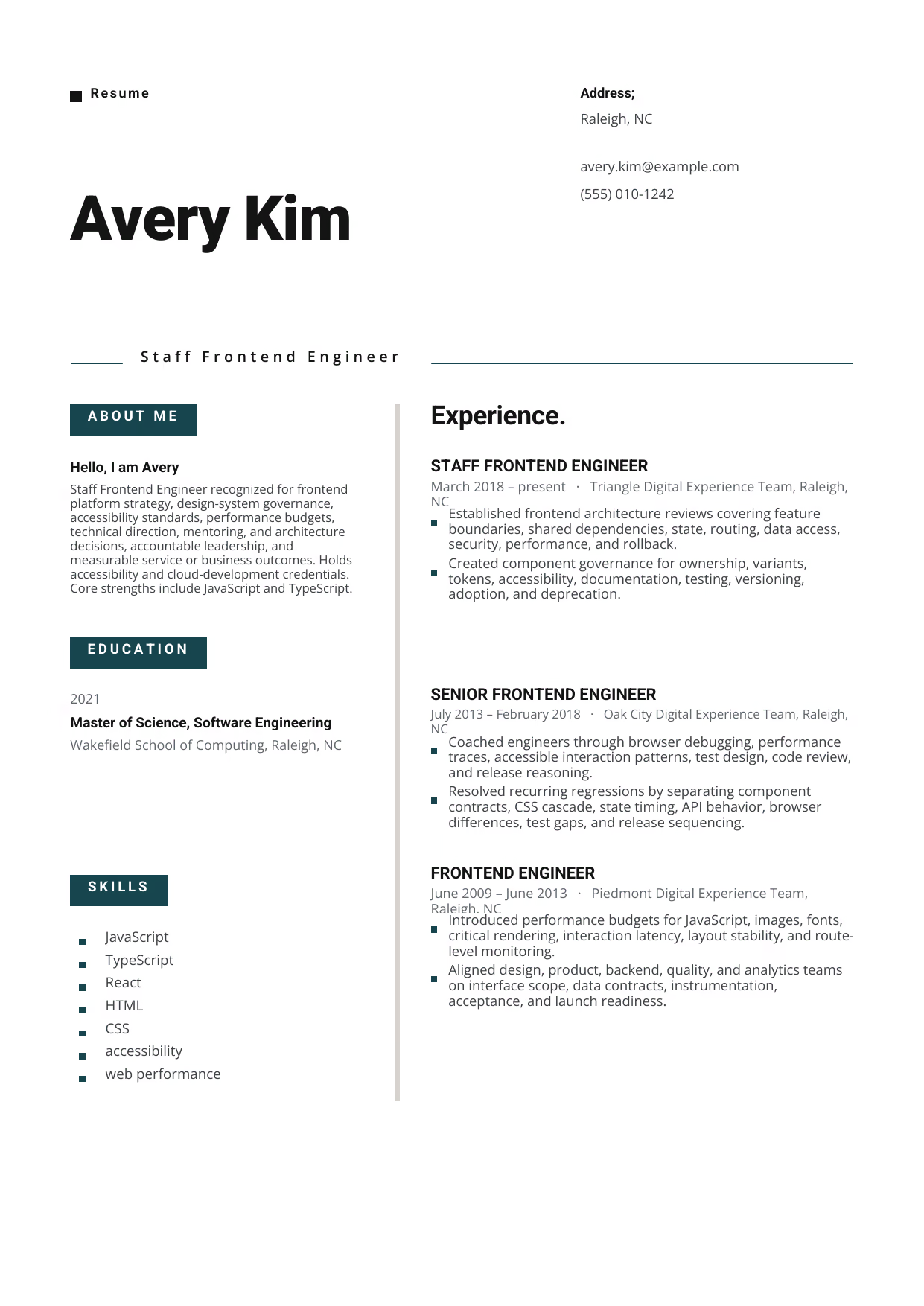
Staff Frontend Engineer
A builder-ready advanced Frontend Engineer example in the Indus template, showing stage-appropriate evidence in a focused, editable resume format.
- Editable role positioning in the Indus layout
- Role-specific evidence and delivery context
- Review the Indus structure with a clean visual hierarchy
View this resume

Staff Frontend Engineer
A builder-ready advanced Frontend Engineer example in the Draco template, showing stage-appropriate evidence in a focused, editable resume format.
- Editable role positioning in the Draco layout
- Role-specific evidence and delivery context
- Review the Draco structure with a clean visual hierarchy
View this resume
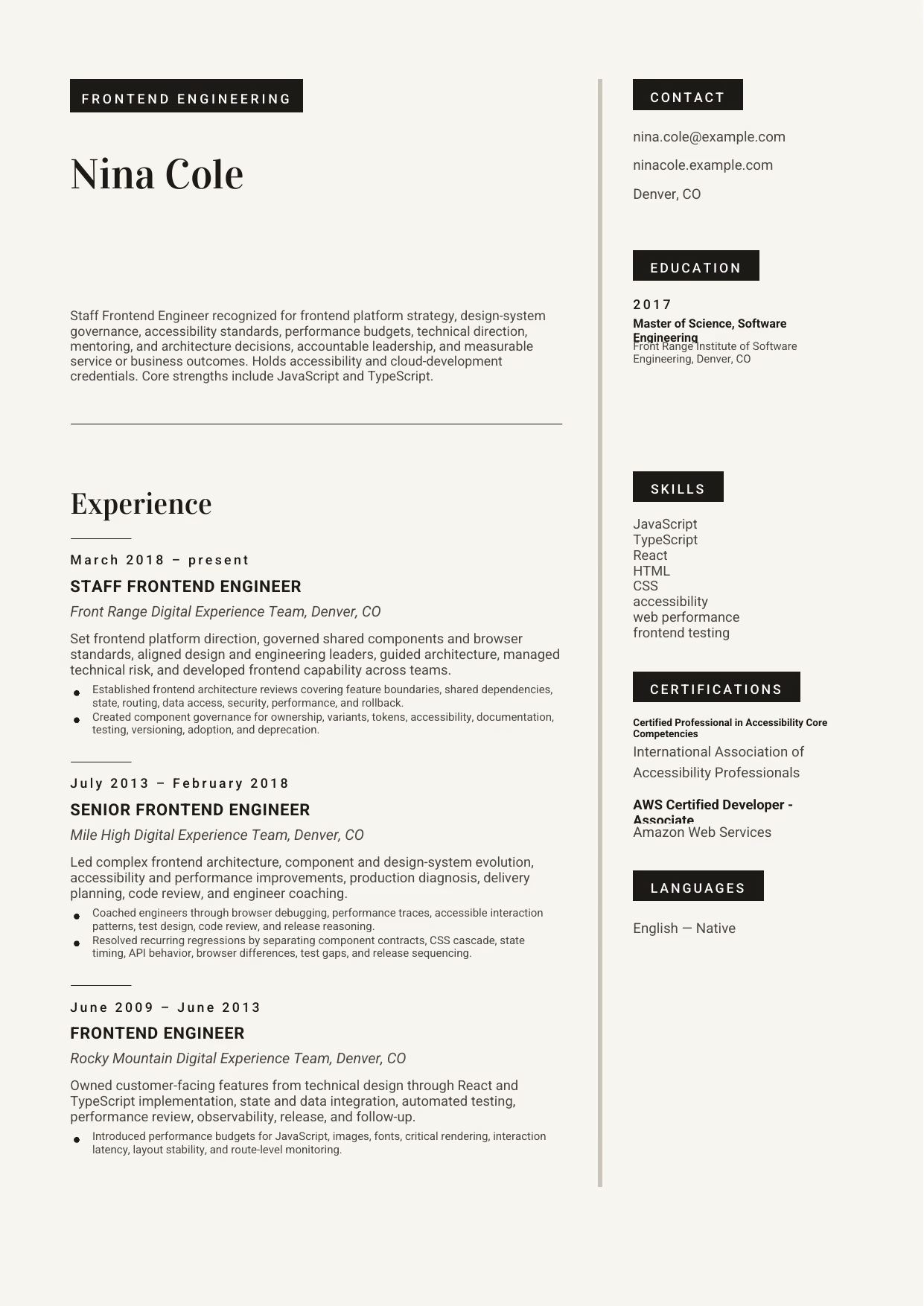
Staff Frontend Engineer
A builder-ready advanced Frontend Engineer example in the Aquila template, showing stage-appropriate evidence in a focused, editable resume format.
- Editable role positioning in the Aquila layout
- Role-specific evidence and delivery context
- Review the Aquila structure with a clean visual hierarchy
View this resume
Frontend Engineer Resume Examples by Specialty
Choose the Frontend Engineer path closest to the job you want. Each guide highlights the work, preparation, and evidence hiring teams expect for that specialty.
Front End Web Developer Resume Examples
- Resume focus:
- semantic interfaces, responsive layouts, browser behavior, and maintainable web delivery;
- Credentials:
- front-end, JavaScript, accessibility, or web-platform training;
- Evidence to include:
- pages, components, browsers, accessibility checks, tests, and release outcomes;
Web Developer Resume Examples
- Resume focus:
- web features spanning interface, data integration, testing, deployment, and maintenance;
- Credentials:
- web-development, cloud, platform, or framework credentials;
- Evidence to include:
- application scope, technologies, integrations, quality, deployment, and support;
UI Developer Resume Examples
- Resume focus:
- design fidelity, reusable interface patterns, accessibility, motion, and visual quality;
- Credentials:
- interface, design-system, accessibility, or framework training;
- Evidence to include:
- component states, responsive rules, accessibility, design partnership, and consistency;
Junior Web Developer Resume Examples
- Resume focus:
- supervised implementation, bug fixes, source control, browser testing, and learning velocity;
- Credentials:
- foundational web, JavaScript, HTML, CSS, or testing coursework;
- Evidence to include:
- assigned scope, implementation, review feedback, tests, and shipped corrections;
Frontend Engineer Licenses and Certifications
List only current education, licenses, or certifications that apply to the target role. Give the credential name and issuing organization, and leave private identifier numbers off a public resume.
Frontend and cloud credentials
- Current JavaScript, frontend, cloud-developer, or framework credential;
- Issuer, level, and completion status relevant to the target stack;
Accessibility and quality
- Accessibility, testing, performance, or secure-development training;
- Only credentials supported by completed coursework or assessment;
Frontend Engineer Skills and ATS Keywords by Category
Use language that truthfully matches your Frontend Engineer experience and the job posting. Pair important terms with a work example instead of presenting an unsupported keyword list.
Skills by category
Interface engineering
- JavaScript, TypeScript, React, semantic HTML, and responsive CSS;
- Component architecture, state, data integration, routing, and browser APIs;
Quality and delivery
- Accessibility, automated testing, web performance, and observability;
- Design-system collaboration, code review, release readiness, and production diagnosis;
ATS keywords by category
Technical keywords
- JavaScript, TypeScript, React, HTML, CSS;
- Responsive design, APIs, state management, component architecture;
Quality keywords
- Accessibility, frontend testing, web performance, browser compatibility;
- Design systems, Core Web Vitals, observability, progressive enhancement;
How to Write a Frontend Engineer Resume
The Resume Summary
The resume summary is your first chance to make a strong impression. It should be concise and highlight your key skills and experience. Use the following formula:
[Years of Experience] + [Job Title] + [Key Skills] + [Key Achievement] + [Career Goal]
Entry-Level Example: Recent Computer Science graduate seeking an Entry-Level Frontend Engineer position. Eager to apply strong foundation in web development principles and contribute to innovative projects.
Mid-Level Example: Highly motivated and experienced Frontend Engineer with 5+ years of experience in developing and maintaining responsive web applications. Proven ability to improve website performance and user experience.
Senior Example: Highly accomplished and results-oriented Senior Frontend Engineer with 10+ years of experience leading and managing high-performing development teams. Proven ability to drive innovation and deliver exceptional user experiences.
Work Experience & Action Verbs
Focus on achievements rather than just listing duties. Use action verbs to start each bullet point and quantify your accomplishments whenever possible.
Here are some examples:
- Before: Responsible for developing web applications.
- After: Developed and maintained responsive web applications using React, Angular, and JavaScript.
- Before: Assisted in improving website performance.
- After: Increased website performance by 30% through code optimization and efficient resource management.
- Before: Worked with designers and back-end developers.
- After: Collaborated with designers and back-end developers to deliver high-quality user interfaces.
- Before: Implemented testing strategies.
- After: Implemented A/B testing to optimize user experience and improve conversion rates by 15%.
- Before: Provided guidance to junior developers.
- After: Mentored junior developers and provided technical guidance on best practices.
Top Skills for Frontend Engineers
Here are some top skills to include on your Frontend Engineer resume:
Hard Skills:
- JavaScript
- HTML
- CSS
- React
- Angular
- Vue.js
- Node.js
Soft Skills:
- Problem-solving
- Communication
- Teamwork
- Leadership
- Time Management
Tools/Software:
- Git
- Webpack
- Babel
- Jest
- Docker
- Kubernetes
Education & Certifications
List your education in reverse chronological order. If you have limited experience, include relevant coursework. For senior roles, highlight any relevant certifications.
Here are some recommended certifications for Frontend Engineers:
- Certified Front End Architect
- AWS Certified Developer
- Microsoft Certified Azure Developer
10 Common Frontend Engineer Resume Mistakes
- Misspelling Core Industry Terminology: Typos in general are bad, but misspelling critical tools or certifications (like ‘JavaScript’, ‘React’, or ‘CSS’) acts as an immediate red flag regarding your attention to detail. Recruiters will assume a lack of expertise if you can’t spell the basics. Double-check everything.
- Listing Duties Instead of Impact: Recruiters know what a Frontend Engineer does; they want to know how well you did it. Replace passive phrases like ‘Responsible for front-end development’ with quantified wins like ‘Improved website loading speed by 20% through optimized code’.
- Ignoring the Job Description: Sending a generic resume is a surefire way to get rejected. Applicant Tracking Systems (ATS) scan for specific keywords. Tailor your resume to match the exact requirements and skills listed in each job description to increase your chances of getting an interview.
- Neglecting the Summary Statement: The summary is your elevator pitch. A weak or missing summary fails to immediately grab the recruiter’s attention. Craft a compelling summary that highlights your key skills, experience, and career goals to entice them to read further.
- Poor Formatting and Readability: A cluttered and poorly formatted resume is difficult to read and makes you appear unprofessional. Use clear headings, bullet points, and white space to create a visually appealing and easy-to-scan document. Choose a professional font and maintain consistency throughout.
- Lack of Measurable Results: Quantifiable achievements demonstrate your impact and value. Instead of saying ‘Improved user experience,’ say ‘Improved user experience, resulting in a 15% increase in conversion rates’. Use metrics to showcase your accomplishments.
- Omitting Relevant Skills: Failing to include essential skills for a Frontend Engineer role will make you appear unqualified. Include both hard skills (e.g., JavaScript, React) and soft skills (e.g., communication, problem-solving) that are relevant to the job description.
- Not Optimizing for ATS: Many companies use Applicant Tracking Systems (ATS) to filter resumes. Use keywords from the job description and avoid using graphics or complex formatting that can confuse the ATS. Submit your resume in a format that is easily readable by the ATS (e.g., .docx or .pdf).
- Inconsistent Tense and Grammar: Inconsistent tense and grammatical errors make you appear careless and unprofessional. Proofread your resume carefully and ensure that all verbs are in the correct tense and that there are no spelling or grammatical errors.
- Generic Action Verbs: Using weak and generic action verbs like ‘Worked on’ or ‘Assisted with’ fails to highlight your accomplishments. Use strong and specific action verbs like ‘Developed’, ‘Implemented’, or ‘Managed’ to showcase your skills and experience more effectively.
Frequently Asked Questions (Frontend Engineer)
- What should a Frontend Engineer resume emphasize first? Lead with the scope of semantic HTML, responsive CSS, component implementation, accessibility checks, browser testing, source control, and clear review notes, then connect your contribution to a clear outcome, tool, or decision.
- Which skills deserve priority on a Frontend Engineer resume? Prioritize JavaScript, TypeScript, and React when they match the role and can be supported by evidence.
- How can a Frontend Engineer show project scope and impact? Name the environment, scale, constraints, and result; feature ownership, TypeScript architecture, reusable components, state and data flows, automated tests, web performance, and cross-functional delivery becomes more credible when the context is concrete.
- How should a Frontend Engineer describe tools and technical decisions? Describe why you selected a method, how you implemented it, and what changed afterward in the Frontend Engineer role.
- Which achievements matter most for a Frontend Engineer application? Use outcome-led bullets that show frontend platform strategy, design-system governance, accessibility standards, performance budgets, technical direction, mentoring, and architecture decisions through delivery quality, measurable scope, or stakeholder value.
- How long should a Frontend Engineer resume be? Use the shortest length that proves fit; a focused page can work early-career, while broader Frontend Engineer scope may need more room.
- How can a Frontend Engineer explain progression between career stages? Group examples by increasing ownership, moving from semantic HTML, responsive CSS, component implementation, accessibility checks, browser testing, source control, and clear review notes toward frontend platform strategy, design-system governance, accessibility standards, performance budgets, technical direction, mentoring, and architecture decisions as responsibility grows.
- Which keywords should a Frontend Engineer include for screening systems? Mirror truthful language from the posting, especially HTML, without stuffing unrelated terms.
- How should a Frontend Engineer present reliability, quality, or safety work? Show how you protected outcomes through CSS and explain the evidence a hiring team can verify.
- What format makes a Frontend Engineer resume easy for hiring teams to scan? Use clear headings, readable bullets, and consistent dates so a hiring manager can evaluate Frontend Engineer fit quickly.
Crafting a compelling Frontend Engineer resume requires careful attention to detail and a strategic approach. By following the tips and examples in this guide, you can create a resume that stands out from the competition and lands you more interviews.
Ready to take the next step? Search more Frontend Engineer resources on our site to find templates and additional advice!
RockStarCV Editorial Team