Cloud Engineer Resume Guide
Landing a Cloud Engineer role can be tough. Applicant Tracking Systems (ATS) filter out countless resumes, and you’re facing fierce competition. But don’t worry! This guide provides Cloud Engineer resume examples for every experience level, from entry-level to senior management, to help you stand out.
- Quantify Achievements: Use numbers to showcase the impact of your work.
- Highlight Relevant Skills: Focus on skills like cloud navigation, software proficiency, and problem-solving.
- Tailor to Job Description: Customize your resume to match the specific requirements of each job.
- Optimize for ATS: Use keywords from the job description and a clean, ATS-friendly format.
- Use Action Verbs: Start each bullet point with a strong action verb to describe your accomplishments.
- Showcase Certifications: Prominently display relevant cloud certifications.
Let’s dive into some Cloud Engineer resume examples to give you a better idea.
Explore editable Cloud Engineer resume examples by career stage. Each sample opens in the RockStarCV builder so you can study the structure and make your own version.
Entry-Level Cloud Engineer Resume (0-2 Years Experience)
Use these entry-level examples to compare the scope, evidence, and language expected for Cloud Engineer roles at this stage.
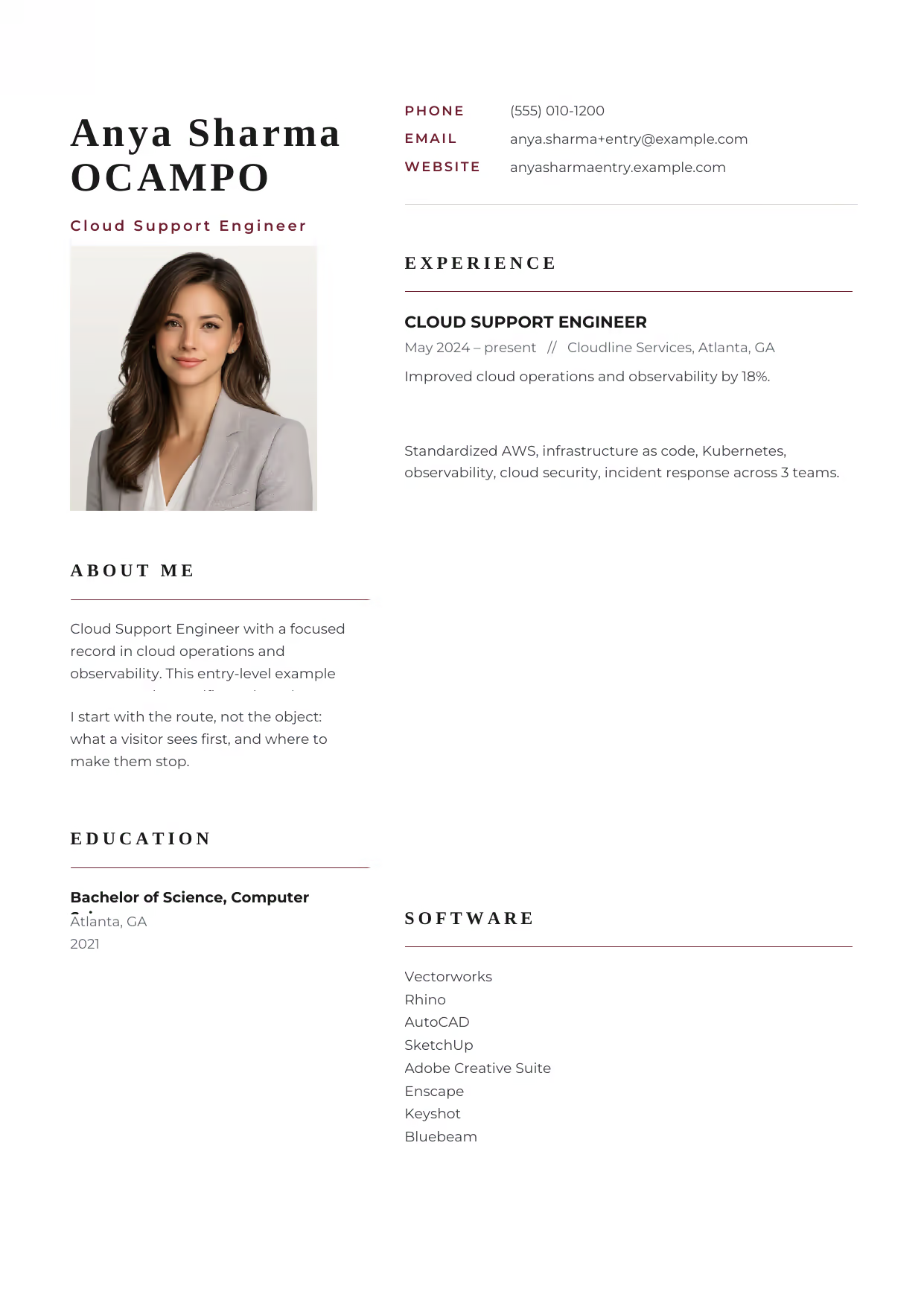
Cloud Support Engineer
A builder-ready entry-level Cloud Engineer example in the Hydra template, showing stage-appropriate evidence in a focused, editable resume format.
- Editable role positioning in the Hydra layout
- Role-specific evidence and delivery context
- Review the Hydra structure with a clean visual hierarchy
View this resume

Cloud Support Engineer
A builder-ready entry-level Cloud Engineer example in the Acamar template, showing stage-appropriate evidence in a focused, editable resume format.
- Editable role positioning in the Acamar layout
- Role-specific evidence and delivery context
- Review the Acamar structure with a clean visual hierarchy
View this resume
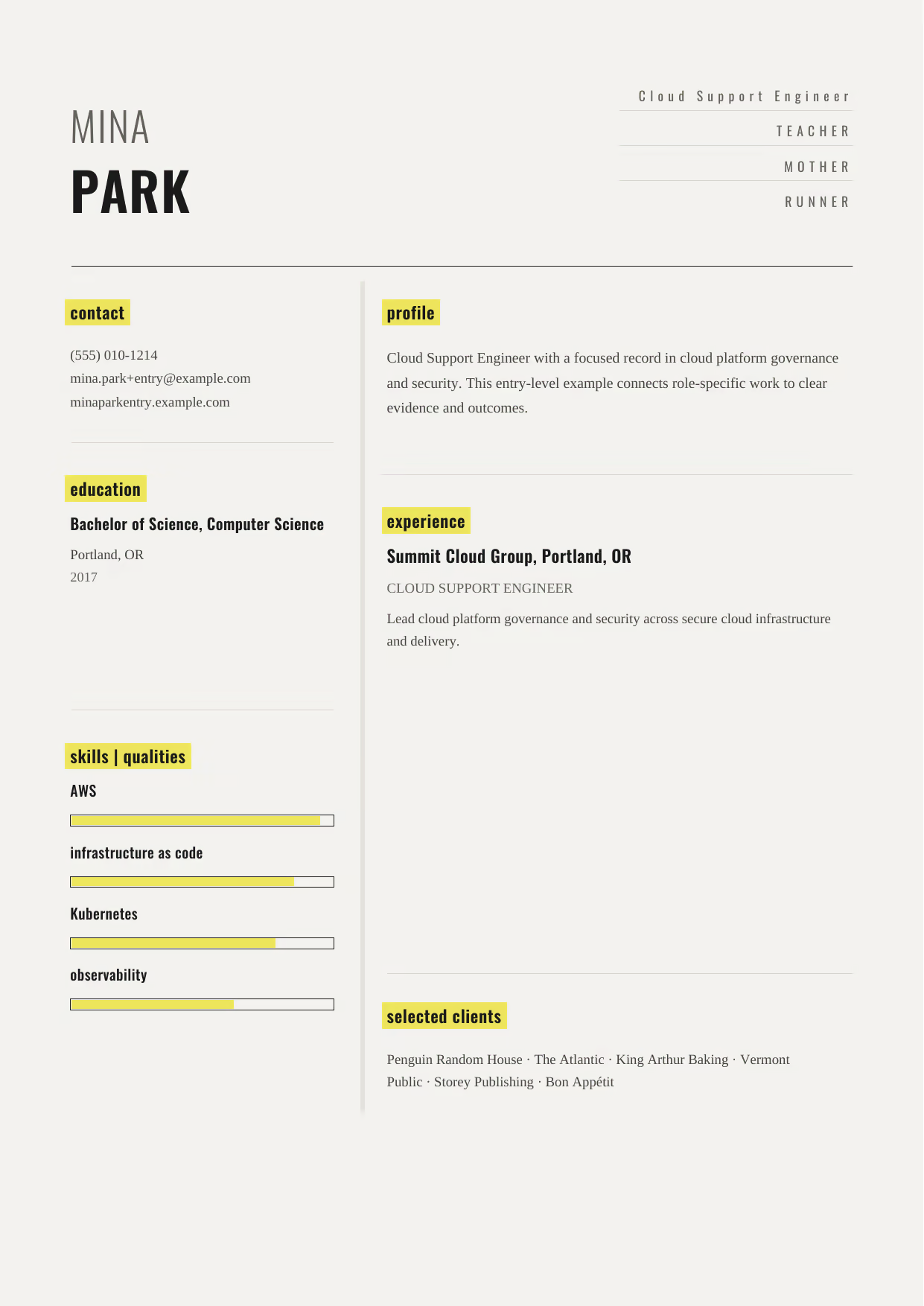
Cloud Support Engineer
A builder-ready entry-level Cloud Engineer example in the Dorado template, showing stage-appropriate evidence in a focused, editable resume format.
- Editable role positioning in the Dorado layout
- Role-specific evidence and delivery context
- Review the Dorado structure with a clean visual hierarchy
View this resume
Mid-Level Cloud Engineer Resume (3-7 Years Experience)
Use these mid-level examples to compare the scope, evidence, and language expected for Cloud Engineer roles at this stage.
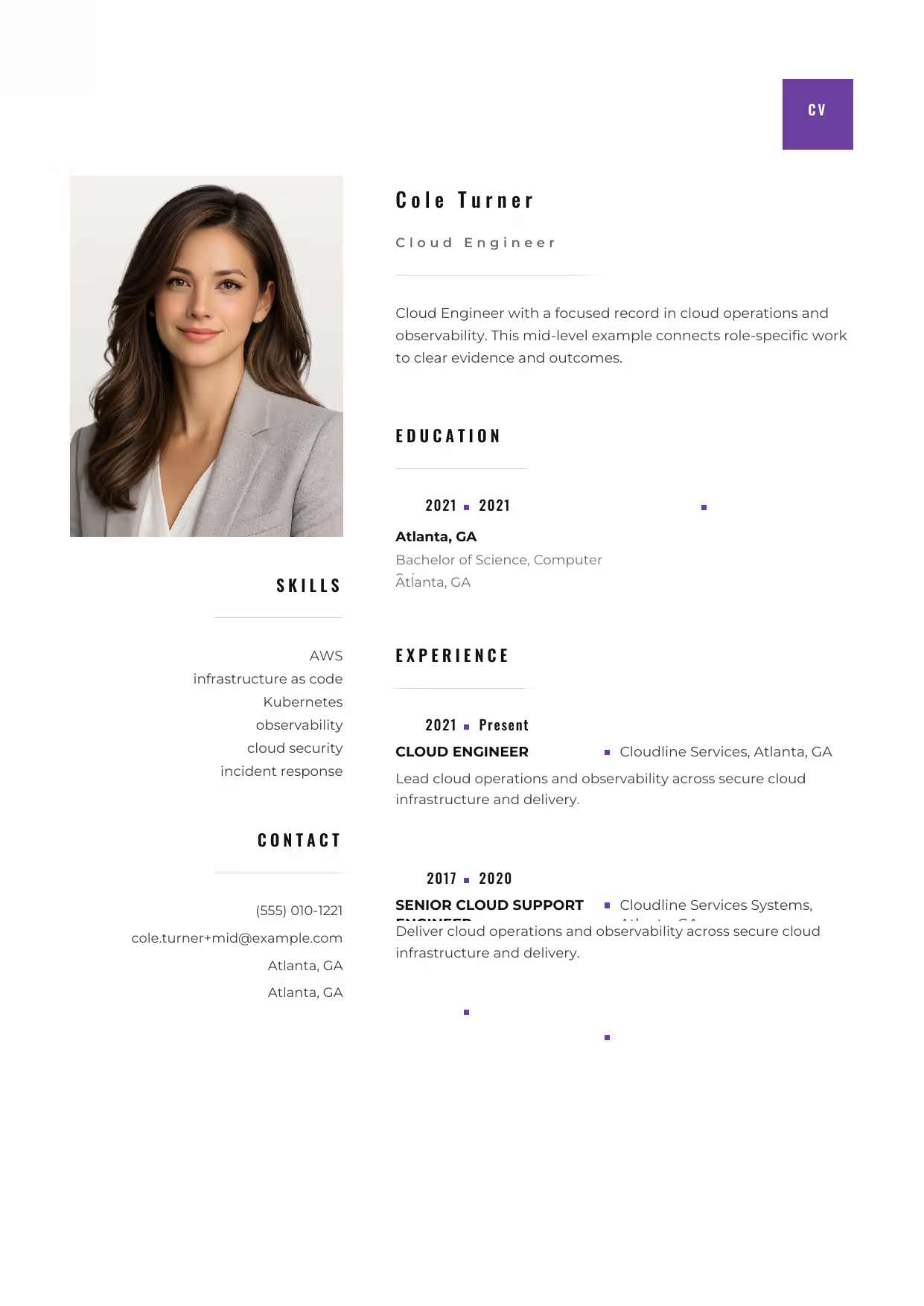
Cloud Engineer
A builder-ready mid-level Cloud Engineer example in the Pyxis template, showing stage-appropriate evidence in a focused, editable resume format.
- Editable role positioning in the Pyxis layout
- Role-specific evidence and delivery context
- Review the Pyxis structure with a clean visual hierarchy
View this resume
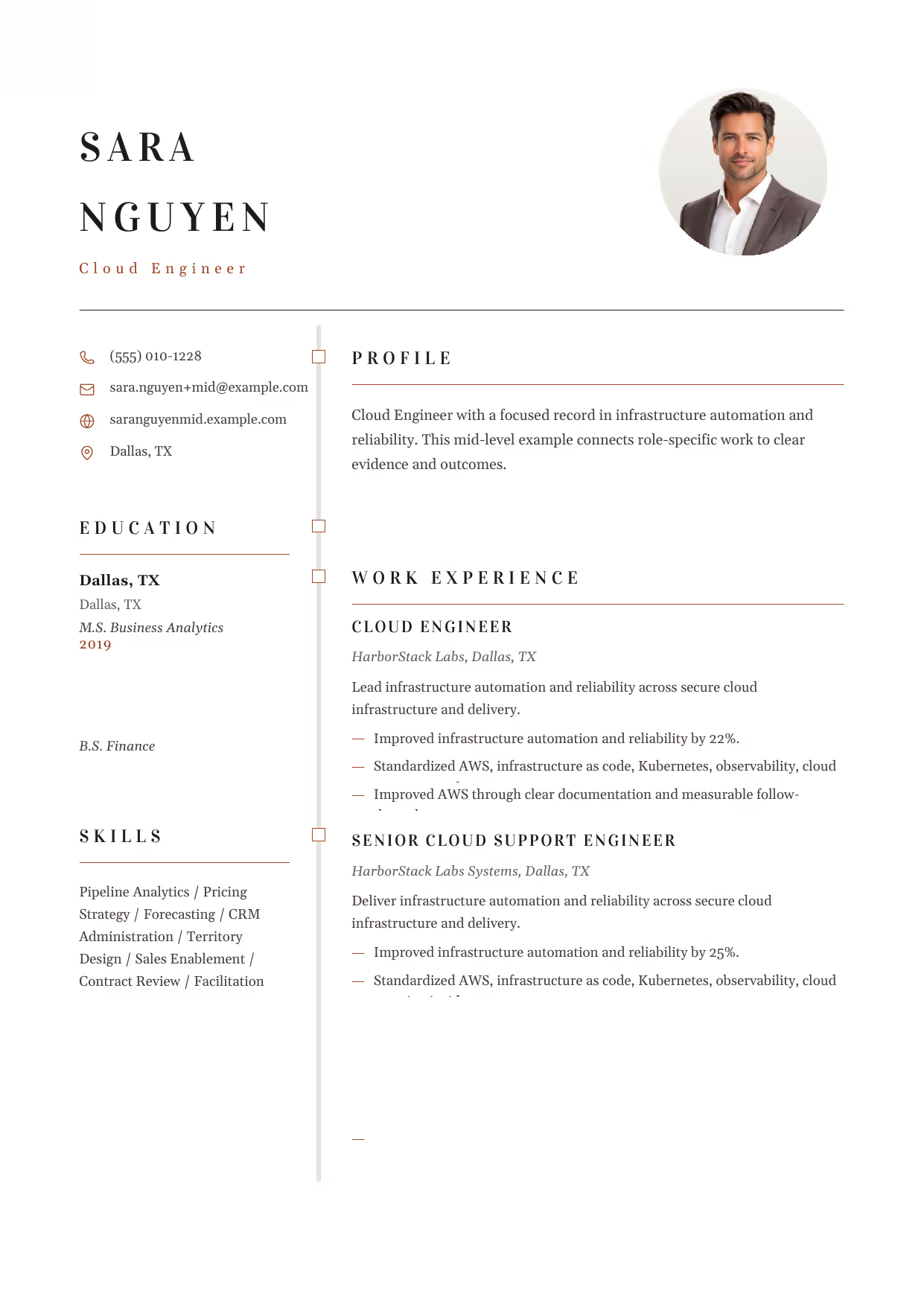
Cloud Engineer
A builder-ready mid-level Cloud Engineer example in the Draco template, showing stage-appropriate evidence in a focused, editable resume format.
- Editable role positioning in the Draco layout
- Role-specific evidence and delivery context
- Review the Draco structure with a clean visual hierarchy
View this resume

Cloud Engineer
A builder-ready mid-level Cloud Engineer example in the Cetus template, showing stage-appropriate evidence in a focused, editable resume format.
- Editable role positioning in the Cetus layout
- Role-specific evidence and delivery context
- Review the Cetus structure with a clean visual hierarchy
View this resume
Senior Cloud Engineer Resume (8+ Years / Management)
Use these advanced examples to compare the scope, evidence, and language expected for Cloud Engineer roles at this stage.

Senior Cloud Engineer
A builder-ready advanced Cloud Engineer example in the Achernar template, showing stage-appropriate evidence in a focused, editable resume format.
- Editable role positioning in the Achernar layout
- Role-specific evidence and delivery context
- Review the Achernar structure with a clean visual hierarchy
View this resume

Senior Cloud Engineer
A builder-ready advanced Cloud Engineer example in the Eridanus template, showing stage-appropriate evidence in a focused, editable resume format.
- Editable role positioning in the Eridanus layout
- Role-specific evidence and delivery context
- Review the Eridanus structure with a clean visual hierarchy
View this resume
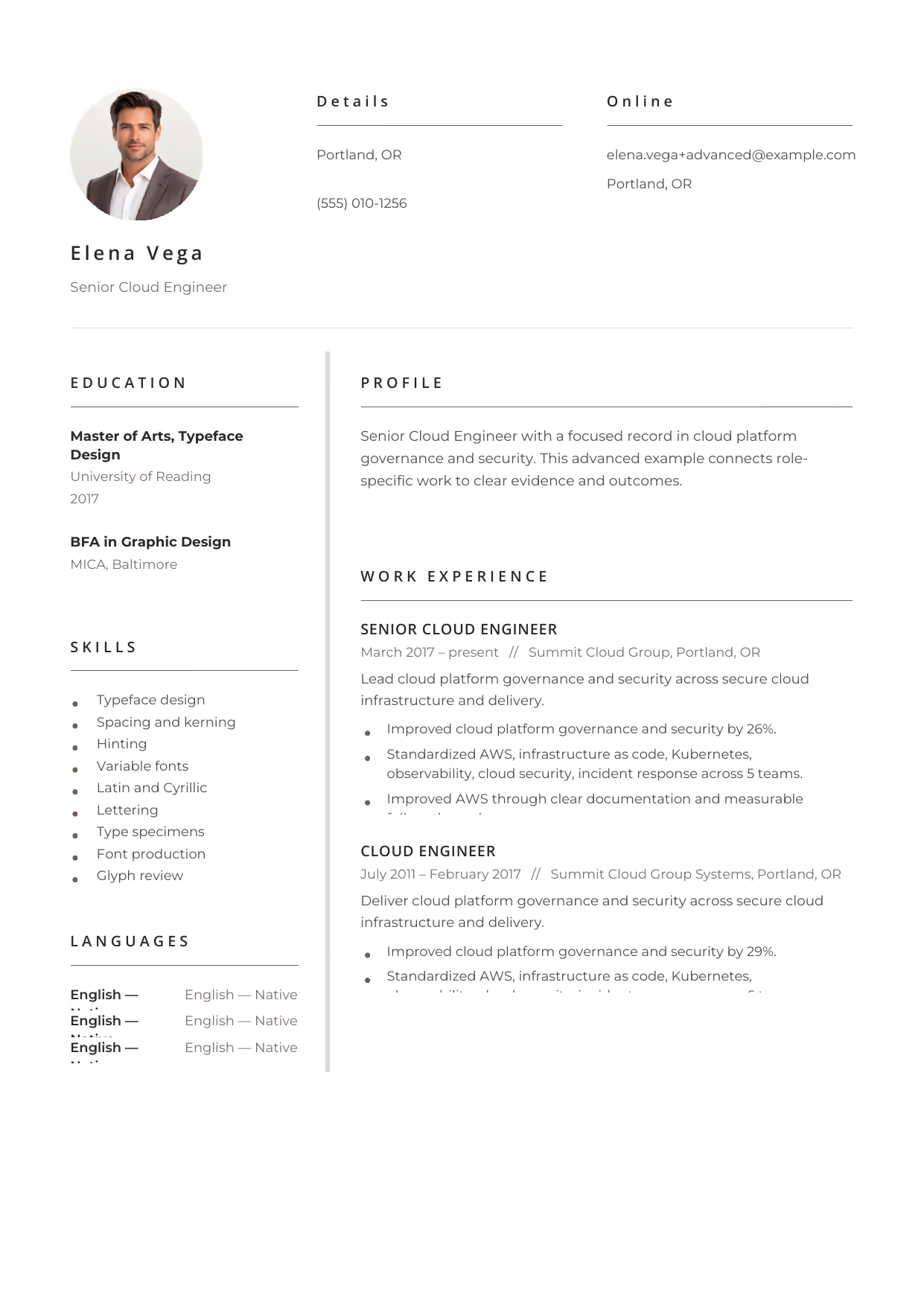
Senior Cloud Engineer
A builder-ready advanced Cloud Engineer example in the Pictor template, showing stage-appropriate evidence in a focused, editable resume format.
- Editable role positioning in the Pictor layout
- Role-specific evidence and delivery context
- Review the Pictor structure with a clean visual hierarchy
View this resume
How to Write a Cloud Engineer Resume
The Resume Summary
The resume summary is your chance to make a strong first impression. It should highlight your key skills, experience, and career goals.
Formula: [Years of Experience] + [Job Title] + [Key Skills] + [Quantifiable Achievement] + [Career Goal]
Entry-Level Example: Enthusiastic Computer Science graduate seeking an entry-level Cloud Engineer position to apply academic knowledge and contribute to innovative cloud solutions.
Mid-Level Example: Results-oriented Cloud Engineer with 5+ years of experience designing and managing cloud infrastructure, seeking to leverage expertise in AWS and Terraform to optimize cloud resources.
Senior Example: Highly accomplished Senior Cloud Engineer with 10+ years of experience leading cloud initiatives and managing high-performing teams, seeking to drive innovation and achieve strategic business goals.
Work Experience & Action Verbs
The work experience section is where you showcase your accomplishments and demonstrate your value to potential employers. Focus on achievements rather than just listing duties. Use strong action verbs to describe your responsibilities and quantify your results whenever possible.
- Before: Responsible for managing cloud infrastructure. After: Managed cloud infrastructure, ensuring 99.99% uptime and reducing downtime by 15%.
- Before: Assisted with cloud migrations. After: Led cloud migrations, migrating 50+ applications to AWS and reducing migration time by 20%.
- Before: Worked on security implementation. After: Implemented security best practices, reducing security incidents by 30%.
- Before: Deployed applications on cloud. After: Automated application deployments on AWS using Terraform, reducing deployment time by 40%.
- Before: Monitored cloud performance. After: Monitored cloud performance using CloudWatch, identifying and resolving performance bottlenecks, resulting in a 10% improvement in application performance.
Top Skills for Cloud Engineers
Here are some of the top skills that Cloud Engineers should highlight on their resumes:
Hard Skills
- Cloud Computing
- Infrastructure as Code
- Automation
- Security
- Networking
Soft Skills
- Problem-solving
- Communication
- Teamwork
- Leadership
- Critical Thinking
Tools/Software
- AWS (Amazon Web Services)
- Azure (Microsoft Azure)
- Google Cloud Platform (GCP)
- Terraform
- Docker
- Kubernetes
Education & Certifications
List your education and certifications in reverse chronological order. For entry-level candidates, highlight relevant coursework and academic projects. For mid-level and senior candidates, focus on certifications and advanced degrees.
Recommended Certifications:
- AWS Certified Solutions Architect – Associate
- AWS Certified Solutions Architect – Professional
- Microsoft Certified: Azure Solutions Architect Expert
- Google Cloud Certified Professional Cloud Architect
10 Common Cloud Engineer Resume Mistakes
- Lack of Quantifiable Achievements: Recruiters want to see the impact of your work. Instead of saying “Managed cloud infrastructure,” say “Managed cloud infrastructure, ensuring 99.99% uptime and reducing downtime by 15%.” This concrete data proves your abilities.
- Ignoring ATS Optimization: Applicant Tracking Systems (ATS) scan resumes for specific keywords. Failing to optimize your resume for ATS can result in it being automatically rejected. Use keywords from the job description and ensure your resume is formatted in a clean, ATS-friendly format.
- Generic Skill Lists: Simply listing skills without providing context is not effective. Instead of just saying “Cloud Computing,” provide specific examples of how you have used your cloud computing skills to solve problems or achieve results.
- Poorly Written Summary: The summary is your first impression. A poorly written summary can turn off recruiters immediately. Make sure your summary is concise, engaging, and highlights your key skills and experience.
- Typos and Grammatical Errors: Typos and grammatical errors can make you look unprofessional and careless. Proofread your resume carefully before submitting it. Use tools like Grammarly to help you catch errors.
- Not Tailoring to the Job Description: Sending the same generic resume to every job is a mistake. Tailor your resume to match the specific requirements of each job description. Highlight the skills and experience that are most relevant to the position.
- Omitting Relevant Projects: If you have worked on any relevant projects, be sure to include them on your resume. This is especially important for entry-level candidates who may not have a lot of professional experience. Describe the project, your role, and the results you achieved.
- Failing to Highlight Certifications: Cloud certifications are highly valued by employers. If you have any relevant certifications, be sure to highlight them prominently on your resume. List the certification name, the issuing organization, and the date you obtained the certification.
- Inconsistent Formatting: Inconsistent formatting can make your resume look unprofessional and disorganized. Use a consistent font, font size, and spacing throughout your resume. Use bullet points to organize your information and make it easy to read.
- Lack of Action Verbs: Using weak or passive verbs can make your accomplishments sound less impressive. Use strong action verbs to describe your responsibilities and quantify your results whenever possible. For example, instead of saying “Responsible for managing cloud infrastructure,” say “Managed cloud infrastructure, ensuring 99.99% uptime and reducing downtime by 15%.”
Frequently Asked Questions (Cloud Engineer)
- What should I include in my Cloud Engineer resume summary? Your summary should highlight your cloud infrastructure skills, experience, measurable achievements, and career goals.
- How do I tailor a Cloud Engineer resume to a specific job description? Review the job description carefully and identify the key skills and experience that the employer is looking for. Then, tailor your resume to highlight those skills and experience.
- What are the most important skills for a Cloud Engineer? The most important skills for a Cloud Engineer include cloud computing, infrastructure as code, automation, security, and networking.
- What certifications should I include on my Cloud Engineer resume? Recommended certifications include AWS Certified Solutions Architect – Associate, AWS Certified Solutions Architect – Professional, Microsoft Certified: Azure Solutions Architect Expert, and Google Cloud Certified Professional Cloud Architect.
- How do I quantify achievements on a Cloud Engineer resume? Use numbers to showcase the impact of your work. For example, instead of saying “Managed cloud infrastructure,” say “Managed cloud infrastructure, ensuring 99.99% uptime and reducing downtime by 15%.”
- Why is ATS optimization important for a Cloud Engineer resume? ATS optimization is the process of formatting your resume to be easily scanned by Applicant Tracking Systems (ATS). It is important because many employers use ATS to filter out resumes that do not meet their criteria.
- Should I include a cover letter with my Cloud Engineer resume? Yes, you should always include a cover letter with your resume. A cover letter gives you the opportunity to explain why you are interested in the position and why you are a good fit for the company.
- How long should my Cloud Engineer resume be? Keep it to no more than two pages, prioritizing relevant cloud infrastructure, automation, and security evidence.
- What font should I use for my Cloud Engineer resume? Use a professional and easy-to-read font, such as Arial, Calibri, or Times New Roman.
- Should I include my LinkedIn profile on my Cloud Engineer resume? Yes, you should include your LinkedIn profile on your resume. This gives employers the opportunity to learn more about your experience and qualifications.
Crafting a compelling Cloud Engineer resume is crucial in today’s competitive job market. By following the examples and tips in this guide, you can create a resume that showcases your skills, experience, and potential. Remember to tailor your resume to each job description and highlight your achievements with quantifiable results.
To find even more tips and resources to help you land your dream Cloud Engineer job, Search more Cloud Engineer resources on our site!