
Early Childhood Teacher Resume Examples (Entry-Level to Senior) | Ultimate Guide
Welcome to your ultimate guide to crafting a standout Early Childhood Teacher resume! Whether you’re just starting your career or looking to advance into a leadership role, this guide provides resume examples, expert tips, and actionable strategies to help you land your dream job.
Explore editable Early Childhood Teacher resume examples by career stage. Each sample opens in the RockStarCV builder so you can study the structure and make your own version.
Entry-Level Early Childhood Teacher Resume (0-2 Years Experience)
Use these entry-level examples to compare the scope, evidence, and language expected for Early Childhood Teacher roles at this stage.

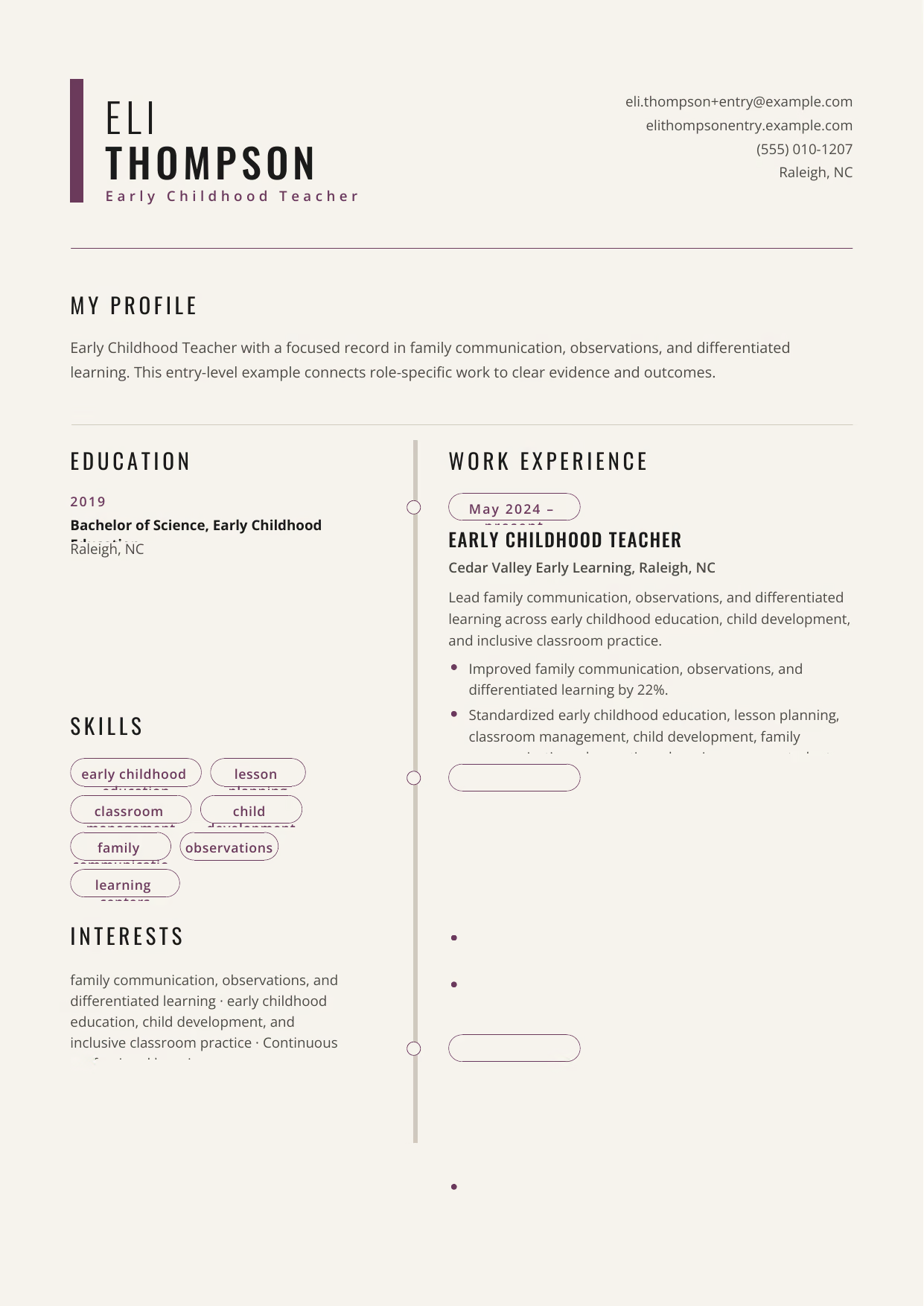
Early Childhood Teacher
A builder-ready entry-level Early Childhood Teacher example in the Pavo template, showing stage-appropriate evidence in a focused, editable resume format.
- Editable role positioning in the Pavo layout
- Role-specific evidence and delivery context
- Review the Pavo structure with a clean visual hierarchy
View this resume
Early Childhood Teacher
A builder-ready entry-level Early Childhood Teacher example in the Caelum template, showing stage-appropriate evidence in a focused, editable resume format.
- Editable role positioning in the Caelum layout
- Role-specific evidence and delivery context
- Review the Caelum structure with a clean visual hierarchy
View this resume

Early Childhood Teacher
A builder-ready entry-level Early Childhood Teacher example in the Achernar template, showing stage-appropriate evidence in a focused, editable resume format.
- Editable role positioning in the Achernar layout
- Role-specific evidence and delivery context
- Review the Achernar structure with a clean visual hierarchy
View this resume
Mid-Level Early Childhood Teacher Resume (3-7 Years Experience)
Use these mid-level examples to compare the scope, evidence, and language expected for Early Childhood Teacher roles at this stage.
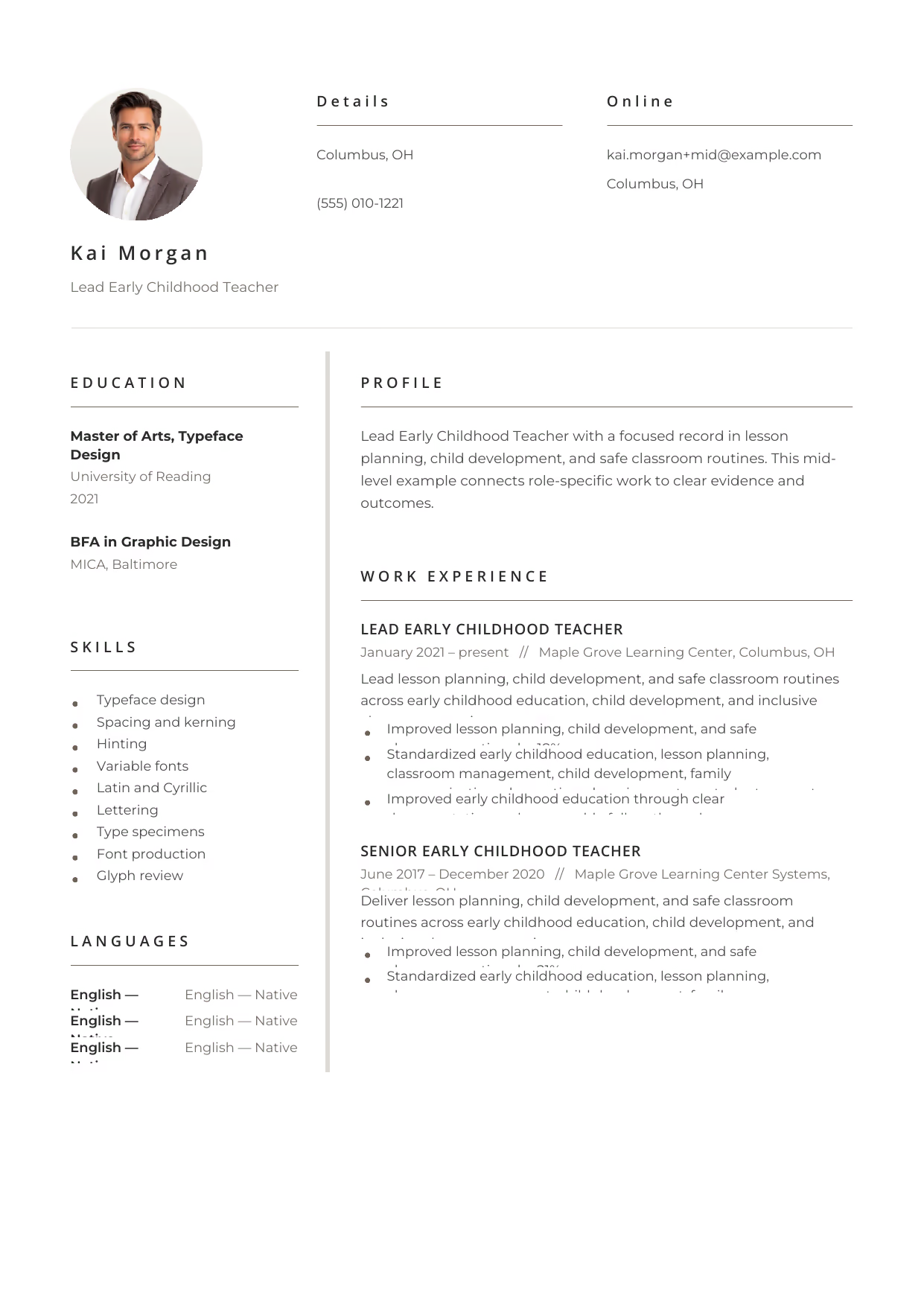
Lead Early Childhood Teacher
A builder-ready mid-level Early Childhood Teacher example in the Pictor template, showing stage-appropriate evidence in a focused, editable resume format.
- Editable role positioning in the Pictor layout
- Role-specific evidence and delivery context
- Review the Pictor structure with a clean visual hierarchy
View this resume
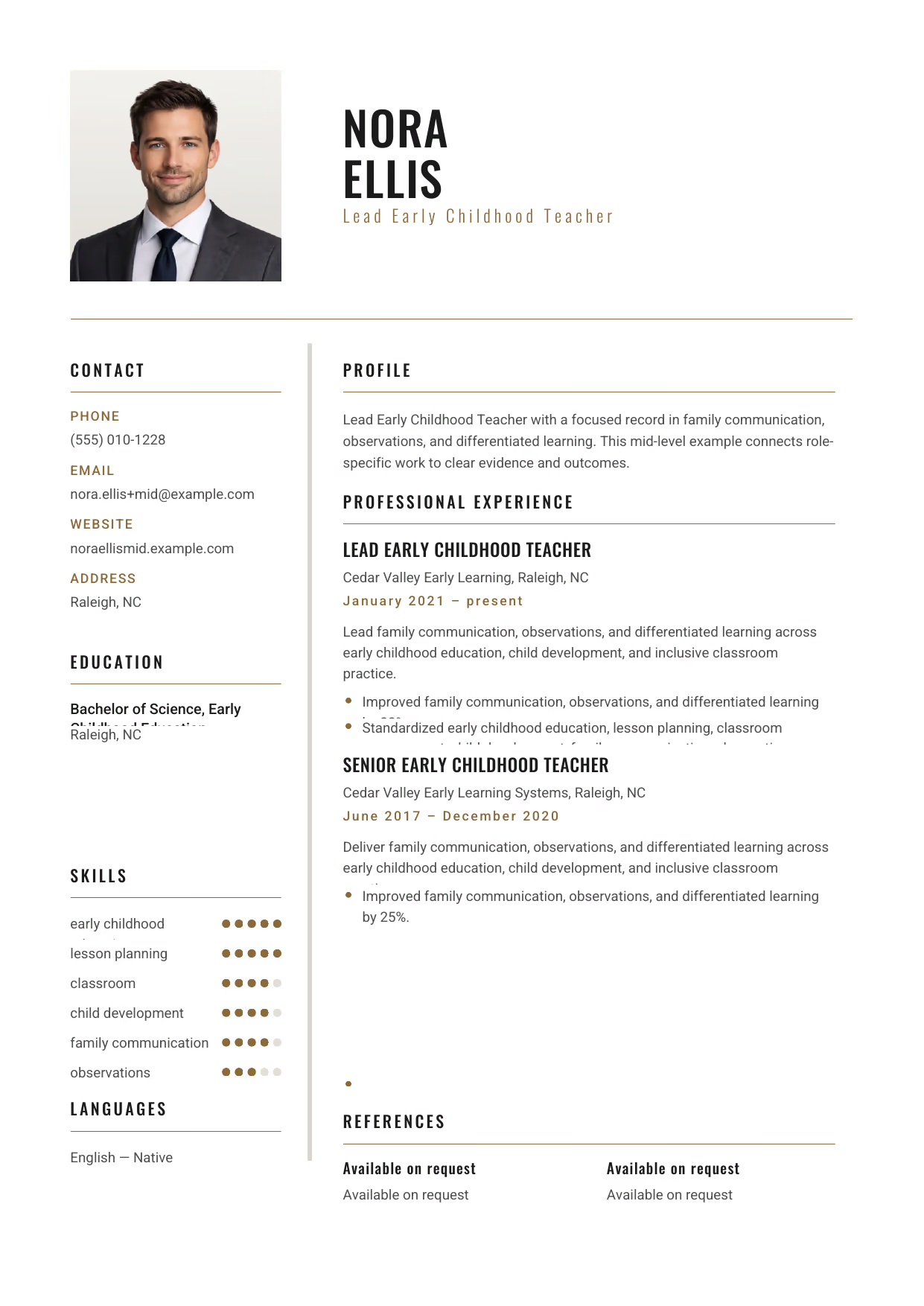
Lead Early Childhood Teacher
A builder-ready mid-level Early Childhood Teacher example in the Acamar template, showing stage-appropriate evidence in a focused, editable resume format.
- Editable role positioning in the Acamar layout
- Role-specific evidence and delivery context
- Review the Acamar structure with a clean visual hierarchy
View this resume
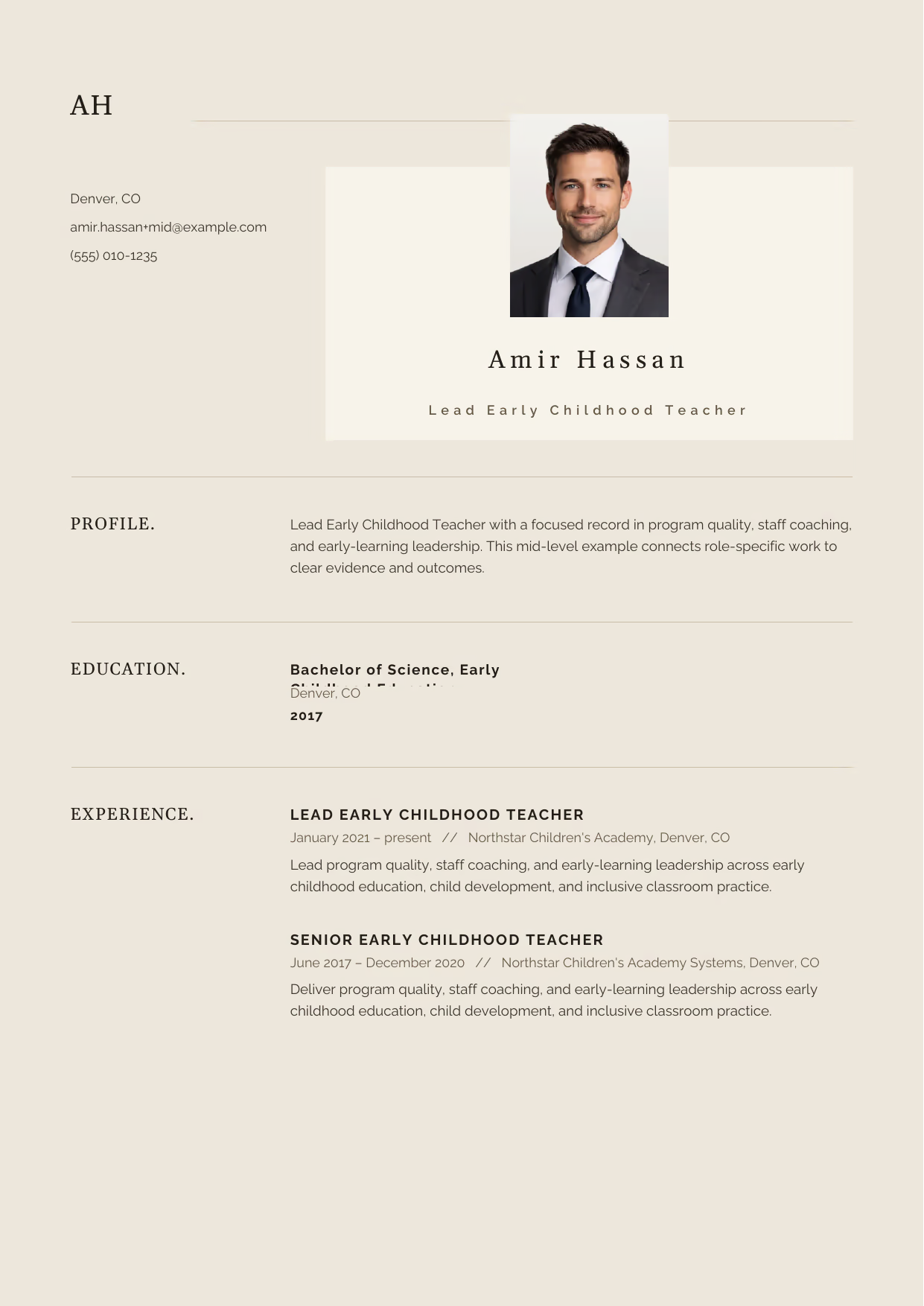
Lead Early Childhood Teacher
A builder-ready mid-level Early Childhood Teacher example in the Norma template, showing stage-appropriate evidence in a focused, editable resume format.
- Editable role positioning in the Norma layout
- Role-specific evidence and delivery context
- Review the Norma structure with a clean visual hierarchy
View this resume
Senior Early Childhood Teacher Resume (8+ Years / Management)
Use these advanced examples to compare the scope, evidence, and language expected for Early Childhood Teacher roles at this stage.

Early Childhood Program Director
A builder-ready advanced Early Childhood Teacher example in the Puppis template, showing stage-appropriate evidence in a focused, editable resume format.
- Editable role positioning in the Puppis layout
- Role-specific evidence and delivery context
- Review the Puppis structure with a clean visual hierarchy
View this resume

Early Childhood Program Director
A builder-ready advanced Early Childhood Teacher example in the Dorado template, showing stage-appropriate evidence in a focused, editable resume format.
- Editable role positioning in the Dorado layout
- Role-specific evidence and delivery context
- Review the Dorado structure with a clean visual hierarchy
View this resume

Early Childhood Program Director
A builder-ready advanced Early Childhood Teacher example in the Aquila template, showing stage-appropriate evidence in a focused, editable resume format.
- Editable role positioning in the Aquila layout
- Role-specific evidence and delivery context
- Review the Aquila structure with a clean visual hierarchy
View this resume
How to Write a Early Childhood Teacher Resume
The Resume Summary
The resume summary is your opportunity to make a strong first impression. Tailor it to the specific job and highlight your most relevant skills and experiences.
Formula: Enthusiastic/Dedicated/Experienced + [Your Title] + with [X] years of experience in [Relevant Field] + seeking [Desired Role] + to leverage skills in [Skill 1], [Skill 2], and [Skill 3] + to achieve [Specific Goal].
Entry-Level Example: Enthusiastic recent graduate with a Bachelor’s Degree in Early Childhood Education seeking an entry-level Early Childhood Teacher position to leverage skills in classroom management, lesson planning, and child development to foster a positive and stimulating learning environment.
Mid-Level Example: Dedicated and experienced Early Childhood Teacher with 5+ years of experience creating engaging and effective learning environments. Seeking a challenging role where I can leverage my expertise in curriculum development, classroom management, and parent communication to enhance student learning and development.
Senior-Level Example: Highly accomplished and results-driven Early Childhood Education Leader with 10+ years of experience in curriculum development, program management, and staff supervision. Seeking a leadership role where I can leverage my expertise to drive innovation and excellence in early childhood education.
Work Experience & Action Verbs
Focus on achievements rather than just listing duties. Use strong action verbs to describe your accomplishments and quantify your impact whenever possible.
- Duties vs. Achievements: Instead of simply stating your responsibilities, showcase how you made a difference. For example, instead of saying “Responsible for lesson planning,” say “Developed and implemented engaging lesson plans that improved student participation by 30%.”
- Before: Assisted with classroom activities. After: Supported lead teacher in implementing daily lesson plans, providing personalized attention to students and improving their engagement.
- Before: Managed classroom behavior. After: Implemented a positive behavior management system that reduced disruptive incidents by 25%.
- Before: Communicated with parents. After: Maintained open communication with parents through regular updates and conferences, resulting in a 95% parent satisfaction rate.
- Before: Developed lesson plans. After: Designed and implemented innovative lesson plans that aligned with state standards and improved student test scores by 10%.
- Before: Supervised students during activities. After: Supervised and engaged students in various activities, ensuring their safety and promoting their social and emotional development.
Top Skills for Early Childhood Teachers
Highlight a mix of hard skills, soft skills, and technical skills to showcase your well-rounded abilities.
Hard Skills:
- Curriculum Development
- Classroom Management
- Lesson Planning
- Child Development
- Student Assessment
- Literacy Instruction
- Behavior Management
- Differentiated Instruction
Soft Skills:
- Communication (Written & Verbal)
- Patience
- Creativity
- Active Listening
- Problem-Solving
- Empathy
- Adaptability
- Collaboration
Tools/Software:
- ABCmouse
- Starfall
- ClassDojo
- Seesaw
- Google Classroom
- Microsoft Office Suite
Education & Certifications
List your education and certifications in reverse chronological order. Highlight relevant coursework and academic achievements, especially if you are an entry-level candidate.
- Education Formatting: For entry-level candidates, include GPA and relevant coursework. For mid-level and senior-level candidates, focus on degrees and certifications.
Required or Recommended Certifications:
- Child Development Associate (CDA)
- Early Childhood Education Degree (Associate’s or Bachelor’s)
- State Teaching License
- National Board Certification in Early Childhood
- First Aid and CPR Certification
10 Common Early Childhood Teacher Resume Mistakes
- Generic Objective Statements: Using a vague objective statement like “Seeking a challenging position” wastes valuable space. Instead, craft a compelling summary that highlights your key skills and experiences relevant to the specific Early Childhood Teacher role, showcasing your value to the school or organization.
- Listing Irrelevant Experience: Including jobs that have no connection to early childhood education, such as a summer job in retail, can dilute your resume’s impact. Focus on experiences that demonstrate relevant skills like communication, patience, and classroom management, highlighting how these skills translate to the Early Childhood Teacher role.
- Neglecting Quantifiable Achievements: Failing to quantify your accomplishments makes it difficult for recruiters to assess your impact. Instead of saying “Improved student engagement,” quantify it with “Improved student engagement by 25% through the implementation of interactive learning activities,” showcasing your ability to drive positive results.
- Poor Formatting and Readability: Using a cluttered or difficult-to-read format can deter recruiters from reviewing your resume. Opt for a clean, professional design with clear headings, bullet points, and ample white space, ensuring your resume is visually appealing and easy to scan for key information.
- Grammar and Spelling Errors: Errors in grammar and spelling reflect poorly on your attention to detail. Proofread your resume carefully and use grammar-checking tools to ensure it is error-free, presenting yourself as a polished and professional candidate for the Early Childhood Teacher position.
- Ignoring Keywords: Failing to incorporate relevant keywords from the job description can cause your resume to be overlooked by Applicant Tracking Systems (ATS). Research common keywords related to early childhood education, such as “child development,” “curriculum planning,” and “classroom management,” and strategically integrate them into your resume.
- Focusing on Duties Instead of Accomplishments: Listing only your responsibilities without highlighting your achievements fails to demonstrate your impact. Transform duty-based statements into accomplishment-driven bullet points by quantifying your achievements and using strong action verbs, showcasing your ability to deliver results as an Early Childhood Teacher.
- Omitting Essential Skills: Overlooking critical skills such as communication, patience, and creativity can weaken your resume. Include a dedicated skills section that highlights both hard and soft skills relevant to early childhood education, demonstrating your well-rounded capabilities and suitability for the role.
- Inconsistent Tense and Formatting: Switching between past and present tense or using inconsistent formatting can create a disorganized impression. Maintain consistent tense and formatting throughout your resume, ensuring it is polished, professional, and easy to read.
- Lack of Tailoring to the Specific Job: Using a generic resume without tailoring it to the specific Early Childhood Teacher position can reduce its effectiveness. Customize your resume to match the requirements and preferences outlined in the job description, highlighting the skills and experiences that make you the ideal candidate for that particular role.
Frequently Asked Questions (Early Childhood Teacher)
- What should a Early Childhood Teacher resume emphasize first? Lead with the scope of lesson planning, child development, and safe classroom routines, then connect your contribution to a clear outcome, tool, or decision.
- Which skills deserve priority on a Early Childhood Teacher resume? Prioritize early childhood education, lesson planning, and classroom management when they match the role and can be supported by evidence.
- How can a Early Childhood Teacher show project scope and impact? Name the environment, scale, constraints, and result; family communication, observations, and differentiated learning becomes more credible when the context is concrete.
- How should a Early Childhood Teacher describe tools and technical decisions? Describe why you selected a method, how you implemented it, and what changed afterward in the Early Childhood Teacher role.
- Which achievements matter most for a Early Childhood Teacher application? Use outcome-led bullets that show program quality, staff coaching, and early-learning leadership through delivery quality, measurable scope, or stakeholder value.
- How long should a Early Childhood Teacher resume be? Use the shortest length that proves fit; a focused page can work early-career, while broader Early Childhood Teacher scope may need more room.
- How can a Early Childhood Teacher explain progression between career stages? Group examples by increasing ownership, moving from lesson planning, child development, and safe classroom routines toward program quality, staff coaching, and early-learning leadership as responsibility grows.
- Which keywords should a Early Childhood Teacher include for screening systems? Mirror truthful language from the posting, especially child development, without stuffing unrelated terms.
- How should a Early Childhood Teacher present reliability, quality, or safety work? Show how you protected outcomes through family communication and explain the evidence a hiring team can verify.
- What format makes a Early Childhood Teacher resume easy for hiring teams to scan? Use clear headings, readable bullets, and consistent dates so a hiring manager can evaluate Early Childhood Teacher fit quickly.
Crafting a compelling Early Childhood Teacher resume requires careful attention to detail and a strategic approach to showcasing your skills and experiences. By following the examples and tips in this guide, you can create a resume that stands out and helps you land your dream job in early childhood education. Search more Early Childhood Teacher resources to further enhance your job search.
Editorial review: RockStarCV Editorial Team reviewed this Early Childhood Teacher guide for source fidelity, role-specific usefulness, accessibility, builder examples, and question completeness.