Cybersecurity Analyst Resume Examples & Guide
Landing a Cybersecurity Analyst job can be tough. Applicant Tracking Systems (ATS) filter out many qualified candidates, and you’re facing fierce competition. This guide provides Cybersecurity Analyst resume examples for every experience level, arming you with the knowledge to stand out.
- Quantify Achievements: Use numbers to showcase the impact of your work.
- Highlight Relevant Skills: Emphasize key skills like network navigation, security software proficiency, and incident response.
- Tailor to Job Description: Match your resume content to the specific requirements of each job.
- Optimize for ATS: Use keywords from the job description and a clean, ATS-friendly format.
- Use Action Verbs: Start your bullet points with strong action verbs to demonstrate your accomplishments.
- Showcase Certifications: Prominently display relevant certifications like CISSP, CISM, or CompTIA Security+.
Let’s dive into some Cybersecurity Analyst resume examples to illustrate these principles.
Explore editable Cybersecurity Analyst resume examples by career stage. Each sample opens in the RockStarCV builder so you can study the structure and make your own version. Every example includes role-relevant education, skills, credentials, and work history—not just a matching headline. As you compare them, look for truthful evidence of endpoint security, network security, and risk assessment at the seniority level shown.
Entry-Level Cyber Security Analyst Resume (0-2 Years Experience)
Use these entry-level examples to compare the scope, evidence, and language expected for Cybersecurity Analyst roles at this stage.
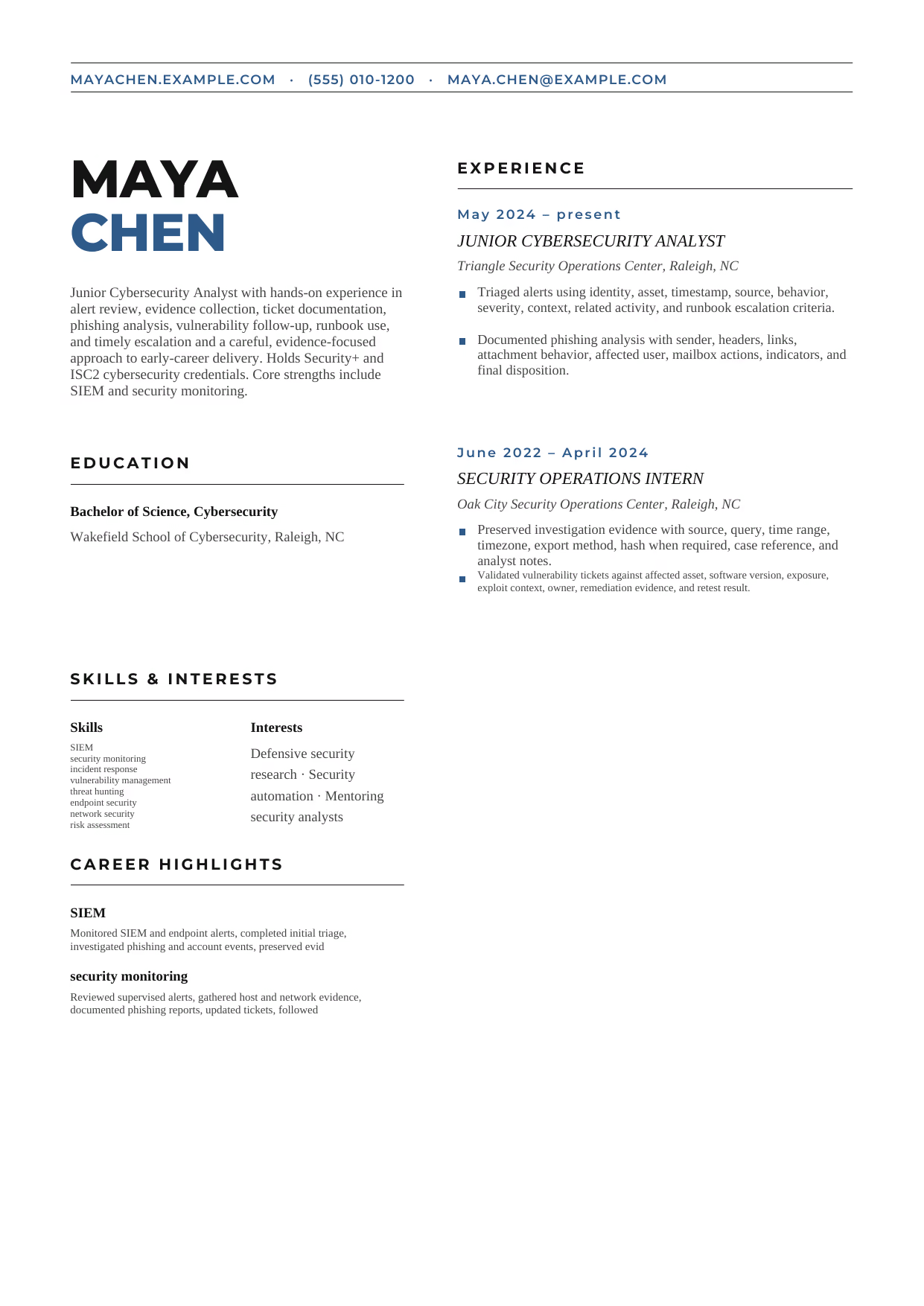
Junior Cybersecurity Analyst
A builder-ready entry-level Cybersecurity Analyst example in the Bootes template, showing stage-appropriate evidence in a focused, editable resume format.
- Editable role positioning in the Bootes layout
- Role-specific evidence and delivery context
- Review the Bootes structure with a clean visual hierarchy
View this resume
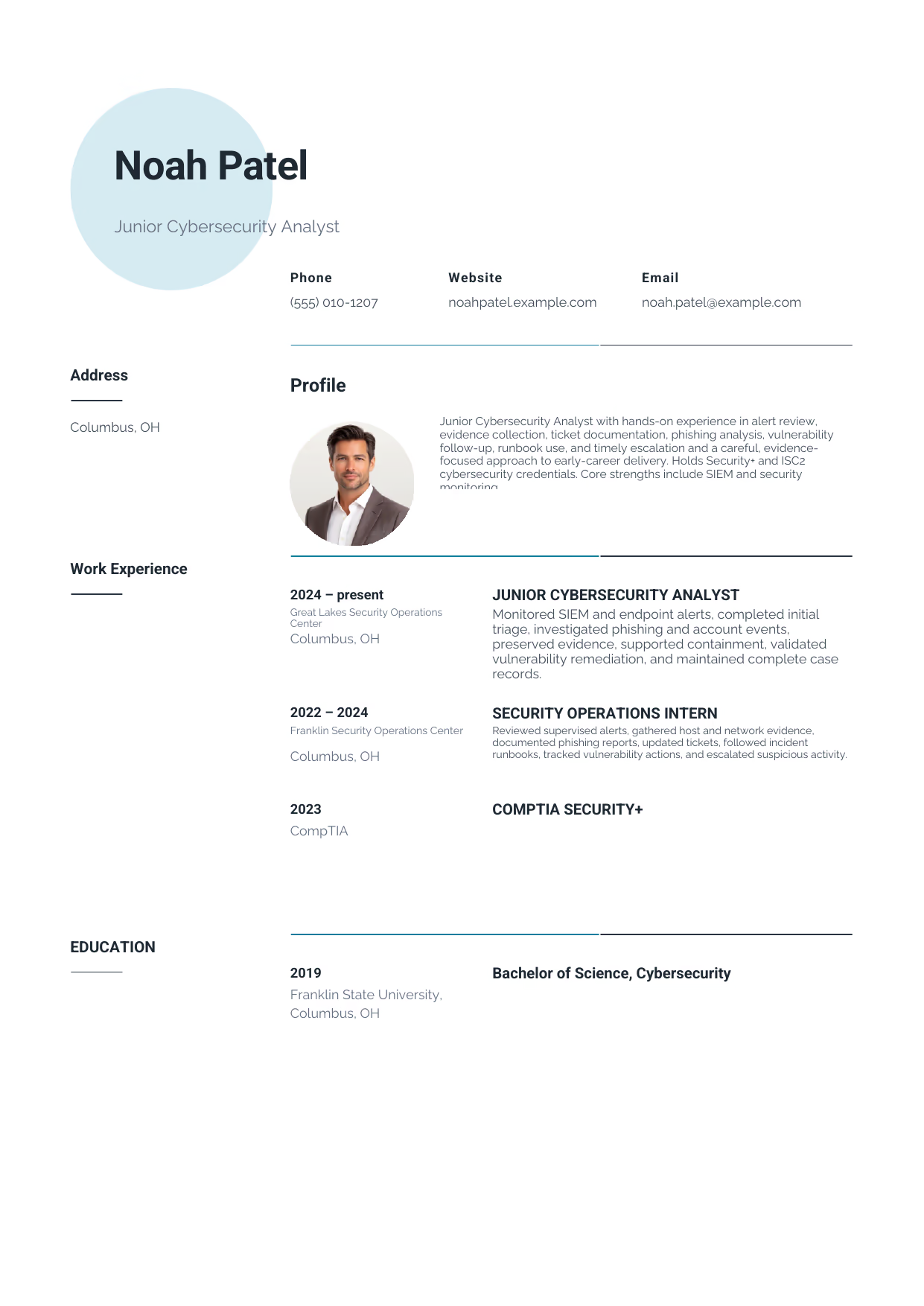
Junior Cybersecurity Analyst
A builder-ready entry-level Cybersecurity Analyst example in the Pavo template, showing stage-appropriate evidence in a focused, editable resume format.
- Editable role positioning in the Pavo layout
- Role-specific evidence and delivery context
- Review the Pavo structure with a clean visual hierarchy
View this resume

Junior Cybersecurity Analyst
A builder-ready entry-level Cybersecurity Analyst example in the Synnove template, showing stage-appropriate evidence in a focused, editable resume format.
- Editable role positioning in the Synnove layout
- Role-specific evidence and delivery context
- Review the Synnove structure with a clean visual hierarchy
View this resume
Mid-Level Cyber Security Analyst Resume (3-7 Years Experience)
Use these mid-level examples to compare the scope, evidence, and language expected for Cybersecurity Analyst roles at this stage.

Cybersecurity Analyst
A builder-ready mid-level Cybersecurity Analyst example in the Draco template, showing stage-appropriate evidence in a focused, editable resume format.
- Editable role positioning in the Draco layout
- Role-specific evidence and delivery context
- Review the Draco structure with a clean visual hierarchy
View this resume
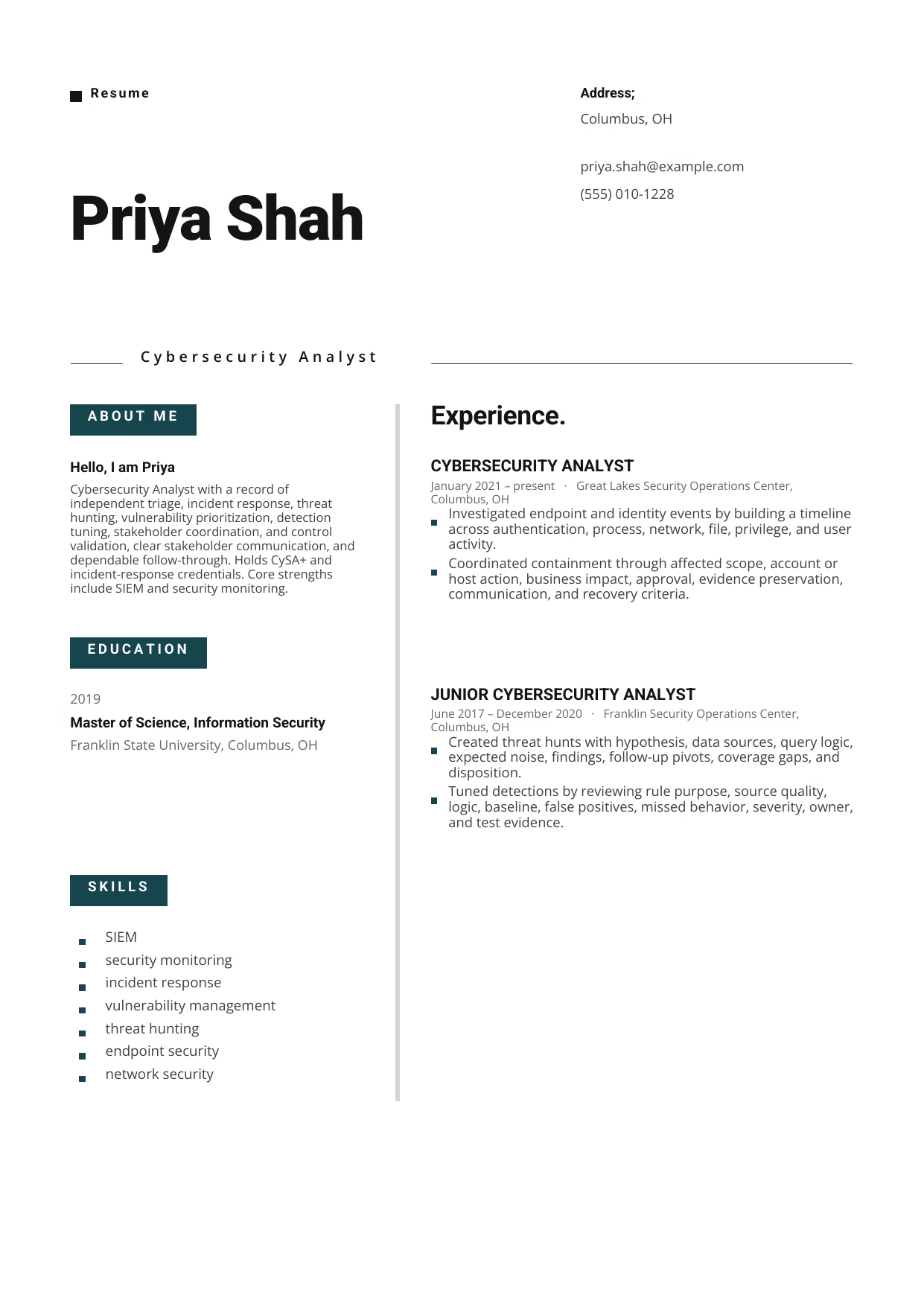
Cybersecurity Analyst
A builder-ready mid-level Cybersecurity Analyst example in the Indus template, showing stage-appropriate evidence in a focused, editable resume format.
- Editable role positioning in the Indus layout
- Role-specific evidence and delivery context
- Review the Indus structure with a clean visual hierarchy
View this resume
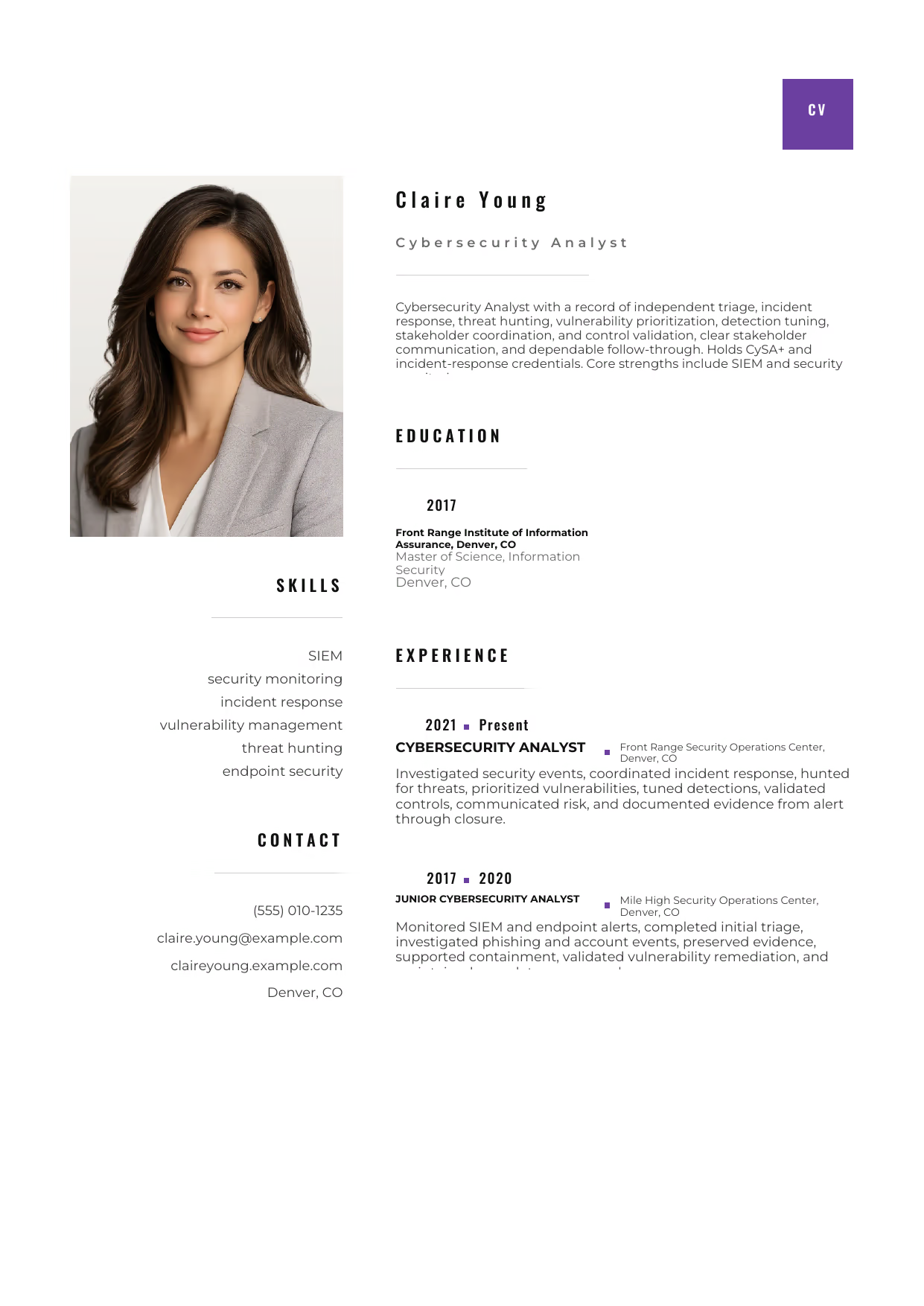
Cybersecurity Analyst
A builder-ready mid-level Cybersecurity Analyst example in the Pyxis template, showing stage-appropriate evidence in a focused, editable resume format.
- Editable role positioning in the Pyxis layout
- Role-specific evidence and delivery context
- Review the Pyxis structure with a clean visual hierarchy
View this resume
Senior Cyber Security Analyst Resume (8+ Years / Management)
Use these advanced examples to compare the scope, evidence, and language expected for Cybersecurity Analyst roles at this stage.
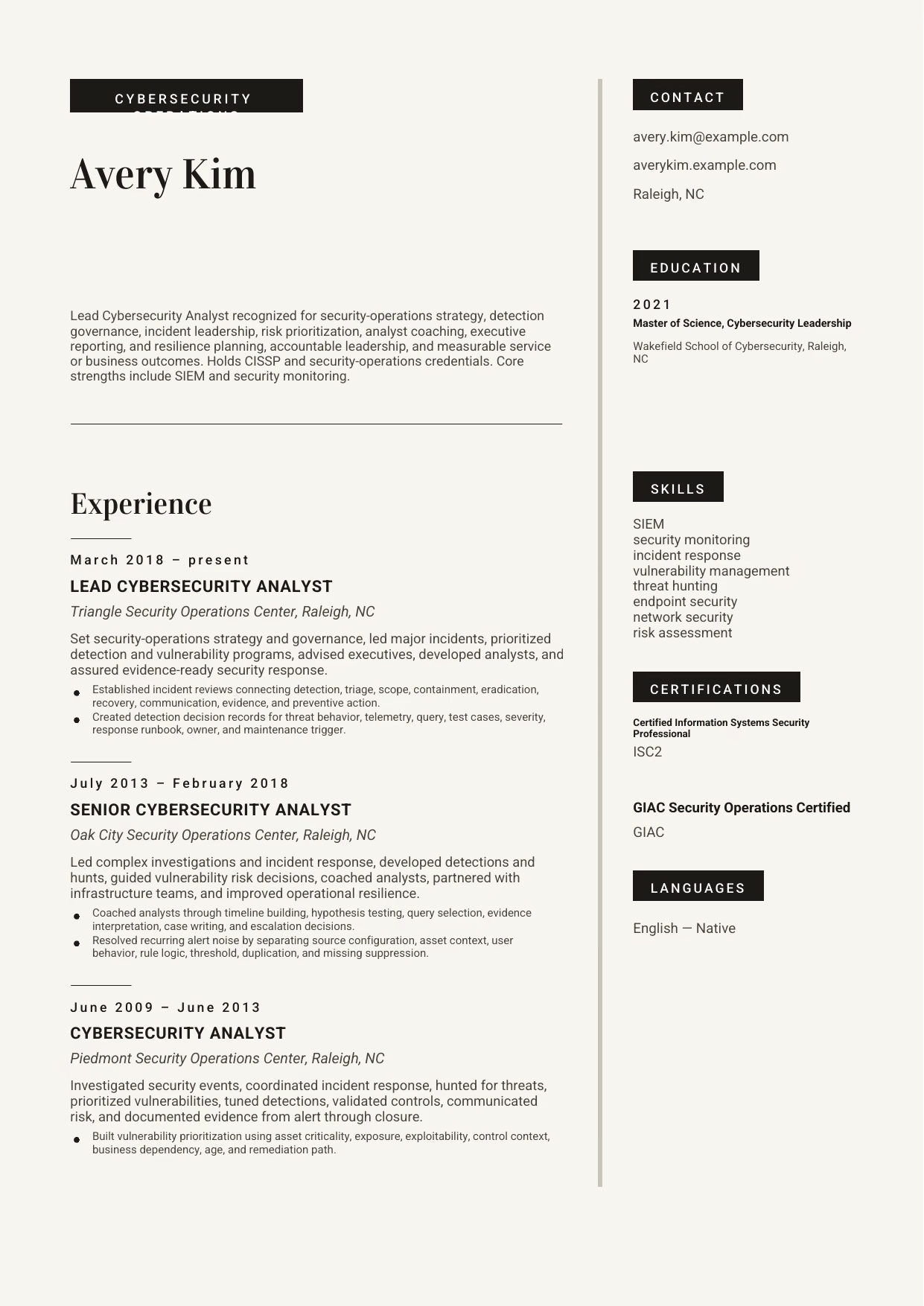
Lead Cybersecurity Analyst
A builder-ready advanced Cybersecurity Analyst example in the Aquila template, showing stage-appropriate evidence in a focused, editable resume format.
- Editable role positioning in the Aquila layout
- Role-specific evidence and delivery context
- Review the Aquila structure with a clean visual hierarchy
View this resume

Lead Cybersecurity Analyst
A builder-ready advanced Cybersecurity Analyst example in the Eridanus template, showing stage-appropriate evidence in a focused, editable resume format.
- Editable role positioning in the Eridanus layout
- Role-specific evidence and delivery context
- Review the Eridanus structure with a clean visual hierarchy
View this resume
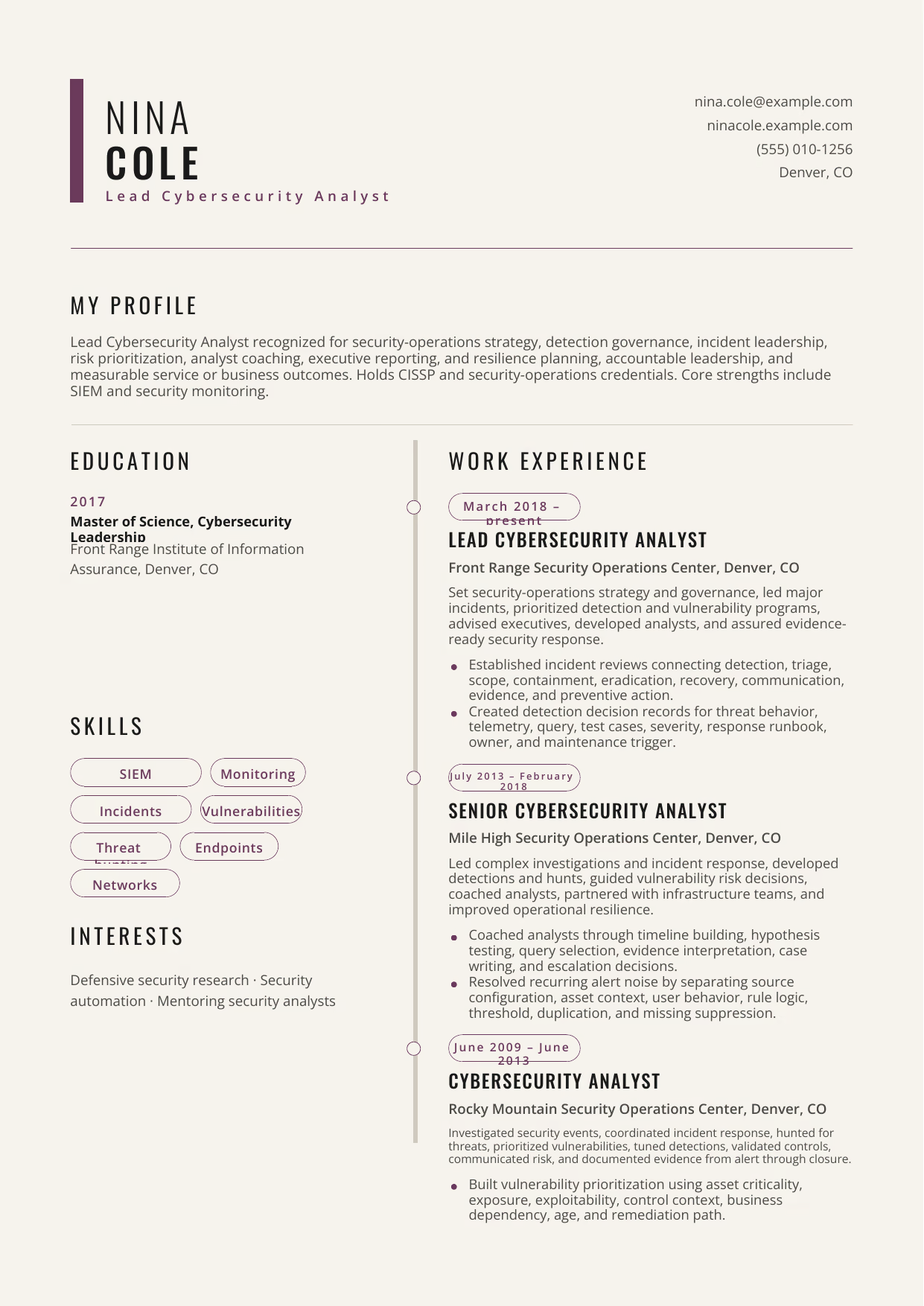
Lead Cybersecurity Analyst
A builder-ready advanced Cybersecurity Analyst example in the Caelum template, showing stage-appropriate evidence in a focused, editable resume format.
- Editable role positioning in the Caelum layout
- Role-specific evidence and delivery context
- Review the Caelum structure with a clean visual hierarchy
View this resume
Cybersecurity Analyst Resume Examples by Specialty
Choose the Cybersecurity Analyst path closest to the job you want. Each guide highlights the work, preparation, and evidence hiring teams expect for that specialty.
Information Security Analyst Resume Examples
- Resume focus:
- security controls, monitoring, risk assessment, policy, incidents, and assurance;
- Credentials:
- security, risk, audit, or platform credentials;
- Evidence to include:
- control scope, monitoring, findings, remediation, incidents, and risk decisions;
Network Security Analyst Resume Examples
- Resume focus:
- network telemetry, firewalls, segmentation, detection, investigation, and secure change;
- Credentials:
- network and security credentials relevant to the environment;
- Evidence to include:
- network scope, traffic evidence, rule review, incidents, changes, and validated protection;
Security Analyst Resume Examples
- Resume focus:
- monitoring, triage, vulnerability follow-up, access review, incidents, and security reporting;
- Credentials:
- foundational or analyst-level security credentials;
- Evidence to include:
- alert scope, investigation, response, remediation, controls, and reporting;
Cyber Analyst Resume Examples
- Resume focus:
- threat analysis, intelligence, detection, investigations, risk, and defensive recommendations;
- Credentials:
- cyber defense, intelligence, incident, or threat-hunting credentials;
- Evidence to include:
- sources, threat behavior, analysis, confidence, affected scope, and defensive action;
Cybersecurity Analyst Licenses and Certifications
List only current education, licenses, or certifications that apply to the target role. Give the credential name and issuing organization, and leave private identifier numbers off a public resume.
Security credentials
- Security+, CySA+, CISSP, GIAC, or another role-relevant credential;
- Issuer, level, and active status;
Platform and response training
- SIEM, EDR, cloud, network, incident-response, or forensics training;
- Only credentials relevant to the target security environment;
Cybersecurity Analyst Skills and ATS Keywords by Category
Use language that truthfully matches your Cybersecurity Analyst experience and the job posting. Pair important terms with a work example instead of presenting an unsupported keyword list.
Skills by category
Detection and response
- SIEM monitoring, alert triage, incident response, and threat hunting;
- Endpoint, identity, network, cloud, and evidence analysis;
Risk and resilience
- Vulnerability management, control validation, and risk assessment;
- Detection tuning, runbooks, stakeholder communication, and post-incident improvement;
ATS keywords by category
Security operations keywords
- SIEM, security monitoring, incident response, threat hunting;
- EDR, endpoint security, network security, phishing analysis;
Risk keywords
- Vulnerability management, risk assessment, detection engineering;
- Containment, evidence preservation, remediation validation, resilience;
How to Write a Cybersecurity Analyst Resume
The Resume Summary
The resume summary is your first impression. Make it count!
Formula: [Years of Experience] Cybersecurity Analyst with expertise in [Skill 1], [Skill 2], and [Skill 3]. Proven ability to [Achievement 1] and [Achievement 2]. Seeking a challenging role at [Target Company] to leverage expertise in [Area of Expertise].
Entry-Level Example: Recent Computer Science graduate with a strong foundation in network security and incident response. Eager to apply academic knowledge and develop practical skills in a challenging Cybersecurity Analyst role at a forward-thinking organization.
Mid-Level Example: 5+ years of experience as a Cybersecurity Analyst with expertise in SIEM, intrusion detection, and vulnerability management. Proven ability to reduce security incidents and improve security posture. Seeking a challenging role at a growing company to leverage expertise in cloud security.
Senior Example: Highly accomplished Cyber Security Leader with 10+ years of experience in building and managing high-performing security teams. Proven ability to develop and implement security strategies and manage budgets. Seeking a Director of Cyber Security role at a large enterprise to leverage expertise in risk management and security governance.
Work Experience & Action Verbs
The work experience section is where you showcase your accomplishments. Focus on achievements, not just duties. Quantify your impact whenever possible.
- Before: Responsible for monitoring network traffic. After: Monitored network traffic, identifying and resolving 12+ security incidents per month.
- Before: Assisted with vulnerability assessments. After: Conducted vulnerability assessments, identifying and remediating over 50 critical vulnerabilities.
- Before: Supported incident response activities. After: Led incident response activities, reducing incident resolution time by 25%.
- Before: Managed security tools. After: Managed security tools, improving security monitoring coverage by 15%.
- Before: Developed security policies. After: Developed and implemented security policies, ensuring compliance with industry regulations and reducing risk exposure by 10%.
Top Skills for Cybersecurity Analysts
Here are some of the top skills to include on your Cybersecurity Analyst resume:
Hard Skills:
- Network Security
- Vulnerability Management
- Incident Response
- SIEM
- Penetration Testing
- Cloud Security
- Security Auditing
- Risk Management
Soft Skills:
- Problem-solving
- Communication
- Teamwork
- Analytical Skills
- Critical Thinking
- Attention to Detail
Tools/Software:
- Splunk
- QRadar
- Nessus
- Qualys
- Wireshark
- Metasploit
- Burp Suite
Education & Certifications
For entry-level candidates, list education prominently. For mid-level and senior candidates, focus on certifications and experience.
Required or recommended certifications:
- CompTIA Security+
- Certified Ethical Hacker (CEH)
- Certified Information Systems Security Professional (CISSP)
- Certified Information Security Manager (CISM)
10 Common Cybersecurity Analyst Resume Mistakes
- Lack of Quantifiable Achievements: Simply listing responsibilities doesn’t show your impact. Quantify your accomplishments with metrics like ‘Reduced security incidents by 20%’ to demonstrate your value and make your resume stand out to recruiters and pass ATS scans.
- Ignoring the Job Description: Failing to tailor your resume to the specific job requirements can lead to rejection. Customize your skills and experience sections to match the keywords and qualifications listed in the job posting to improve your chances of getting an interview.
- Neglecting ATS Optimization: Using fancy formatting or graphics can confuse Applicant Tracking Systems. Stick to a clean, ATS-friendly format with clear headings and bullet points to ensure your resume is properly scanned and parsed.
- Poor Grammar and Spelling: Typos and grammatical errors can make you appear unprofessional and careless. Proofread your resume carefully and use a grammar checker to catch any mistakes before submitting your application.
- Generic Summary Statement: A generic summary statement fails to capture your unique value proposition. Craft a compelling summary that highlights your key skills, experience, and career goals to grab the attention of recruiters.
- Overstating Skills: Claiming expertise in skills you don’t possess can backfire during the interview process. Be honest about your skill level and focus on highlighting your strengths and accomplishments.
- Omitting Relevant Projects: If you lack extensive work experience, include relevant projects to showcase your skills and knowledge. Describe the project goals, your role, and the outcomes you achieved to demonstrate your capabilities to potential employers.
- Using Passive Language: Starting bullet points with weak or passive verbs can make your accomplishments seem less impactful. Use strong action verbs like ‘Developed,’ ‘Implemented,’ and ‘Managed’ to showcase your contributions and demonstrate your leadership abilities.
- Ignoring Security Best Practices: Failing to demonstrate knowledge of current security best practices can raise red flags. Highlight your understanding of industry standards like NIST and ISO to showcase your expertise and commitment to security excellence.
- Misspelling Core Industry Terminology: Typos in general are bad, but misspelling critical tools or certifications (like ‘SIEM’, ‘OWASP’, or ‘CISSP’) acts as an immediate red flag regarding your attention to detail and knowledge of the field. Always double-check the spelling of technical terms.
Frequently Asked Questions (Cybersecurity Analyst)
- What should a Cybersecurity Analyst resume emphasize first? Lead with the scope of alert review, evidence collection, ticket documentation, phishing analysis, vulnerability follow-up, runbook use, and timely escalation, then connect your contribution to a clear outcome, tool, or decision.
- Which skills deserve priority on a Cybersecurity Analyst resume? Prioritize SIEM, security monitoring, and incident response when they match the role and can be supported by evidence.
- How can a Cybersecurity Analyst show project scope and impact? Name the environment, scale, constraints, and result; independent triage, incident response, threat hunting, vulnerability prioritization, detection tuning, stakeholder coordination, and control validation becomes more credible when the context is concrete.
- How should a Cybersecurity Analyst describe tools and technical decisions? Describe why you selected a method, how you implemented it, and what changed afterward in the Cybersecurity Analyst role.
- Which achievements matter most for a Cybersecurity Analyst application? Use outcome-led bullets that show security-operations strategy, detection governance, incident leadership, risk prioritization, analyst coaching, executive reporting, and resilience planning through delivery quality, measurable scope, or stakeholder value.
- How long should a Cybersecurity Analyst resume be? Use the shortest length that proves fit; a focused page can work early-career, while broader Cybersecurity Analyst scope may need more room.
- How can a Cybersecurity Analyst explain progression between career stages? Group examples by increasing ownership, moving from alert review, evidence collection, ticket documentation, phishing analysis, vulnerability follow-up, runbook use, and timely escalation toward security-operations strategy, detection governance, incident leadership, risk prioritization, analyst coaching, executive reporting, and resilience planning as responsibility grows.
- Which keywords should a Cybersecurity Analyst include for screening systems? Mirror truthful language from the posting, especially vulnerability management, without stuffing unrelated terms.
- How should a Cybersecurity Analyst present reliability, quality, or safety work? Show how you protected outcomes through threat hunting and explain the evidence a hiring team can verify.
- What format makes a Cybersecurity Analyst resume easy for hiring teams to scan? Use clear headings, readable bullets, and consistent dates so a hiring manager can evaluate Cybersecurity Analyst fit quickly.
Ready to take the next step? Search more Cybersecurity Analyst resources on our site to find templates and additional advice!
RockStarCV Editorial Team