Business Analyst Resume Examples & Guide
Landing a Business Analyst role can be challenging. Applicant Tracking Systems (ATS) filter out countless resumes, and the competition is fierce. This guide provides Business Analyst resume examples for entry-level, mid-level, and senior-level candidates, ensuring you have the tools to succeed.
- Quantify Achievements: Use numbers and data to showcase the impact you’ve made in previous roles.
- Highlight Relevant Skills: Emphasize skills like data analysis, process improvement, and communication.
- Tailor to Job Description: Customize your resume to match the specific requirements of each job you apply for.
- Optimize for ATS: Use keywords from the job description and format your resume in a way that ATS can easily read.
- Use Action Verbs: Start your bullet points with strong action verbs to demonstrate your accomplishments.
- Showcase Problem-Solving: Highlight your ability to identify and solve business problems.
Let’s dive into some resume examples to see these tips in action.
Explore editable Business Analyst resume examples by career stage. Each sample opens in the RockStarCV builder so you can study the structure and make your own version. Every example includes role-relevant education, skills, credentials, and work history—not just a matching headline. As you compare them, look for truthful evidence of stakeholder analysis, UAT, and requirements traceability at the seniority level shown.
Entry-Level Business Analyst Resume (0-2 Years Experience)
Use these entry-level examples to compare the scope, evidence, and language expected for Business Analyst roles at this stage.
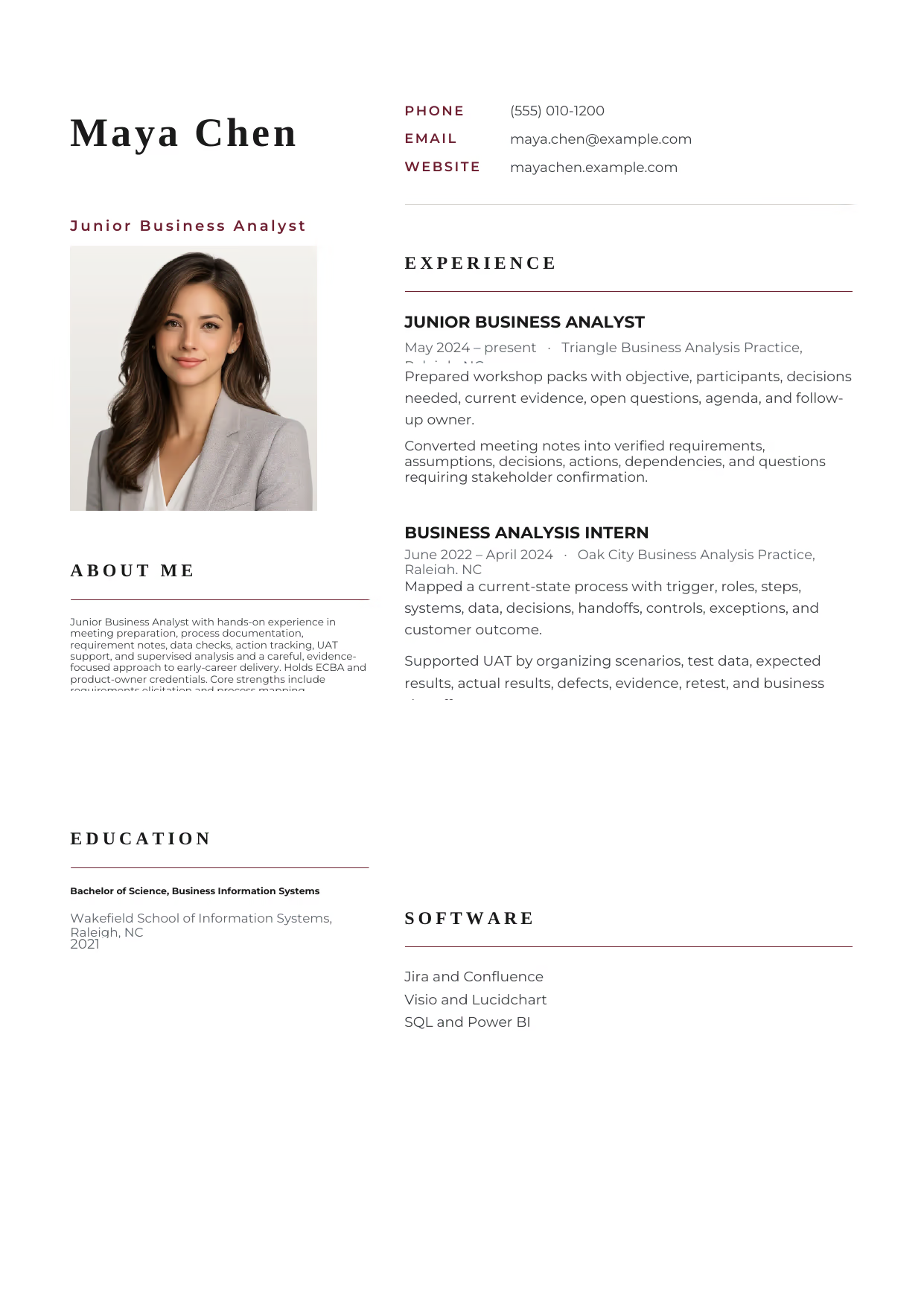
Junior Business Analyst
A builder-ready entry-level Business Analyst example in the Hydra template, showing stage-appropriate evidence in a focused, editable resume format.
- Editable role positioning in the Hydra layout
- Role-specific evidence and delivery context
- Review the Hydra structure with a clean visual hierarchy
View this resume

Junior Business Analyst
A builder-ready entry-level Business Analyst example in the Norma template, showing stage-appropriate evidence in a focused, editable resume format.
- Editable role positioning in the Norma layout
- Role-specific evidence and delivery context
- Review the Norma structure with a clean visual hierarchy
View this resume
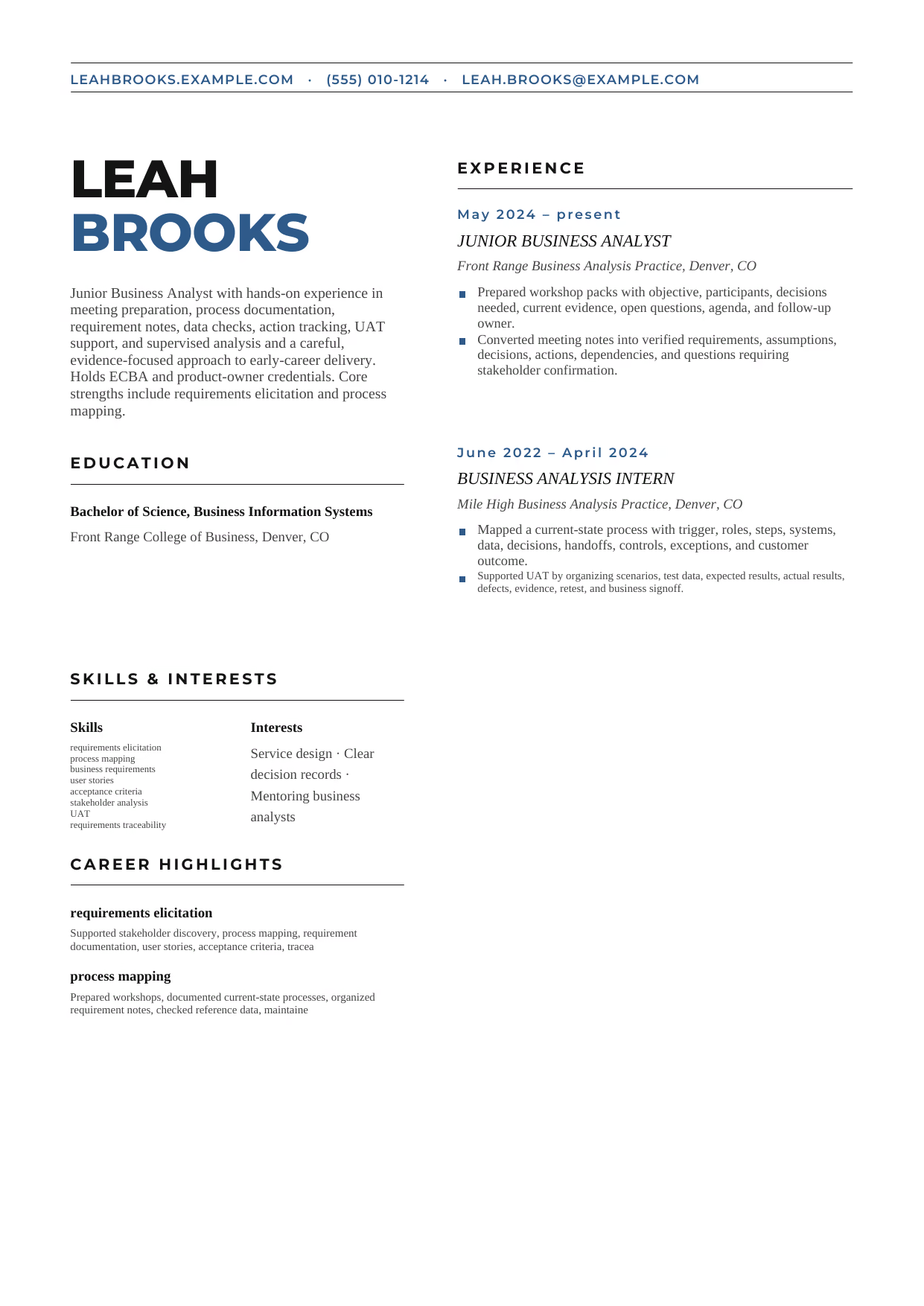
Junior Business Analyst
A builder-ready entry-level Business Analyst example in the Bootes template, showing stage-appropriate evidence in a focused, editable resume format.
- Editable role positioning in the Bootes layout
- Role-specific evidence and delivery context
- Review the Bootes structure with a clean visual hierarchy
View this resume
Mid-Level Business Analyst Resume (3-7 Years Experience)
Use these mid-level examples to compare the scope, evidence, and language expected for Business Analyst roles at this stage.
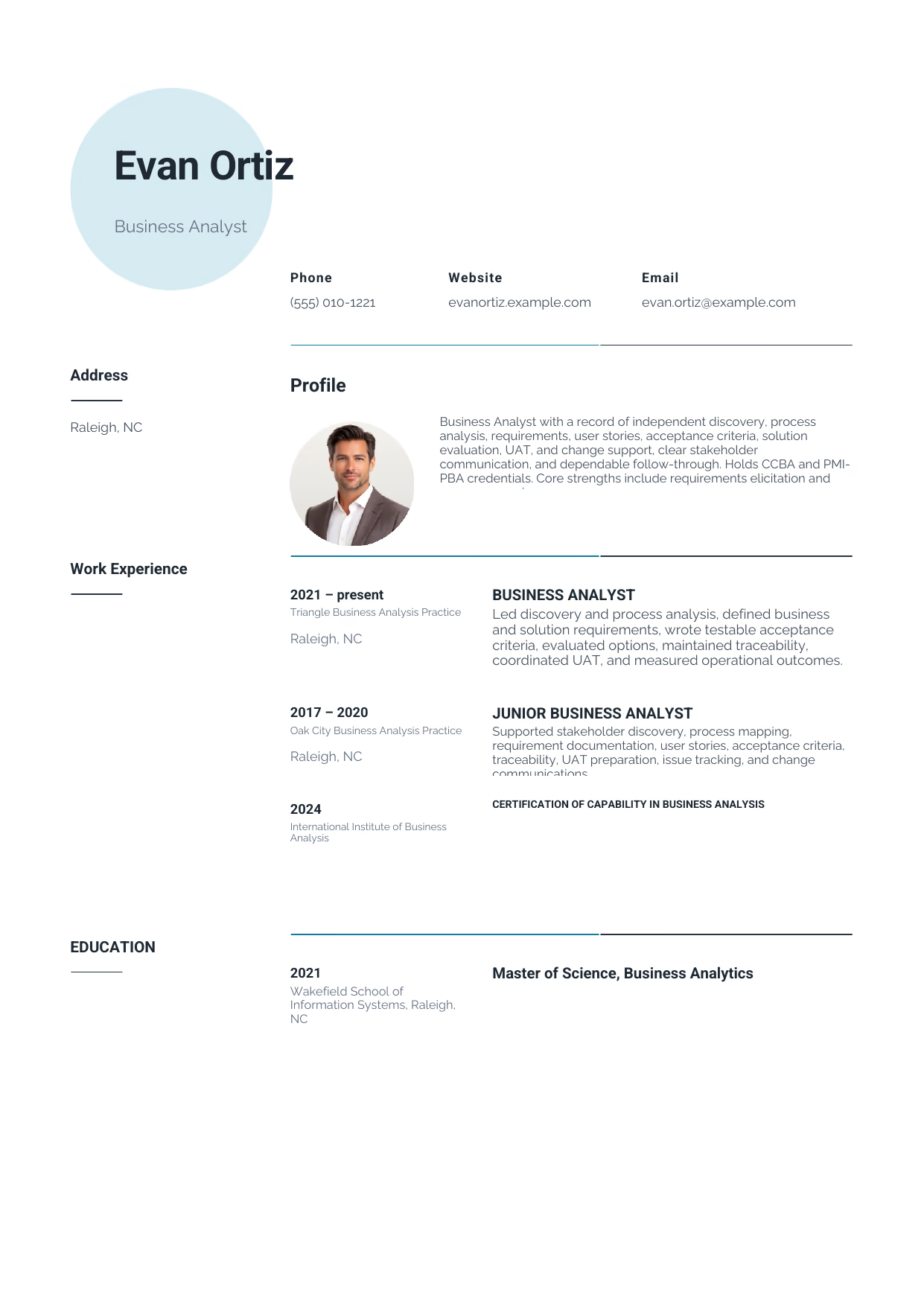
Business Analyst
A builder-ready mid-level Business Analyst example in the Pavo template, showing stage-appropriate evidence in a focused, editable resume format.
- Editable role positioning in the Pavo layout
- Role-specific evidence and delivery context
- Review the Pavo structure with a clean visual hierarchy
View this resume
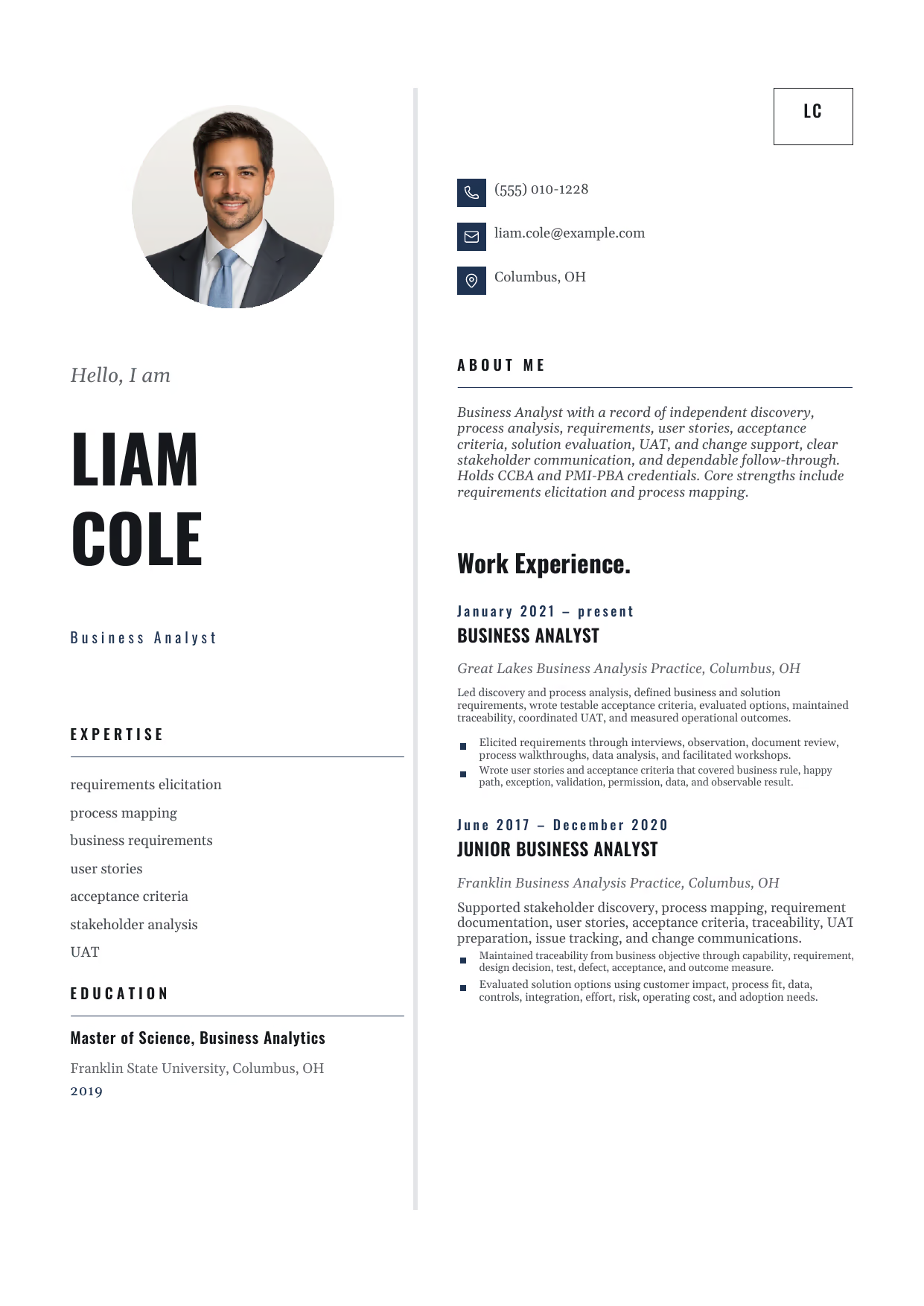
Business Analyst
A builder-ready mid-level Business Analyst example in the Equuleus template, showing stage-appropriate evidence in a focused, editable resume format.
- Editable role positioning in the Equuleus layout
- Role-specific evidence and delivery context
- Review the Equuleus structure with a clean visual hierarchy
View this resume

Business Analyst
A builder-ready mid-level Business Analyst example in the Synnove template, showing stage-appropriate evidence in a focused, editable resume format.
- Editable role positioning in the Synnove layout
- Role-specific evidence and delivery context
- Review the Synnove structure with a clean visual hierarchy
View this resume
Senior Business Analyst Resume (8+ Years / Management)
Use these advanced examples to compare the scope, evidence, and language expected for Business Analyst roles at this stage.
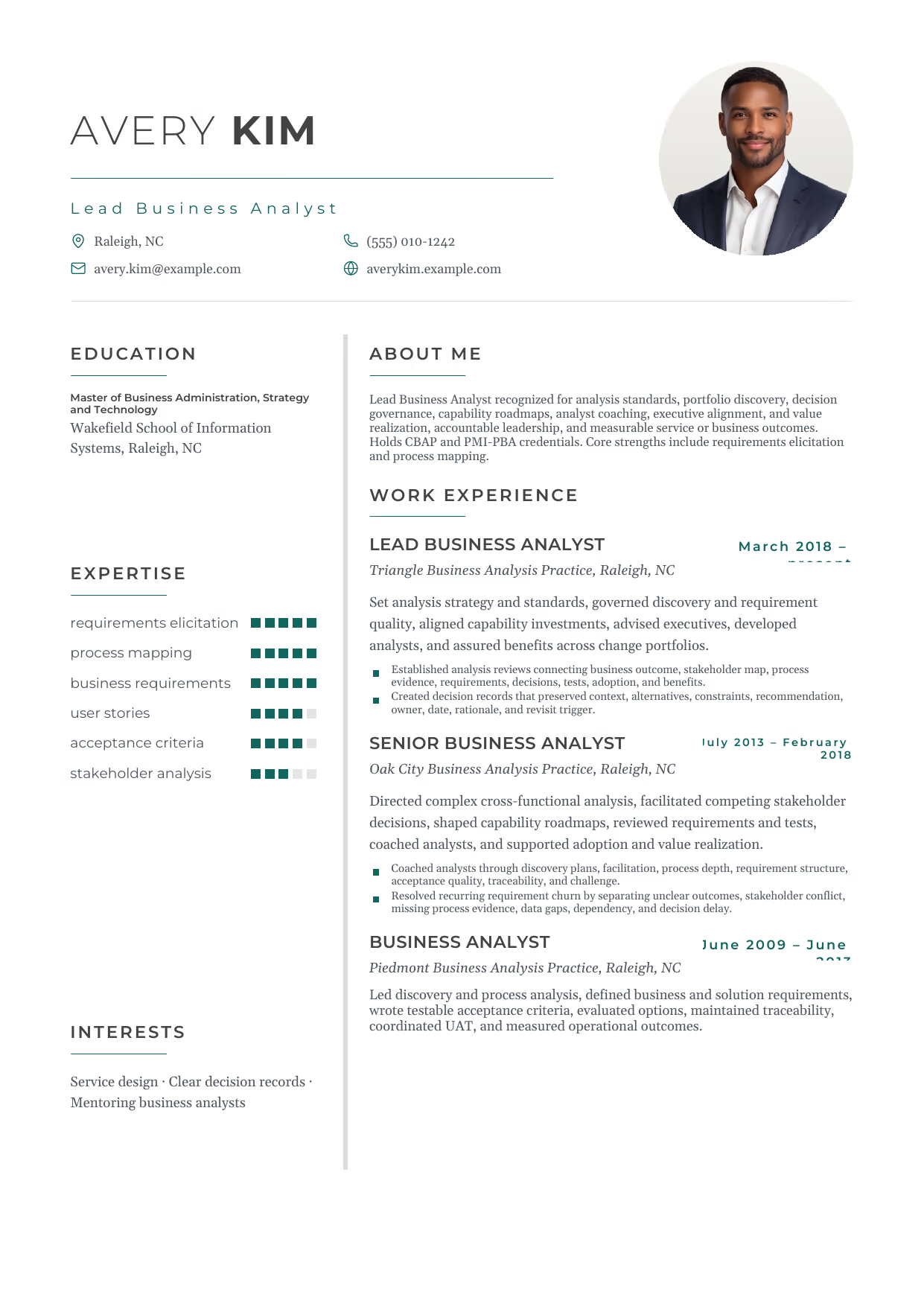
Lead Business Analyst
A builder-ready advanced Business Analyst example in the Achernar template, showing stage-appropriate evidence in a focused, editable resume format.
- Editable role positioning in the Achernar layout
- Role-specific evidence and delivery context
- Review the Achernar structure with a clean visual hierarchy
View this resume
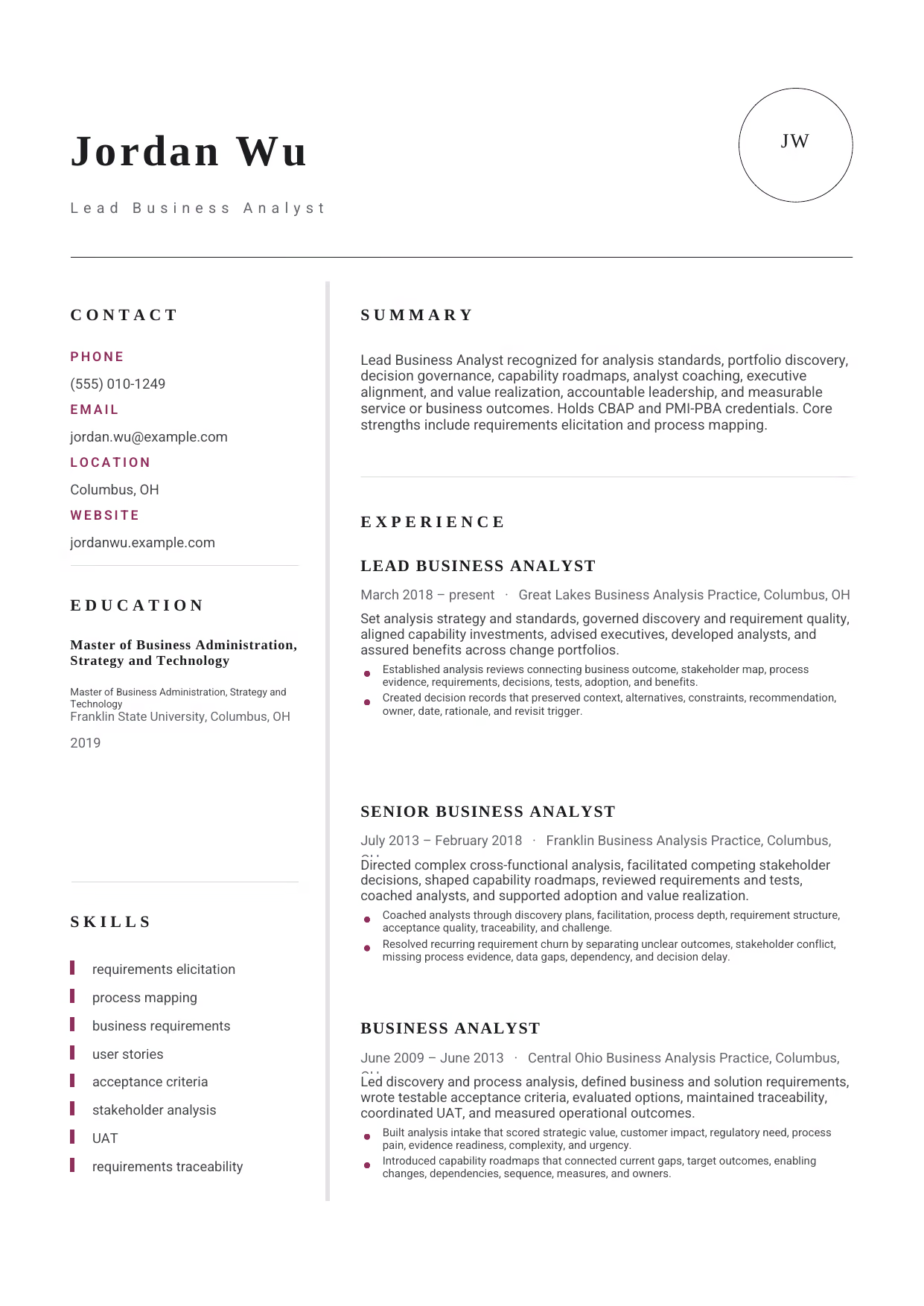
Lead Business Analyst
A builder-ready advanced Business Analyst example in the Grus template, showing stage-appropriate evidence in a focused, editable resume format.
- Editable role positioning in the Grus layout
- Role-specific evidence and delivery context
- Review the Grus structure with a clean visual hierarchy
View this resume

Lead Business Analyst
A builder-ready advanced Business Analyst example in the Draco template, showing stage-appropriate evidence in a focused, editable resume format.
- Editable role positioning in the Draco layout
- Role-specific evidence and delivery context
- Review the Draco structure with a clean visual hierarchy
View this resume
Business Analyst Resume Examples by Specialty
Choose the Business Analyst path closest to the job you want. Each guide highlights the work, preparation, and evidence hiring teams expect for that specialty.
IT Business Analyst Resume Examples
- Resume focus:
- technology requirements, integrations, data, testing, releases, and business adoption;
- Credentials:
- business analysis, agile, technology, or service credentials;
- Evidence to include:
- systems scope, requirements, interfaces, UAT, rollout, adoption, and outcome;
Healthcare Business Analyst Resume Examples
- Resume focus:
- clinical and administrative workflows, data privacy, systems, controls, and care operations;
- Credentials:
- business-analysis and relevant healthcare training;
- Evidence to include:
- workflow, users, privacy, measures, requirements, validation, and operational result;
Salesforce Business Analyst Resume Examples
- Resume focus:
- CRM processes, personas, data, automation, reporting, releases, and adoption;
- Credentials:
- Salesforce Business Analyst or administrator credential when held;
- Evidence to include:
- cloud scope, process, objects, automation, tests, release, adoption, and value;
Financial Business Analyst Resume Examples
- Resume focus:
- finance processes, controls, reporting, systems, requirements, and decision support;
- Credentials:
- business-analysis, finance, accounting, or systems credentials;
- Evidence to include:
- process scope, control needs, data, requirements, testing, and reporting outcome;
Business Analyst Licenses and Certifications
List only current education, licenses, or certifications that apply to the target role. Give the credential name and issuing organization, and leave private identifier numbers off a public resume.
Business-analysis credentials
- ECBA, CCBA, CBAP, PMI-PBA, or another current credential;
- Issuer, level, and active status;
Domain and platform training
- Agile, CRM, ERP, process, data, or domain training;
- Only credentials relevant to the target change context;
Business Analyst Skills and ATS Keywords by Category
Use language that truthfully matches your Business Analyst experience and the job posting. Pair important terms with a work example instead of presenting an unsupported keyword list.
Skills by category
Discovery and definition
- Stakeholder analysis, elicitation, process mapping, and problem framing;
- Business requirements, user stories, acceptance criteria, and traceability;
Validation and change
- Solution evaluation, data analysis, UAT, and defect triage;
- Decision facilitation, change readiness, adoption, and value review;
ATS keywords by category
Analysis keywords
- Requirements elicitation, process mapping, business requirements;
- User stories, acceptance criteria, stakeholder analysis;
Delivery keywords
- UAT, requirements traceability, solution evaluation;
- Change management, business process improvement, benefits realization;
How to Write a Business Analyst Resume
The Resume Summary
The resume summary is your chance to make a strong first impression. It should be a concise overview of your skills, experience, and career goals. Use this formula: [Years of Experience] + [Job Title] + [Key Skills] + [Quantifiable Achievement or Goal]
Entry-Level Example: Recent graduate with strong analytical and problem-solving skills seeking an entry-level Business Analyst position to contribute to data-driven decision-making.
Mid-Level Example: Results-driven Business Analyst with 5+ years of experience in analyzing business processes and implementing data-driven solutions, resulting in a 20% increase in efficiency.
Senior-Level Example: Highly accomplished Senior Business Analyst with 10+ years of experience leading cross-functional teams and managing large-scale projects, driving business growth and improving efficiency.
Work Experience & Action Verbs
The work experience section is where you showcase your accomplishments and demonstrate your value to potential employers. Focus on achievements rather than just listing duties.
Here are some examples of how to transform duties into achievements:
- Before: Responsible for data analysis. After: Conducted data analysis to identify trends and patterns, resulting in actionable recommendations that increased sales by 15%.
- Before: Managed project timelines. After: Managed project timelines and resources, ensuring on-time and within-budget delivery of projects.
- Before: Gathered requirements from stakeholders. After: Facilitated requirements gathering sessions with stakeholders, resulting in clear and concise requirements documentation.
- Before: Developed process flows. After: Developed process flows and use cases to document current and future state processes, improving process understanding and communication.
- Before: Created reports. After: Created reports and dashboards to track key performance indicators, providing stakeholders with real-time insights into business performance.
Top Skills for Business Analysts
Here are some of the top skills that Business Analysts should include on their resumes:
- Hard Skills:
- Data Analysis
- Process Improvement
- Requirements Elicitation
- SQL
- Data Visualization (Tableau, Power BI)
- Project Management
- Soft Skills:
- Communication
- Problem-Solving
- Analytical Thinking
- Critical Thinking
- Collaboration
- Tools/Software:
- Microsoft Excel
- Microsoft Visio
- Jira
- Confluence
- SQL Developer
Education & Certifications
The education section should include your degree, major, and graduation date. If you have limited experience, you can also include relevant coursework or projects. For senior-level roles, prioritize certifications over education details.
Recommended certifications for Business Analysts include:
- Certified Business Analysis Professional (CBAP)
- Entry Certificate in Business Analysis (ECBA)
- Certification of Competency in Business Analysis (CCBA)
- Project Management Professional (PMP)
10 Common Business Analyst Resume Mistakes
- Generic Resume: Submitting the same resume for every Business Analyst role. This fails because ATS systems prioritize relevance. Quick Fix: Tailor your resume to each job description by including specific keywords and skills mentioned in the posting.
- Listing Duties Instead of Impact: Recruiters want to see how you made a difference. Quick Fix: Replace passive phrases like ‘Responsible for data analysis’ with quantified wins like ‘Identified key trends in data analysis, leading to a 15% increase in sales’.
- Ignoring ATS Optimization: Using fancy formatting or graphics that ATS systems can’t read. Quick Fix: Use a simple, clean format with clear headings and bullet points. Save your resume as a .docx or .pdf file.
- Lack of Keywords: Failing to include relevant keywords from the job description. Quick Fix: Research common Business Analyst keywords and incorporate them naturally into your resume.
- Poor Grammar and Spelling: Making careless errors that reflect poorly on your attention to detail. Quick Fix: Proofread your resume carefully before submitting it. Use a grammar checker or ask someone else to review it.
- Omitting Key Skills: Not highlighting essential Business Analyst skills such as data analysis, process improvement, and communication. Quick Fix: Create a dedicated skills section and list both hard and soft skills relevant to the role.
- Irrelevant Information: Including information that is not relevant to the job you are applying for. Quick Fix: Focus on the skills and experience that are most relevant to the Business Analyst role. Remove any unnecessary information.
- Inconsistent Formatting: Using inconsistent formatting throughout your resume. Quick Fix: Use a consistent font, font size, and bullet point style throughout your resume.
- Weak Summary: Failing to create a compelling summary that grabs the reader’s attention. Quick Fix: Write a concise and engaging summary that highlights your key skills, experience, and career goals.
- Not Quantifying Achievements: Failing to quantify your achievements with numbers and data. Quick Fix: Use numbers and data to showcase the impact you’ve made in previous roles. For example, ‘Improved process efficiency by 20%’.
Frequently Asked Questions (Business Analyst)
- What should a Business Analyst resume emphasize first? Lead with the scope of meeting preparation, process documentation, requirement notes, data checks, action tracking, UAT support, and supervised analysis, then connect your contribution to a clear outcome, tool, or decision.
- Which skills deserve priority on a Business Analyst resume? Prioritize requirements elicitation, process mapping, and business requirements when they match the role and can be supported by evidence.
- How can a Business Analyst show project scope and impact? Name the environment, scale, constraints, and result; independent discovery, process analysis, requirements, user stories, acceptance criteria, solution evaluation, UAT, and change support becomes more credible when the context is concrete.
- How should a Business Analyst describe tools and technical decisions? Describe why you selected a method, how you implemented it, and what changed afterward in the Business Analyst role.
- Which achievements matter most for a Business Analyst application? Use outcome-led bullets that show analysis standards, portfolio discovery, decision governance, capability roadmaps, analyst coaching, executive alignment, and value realization through delivery quality, measurable scope, or stakeholder value.
- How long should a Business Analyst resume be? Use the shortest length that proves fit; a focused page can work early-career, while broader Business Analyst scope may need more room.
- How can a Business Analyst explain progression between career stages? Group examples by increasing ownership, moving from meeting preparation, process documentation, requirement notes, data checks, action tracking, UAT support, and supervised analysis toward analysis standards, portfolio discovery, decision governance, capability roadmaps, analyst coaching, executive alignment, and value realization as responsibility grows.
- Which keywords should a Business Analyst include for screening systems? Mirror truthful language from the posting, especially user stories, without stuffing unrelated terms.
- How should a Business Analyst present reliability, quality, or safety work? Show how you protected outcomes through acceptance criteria and explain the evidence a hiring team can verify.
- What format makes a Business Analyst resume easy for hiring teams to scan? Use clear headings, readable bullets, and consistent dates so a hiring manager can evaluate Business Analyst fit quickly.
A well-crafted Business Analyst resume is your ticket to landing your dream job. By following the tips and examples in this guide, you can create a resume that showcases your skills, experience, and potential.
Ready to take the next step? Search more Business Analyst resources on our site to find templates and additional advice!
RockStarCV Editorial Team