Writer Resume Examples & Guide
Landing a Writer job can be tough. Applicant Tracking Systems (ATS) filter out many applications, and you’re facing fierce competition. This guide provides writer resume examples for all experience levels, offering the insights you need to stand out.
- Quantify Achievements: Use numbers to showcase the impact of your writing.
- Highlight Relevant Skills: Emphasize skills like SEO, content management systems, and editing.
- Tailor to Job Description: Customize your resume for each specific writing role.
- Optimize for ATS: Use keywords from the job description to pass the ATS scan.
- Use Action Verbs: Start each bullet point with a strong action verb to demonstrate your accomplishments.
- Showcase Your Niche: Highlight any specialized writing experience, such as technical writing or copywriting.
- Proofread Meticulously: Ensure your resume is free of grammatical errors and typos.
Let’s dive into some writer resume examples for different experience levels.
Explore editable Writer resume examples by career stage. Each sample opens in the RockStarCV builder so you can study the structure and make your own version.
Entry-Level Writer Resume (0-2 Years Experience)
Use these entry-level examples to compare the scope, evidence, and language expected for Writer roles at this stage.
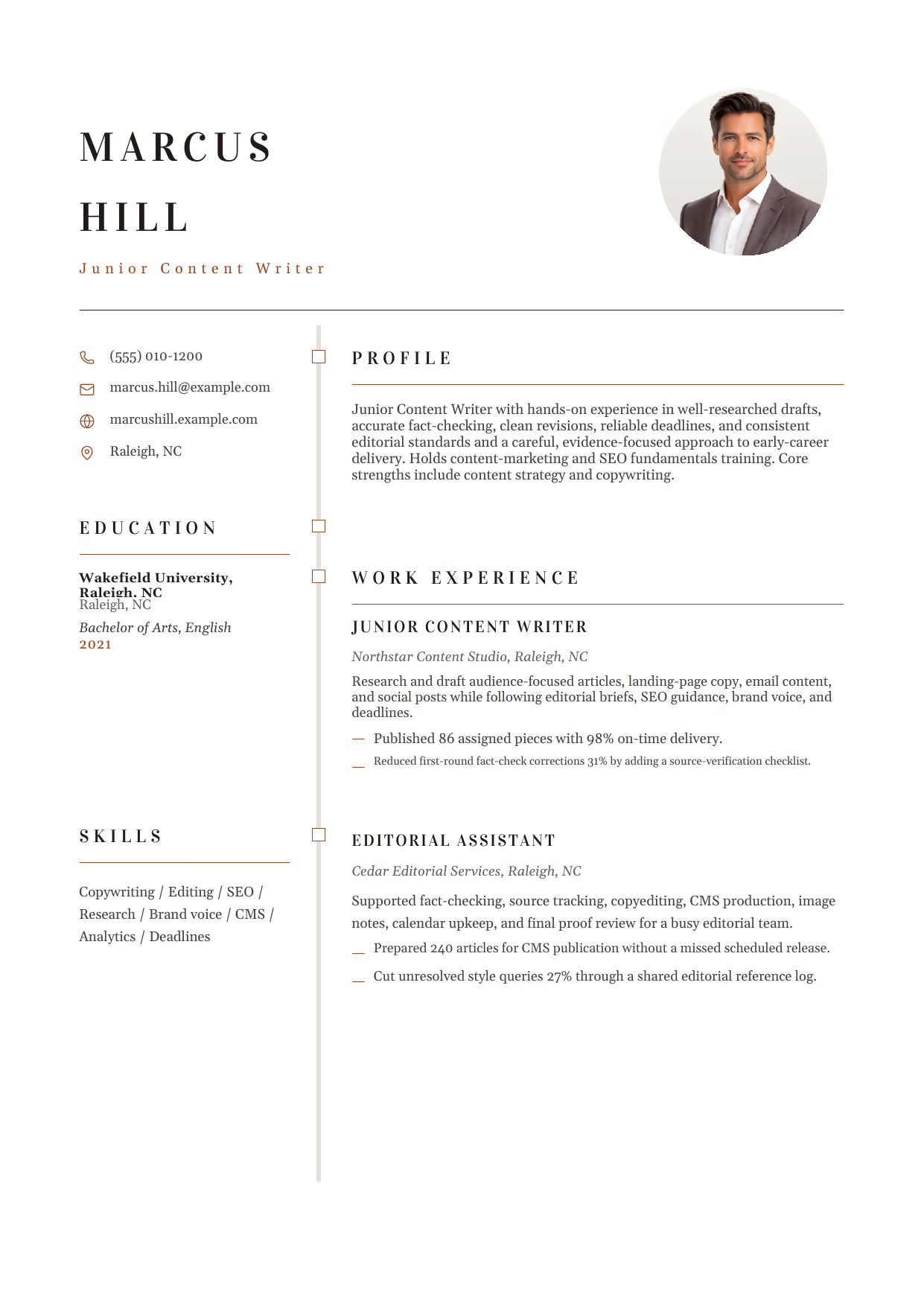
Junior Content Writer
A builder-ready entry-level Writer example in the Draco template, showing stage-appropriate evidence in a focused, editable resume format.
- Editable role positioning in the Draco layout
- Role-specific evidence and delivery context
- Review the Draco structure with a clean visual hierarchy
View this resume

Junior Content Writer
A builder-ready entry-level Writer example in the Pyxis template, showing stage-appropriate evidence in a focused, editable resume format.
- Editable role positioning in the Pyxis layout
- Role-specific evidence and delivery context
- Review the Pyxis structure with a clean visual hierarchy
View this resume

Junior Content Writer
A builder-ready entry-level Writer example in the Achernar template, showing stage-appropriate evidence in a focused, editable resume format.
- Editable role positioning in the Achernar layout
- Role-specific evidence and delivery context
- Review the Achernar structure with a clean visual hierarchy
View this resume
Mid-Level Writer Resume (3-7 Years Experience)
Use these mid-level examples to compare the scope, evidence, and language expected for Writer roles at this stage.
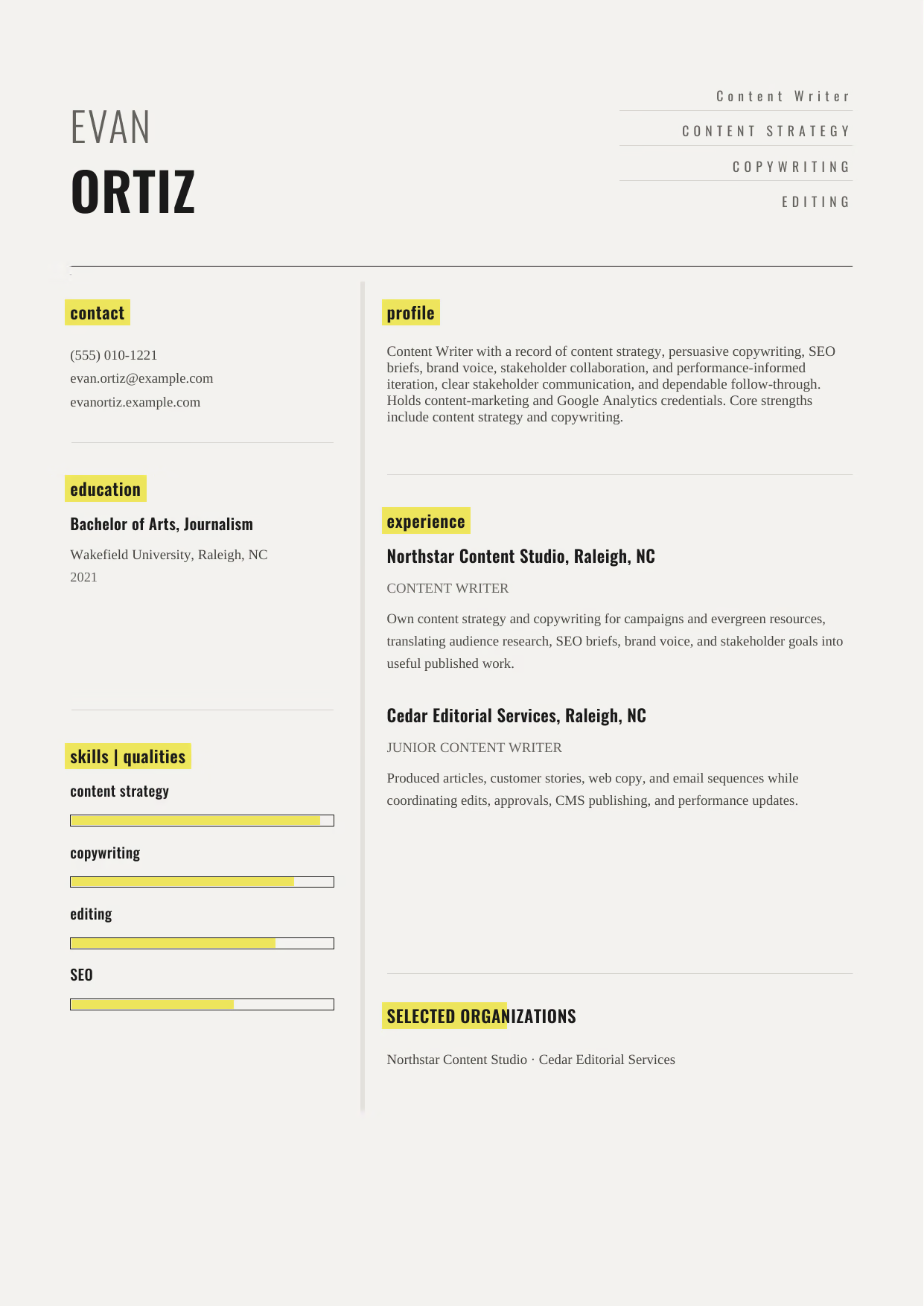
Content Writer
A builder-ready mid-level Writer example in the Dorado template, showing stage-appropriate evidence in a focused, editable resume format.
- Editable role positioning in the Dorado layout
- Role-specific evidence and delivery context
- Review the Dorado structure with a clean visual hierarchy
View this resume
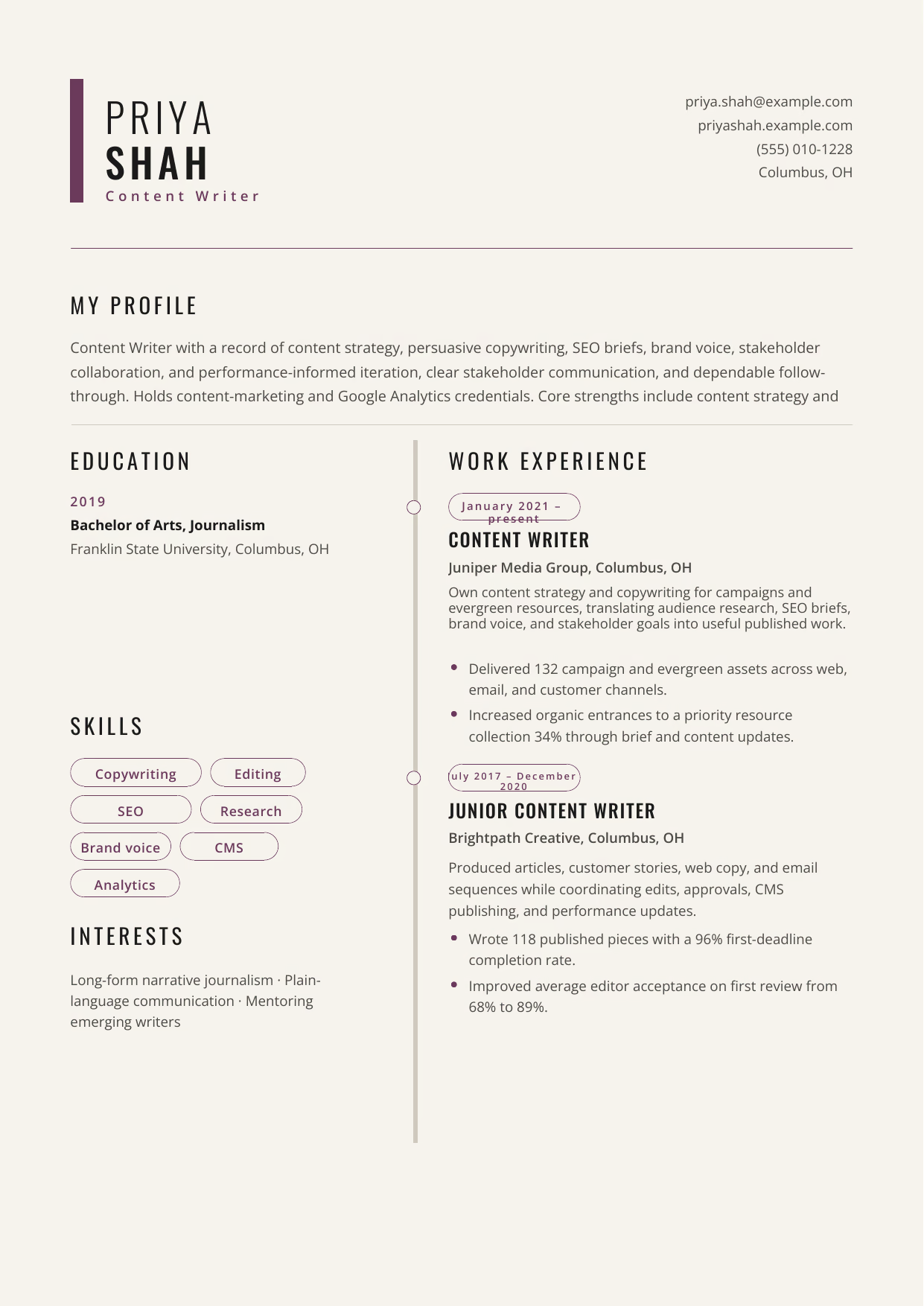
Content Writer
A builder-ready mid-level Writer example in the Caelum template, showing stage-appropriate evidence in a focused, editable resume format.
- Editable role positioning in the Caelum layout
- Role-specific evidence and delivery context
- Review the Caelum structure with a clean visual hierarchy
View this resume
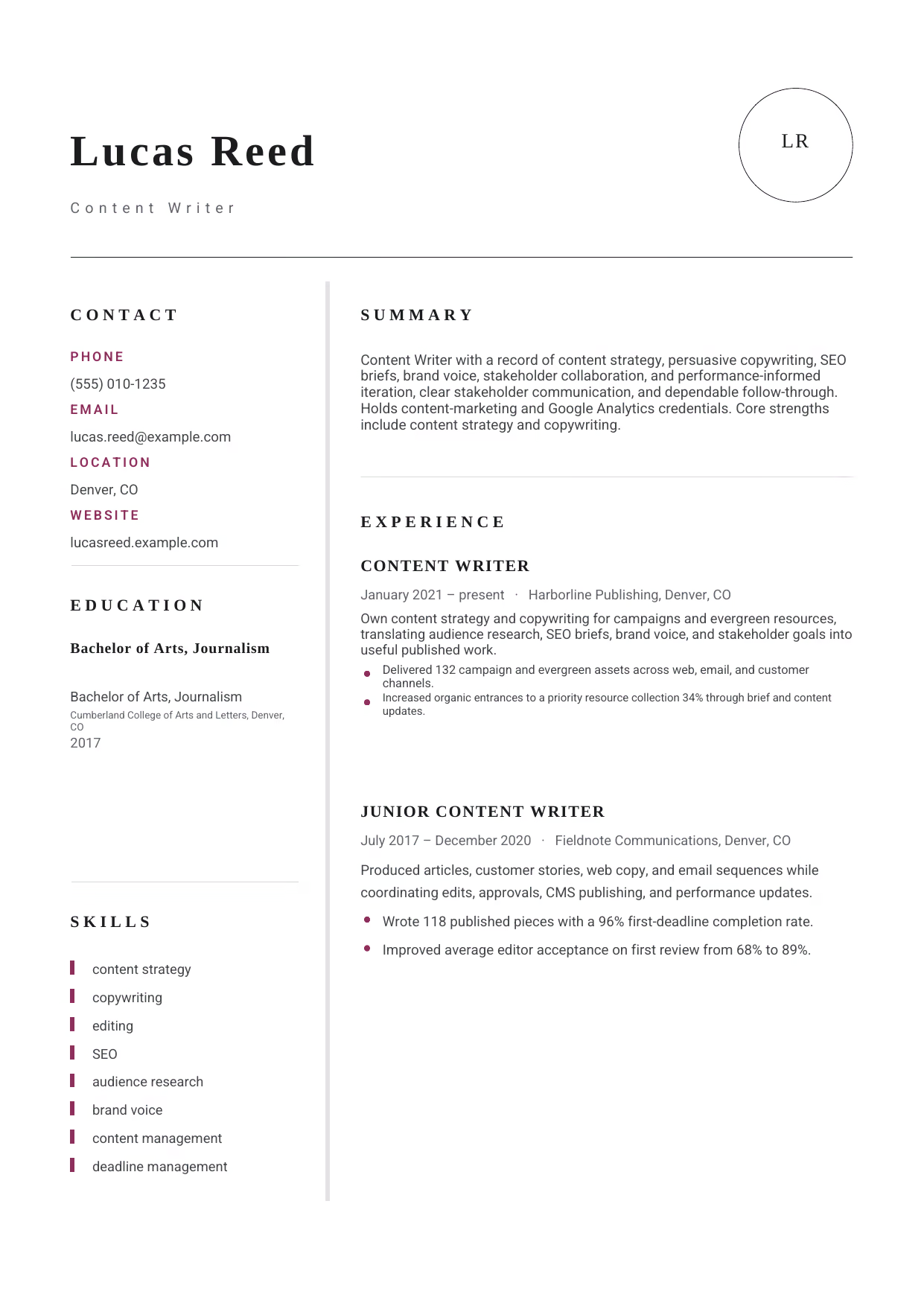
Content Writer
A builder-ready mid-level Writer example in the Grus template, showing stage-appropriate evidence in a focused, editable resume format.
- Editable role positioning in the Grus layout
- Role-specific evidence and delivery context
- Review the Grus structure with a clean visual hierarchy
View this resume
Senior Writer Resume (8+ Years / Management)
Use these advanced examples to compare the scope, evidence, and language expected for Writer roles at this stage.
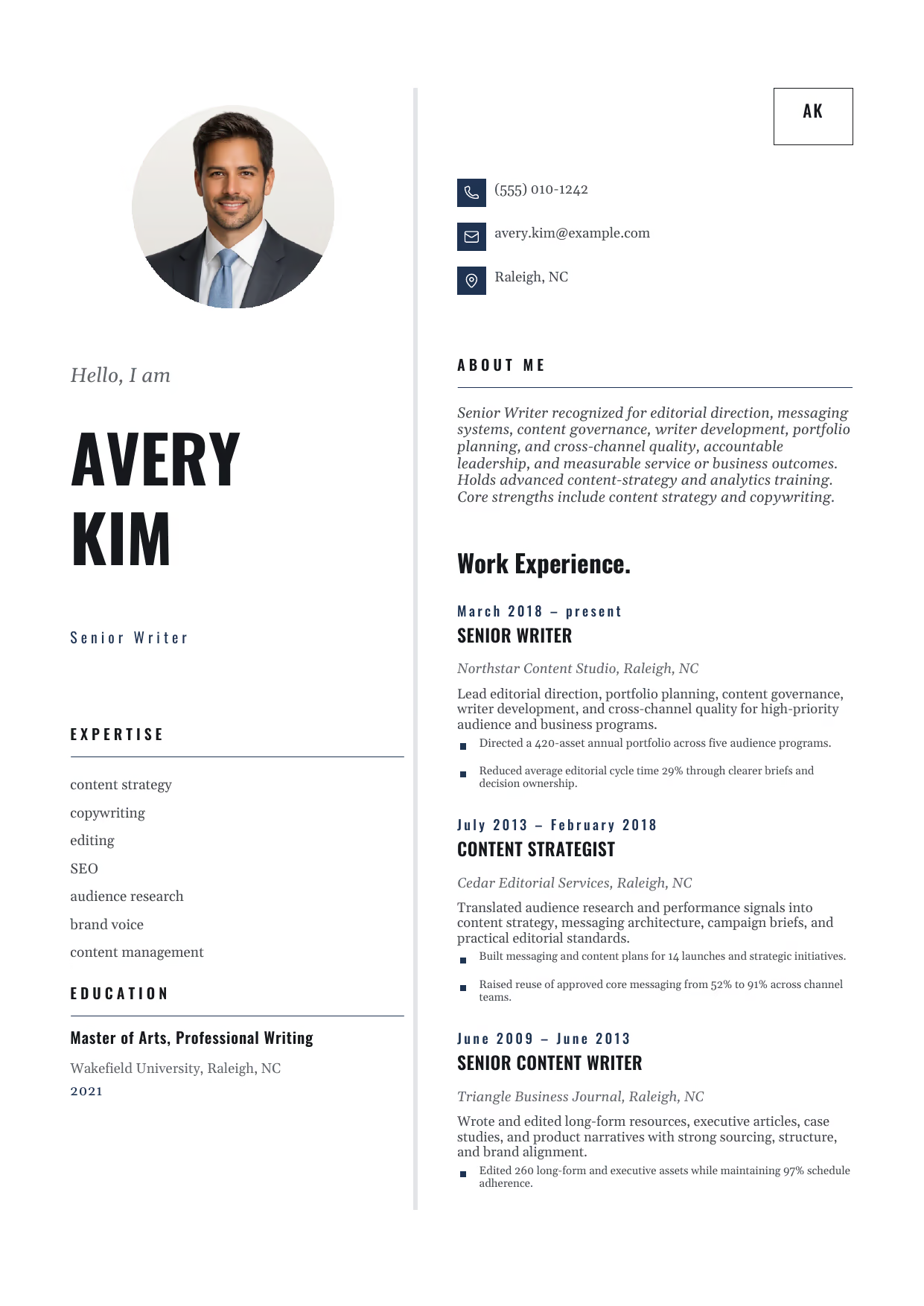
Senior Writer
A builder-ready advanced Writer example in the Equuleus template, showing stage-appropriate evidence in a focused, editable resume format.
- Editable role positioning in the Equuleus layout
- Role-specific evidence and delivery context
- Review the Equuleus structure with a clean visual hierarchy
View this resume
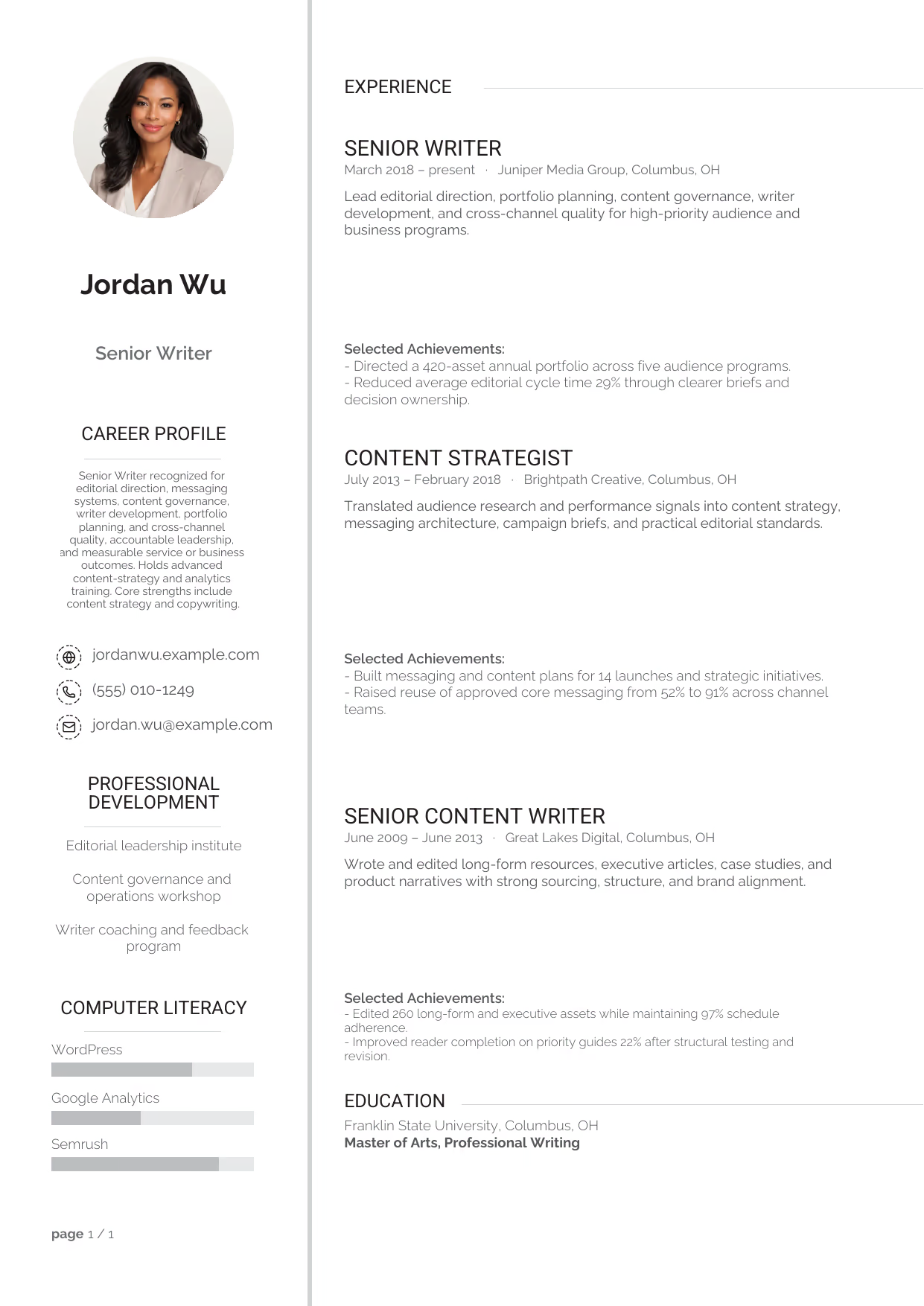
Senior Writer
A builder-ready advanced Writer example in the Synnove template, showing stage-appropriate evidence in a focused, editable resume format.
- Editable role positioning in the Synnove layout
- Role-specific evidence and delivery context
- Review the Synnove structure with a clean visual hierarchy
View this resume
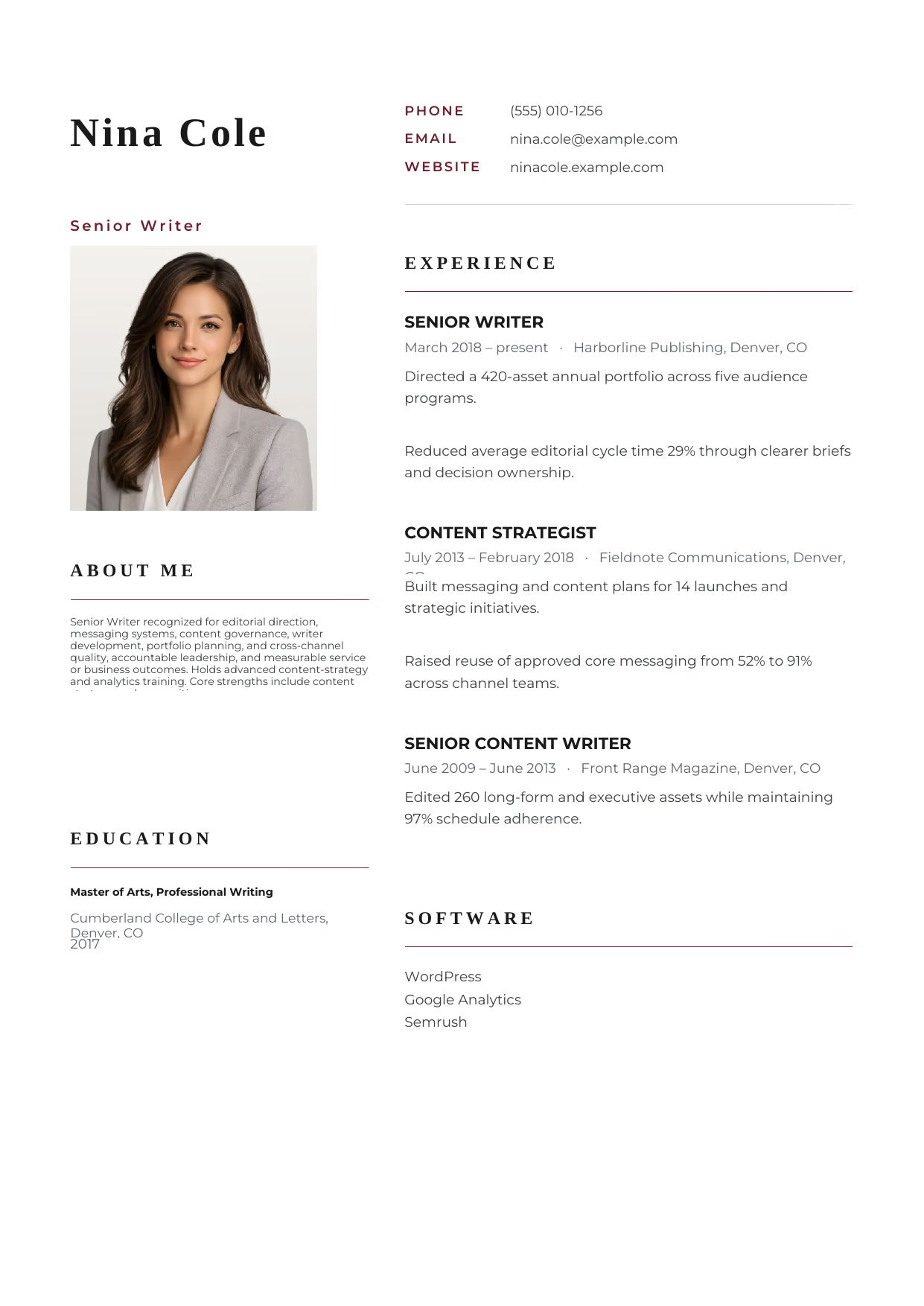
Senior Writer
A builder-ready advanced Writer example in the Hydra template, showing stage-appropriate evidence in a focused, editable resume format.
- Editable role positioning in the Hydra layout
- Role-specific evidence and delivery context
- Review the Hydra structure with a clean visual hierarchy
View this resume
How to Write a Writer Resume
The Resume Summary
The resume summary is your chance to make a strong first impression. It should be a concise overview of your skills, experience, and career goals. Use this formula: [Years of Experience] + [Relevant Skills] + [Key Achievement] + [Career Goal].
Entry-Level Example: Recent English graduate with strong writing and communication skills seeking an entry-level writing position to contribute to a dynamic team.
Mid-Level Example: Results-driven writer with 5+ years of experience in content marketing and SEO, proven ability to increase website traffic, seeking a challenging role to further develop content strategies.
Senior Example: Strategic Senior Writer with 10+ years of experience in leading content marketing teams and developing successful content strategies, seeking to leverage expertise to drive brand awareness and generate leads.
Work Experience & Action Verbs
Distinguish between listing duties and showcasing achievements. Duties describe what you did, while achievements highlight the impact of your work. Focus on quantifying your accomplishments whenever possible.
- Before: Responsible for writing blog posts. After: Increased blog traffic by 20% by writing engaging and SEO-optimized blog posts.
- Before: Created social media content. After: Increased social media engagement by 15% by creating compelling and shareable social media content.
- Before: Edited and proofread content. After: Improved content quality and accuracy by editing and proofreading all marketing materials, reducing errors by 10%.
- Before: Conducted keyword research. After: Identified and implemented relevant keywords, resulting in a 25% increase in organic search traffic.
- Before: Managed content calendar. After: Streamlined content production by managing the content calendar and ensuring timely publication of all content.
Top Skills for Writers
Here are some essential skills to include on your writer resume:
- Hard Skills:
- SEO Writing
- Content Marketing
- Copywriting
- Keyword Research
- Content Strategy
- Social Media Marketing
- Soft Skills:
- Communication Skills
- Creativity
- Adaptability
- Research Skills
- Problem-Solving Skills
- Time Management
- Tools/Software:
- Google Analytics
- SEMrush
- Ahrefs
- WordPress
- Microsoft Office Suite
- Grammarly
Education & Certifications
For entry-level writers, list your education prominently, including relevant coursework and GPA. As you gain experience, move your education section lower on your resume. Consider including certifications to demonstrate your expertise.
Recommended certifications for writers:
- Content Marketing Certification
- SEO Certification
- Copywriting Certification
10 Common Writer Resume Mistakes
- Generic Objective Statements: Avoid vague objectives like “Seeking a challenging position.” Instead, use a targeted summary highlighting specific skills and career goals relevant to the writer position. Recruiters need to quickly understand your value proposition, and a generic statement fails to capture their attention.
- Listing Duties Instead of Impact: Recruiters know what a Writer does; they want to know how well you did it. Replace passive phrases like “Responsible for writing blog posts” with quantified wins like “Increased blog traffic by 20% by writing engaging and SEO-optimized blog posts.”
- Neglecting SEO Keywords: Applicant Tracking Systems (ATS) scan resumes for specific keywords. Failing to include relevant keywords from the job description, such as “SEO writing,” “content marketing,” or “copywriting,” can lead to your resume being automatically rejected.
- Ignoring Formatting and Readability: A cluttered or poorly formatted resume is difficult to read and can create a negative impression. Use clear headings, bullet points, and white space to make your resume visually appealing and easy to scan. Recruiters spend very little time on each resume, so make it easy for them to find the information they need.
- Grammar Errors and Typos: Nothing undermines your credibility as a Writer more than grammatical errors and typos. Proofread your resume carefully and consider asking someone else to review it for you. Even small errors can suggest a lack of attention to detail, a critical attribute for a Writer.
- Inconsistent Verb Tense: Use consistent verb tenses throughout your resume. Use past tense for previous jobs and present tense for your current job. Inconsistent verb tense can make your resume appear unprofessional and sloppy.
- Omitting Relevant Skills: Failing to include relevant skills, such as SEO writing, content marketing, or social media marketing, can weaken your resume. Tailor your skills section to match the requirements of the specific writer position you are applying for.
- Using a Generic Resume for Every Job: A generic resume that is not tailored to the specific job description is unlikely to stand out. Customize your resume for each writer position by highlighting the skills and experience that are most relevant to the job.
- Not Quantifying Achievements: Failing to quantify your achievements makes it difficult for recruiters to assess your impact. Use numbers and metrics to showcase your accomplishments whenever possible. For example, “Increased website traffic by 30%” is much more impactful than “Improved website traffic.”
- Lack of a Professional Summary: Omitting a professional summary can make it difficult for recruiters to quickly understand your value proposition. Use a concise and compelling summary to highlight your key skills, experience, and career goals as a Writer.
Frequently Asked Questions (Writer)
- What should a Writer resume emphasize first? Lead with the scope of well-researched drafts, accurate fact-checking, clean revisions, reliable deadlines, and consistent editorial standards, then connect your contribution to a clear outcome, tool, or decision.
- Which skills deserve priority on a Writer resume? Prioritize content strategy, copywriting, and editing when they match the role and can be supported by evidence.
- How can a Writer show project scope and impact? Name the environment, scale, constraints, and result; content strategy, persuasive copywriting, SEO briefs, brand voice, stakeholder collaboration, and performance-informed iteration becomes more credible when the context is concrete.
- How should a Writer describe tools and technical decisions? Describe why you selected a method, how you implemented it, and what changed afterward in the Writer role.
- Which achievements matter most for a Writer application? Use outcome-led bullets that show editorial direction, messaging systems, content governance, writer development, portfolio planning, and cross-channel quality through delivery quality, measurable scope, or stakeholder value.
- How long should a Writer resume be? Use the shortest length that proves fit; a focused page can work early-career, while broader Writer scope may need more room.
- How can a Writer explain progression between career stages? Group examples by increasing ownership, moving from well-researched drafts, accurate fact-checking, clean revisions, reliable deadlines, and consistent editorial standards toward editorial direction, messaging systems, content governance, writer development, portfolio planning, and cross-channel quality as responsibility grows.
- Which keywords should a Writer include for screening systems? Mirror truthful language from the posting, especially SEO, without stuffing unrelated terms.
- How should a Writer present reliability, quality, or safety work? Show how you protected outcomes through audience research and explain the evidence a hiring team can verify.
- What format makes a Writer resume easy for hiring teams to scan? Use clear headings, readable bullets, and consistent dates so a hiring manager can evaluate Writer fit quickly.
Crafting a compelling writer resume requires careful attention to detail and a strategic approach. By following the examples and tips in this guide, you can create a resume that showcases your skills, experience, and potential.
Ready to take the next step in your career? Search more Writer resources on our site to find even more templates and advice.
RockStarCV Editorial Team