Use this Site Reliability Engineer guide to compare complete editable resumes, choose evidence that fits your career stage, and write a focused application for the customer and work context you want.
Site Reliability Engineer Resume Examples & Guide
The examples connect site reliability engineering, SRE, service level objectives, and observability to credible work evidence. Open any resume in the builder to inspect and edit the full document.
Choose your career stage
Explore editable Site Reliability Engineer resume examples by career stage. Each sample opens in the RockStarCV builder so you can study the structure and make your own version. Every example includes role-relevant education, skills, credentials, and work history—not just a matching headline. As you compare them, look for truthful evidence of automation, Kubernetes, and capacity planning at the seniority level shown.
Entry-Level Site Reliability Engineer Resume
Use these entry-level examples to compare the scope, evidence, and language expected for Site Reliability Engineer roles at this stage.
 Open editable resume
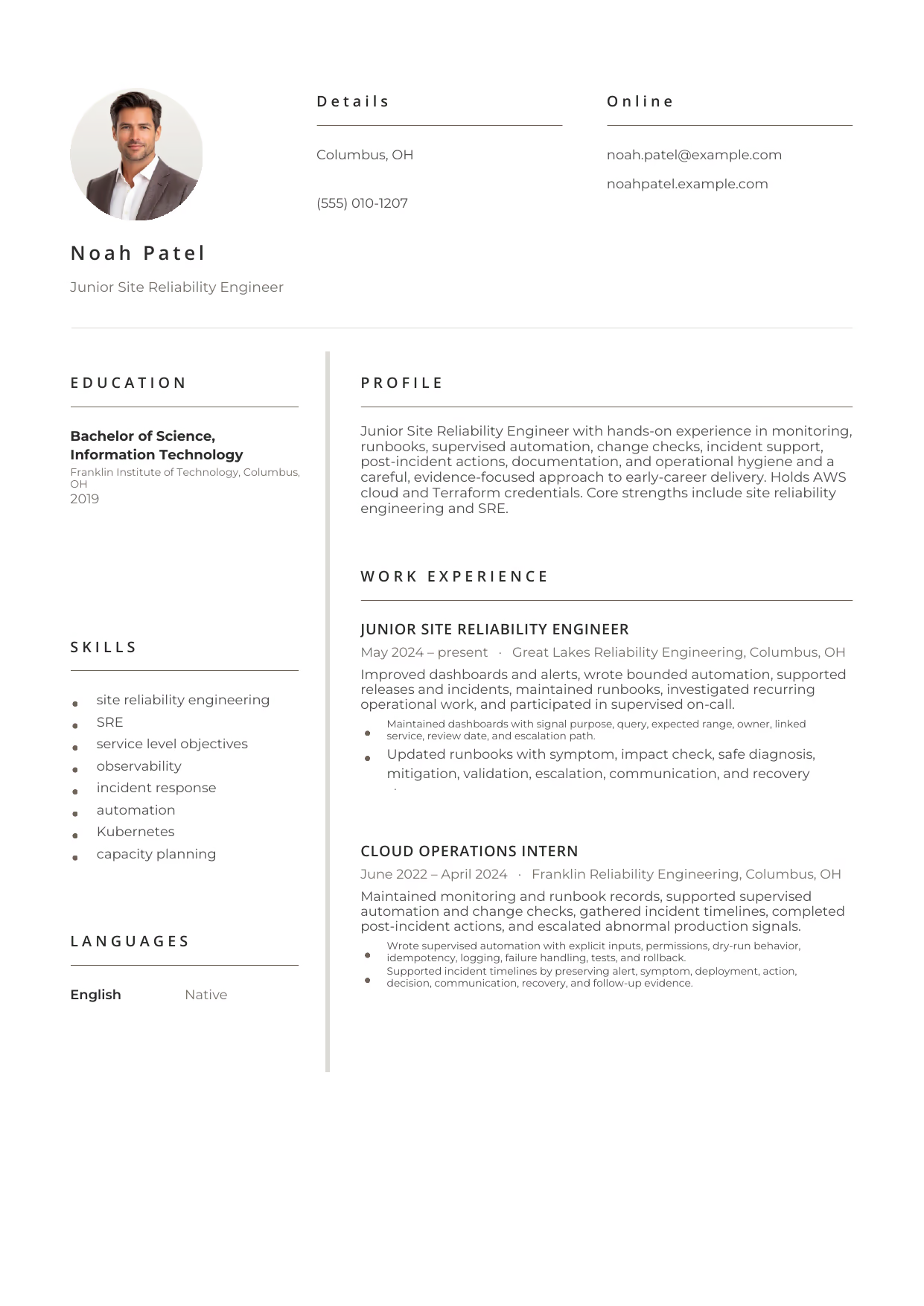
Junior Site Reliability Engineer
Study how this entry-level Junior Site Reliability Engineer resume organizes monitoring, runbooks, supervised automation, change checks, incident support, post-incident actions, documentation, and operational hygiene in the Pegasus template. Replace every example with your own verified scope, tools, decisions, and outcomes.
- Evidence focus: monitoring, runbooks, supervised automation, change checks, incident support, post-incident actions, documentation, and operational hygiene
- Career-stage lens: entry-level scope and ownership
- Layout lens: Pegasus information hierarchy
 Open editable resume
Junior Site Reliability Engineer
Study how this entry-level Junior Site Reliability Engineer resume organizes monitoring, runbooks, supervised automation, change checks, incident support, post-incident actions, documentation, and operational hygiene in the Pictor template. Replace every example with your own verified scope, tools, decisions, and outcomes.
- Evidence focus: monitoring, runbooks, supervised automation, change checks, incident support, post-incident actions, documentation, and operational hygiene
- Career-stage lens: entry-level scope and ownership
- Layout lens: Pictor information hierarchy
 Open editable resume
Junior Site Reliability Engineer
Study how this entry-level Junior Site Reliability Engineer resume organizes monitoring, runbooks, supervised automation, change checks, incident support, post-incident actions, documentation, and operational hygiene in the Eridanus template. Replace every example with your own verified scope, tools, decisions, and outcomes.
- Evidence focus: monitoring, runbooks, supervised automation, change checks, incident support, post-incident actions, documentation, and operational hygiene
- Career-stage lens: entry-level scope and ownership
- Layout lens: Eridanus information hierarchy
Mid-Level Site Reliability Engineer Resume
Use these mid-level examples to compare the scope, evidence, and language expected for Site Reliability Engineer roles at this stage.
 Open editable resume
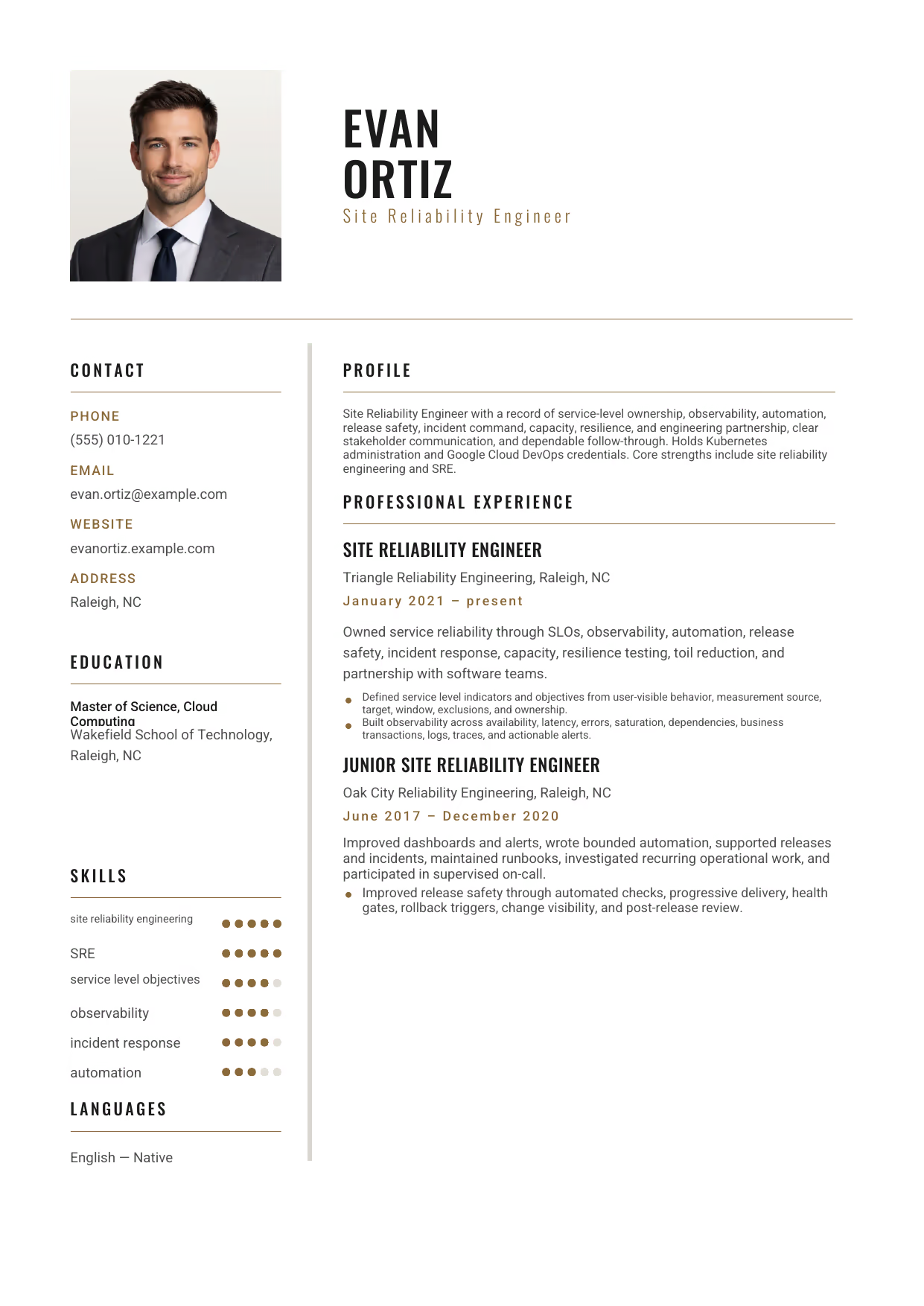
Site Reliability Engineer
Study how this mid-level Site Reliability Engineer resume organizes service-level ownership, observability, automation, release safety, incident command, capacity, resilience, and engineering partnership in the Acamar template. Replace every example with your own verified scope, tools, decisions, and outcomes.
- Evidence focus: service-level ownership, observability, automation, release safety, incident command, capacity, resilience, and engineering partnership
- Career-stage lens: mid-level scope and ownership
- Layout lens: Acamar information hierarchy
 Open editable resume
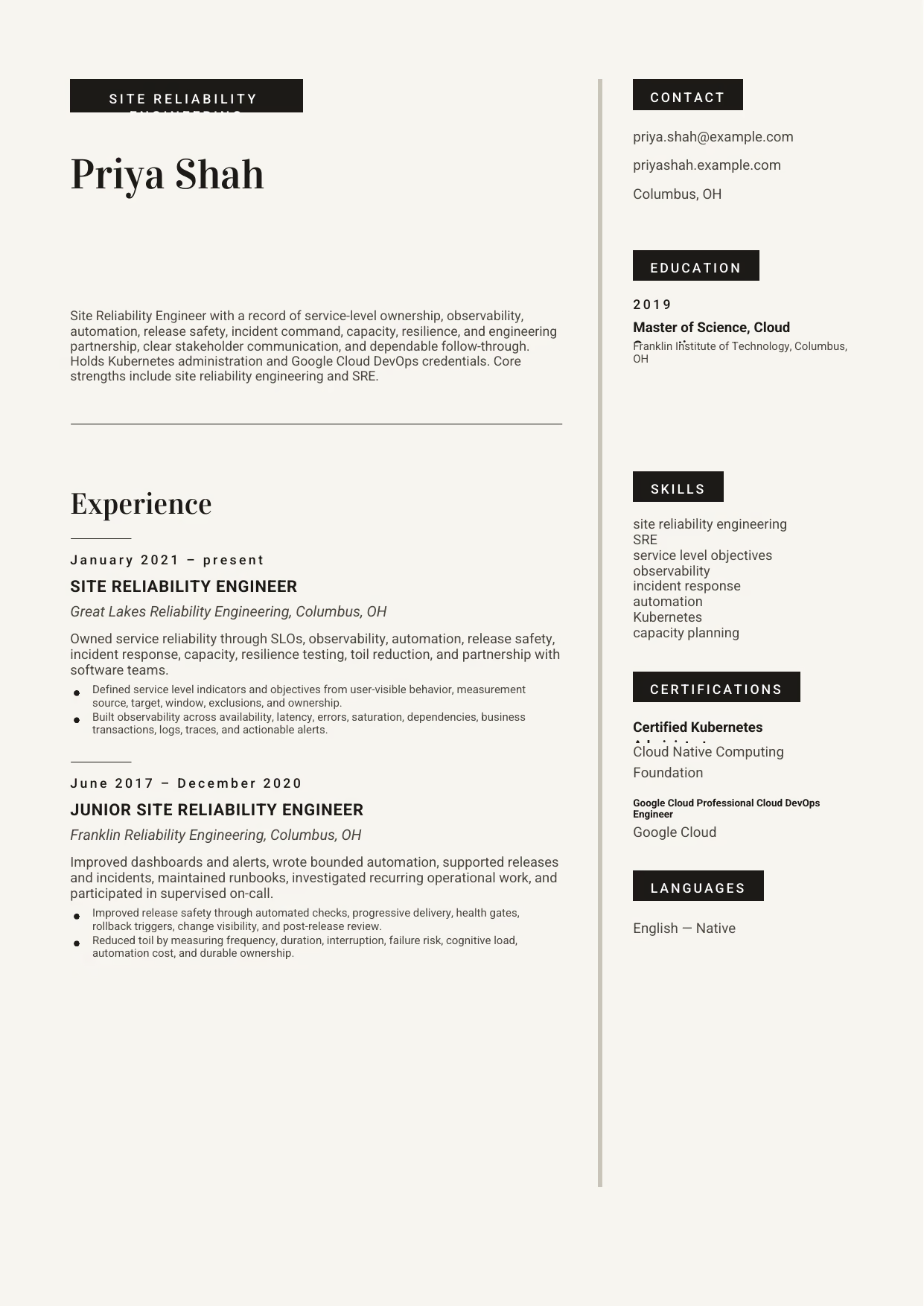
Site Reliability Engineer
Study how this mid-level Site Reliability Engineer resume organizes service-level ownership, observability, automation, release safety, incident command, capacity, resilience, and engineering partnership in the Aquila template. Replace every example with your own verified scope, tools, decisions, and outcomes.
- Evidence focus: service-level ownership, observability, automation, release safety, incident command, capacity, resilience, and engineering partnership
- Career-stage lens: mid-level scope and ownership
- Layout lens: Aquila information hierarchy
 Open editable resume
Site Reliability Engineer
Study how this mid-level Site Reliability Engineer resume organizes service-level ownership, observability, automation, release safety, incident command, capacity, resilience, and engineering partnership in the Caelum template. Replace every example with your own verified scope, tools, decisions, and outcomes.
- Evidence focus: service-level ownership, observability, automation, release safety, incident command, capacity, resilience, and engineering partnership
- Career-stage lens: mid-level scope and ownership
- Layout lens: Caelum information hierarchy
Senior Site Reliability Engineer Resume
Use these advanced examples to compare the scope, evidence, and language expected for Site Reliability Engineer roles at this stage.
 Open editable resume
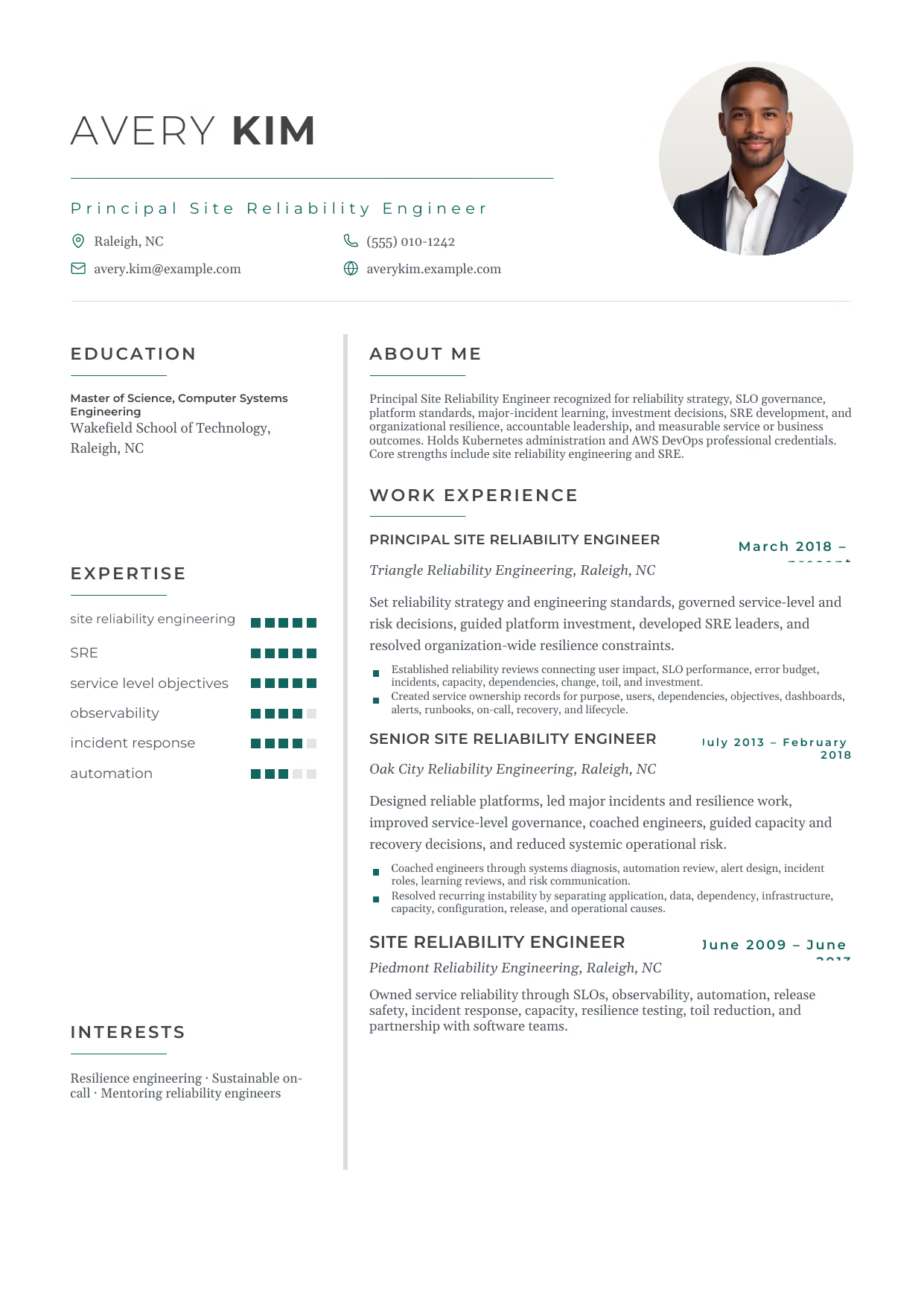
Principal Site Reliability Engineer
Study how this advanced Principal Site Reliability Engineer resume organizes reliability strategy, SLO governance, platform standards, major-incident learning, investment decisions, SRE development, and organizational resilience in the Achernar template. Replace every example with your own verified scope, tools, decisions, and outcomes.
- Evidence focus: reliability strategy, SLO governance, platform standards, major-incident learning, investment decisions, SRE development, and organizational resilience
- Career-stage lens: advanced scope and ownership
- Layout lens: Achernar information hierarchy
 Open editable resume
Principal Site Reliability Engineer
Study how this advanced Principal Site Reliability Engineer resume organizes reliability strategy, SLO governance, platform standards, major-incident learning, investment decisions, SRE development, and organizational resilience in the Equuleus template. Replace every example with your own verified scope, tools, decisions, and outcomes.
- Evidence focus: reliability strategy, SLO governance, platform standards, major-incident learning, investment decisions, SRE development, and organizational resilience
- Career-stage lens: advanced scope and ownership
- Layout lens: Equuleus information hierarchy
 Open editable resume
Principal Site Reliability Engineer
Study how this advanced Principal Site Reliability Engineer resume organizes reliability strategy, SLO governance, platform standards, major-incident learning, investment decisions, SRE development, and organizational resilience in the Grus template. Replace every example with your own verified scope, tools, decisions, and outcomes.
- Evidence focus: reliability strategy, SLO governance, platform standards, major-incident learning, investment decisions, SRE development, and organizational resilience
- Career-stage lens: advanced scope and ownership
- Layout lens: Grus information hierarchy
Choose a direction
Site Reliability Engineer Resume Examples by Specialty
Choose the Site Reliability Engineer path closest to the job you want. Each guide highlights the work, preparation, and evidence hiring teams expect for that specialty.
Specialty 01
Cloud Site Reliability Engineer Resume Examples
- Resume focus:
- cloud services, infrastructure automation, observability, scaling, resilience, and cost-aware reliability;
- Credentials:
- cloud, Kubernetes, Terraform, or DevOps credentials;
- Evidence to include:
- cloud scope, SLOs, automation, incidents, capacity, resilience, and outcomes;
Specialty 02
Platform Reliability Engineer Resume Examples
- Resume focus:
- shared platforms, developer workflows, service levels, operational controls, and reduced toil;
- Credentials:
- cloud-native, platform, Kubernetes, or security credentials;
- Evidence to include:
- platform scope, internal users, objectives, adoption, incidents, toil, and service outcomes;
Specialty 03
Kubernetes SRE Resume Examples
- Resume focus:
- cluster reliability, workloads, networking, storage, policy, upgrades, and observability;
- Credentials:
- CKA, CKAD, CKS, cloud, or Kubernetes credentials;
- Evidence to include:
- clusters, workloads, availability, upgrades, incidents, automation, and capacity;
Specialty 04
DevOps Site Reliability Engineer Resume Examples
- Resume focus:
- delivery automation, infrastructure as code, release safety, observability, and incident learning;
- Credentials:
- DevOps, cloud, Kubernetes, Terraform, or CI/CD credentials;
- Evidence to include:
- pipelines, deployments, rollback, lead time, failures, recovery, and reliability;
Credentials
Site Reliability Engineer Licenses and Certifications
List only current education, licenses, or certifications that apply to the target role. Give the credential name and issuing organization, and leave private identifier numbers off a public resume.
Cloud-native operations
- Current cloud, Kubernetes, or Terraform credential;
- Exact issuer, credential level, and current status;
Reliability and delivery
- DevOps, observability, security, incident, or service-management training;
- Only qualifications connected to the target production environment;
Role language
Site Reliability Engineer Skills and ATS Keywords by Category
Use language that truthfully matches your Site Reliability Engineer experience and the job posting. Pair important terms with a work example instead of presenting an unsupported keyword list.
Skills by category
Reliability engineering
- SLIs, SLOs, error budgets, observability, capacity, and resilience;
- Incident response, post-incident learning, runbooks, and service ownership;
Automation and platforms
- Python or Go, infrastructure as code, cloud, Kubernetes, and CI/CD;
- Progressive delivery, monitoring, security, toil reduction, and cost awareness;
ATS keywords by category
Core SRE keywords
- Site Reliability Engineer, SRE, SLI, SLO, error budget;
- Observability, incident response, capacity planning, resilience;
Platform keywords
- Kubernetes, Terraform, AWS, Prometheus, Grafana, OpenTelemetry;
- Automation, CI/CD, infrastructure as code, toil reduction, on-call;
Writing framework
How to Write a Site Reliability Engineer Resume
Start with the target role and the problems it owns. Select examples that prove site reliability engineering, SRE, and service level objectives; then state the context, your action, the evidence reviewed, and the outcome without inventing facts.
- Use a concise summary that names your field, scope, and strongest supported capabilities;
- Show progression through broader judgment, independence, complexity, and leadership;
- Pair tools and methods with the work they enabled and the quality checks you used;
- Keep dates, headings, credentials, and contact details consistent and easy to scan;
Quality check
10 Common Site Reliability Engineer Resume Mistakes
- Listing site reliability engineering without showing the decision, method, or outcome.
- Naming SRE as a skill without evidence from real work.
- Using the same scope for entry-level, mid-level, and leadership examples.
- Hiding the business or customer question that made the work necessary.
- Presenting tools as a list instead of explaining how they supported delivery.
- Leaving definitions, assumptions, constraints, or quality checks unclear.
- Writing long duty paragraphs instead of focused evidence-led bullets.
- Using unsupported claims or invented metrics that a reviewer cannot verify.
- Ignoring language and priorities stated in the target job description.
- Submitting inconsistent headings, dates, spacing, or contact information.
Common questions
Frequently Asked Questions (Site Reliability Engineer)
What should a Site Reliability Engineer resume emphasize first?
Lead with the scope of monitoring, runbooks, supervised automation, change checks, incident support, post-incident actions, documentation, and operational hygiene, then connect your contribution to a clear outcome, tool, or decision.
Which skills deserve priority on a Site Reliability Engineer resume?
Prioritize site reliability engineering, SRE, and service level objectives when they match the role and can be supported by evidence.
How can a Site Reliability Engineer show project scope and impact?
Name the environment, scale, constraints, and result; service-level ownership, observability, automation, release safety, incident command, capacity, resilience, and engineering partnership becomes more credible when the context is concrete.
How should a Site Reliability Engineer describe tools and technical decisions?
Describe why you selected a method, how you implemented it, and what changed afterward in the Site Reliability Engineer role.
Which achievements matter most for a Site Reliability Engineer application?
Use outcome-led bullets that show reliability strategy, SLO governance, platform standards, major-incident learning, investment decisions, SRE development, and organizational resilience through delivery quality, measurable scope, or stakeholder value.
How long should a Site Reliability Engineer resume be?
Use the shortest length that proves fit; a focused page can work early-career, while broader Site Reliability Engineer scope may need more room.
How can a Site Reliability Engineer explain progression between career stages?
Group examples by increasing ownership, moving from monitoring, runbooks, supervised automation, change checks, incident support, post-incident actions, documentation, and operational hygiene toward reliability strategy, SLO governance, platform standards, major-incident learning, investment decisions, SRE development, and organizational resilience as responsibility grows.
Which keywords should a Site Reliability Engineer include for screening systems?
Mirror truthful language from the posting, especially observability, without stuffing unrelated terms.
How should a Site Reliability Engineer present reliability, quality, or safety work?
Show how you protected outcomes through incident response and explain the evidence a hiring team can verify.
What format makes a Site Reliability Engineer resume easy for hiring teams to scan?
Use clear headings, readable bullets, and consistent dates so a hiring manager can evaluate Site Reliability Engineer fit quickly.
RockStarCV Editorial Team