Nurse Resume Examples & Guide
Landing a nursing position in today’s market can be tough. Applicant Tracking Systems (ATS) filter out many qualified candidates, and the competition is fierce. This guide provides nurse resume examples for every experience level, along with tips to help you stand out.
- Quantify Achievements: Use numbers to showcase the impact of your work, like patients served or efficiency improvements.
- Highlight Relevant Skills: Emphasize skills specific to nursing, such as electronic health record (EHR) navigation and patient monitoring software proficiency.
- Tailor to Job Description: Customize your resume for each application, focusing on the skills and experience the employer seeks.
- Optimize for ATS: Use keywords from the job description throughout your resume to ensure it passes ATS scans.
- Use Action Verbs: Start your bullet points with strong action verbs to describe your accomplishments.
Let’s dive into some resume examples.
Explore editable Nurse resume examples by career stage. Each sample opens in the RockStarCV builder so you can study the structure and make your own version.
Entry-Level Nurse Resume (0-2 Years Experience)
Use these entry-level examples to compare the scope, evidence, and language expected for Nurse roles at this stage.
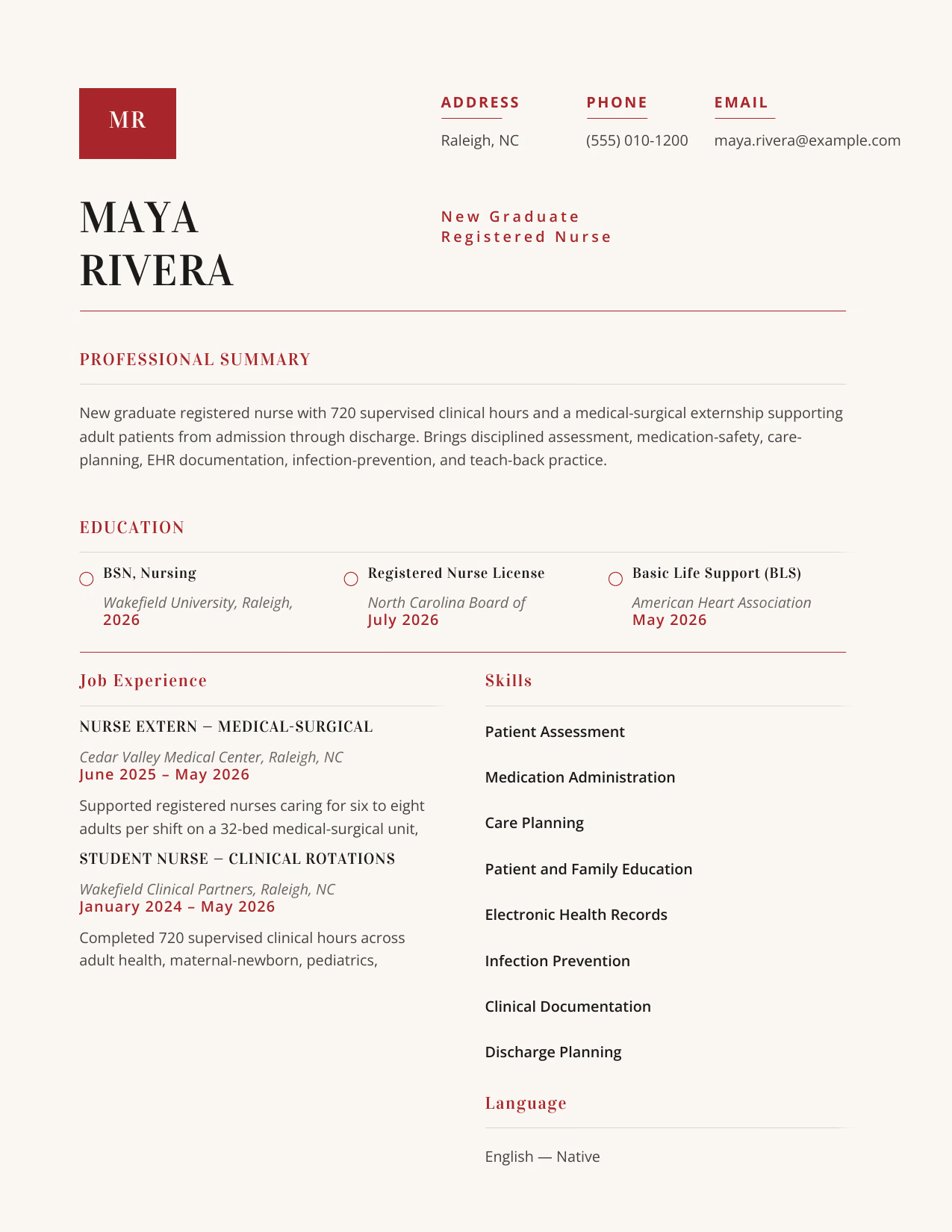
New Graduate Registered Nurse
A builder-ready medical-surgical graduate example showing clinical rotations, patient safety, and accurate documentation.
- Editable role positioning in the Delphinus layout
- Role-specific evidence and delivery context
- Review the Delphinus structure with a clean visual hierarchy
View this resume
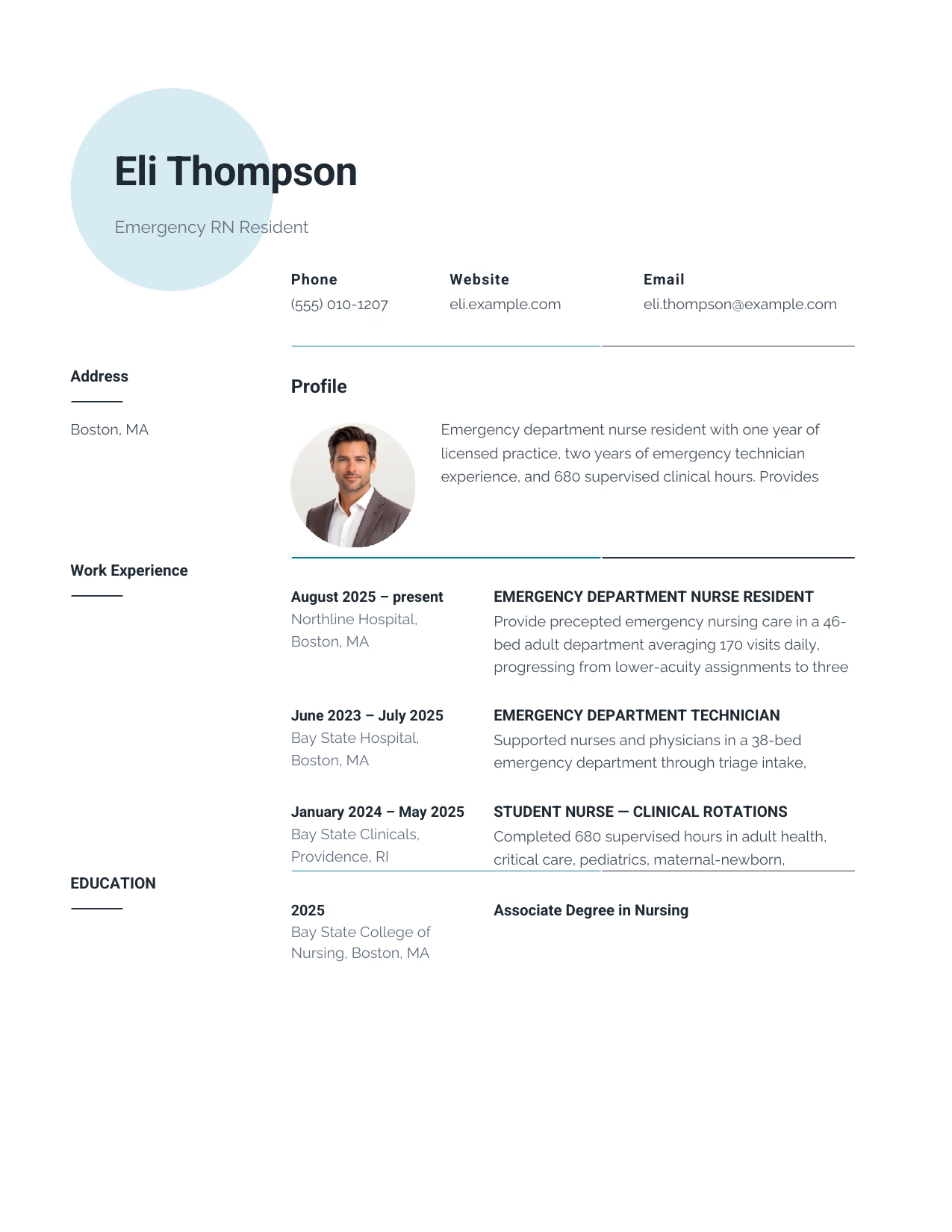
Emergency RN Resident
A builder-ready emergency nursing example showing supervised assessment, escalation, simulation, and patient-safety evidence.
- Editable role positioning in the Pavo layout
- Role-specific evidence and delivery context
- Review the Pavo structure with a clean visual hierarchy
View this resume

Pediatric Nurse Resident
A builder-ready pediatric residency example showing family-centered care, age-appropriate assessment, and medication safety.
- Editable role positioning in the Bootes layout
- Role-specific evidence and delivery context
- Review the Bootes structure with a clean visual hierarchy
View this resume
Mid-Level Nurse Resume (3-7 Years Experience)
Use these mid-level examples to compare the scope, evidence, and language expected for Nurse roles at this stage.
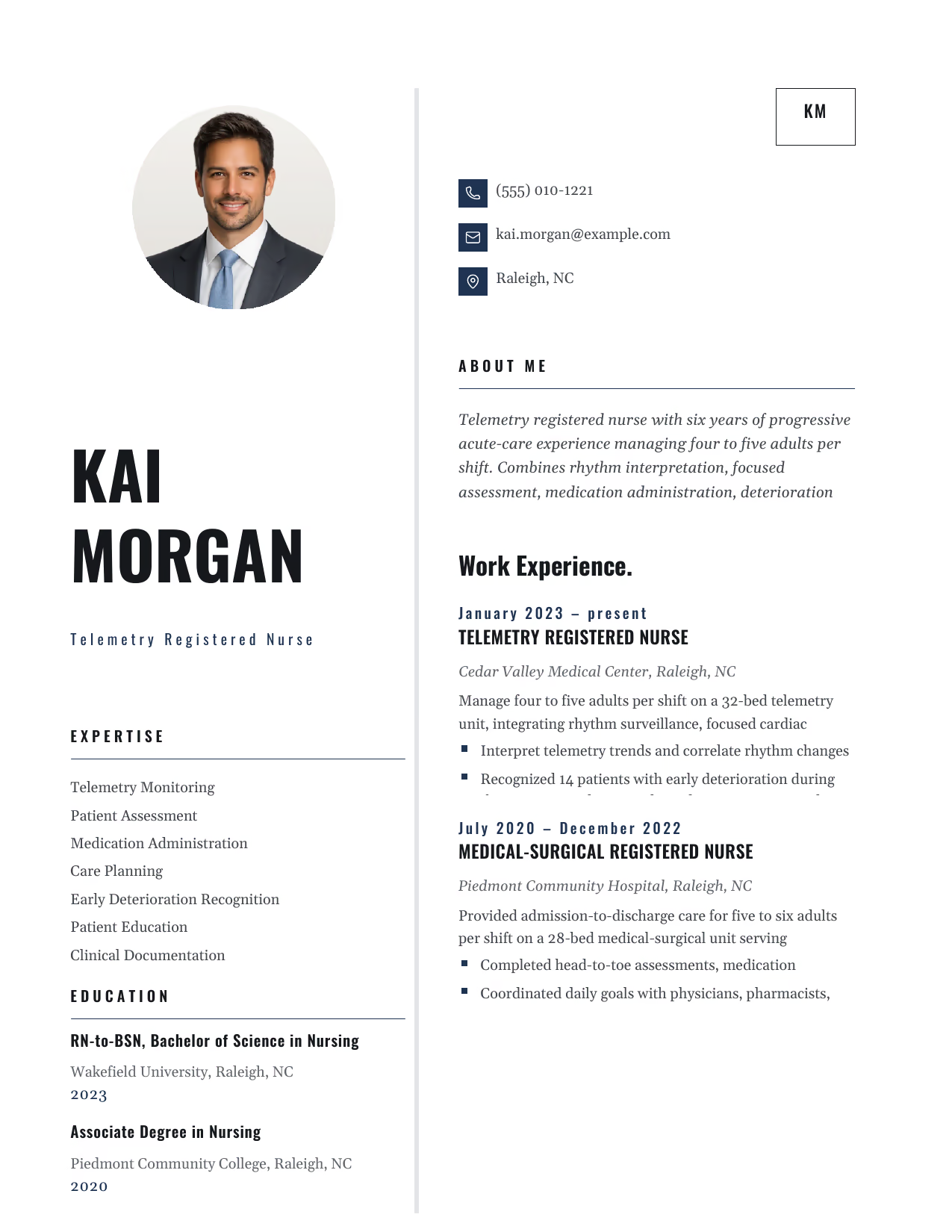
Telemetry Registered Nurse
A builder-ready telemetry example showing rhythm surveillance, deterioration recognition, care coordination, and safe discharge.
- Editable role positioning in the Equuleus layout
- Role-specific evidence and delivery context
- Review the Equuleus structure with a clean visual hierarchy
View this resume
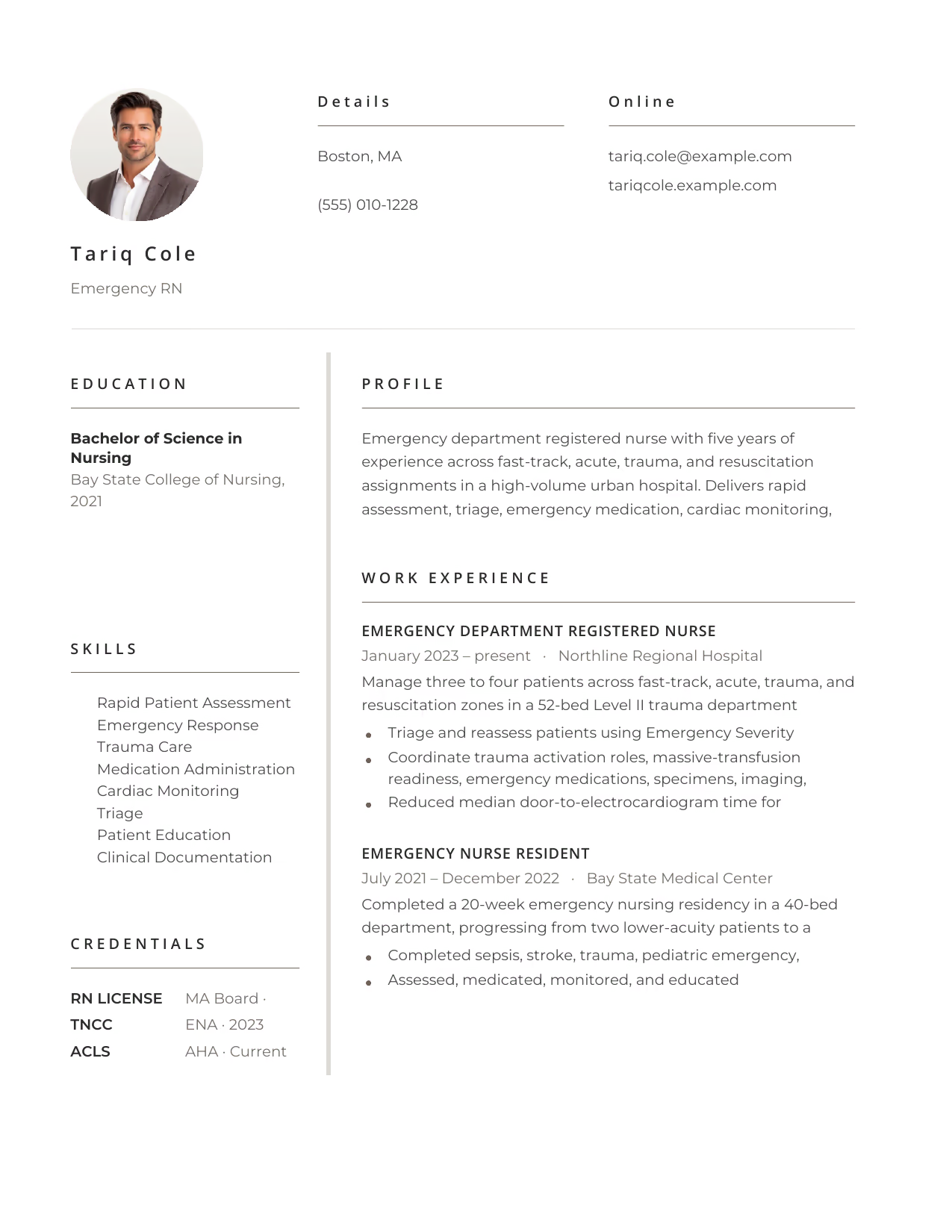
Emergency RN
A builder-ready emergency RN example showing triage, stabilization, trauma response, and high-volume team coordination.
- Editable role positioning in the Pictor layout
- Role-specific evidence and delivery context
- Review the Pictor structure with a clean visual hierarchy
View this resume
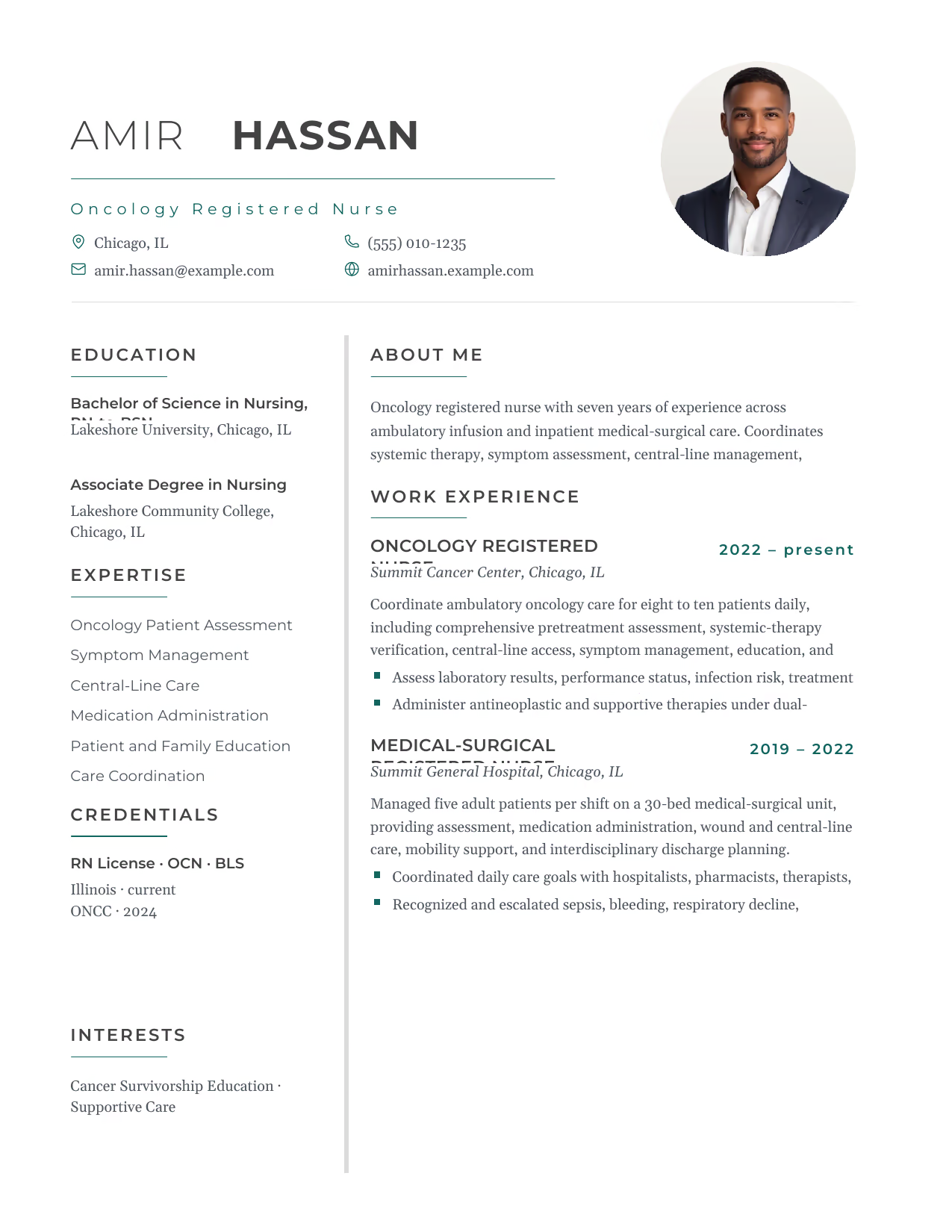
Oncology Registered Nurse
A builder-ready oncology example showing treatment safety, symptom management, patient education, and continuity of care.
- Editable role positioning in the Achernar layout
- Role-specific evidence and delivery context
- Review the Achernar structure with a clean visual hierarchy
View this resume
Senior Nurse Resume (8+ Years / Management)
Use these advanced examples to compare the scope, evidence, and language expected for Nurse roles at this stage.
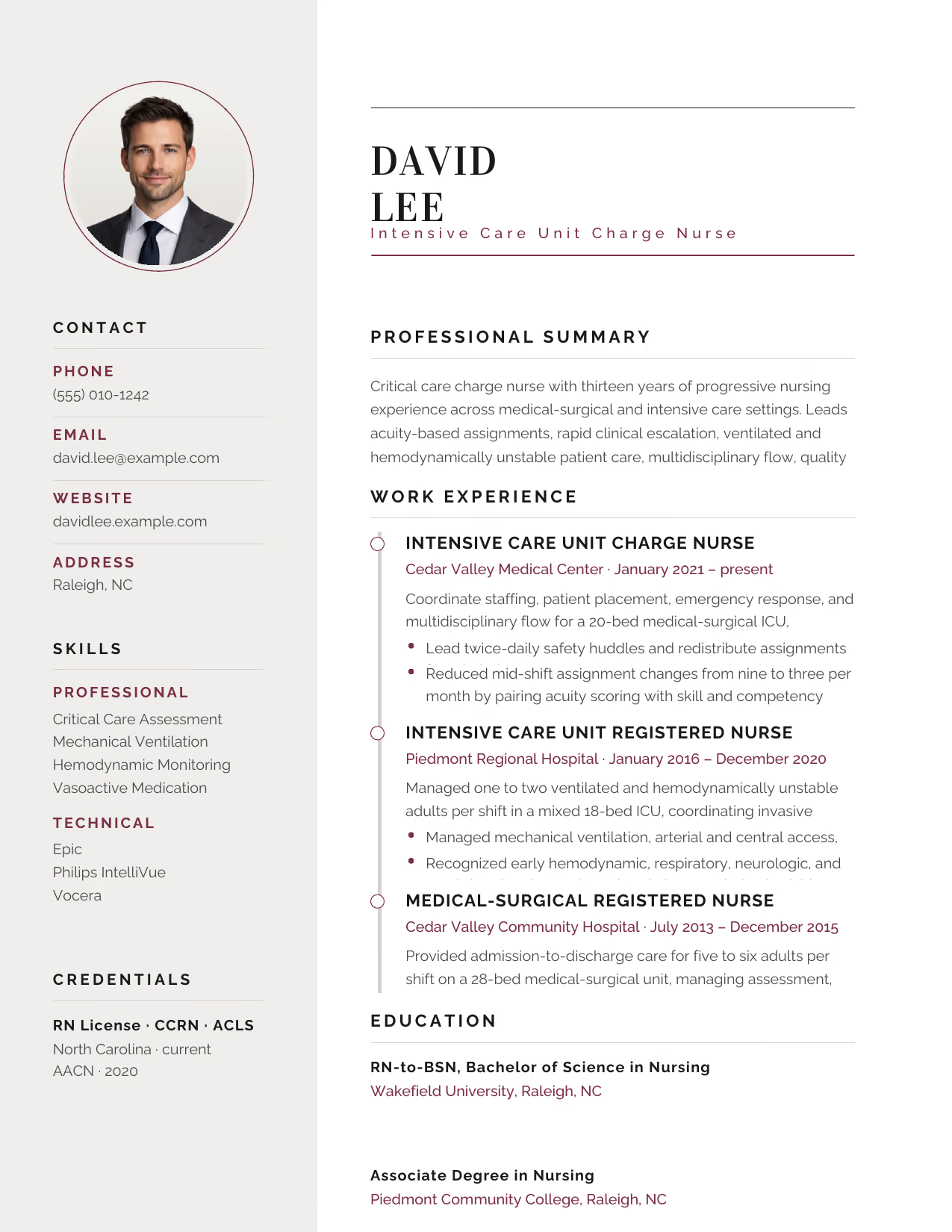
Intensive Care Unit Charge Nurse
A builder-ready ICU leadership example showing critical-care coordination, escalation, mentoring, and quality improvement.
- Editable role positioning in the Cetus layout
- Role-specific evidence and delivery context
- Review the Cetus structure with a clean visual hierarchy
View this resume

Progressive Care Charge RN
A builder-ready progressive-care leadership example showing charge coverage, team development, and measurable care-quality results.
- Editable role positioning in the Hydra layout
- Role-specific evidence and delivery context
- Review the Hydra structure with a clean visual hierarchy
View this resume

Orthopedic and Surgical Charge Nurse
A builder-ready orthopedic and surgical leadership example showing perioperative coordination, mentoring, and safe transitions.
- Editable role positioning in the Puppis layout
- Role-specific evidence and delivery context
- Review the Puppis structure with a clean visual hierarchy
View this resume
Nurse Resume Examples by Specialty
Choose the nurse path closest to the job you want. Each guide highlights the credentials, care setting, and evidence hiring teams expect for that specialty.
Registered Nurse Resume Examples
- Resume focus:
- patient assessment, medication administration, care planning, and measurable patient outcomes;
- Credentials:
- Active RN license; BLS; ACLS when the care setting requires it;
- Evidence to include:
- patient load, unit type, EHR platform, safety record, discharge work, and interdisciplinary collaboration;
Graduate Nurse Resume Examples
- Resume focus:
- clinical rotations, precepted practice, simulation experience, and readiness for supervised patient care;
- Credentials:
- Nursing degree, NCLEX status, RN license status, and BLS;
- Evidence to include:
- rotation units, patient populations, procedures practiced, documentation, and patient education;
ICU Nurse Resume Examples
- Resume focus:
- critical care assessment, hemodynamic monitoring, ventilator support, and rapid escalation;
- Credentials:
- Active RN license; BLS; ACLS; CCRN when held;
- Evidence to include:
- acuity, nurse-to-patient ratios, equipment, code response, and complex care coordination;
ER Nurse Resume Examples
- Resume focus:
- triage, emergency assessment, stabilization, trauma response, and high-volume care;
- Credentials:
- Active RN license; BLS; ACLS; PALS or CEN when held;
- Evidence to include:
- patient volume, trauma level, response time, fast-track work, and emergency procedures;
Oncology Nurse Resume Examples
- Resume focus:
- chemotherapy administration, symptom management, patient education, and continuity of care;
- Credentials:
- Active RN license; BLS; OCN when held;
- Evidence to include:
- treatment protocols, patient education, adverse-reaction monitoring, and team coordination;
School Nurse Resume Examples
- Resume focus:
- student assessment, chronic-condition support, emergency response, and family communication;
- Credentials:
- Active RN license; BLS; school-nurse credential when required;
- Evidence to include:
- student population, care plans, screenings, immunization records, and emergency readiness;
Nurse Licenses and Certifications
List only current credentials that apply to the target setting. Give the credential name, issuing body or state, and renewal status; leave private identifier numbers off a public resume.
License
- Registered Nurse (RN) license;
- Issuing state;
- Expiration or renewal date;
Life-support credentials
- Basic Life Support (BLS);
- Advanced Cardiovascular Life Support (ACLS);
- Pediatric Advanced Life Support (PALS) when relevant;
Specialty credentials
- CCRN for critical care;
- CEN for emergency nursing;
- OCN for oncology nursing;
- Other current specialty certification relevant to the posting;
Nurse Skills and ATS Keywords by Category
Use the language that truthfully matches your experience and the job posting. Pair important terms with a work example instead of presenting an unsupported keyword list.
Skills by category
Clinical care
- Patient assessment;
- Medication administration;
- Care planning;
- Infection control;
- Discharge planning;
Systems and documentation
- Electronic health records;
- Clinical documentation;
- Handoff communication;
- Incident reporting;
- Quality and safety protocols;
Patient and team support
- Patient education;
- Family communication;
- Interdisciplinary collaboration;
- De-escalation;
- Mentoring and precepting;
ATS keywords by category
Credential keywords
- Registered Nurse;
- RN;
- BLS;
- ACLS;
- Active nursing license;
Clinical keywords
- Patient assessment;
- Medication administration;
- Care planning;
- Patient education;
- Infection control;
Setting keywords
- Acute care;
- Critical care;
- Emergency care;
- Outpatient care;
- Long-term care;
How to Write a Nurse Resume
The Resume Summary
The resume summary is your first chance to make a strong impression. It should highlight your key skills, experience, and career goals in a concise and compelling manner.
[Years of Experience] + [Your Title] + [Key Skills] + [Quantifiable Achievement] + [Career Goal]
Entry-Level: Compassionate new graduate nurse with a strong foundation in patient care, seeking a challenging role in a hospital setting to apply clinical skills and contribute to positive patient outcomes.
Mid-Level: Registered Nurse with 5+ years of experience in critical care, dedicated to providing high-quality patient care and improving patient outcomes in a fast-paced hospital environment.
Senior: Experienced Nurse Leader with 10+ years of experience in managing nursing operations, seeking a leadership role to improve patient care and organizational performance through strategic planning and team leadership.
Work Experience & Action Verbs
Focus on achievements rather than just listing duties. Quantify your accomplishments whenever possible to demonstrate the impact of your work.
- Before: Responsible for administering medications. After: Administered medications to an average of 20 patients per shift, ensuring timely and accurate delivery and minimizing medication errors.
- Before: Assisted with patient care. After: Assisted with patient care, including vital signs monitoring, wound care, and hygiene assistance, resulting in improved patient comfort and satisfaction.
- Before: Documented patient information in EHR. After: Documented patient information accurately and efficiently in EHR, ensuring compliance with regulatory requirements and facilitating effective communication among healthcare team members.
- Before: Collaborated with healthcare team members. After: Collaborated with physicians, therapists, and other healthcare professionals to develop and implement individualized patient care plans, resulting in improved patient outcomes.
- Before: Provided patient education. After: Provided patient education on disease management, medication adherence, and healthy lifestyle choices, resulting in improved patient understanding and adherence to treatment plans.
Top Skills for Nurses
Here are some of the most important skills for nurses to include on their resumes:
- Hard Skills:
- Patient Assessment
- Medication Administration
- Wound Care
- Vital Signs Monitoring
- Electronic Health Records (EHR)
- Critical Care
- Emergency Response
- Soft Skills:
- Communication
- Empathy
- Teamwork
- Problem-Solving
- Critical Thinking
- Time Management
- Adaptability
- Tools/Software:
- Epic
- Cerner
- Meditech
- Allscripts
- Electronic Medication Administration Record (eMAR)
- Patient Monitoring Systems
Education & Certifications
List your education in reverse chronological order, starting with your most recent degree. Include your degree name, university name, and graduation date. For experienced nurses, focus on certifications and advanced degrees. Entry-level nurses should highlight relevant coursework and GPA if it’s above 3.5.
Required/Recommended Certifications:
- Registered Nurse (RN) License
- Basic Life Support (BLS)
- Advanced Cardiac Life Support (ACLS)
- Certified Emergency Nurse (CEN)
- Critical Care Registered Nurse (CCRN)
10 Common Nurse Resume Mistakes
- Generic Resume: Sending the same resume for every job. Tailor your resume to each specific job description, highlighting the skills and experience that are most relevant to the position. Generic resumes often fail to pass ATS scans because they lack specific keywords the system is looking for.
- Lack of Quantifiable Achievements: Listing duties instead of accomplishments. Recruiters want to see the impact you’ve made in your previous roles. Replace vague descriptions with quantifiable achievements, such as “Reduced patient readmission rates by 15%.”
- Poor Formatting: Using a cluttered or difficult-to-read format. Use a clean, professional format that is easy to scan. Avoid using excessive fonts, colors, or graphics. A poorly formatted resume can be difficult for ATS to parse, resulting in your application being rejected.
- Grammar and Spelling Errors: Typos and grammatical mistakes make you look unprofessional and careless. Proofread your resume carefully before submitting it. Tools like Grammarly can help catch errors. Misspellings of common medications or medical terminology show a lack of attention to detail.
- Missing Keywords: Failing to include relevant keywords from the job description. ATS systems scan resumes for specific keywords, so it’s important to include them throughout your resume. Review the job description carefully and identify the key skills and qualifications the employer is seeking.
- Irrelevant Information: Including information that is not relevant to the job. Focus on your skills and experience that are directly related to the nursing profession. Remove irrelevant information such as hobbies or unrelated work experience.
- Vague or Generic Language: Using vague or generic language that doesn’t showcase your unique skills and experience. Use specific action verbs and descriptive language to highlight your accomplishments. Avoid using phrases like “responsible for” or “assisted with.”
- Inconsistent Dates: Having inconsistent dates of employment or education. Ensure that all dates are accurate and consistent throughout your resume. Inconsistencies can raise red flags and make it difficult for recruiters to verify your information.
- Omitting Certifications and Licenses: Failing to include relevant certifications and licenses. As a nurse, your certifications and licenses are essential qualifications. Make sure to include them prominently on your resume. Omission can lead to immediate rejection.
- Poor Summary/Objective Statement: Writing a weak or generic summary/objective statement. Your summary/objective statement is your first chance to make a strong impression. Tailor it to the specific job and highlight your key skills and qualifications. A generic statement fails to grab the reader’s attention.
Frequently Asked Questions (Nurse)
- What should a Nurse resume emphasize first? Lead with the scope of clinical rotations, patient safety, and accurate documentation, then connect your contribution to a clear outcome, tool, or decision.
- Which skills deserve priority on a Nurse resume? Prioritize registered nurse, patient assessment, and medication administration when they match the role and can be supported by evidence.
- How can a Nurse show project scope and impact? Name the environment, scale, constraints, and result; acute care, medication administration, and interdisciplinary coordination becomes more credible when the context is concrete.
- How should a Nurse describe tools and technical decisions? Describe why you selected a method, how you implemented it, and what changed afterward in the Nurse role.
- Which achievements matter most for a Nurse application? Use outcome-led bullets that show charge coverage, nurse mentoring, and care-quality leadership through delivery quality, measurable scope, or stakeholder value.
- How long should a Nurse resume be? Use the shortest length that proves fit; a focused page can work early-career, while broader Nurse scope may need more room.
- How can a Nurse explain progression between career stages? Group examples by increasing ownership, moving from clinical rotations, patient safety, and accurate documentation toward charge coverage, nurse mentoring, and care-quality leadership as responsibility grows.
- Which keywords should a Nurse include for screening systems? Mirror truthful language from the posting, especially care planning, without stuffing unrelated terms.
- How should a Nurse present reliability, quality, or safety work? Show how you protected outcomes through patient education and explain the evidence a hiring team can verify.
- What format makes a Nurse resume easy for hiring teams to scan? Use clear headings, readable bullets, and consistent dates so a hiring manager can evaluate Nurse fit quickly.
Crafting a compelling nurse resume requires careful attention to detail and a strategic approach. By following the tips and examples in this guide, you can create a resume that showcases your skills, experience, and qualifications and helps you land your dream job.
Ready to take the next step? Search more Nurse resources on our site to find templates and additional advice!
Editorial review: RockStarCV Editorial Team reviewed this Nurse guide for source fidelity, role-specific usefulness, accessibility, builder examples, and question completeness.