Medical Assistant Resume Examples & Guide
Landing a Medical Assistant position in today’s competitive job market is tough. Applicant Tracking Systems (ATS) filter out countless resumes before a human even sees them. With fierce competition, standing out requires a strategically crafted resume. This guide provides Medical Assistant resume examples for every experience level, from entry-level to seasoned professionals.
- Quantify Achievements: Use numbers and data to showcase the impact of your work.
- Highlight Relevant Skills: Showcase skills like EMR navigation and patient communication.
- Tailor to Job Description: Customize your resume for each specific job application.
- Optimize for ATS: Use keywords from the job description to pass ATS scans.
- Use Action Verbs: Start each bullet point with strong action verbs to demonstrate your accomplishments.
- Showcase Patient Interaction: Highlight experiences where you directly interacted with patients.
- Emphasize Compliance: Mention knowledge of HIPAA and other relevant regulations.
Ready to see how these tips translate into effective resumes? Let’s dive into some examples.
Explore editable Medical Assistant resume examples by career stage. Each sample opens in the RockStarCV builder so you can study the structure and make your own version. Every example includes role-relevant education, skills, credentials, and work history—not just a matching headline. As you compare them, look for truthful evidence of infection control, patient education, and EHR at the seniority level shown.
Entry-Level Medical Assistant Resume (0-2 Years Experience)
Use these entry-level examples to compare the scope, evidence, and language expected for Medical Assistant roles at this stage.

Medical Assistant
A builder-ready entry-level Medical Assistant example in the Bootes template, showing stage-appropriate evidence in a focused, editable resume format.
- Editable role positioning in the Bootes layout
- Role-specific evidence and delivery context
- Review the Bootes structure with a clean visual hierarchy
View this resume
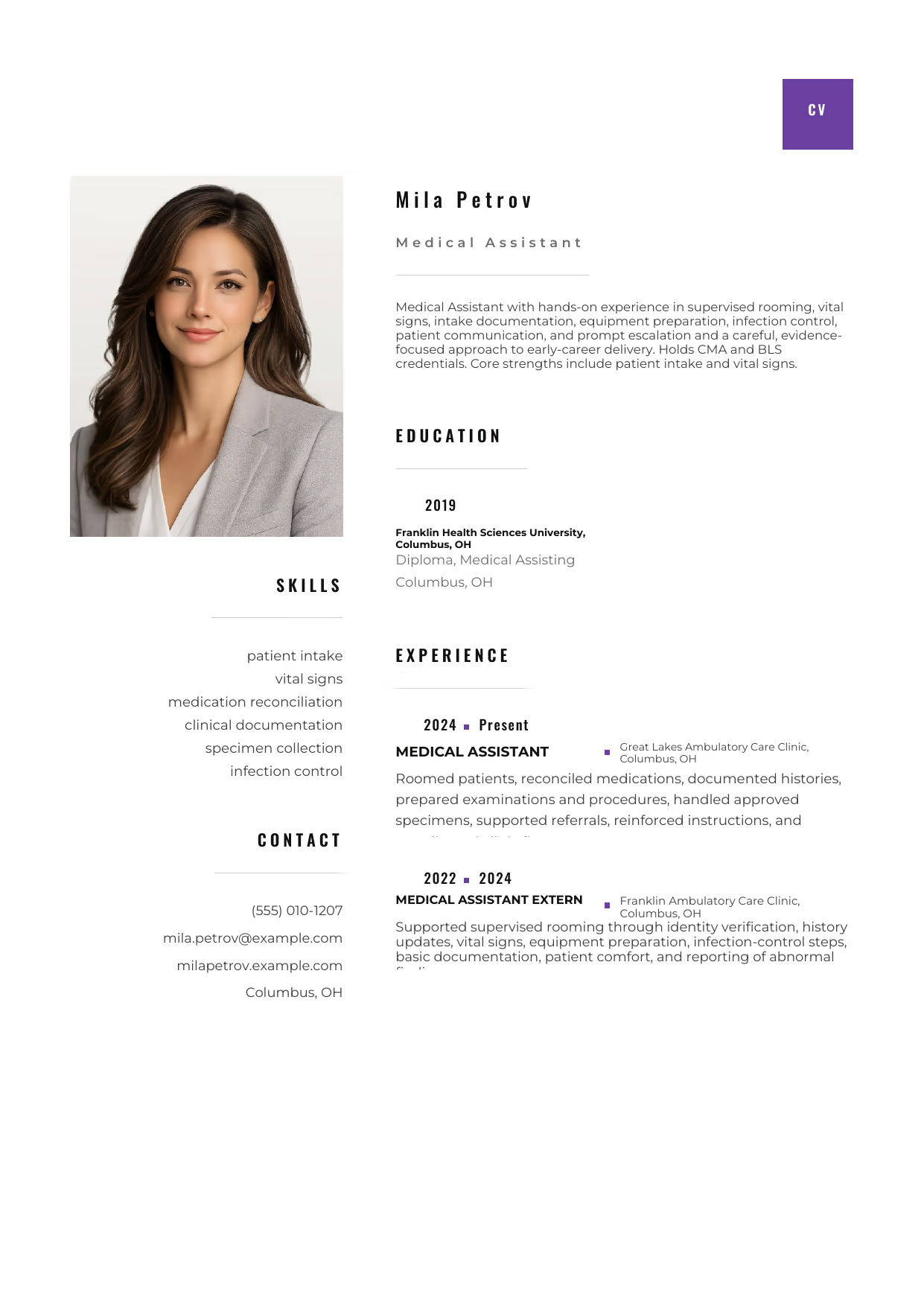
Medical Assistant
A builder-ready entry-level Medical Assistant example in the Pyxis template, showing stage-appropriate evidence in a focused, editable resume format.
- Editable role positioning in the Pyxis layout
- Role-specific evidence and delivery context
- Review the Pyxis structure with a clean visual hierarchy
View this resume
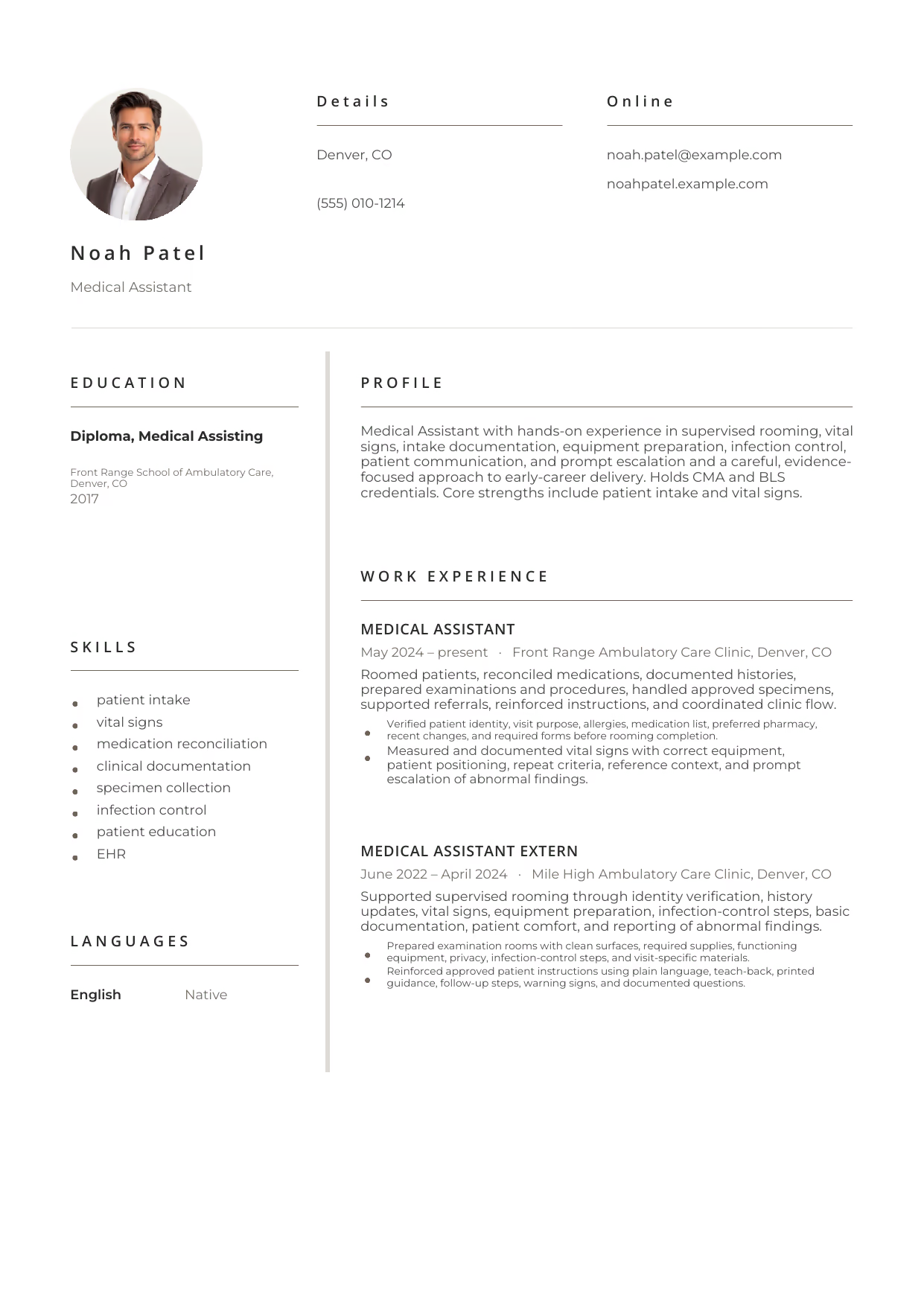
Medical Assistant
A builder-ready entry-level Medical Assistant example in the Pictor template, showing stage-appropriate evidence in a focused, editable resume format.
- Editable role positioning in the Pictor layout
- Role-specific evidence and delivery context
- Review the Pictor structure with a clean visual hierarchy
View this resume
Mid-Level Medical Assistant Resume (3-7 Years Experience)
Use these mid-level examples to compare the scope, evidence, and language expected for Medical Assistant roles at this stage.
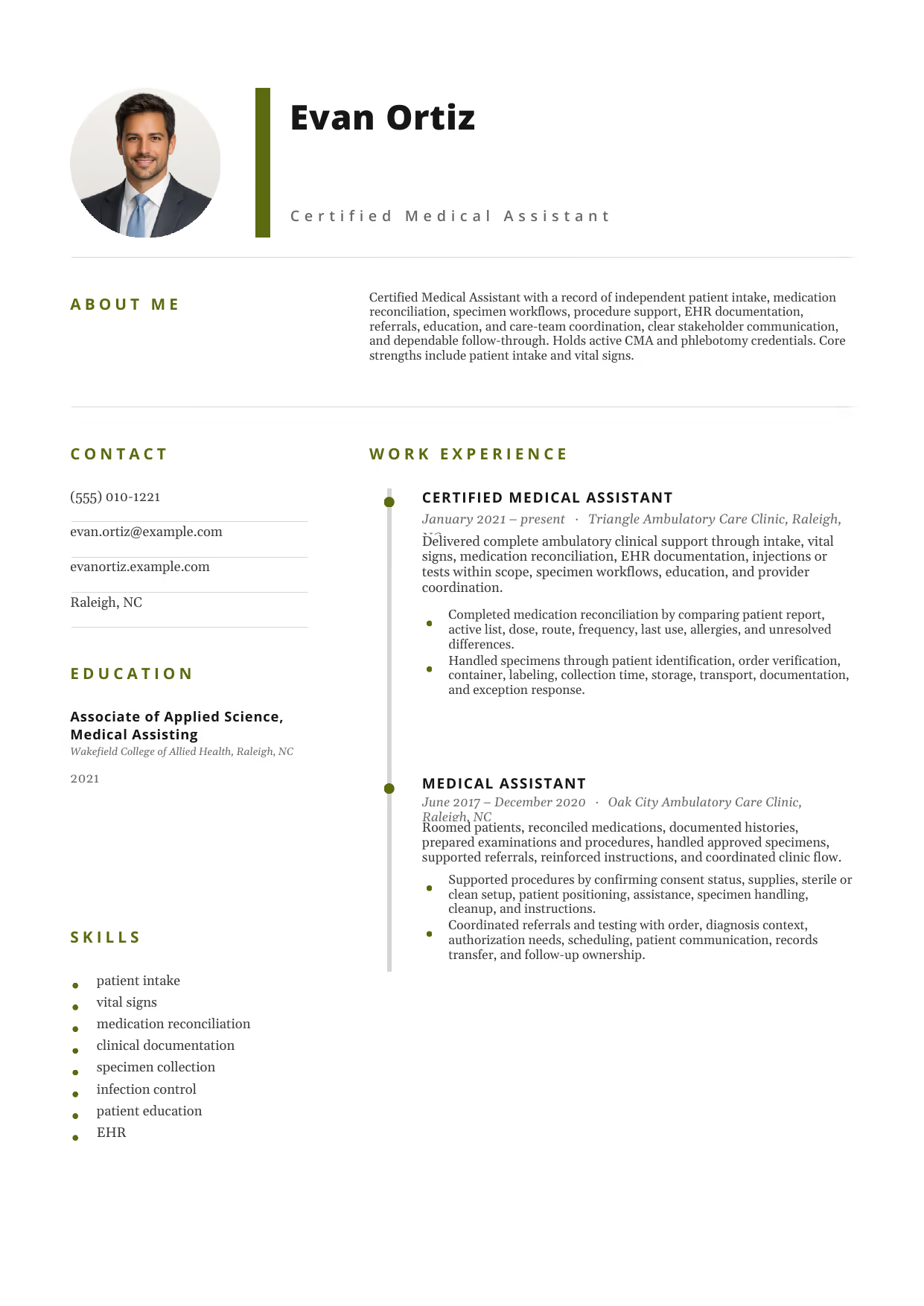
Certified Medical Assistant
A builder-ready mid-level Medical Assistant example in the Pegasus template, showing stage-appropriate evidence in a focused, editable resume format.
- Editable role positioning in the Pegasus layout
- Role-specific evidence and delivery context
- Review the Pegasus structure with a clean visual hierarchy
View this resume

Certified Medical Assistant
A builder-ready mid-level Medical Assistant example in the Aquila template, showing stage-appropriate evidence in a focused, editable resume format.
- Editable role positioning in the Aquila layout
- Role-specific evidence and delivery context
- Review the Aquila structure with a clean visual hierarchy
View this resume

Certified Medical Assistant
A builder-ready mid-level Medical Assistant example in the Andromeda template, showing stage-appropriate evidence in a focused, editable resume format.
- Editable role positioning in the Andromeda layout
- Role-specific evidence and delivery context
- Review the Andromeda structure with a clean visual hierarchy
View this resume
Senior Medical Assistant Resume (8+ Years / Management)
Use these advanced examples to compare the scope, evidence, and language expected for Medical Assistant roles at this stage.
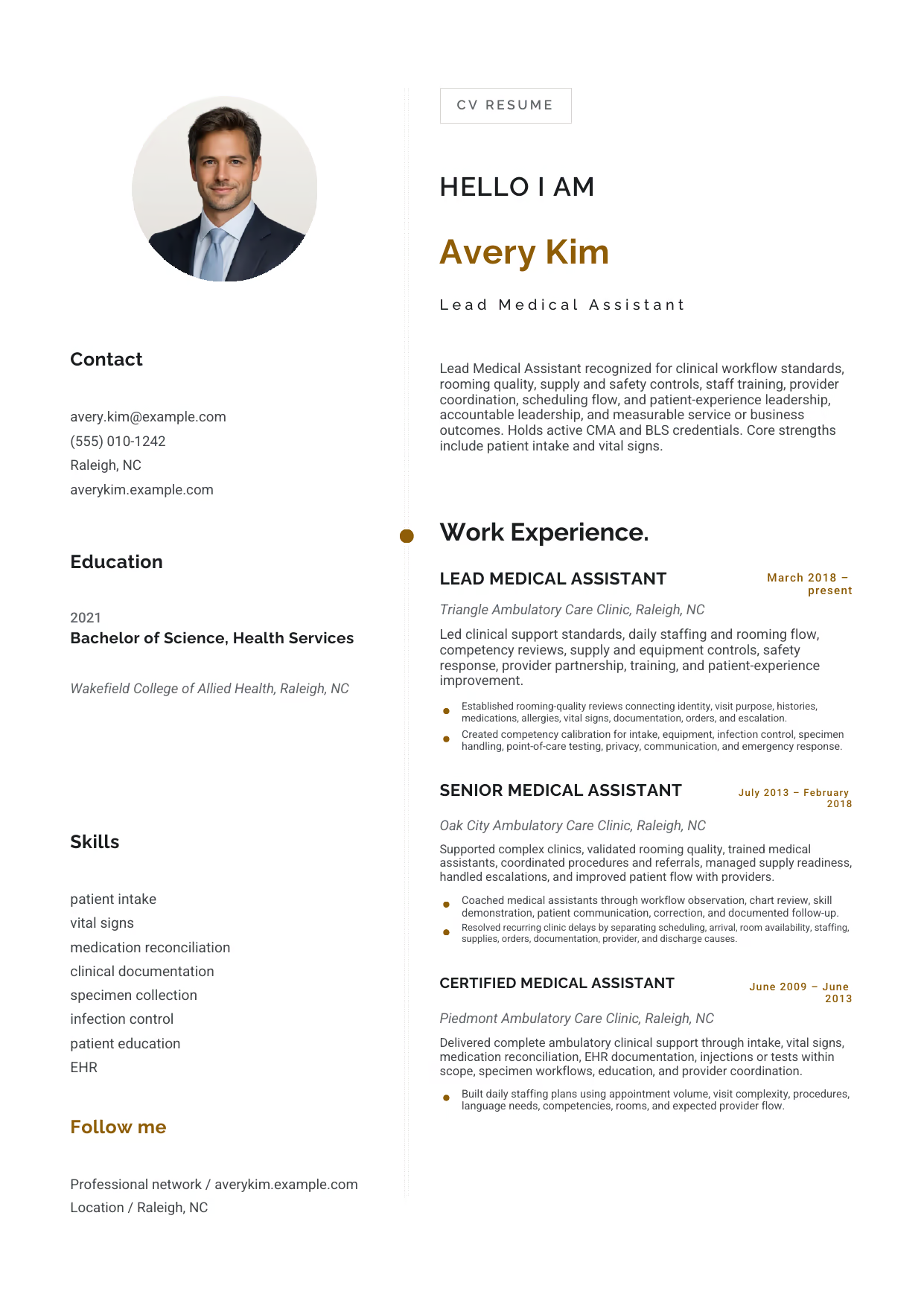
Lead Medical Assistant
A builder-ready advanced Medical Assistant example in the Eridanus template, showing stage-appropriate evidence in a focused, editable resume format.
- Editable role positioning in the Eridanus layout
- Role-specific evidence and delivery context
- Review the Eridanus structure with a clean visual hierarchy
View this resume

Lead Medical Assistant
A builder-ready advanced Medical Assistant example in the Acamar template, showing stage-appropriate evidence in a focused, editable resume format.
- Editable role positioning in the Acamar layout
- Role-specific evidence and delivery context
- Review the Acamar structure with a clean visual hierarchy
View this resume
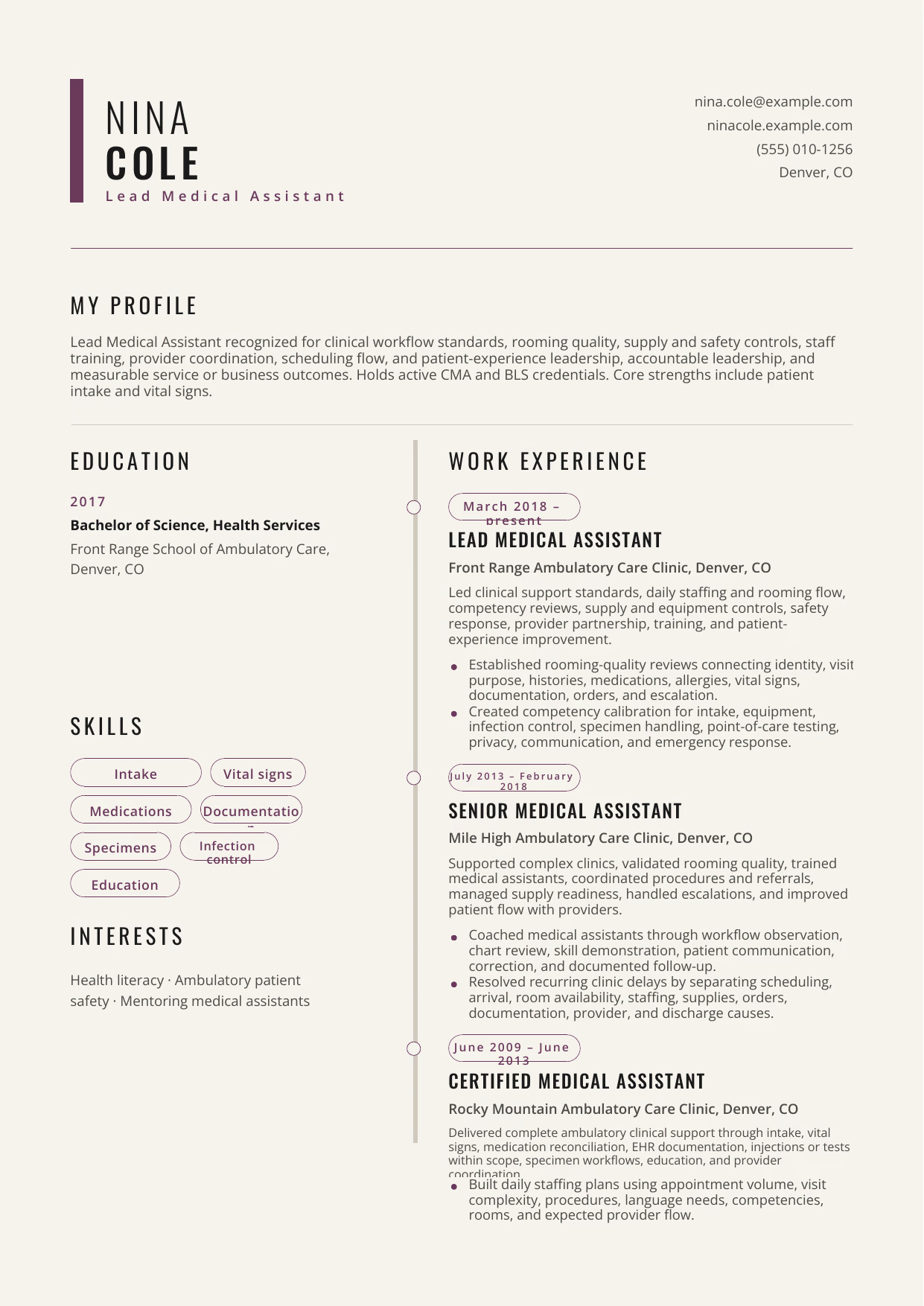
Lead Medical Assistant
A builder-ready advanced Medical Assistant example in the Caelum template, showing stage-appropriate evidence in a focused, editable resume format.
- Editable role positioning in the Caelum layout
- Role-specific evidence and delivery context
- Review the Caelum structure with a clean visual hierarchy
View this resume
Medical Assistant Resume Examples by Specialty
Choose the Medical Assistant path closest to the job you want. Each guide highlights the work, preparation, and evidence hiring teams expect for that specialty.
Certified Medical Assistant Resume Examples
- Resume focus:
- credentialed clinical and administrative support, safe procedures, and complete documentation;
- Credentials:
- Active CMA credential, BLS, and required local training;
- Evidence to include:
- clinic setting, rooming, procedures, documentation, patient education, and coordination;
Clinical Assistant Resume Examples
- Resume focus:
- direct clinical workflow support, equipment readiness, patient care, records, and team coordination;
- Credentials:
- role-appropriate clinical support, life-support, or safety credentials;
- Evidence to include:
- care setting, assigned scope, patient tasks, documentation, handoffs, and safety;
Patient Care Technician Resume Examples
- Resume focus:
- vital signs, mobility, activities of daily living, specimens, observation, and escalation;
- Credentials:
- patient-care, nursing-assistant, phlebotomy, ECG, or BLS credentials;
- Evidence to include:
- patient population, direct-care scope, equipment, observations, escalation, and teamwork;
Medical Office Specialist Resume Examples
- Resume focus:
- scheduling, records, referrals, authorizations, patient communication, and protected information;
- Credentials:
- medical-office, coding, records, privacy, or practice-management training;
- Evidence to include:
- practice setting, transaction types, systems, documentation, coordination, and patient access;
Medical Assistant Licenses and Certifications
List only current education, licenses, or certifications that apply to the target role. Give the credential name and issuing organization, and leave private identifier numbers off a public resume.
Clinical credentials
- Active CMA, RMA, phlebotomy, ECG, or other role-relevant credential;
- Issuer, active status, and renewal information without private credential numbers;
Safety and systems
- BLS, infection-control, privacy, EHR, or point-of-care testing training;
- Only current credentials relevant to the target clinic and permitted scope;
Medical Assistant Skills and ATS Keywords by Category
Use language that truthfully matches your Medical Assistant experience and the job posting. Pair important terms with a work example instead of presenting an unsupported keyword list.
Skills by category
Clinical support
- Patient intake, vital signs, medication reconciliation, and rooming;
- Specimen collection, procedure support, infection control, and patient education;
Coordination and records
- EHR documentation, referrals, scheduling, supply readiness, and follow-up;
- Privacy, escalation, provider communication, clinic flow, and teamwork;
ATS keywords by category
Clinical keywords
- Medical Assistant, patient intake, vital signs, medication reconciliation;
- Clinical documentation, specimen collection, infection control, patient education;
Systems and credential keywords
- CMA, BLS, EHR, HIPAA, ambulatory care;
- Point-of-care testing, referrals, procedure support, clinic flow;
How to Write a Medical Assistant Resume
The Resume Summary
The resume summary is your first impression. Make it count! Use this formula:
[Adjective] + Medical Assistant with [Number] years of experience in [Area of Expertise]. Proven ability to [Key Achievement 1] and [Key Achievement 2]. Seeking to leverage skills in [Skill 1], [Skill 2], and [Skill 3] to contribute to [Company Name].
Entry-Level Example:
Enthusiastic Medical Assistant with a strong foundation in patient care and administrative tasks. Eager to apply learned knowledge and exceptional communication skills to provide excellent patient support and contribute to a positive healthcare environment.
Mid-Level Example:
Dedicated Medical Assistant with 5+ years of experience providing comprehensive patient care in a fast-paced clinic setting. Proven ability to improve patient satisfaction and streamline administrative processes. Proficient in phlebotomy, EKG administration, and medication administration.
Senior Example:
Highly accomplished and results-oriented Senior Medical Assistant with 10+ years of experience in healthcare management. Proven ability to lead and develop high-performing teams, manage budgets, and implement process improvements to enhance patient care and operational efficiency.
Work Experience & Action Verbs
The work experience section is where you showcase your accomplishments. Focus on achievements, not just duties. Instead of listing responsibilities, quantify your impact with numbers and data.
- Before: Responsible for taking patient vital signs. After: Accurately recorded vital signs for 50+ patients daily, ensuring timely and efficient patient flow.
- Before: Assisted physicians with examinations. After: Assisted physicians with over 200 patient examinations per month, contributing to a 10% increase in patient throughput.
- Before: Managed patient records. After: Maintained accurate and up-to-date patient records, ensuring compliance with HIPAA regulations and facilitating efficient information retrieval.
- Before: Scheduled patient appointments. After: Streamlined appointment scheduling process, reducing patient wait times by 15% and improving patient satisfaction.
- Before: Administered medications. After: Administered medications to patients according to physician orders, ensuring accurate dosage and timely delivery, resulting in zero medication errors.
Top Skills for Medical Assistants
Here are some top skills to include on your Medical Assistant resume:
Hard Skills:
- Phlebotomy
- EKG Administration
- Medication Administration
- Vital Signs Monitoring
- Patient Assessment
- Infection Control
- Electronic Health Records (EMR)
Soft Skills:
- Communication (Verbal and Written)
- Empathy and Compassion
- Organization and Time Management
- Problem-Solving
- Attention to Detail
- Teamwork
Tools/Software:
- [Specific EMR System 1]
- [Specific EMR System 2]
- Microsoft Office Suite
- Medical Billing Software
Education & Certifications
For entry-level candidates, list your education prominently. For mid-level and senior candidates, focus on certifications and advanced degrees.
Required or recommended certifications include:
- Certified Medical Assistant (CMA)
- Registered Medical Assistant (RMA)
- Certified Medical Manager (CMM)
- Basic Life Support (BLS) Certification
10 Common Medical Assistant Resume Mistakes
- Generic Objective Statements: A vague objective like “Seeking a challenging position” wastes valuable resume real estate. Instead, tailor a concise summary highlighting your key skills and career goals, specifically aligning with the Medical Assistant role and the clinic’s mission. This shows you’ve researched the position and aren’t just sending out mass applications.
- Listing Duties Instead of Impact: Recruiters know what a Medical Assistant does; they want to know how well you did it. Replace passive phrases like ‘Responsible for taking vitals’ with quantified wins like ‘Accurately recorded vital signs for 50+ patients daily, ensuring timely and efficient patient flow’.
- Ignoring Keywords: Applicant Tracking Systems (ATS) scan resumes for specific keywords related to the Medical Assistant profession. Neglecting to include relevant terms from the job description, such as ‘EMR’, ‘Phlebotomy’, ‘Patient Care’, or ‘HIPAA Compliance’, will result in your resume being automatically rejected.
- Lack of Quantifiable Achievements: Failing to include metrics makes it difficult for hiring managers to assess your impact. Use numbers to showcase your accomplishments, such as ‘Improved patient satisfaction scores by 15%’ or ‘Reduced patient wait times by 20%’. This demonstrates tangible results and sets you apart from other candidates.
- Poor Formatting and Readability: A cluttered and disorganized resume is difficult to read and will likely be overlooked. Use clear headings, bullet points, and white space to create a visually appealing and easy-to-scan document. Choose a professional font and maintain consistent formatting throughout the resume.
- Grammar and Spelling Errors: Typos and grammatical errors make you appear unprofessional and careless. Proofread your resume carefully before submitting it, or ask a friend or colleague to review it for you. Even a small mistake can cost you an interview opportunity.
- Inconsistent Tense: Using inconsistent verb tenses (e.g., mixing present and past tense within the same bullet point) reflects poorly on your attention to detail. Describe past experiences using past tense verbs and current roles using present tense. Consistency makes your resume clearer and more professional.
- Omitting Relevant Skills: Failing to list all relevant hard and soft skills can hinder your chances of getting an interview. Include a dedicated skills section that highlights your technical abilities (e.g., phlebotomy, EKG administration) and interpersonal skills (e.g., communication, empathy). Tailor the skills section to match the requirements of the job description.
- Including Irrelevant Information: Listing hobbies or irrelevant work experience can distract from your qualifications and make your resume appear unfocused. Focus on showcasing experiences and skills that are directly related to the Medical Assistant role. Keep your resume concise and relevant.
- Not Tailoring to the Job Description: Submitting a generic resume without tailoring it to the specific job description is a common mistake. Customize your resume for each application, highlighting the skills and experiences that are most relevant to the position. This shows that you’ve taken the time to understand the requirements and are genuinely interested in the opportunity.
Frequently Asked Questions (Medical Assistant)
- What should a Medical Assistant resume emphasize first? Lead with the scope of supervised rooming, vital signs, intake documentation, equipment preparation, infection control, patient communication, and prompt escalation, then connect your contribution to a clear outcome, tool, or decision.
- Which skills deserve priority on a Medical Assistant resume? Prioritize patient intake, vital signs, and medication reconciliation when they match the role and can be supported by evidence.
- How can a Medical Assistant show project scope and impact? Name the environment, scale, constraints, and result; independent patient intake, medication reconciliation, specimen workflows, procedure support, EHR documentation, referrals, education, and care-team coordination becomes more credible when the context is concrete.
- How should a Medical Assistant describe tools and technical decisions? Describe why you selected a method, how you implemented it, and what changed afterward in the Medical Assistant role.
- Which achievements matter most for a Medical Assistant application? Use outcome-led bullets that show clinical workflow standards, rooming quality, supply and safety controls, staff training, provider coordination, scheduling flow, and patient-experience leadership through delivery quality, measurable scope, or stakeholder value.
- How long should a Medical Assistant resume be? Use the shortest length that proves fit; a focused page can work early-career, while broader Medical Assistant scope may need more room.
- How can a Medical Assistant explain progression between career stages? Group examples by increasing ownership, moving from supervised rooming, vital signs, intake documentation, equipment preparation, infection control, patient communication, and prompt escalation toward clinical workflow standards, rooming quality, supply and safety controls, staff training, provider coordination, scheduling flow, and patient-experience leadership as responsibility grows.
- Which keywords should a Medical Assistant include for screening systems? Mirror truthful language from the posting, especially clinical documentation, without stuffing unrelated terms.
- How should a Medical Assistant present reliability, quality, or safety work? Show how you protected outcomes through specimen collection and explain the evidence a hiring team can verify.
- What format makes a Medical Assistant resume easy for hiring teams to scan? Use clear headings, readable bullets, and consistent dates so a hiring manager can evaluate Medical Assistant fit quickly.
Ready to take the next step? Search more Medical Assistant resources on our site to find templates and additional advice!
RockStarCV Editorial Team