Land Surveyor Resume Examples | Free Downloadable Templates
Land surveying is a detail-oriented profession that requires a blend of technical expertise and practical fieldwork. Your resume needs to showcase both. Whether you’re breaking into the field or aiming for a senior role, these land surveyor resume examples will guide you in crafting a compelling document that highlights your skills and experience.
Explore editable Land Surveyor resume examples by career stage. Each sample opens in the RockStarCV builder so you can study the structure and make your own version.
Entry-Level Land Surveyor Resume (0-2 Years Experience)
Use these entry-level examples to compare the scope, evidence, and language expected for Land Surveyor roles at this stage.
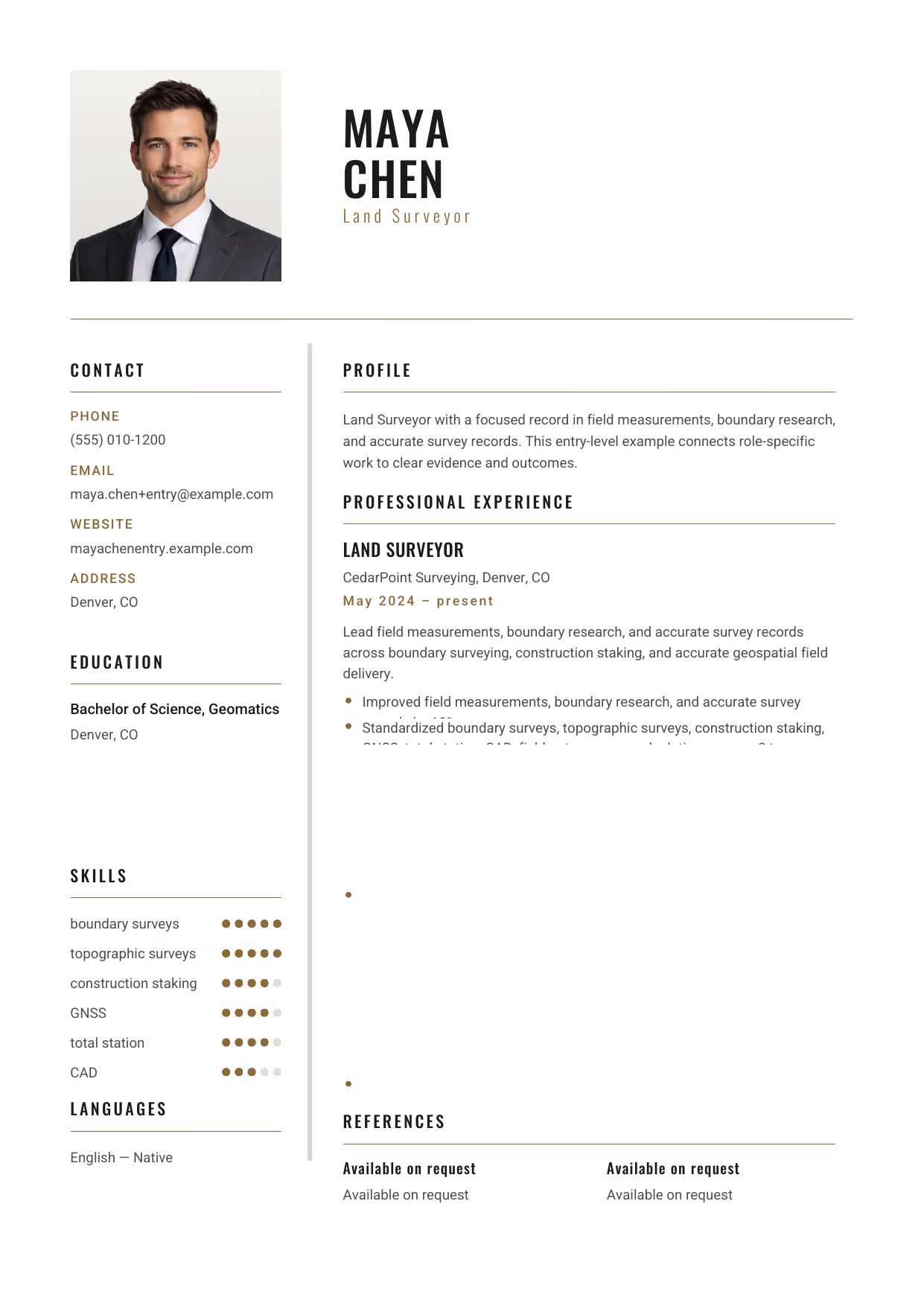
Land Surveyor
A builder-ready entry-level Land Surveyor example in the Acamar template, showing stage-appropriate evidence in a focused, editable resume format.
- Editable role positioning in the Acamar layout
- Role-specific evidence and delivery context
- Review the Acamar structure with a clean visual hierarchy
View this resume

Land Surveyor
A builder-ready entry-level Land Surveyor example in the Pegasus template, showing stage-appropriate evidence in a focused, editable resume format.
- Editable role positioning in the Pegasus layout
- Role-specific evidence and delivery context
- Review the Pegasus structure with a clean visual hierarchy
View this resume

Land Surveyor
A builder-ready entry-level Land Surveyor example in the Grus template, showing stage-appropriate evidence in a focused, editable resume format.
- Editable role positioning in the Grus layout
- Role-specific evidence and delivery context
- Review the Grus structure with a clean visual hierarchy
View this resume
Mid-Level Land Surveyor Resume (3-7 Years Experience)
Use these mid-level examples to compare the scope, evidence, and language expected for Land Surveyor roles at this stage.
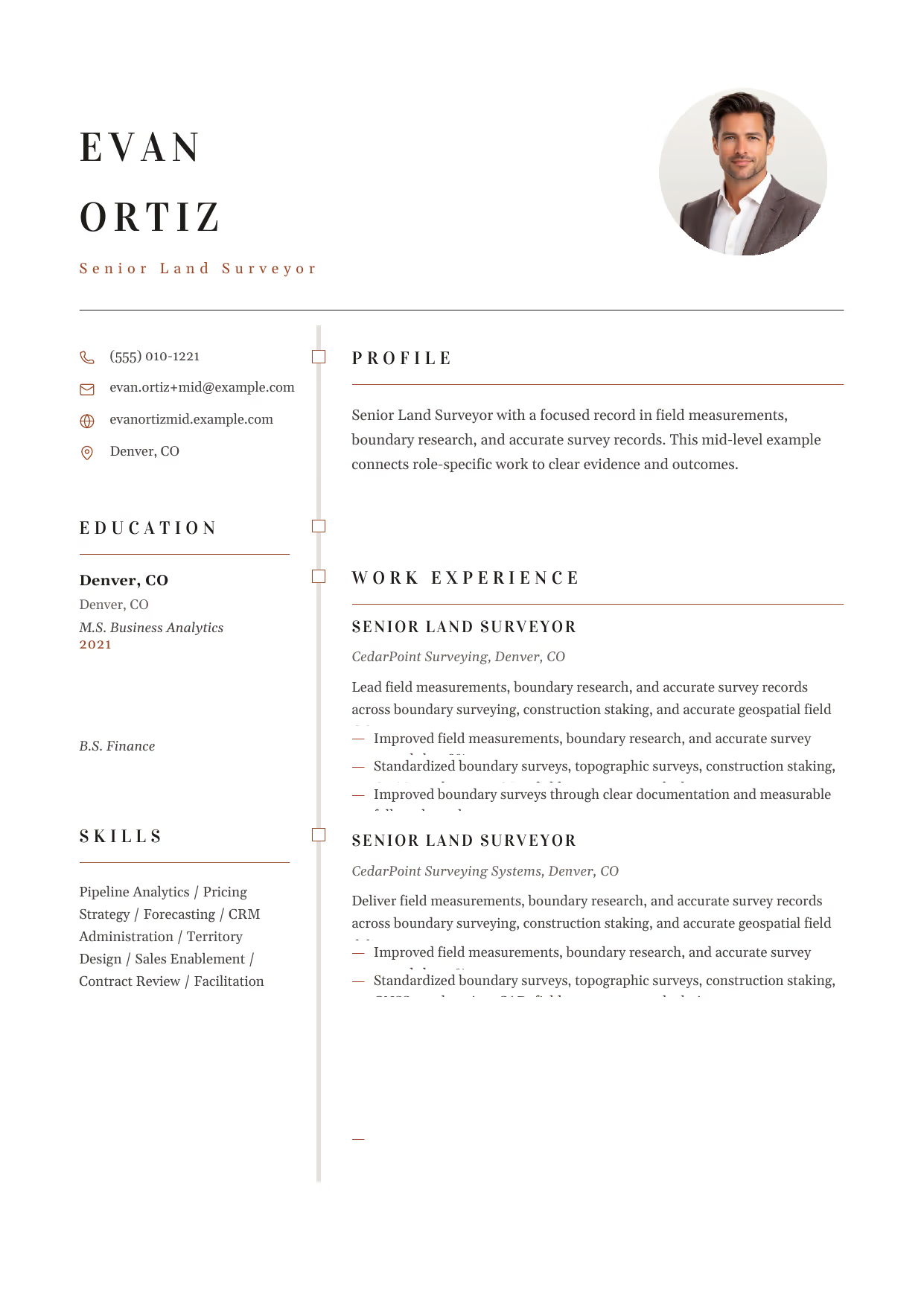
Senior Land Surveyor
A builder-ready mid-level Land Surveyor example in the Draco template, showing stage-appropriate evidence in a focused, editable resume format.
- Editable role positioning in the Draco layout
- Role-specific evidence and delivery context
- Review the Draco structure with a clean visual hierarchy
View this resume
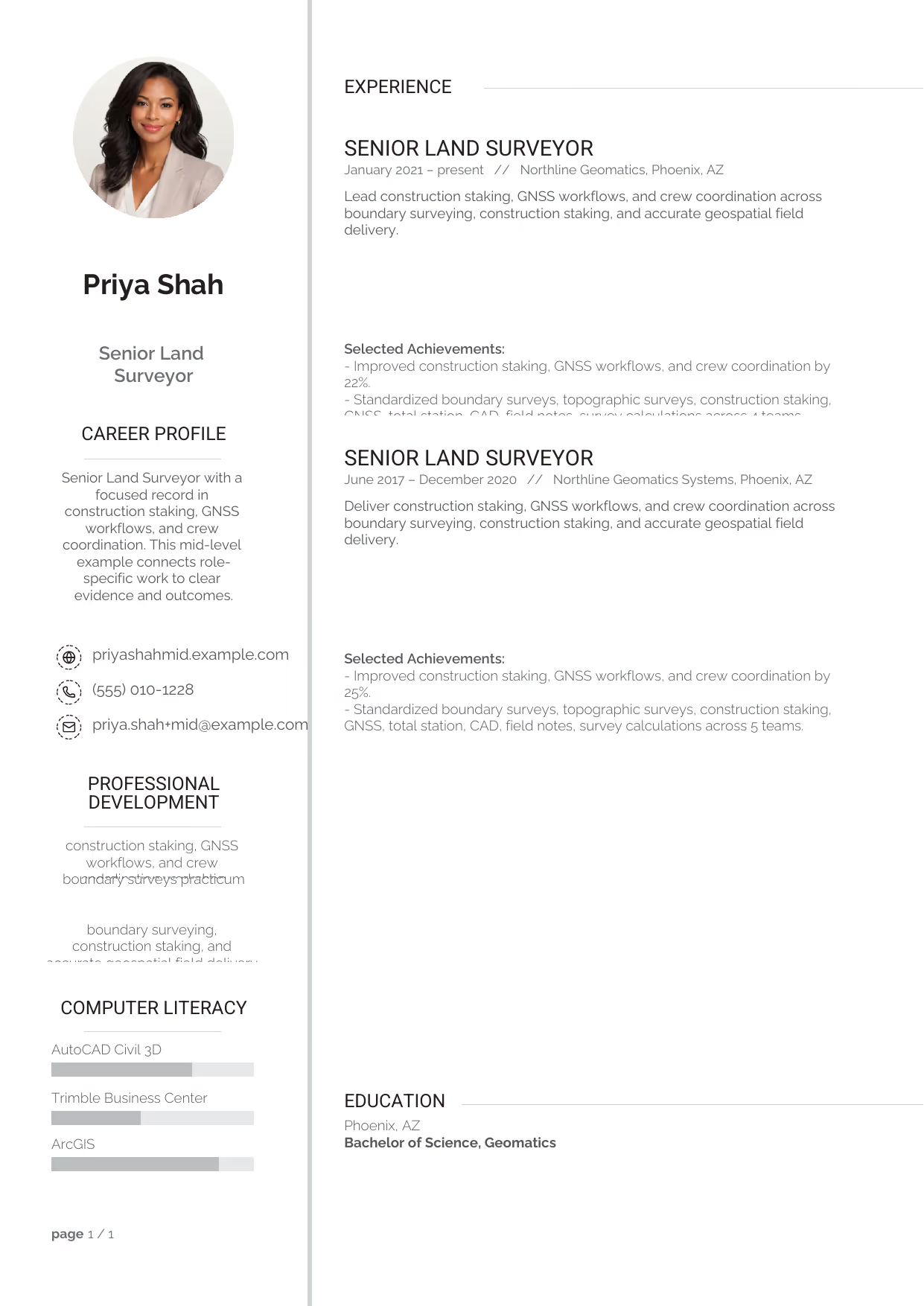
Senior Land Surveyor
A builder-ready mid-level Land Surveyor example in the Synnove template, showing stage-appropriate evidence in a focused, editable resume format.
- Editable role positioning in the Synnove layout
- Role-specific evidence and delivery context
- Review the Synnove structure with a clean visual hierarchy
View this resume
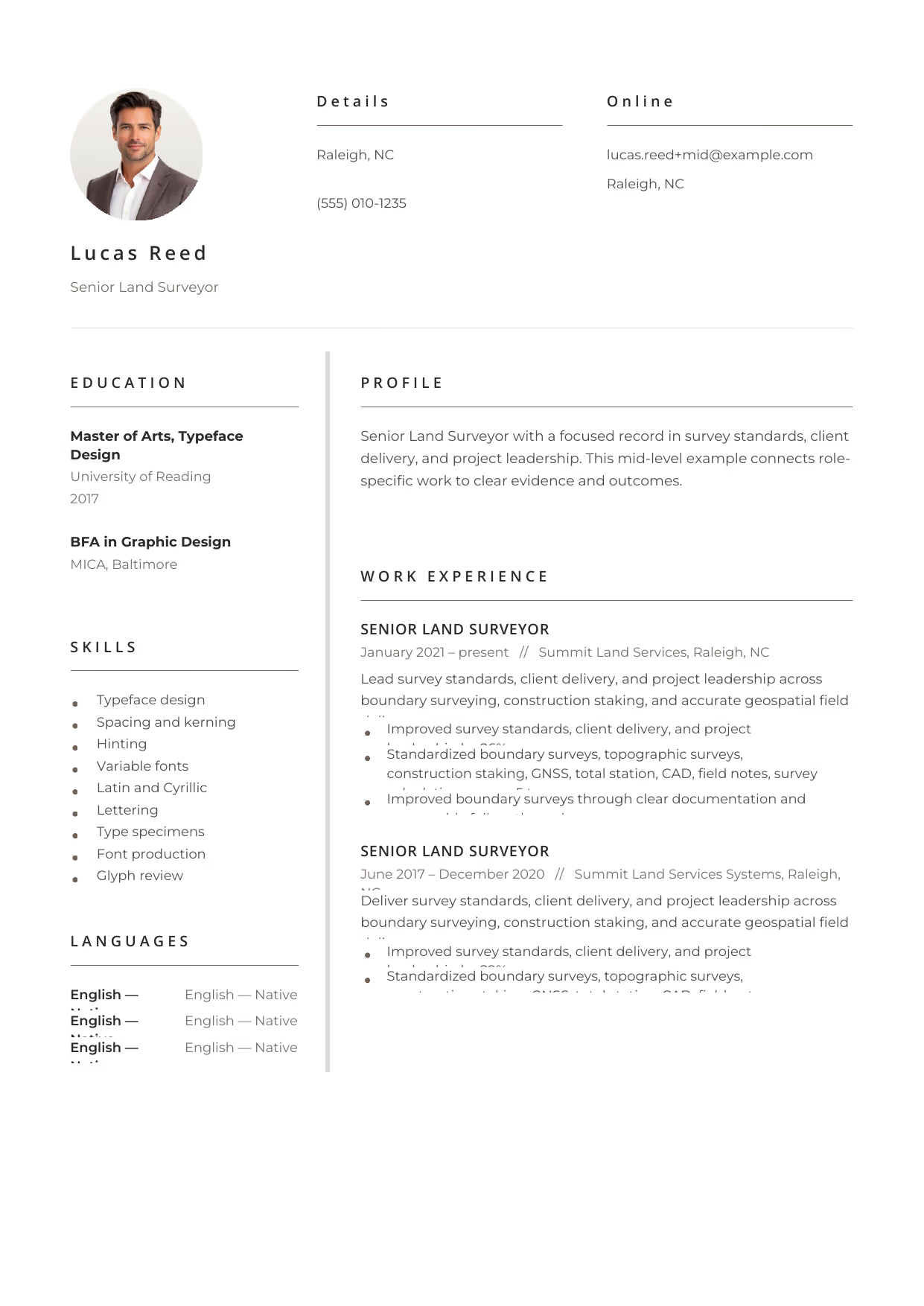
Senior Land Surveyor
A builder-ready mid-level Land Surveyor example in the Pictor template, showing stage-appropriate evidence in a focused, editable resume format.
- Editable role positioning in the Pictor layout
- Role-specific evidence and delivery context
- Review the Pictor structure with a clean visual hierarchy
View this resume
Senior Land Surveyor Resume (8+ Years / Management)
Use these advanced examples to compare the scope, evidence, and language expected for Land Surveyor roles at this stage.

Survey Project Manager
A builder-ready advanced Land Surveyor example in the Caelum template, showing stage-appropriate evidence in a focused, editable resume format.
- Editable role positioning in the Caelum layout
- Role-specific evidence and delivery context
- Review the Caelum structure with a clean visual hierarchy
View this resume

Survey Project Manager
A builder-ready advanced Land Surveyor example in the Hydra template, showing stage-appropriate evidence in a focused, editable resume format.
- Editable role positioning in the Hydra layout
- Role-specific evidence and delivery context
- Review the Hydra structure with a clean visual hierarchy
View this resume
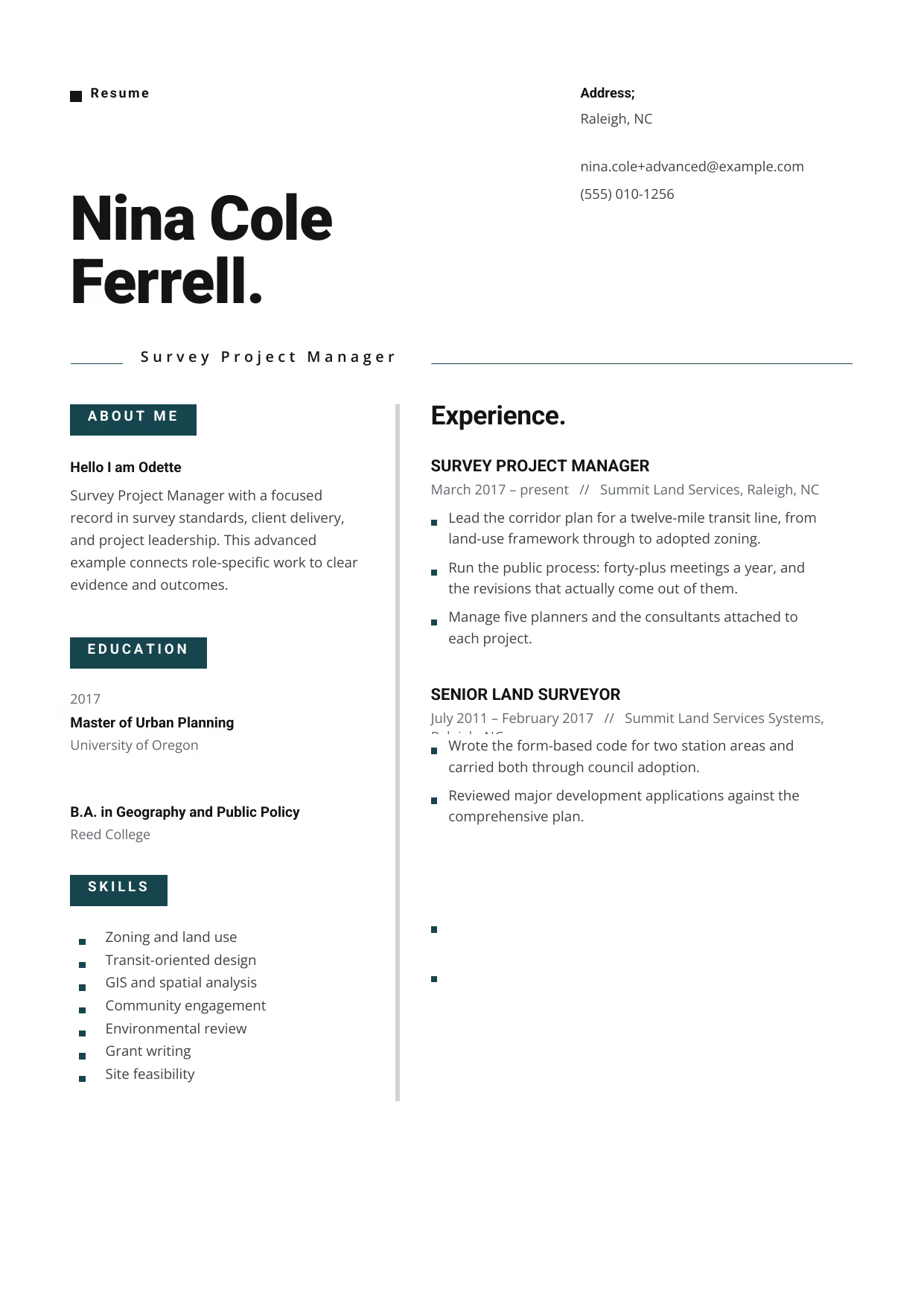
Survey Project Manager
A builder-ready advanced Land Surveyor example in the Indus template, showing stage-appropriate evidence in a focused, editable resume format.
- Editable role positioning in the Indus layout
- Role-specific evidence and delivery context
- Review the Indus structure with a clean visual hierarchy
View this resume
How to Write a Land Surveyor Resume
The Resume Summary
The resume summary is your chance to make a strong first impression. It should highlight your key skills, experience, and career goals in a concise and compelling manner.
Formula: [Years of Experience] + [Key Skills] + [Relevant Achievements] + [Career Goal]
Entry-Level Example: Recent graduate with a Bachelor of Science in Surveying seeking an entry-level Land Surveyor position. Eager to apply academic knowledge and develop practical skills in a challenging environment.
Mid-Level Example: Highly motivated Land Surveyor with 5+ years of experience in boundary surveys, topographic mapping, and construction staking. Proven ability to manage projects from inception to completion.
Senior Example: Accomplished Professional Land Surveyor (PLS) with over 10 years of experience in managing complex surveying projects. Proven ability to lead teams, manage budgets, and ensure compliance.
Work Experience & Action Verbs
The work experience section is where you showcase your accomplishments and demonstrate your value to potential employers. Focus on achievements rather than just listing duties.
Duties vs. Achievements: Instead of saying “Responsible for data collection,” say “Collected and processed field data, resulting in a 10% reduction in survey errors.”
- Before: Assisted with boundary surveys.
After: Conducted boundary surveys for over 30 properties, resolving complex boundary disputes and ensuring accurate property delineation. - Before: Used AutoCAD to create maps.
After: Utilized AutoCAD to create detailed topographic maps for residential and commercial developments, improving project accuracy by 12%. - Before: Helped with construction staking.
After: Performed construction staking for various projects, ensuring accurate placement of structures and infrastructure, resulting in zero errors. - Before: Managed project budgets.
After: Managed project budgets totaling $500,000+, ensuring projects were completed on time and within budget. - Before: Communicated with clients.
After: Communicated with clients to gather project requirements, providing regular updates and addressing concerns, resulting in a 95% client satisfaction rate.
Top Skills for Land Surveyors
Here are some of the top skills that land surveyors should include on their resumes:
Hard Skills
- Boundary Resolution
- Construction Staking
- GPS Data Processing
- Topographic Mapping
- Data Analysis
- Survey Calculations
Soft Skills
- Problem-Solving
- Communication
- Attention to Detail
- Critical Thinking
- Teamwork
- Time Management
Tools/Software
- AutoCAD
- Civil 3D
- GIS Software (e.g., ArcGIS, QGIS)
- Trimble Business Center
- GPS Equipment
- Total Stations
Education & Certifications
Your education section should include your degree and any relevant certifications.
Formatting Education: For entry-level candidates, list your GPA and relevant coursework. For mid-level and senior candidates, focus on your degree and any advanced certifications.
Required/Recommended Certifications:
- Professional Land Surveyor (PLS)
- Certified Survey Technician (CST)
- Geographic Information Systems Professional (GISP)
10 Common Land Surveyor Resume Mistakes
- Generic Career Objectives: Using vague objectives like “Seeking a challenging position” fails to highlight specific skills relevant to land surveying. Tailor your objective to showcase your expertise in areas like boundary resolution or topographic mapping.
- Listing Irrelevant Experience: Including jobs unrelated to surveying (e.g., retail or food service) wastes valuable space. Focus on experiences that demonstrate transferable skills such as attention to detail, problem-solving, or data analysis.
- Neglecting Quantifiable Achievements: Simply listing duties (e.g., “Performed data collection”) fails to showcase your impact. Quantify your achievements by including metrics like “Reduced survey errors by 15% through improved data collection techniques.”
- Poor Formatting and Readability: Using cluttered formatting or small font sizes makes your resume difficult to read. Employ clear headings, bullet points, and ample white space to improve readability and highlight key information.
- Ignoring Keywords: Failing to include industry-specific keywords like “Civil 3D,” “GPS data processing,” or “boundary resolution” can cause your resume to be overlooked by Applicant Tracking Systems (ATS). Research common job descriptions to identify relevant keywords.
- Typos and Grammatical Errors: Errors in spelling and grammar reflect poorly on your attention to detail. Proofread your resume carefully or ask a colleague to review it for errors before submitting it.
- Inconsistent Tense: Using inconsistent verb tenses (e.g., mixing past and present tense) makes your resume appear unprofessional. Use past tense to describe previous roles and present tense to describe current roles.
- Omitting Soft Skills: Neglecting to include soft skills like communication, teamwork, and problem-solving can make you appear less well-rounded. Highlight these skills by providing specific examples of how you’ve used them in your previous roles.
- Unprofessional Email Address: Using an unprofessional email address (e.g., partyanimal@email.com) can create a negative impression. Use a professional email address that includes your name (e.g., john.doe@email.com).
- Lack of a Cover Letter: Failing to include a cover letter can be a missed opportunity to showcase your personality and explain why you’re a good fit for the role. Tailor your cover letter to each specific job application, highlighting your relevant skills and experience.
Frequently Asked Questions (Land Surveyor)
- What should a Land Surveyor resume emphasize first? Lead with the scope of field measurements, boundary research, and accurate survey records, then connect your contribution to a clear outcome, tool, or decision.
- Which skills deserve priority on a Land Surveyor resume? Prioritize boundary surveys, topographic surveys, and construction staking when they match the role and can be supported by evidence.
- How can a Land Surveyor show project scope and impact? Name the environment, scale, constraints, and result; construction staking, GNSS workflows, and crew coordination becomes more credible when the context is concrete.
- How should a Land Surveyor describe tools and technical decisions? Describe why you selected a method, how you implemented it, and what changed afterward in the Land Surveyor role.
- Which achievements matter most for a Land Surveyor application? Use outcome-led bullets that show survey standards, client delivery, and project leadership through delivery quality, measurable scope, or stakeholder value.
- How long should a Land Surveyor resume be? Use the shortest length that proves fit; a focused page can work early-career, while broader Land Surveyor scope may need more room.
- How can a Land Surveyor explain progression between career stages? Group examples by increasing ownership, moving from field measurements, boundary research, and accurate survey records toward survey standards, client delivery, and project leadership as responsibility grows.
- Which keywords should a Land Surveyor include for screening systems? Mirror truthful language from the posting, especially GNSS, without stuffing unrelated terms.
- How should a Land Surveyor present reliability, quality, or safety work? Show how you protected outcomes through total station and explain the evidence a hiring team can verify.
- What format makes a Land Surveyor resume easy for hiring teams to scan? Use clear headings, readable bullets, and consistent dates so a hiring manager can evaluate Land Surveyor fit quickly.
Crafting a compelling land surveyor resume requires a strategic approach that highlights your technical skills, experience, and accomplishments. By following these examples and tips, you can create a resume that showcases your value and helps you land your dream job.
To improve your Land Surveyor job search, Search more Land Surveyor resources on our website.
Editorial review: RockStarCV Editorial Team reviewed this Land Surveyor guide for source fidelity, role-specific usefulness, accessibility, builder examples, and question completeness.