Junior Architect Resume Examples & Guide
Breaking into the architecture field as a junior professional is tough. You’re facing Applicant Tracking Systems (ATS) and fierce competition for every opening. This guide provides Junior Architect resume examples tailored for students, entry-level candidates, and seasoned professionals looking to advance.
- Quantify Achievements: Use numbers to showcase the impact of your designs, projects, or contributions.
- Highlight Relevant Skills: Emphasize both technical skills (CAD, BIM) and soft skills (communication, problem-solving) essential for architects.
- Tailor to Job Description: Customize your resume for each application, highlighting the skills and experiences that match the specific requirements.
- Optimize for ATS: Use keywords from the job description and avoid formatting that could confuse ATS software.
- Use Action Verbs: Start your bullet points with strong action verbs to describe your responsibilities and accomplishments.
- Showcase Collaboration: Architecture is a collaborative field; highlight experiences working in teams and coordinating with other professionals.
Let’s explore some Junior Architect resume examples that demonstrate these strategies in action.
Explore editable Junior Architect resume examples by career stage. Each sample opens in the RockStarCV builder so you can study the structure and make your own version.
Entry-Level Junior Architect Resume (0-2 Years Experience)
Use these entry-level examples to compare the scope, evidence, and language expected for Junior Architect roles at this stage.

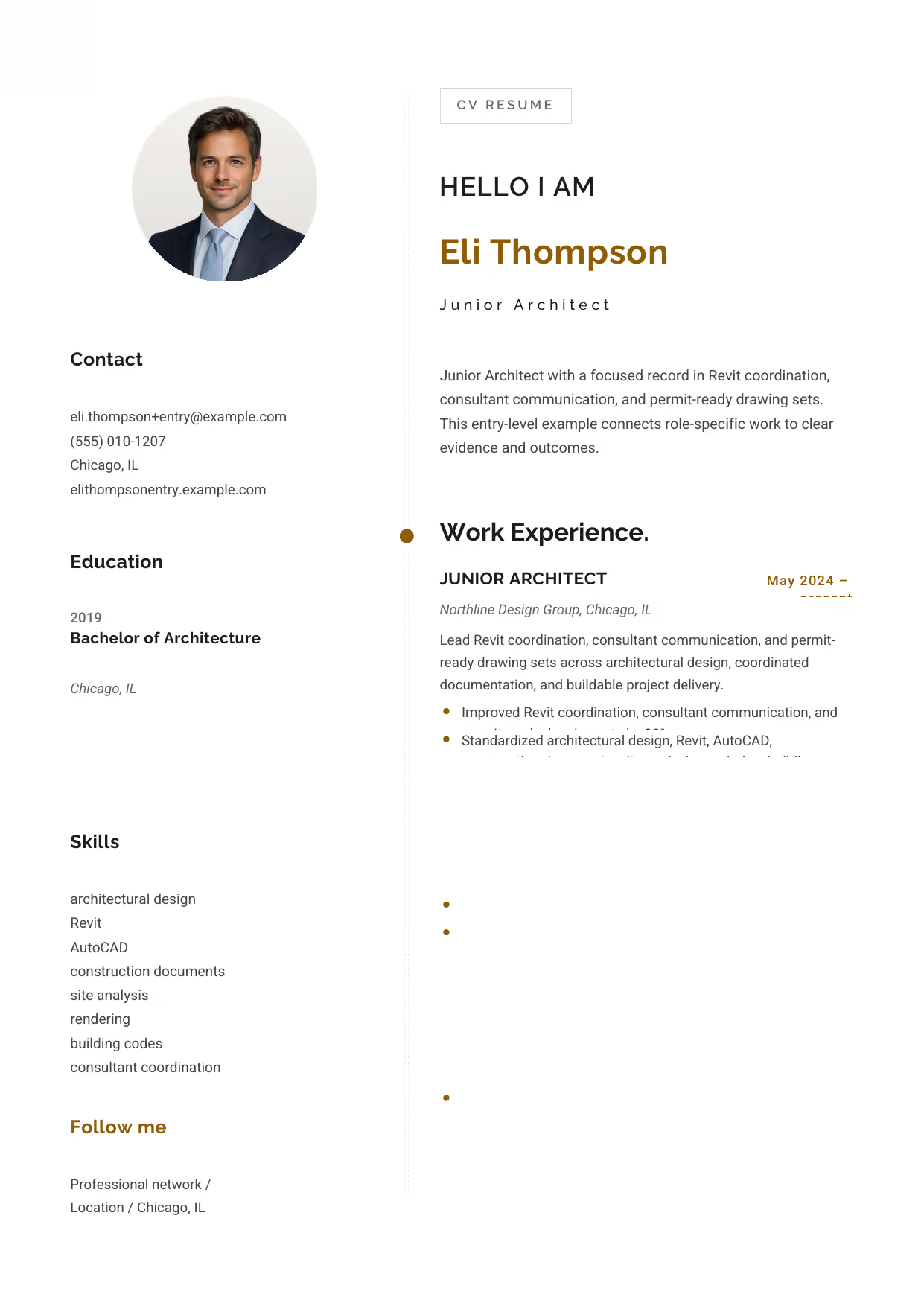
Junior Architect
A builder-ready entry-level Junior Architect example in the Puppis template, showing stage-appropriate evidence in a focused, editable resume format.
- Editable role positioning in the Puppis layout
- Role-specific evidence and delivery context
- Review the Puppis structure with a clean visual hierarchy
View this resume
Junior Architect
A builder-ready entry-level Junior Architect example in the Eridanus template, showing stage-appropriate evidence in a focused, editable resume format.
- Editable role positioning in the Eridanus layout
- Role-specific evidence and delivery context
- Review the Eridanus structure with a clean visual hierarchy
View this resume

Junior Architect
A builder-ready entry-level Junior Architect example in the Delphinus template, showing stage-appropriate evidence in a focused, editable resume format.
- Editable role positioning in the Delphinus layout
- Role-specific evidence and delivery context
- Review the Delphinus structure with a clean visual hierarchy
View this resume
Mid-Level Junior Architect Resume (3-7 Years Experience)
Use these mid-level examples to compare the scope, evidence, and language expected for Junior Architect roles at this stage.
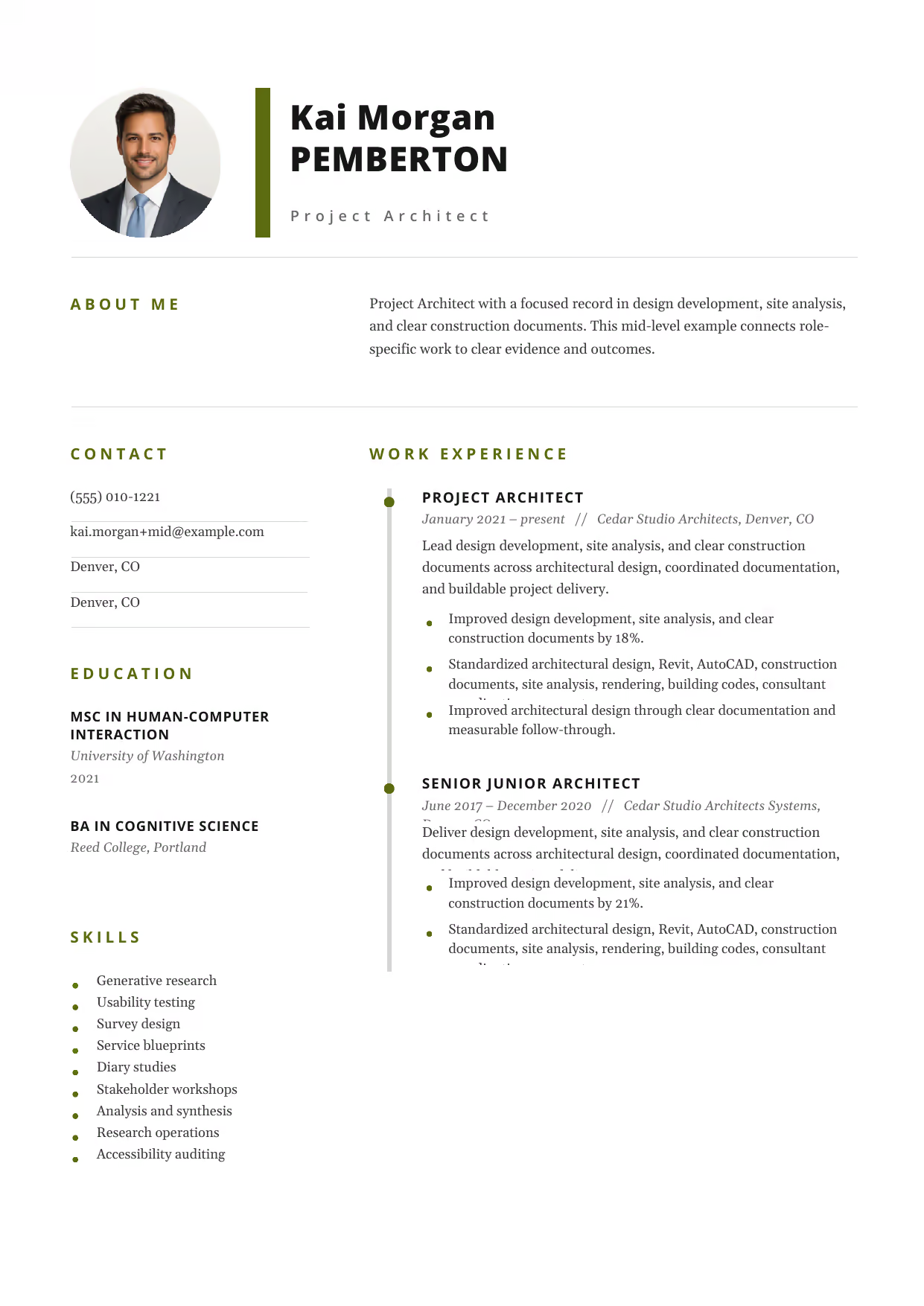
Project Architect
A builder-ready mid-level Junior Architect example in the Pegasus template, showing stage-appropriate evidence in a focused, editable resume format.
- Editable role positioning in the Pegasus layout
- Role-specific evidence and delivery context
- Review the Pegasus structure with a clean visual hierarchy
View this resume
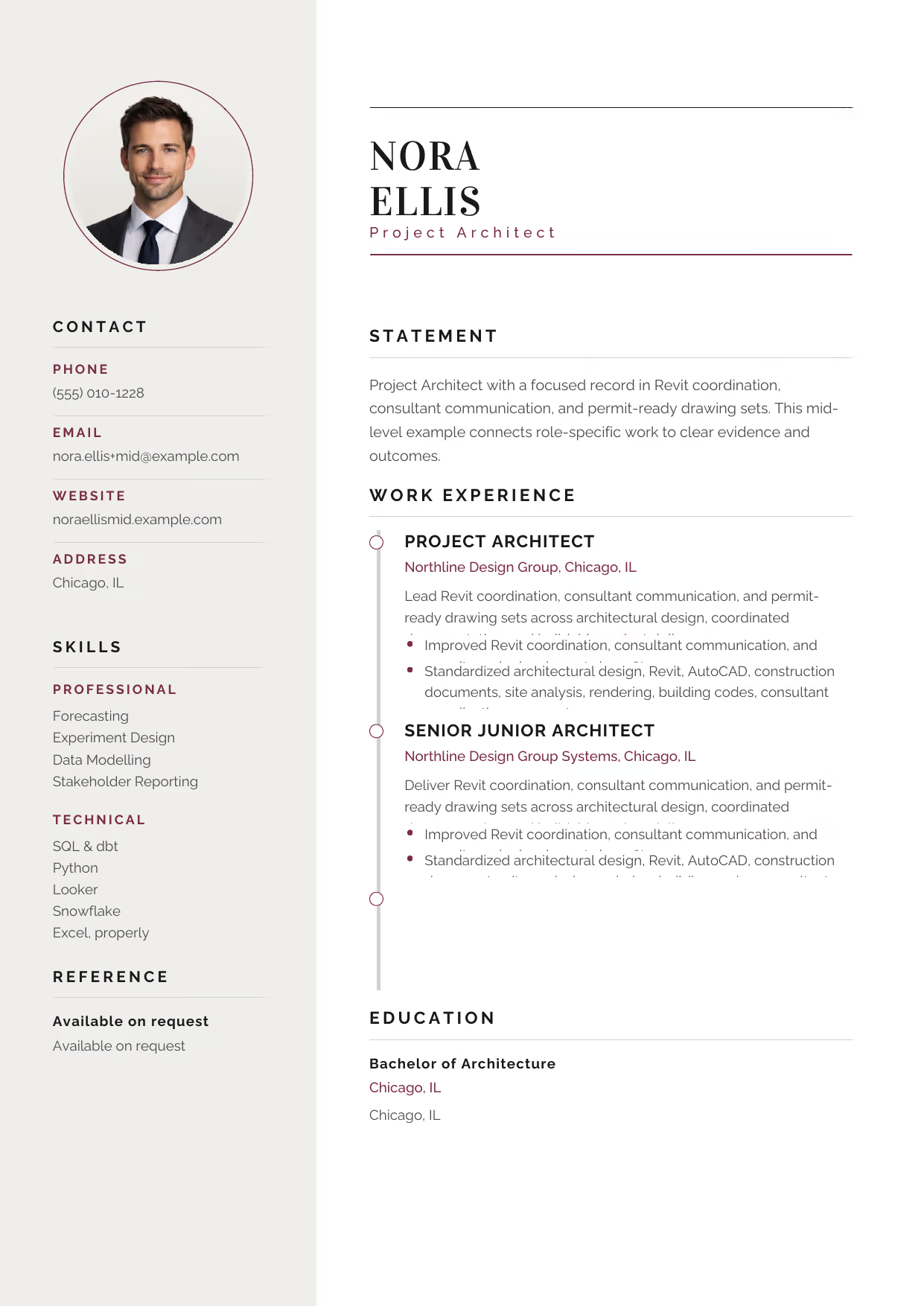
Project Architect
A builder-ready mid-level Junior Architect example in the Cetus template, showing stage-appropriate evidence in a focused, editable resume format.
- Editable role positioning in the Cetus layout
- Role-specific evidence and delivery context
- Review the Cetus structure with a clean visual hierarchy
View this resume
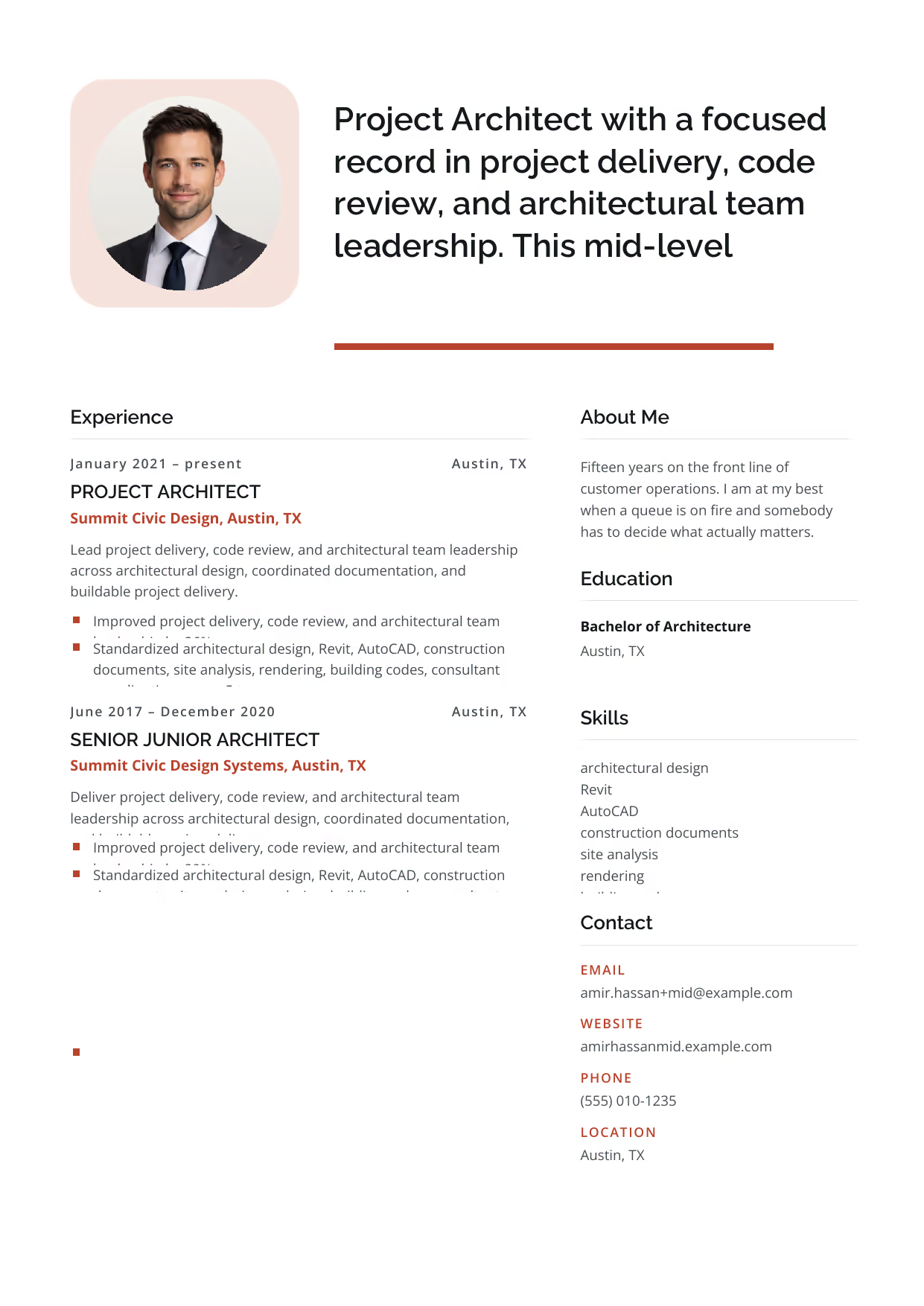
Project Architect
A builder-ready mid-level Junior Architect example in the Andromeda template, showing stage-appropriate evidence in a focused, editable resume format.
- Editable role positioning in the Andromeda layout
- Role-specific evidence and delivery context
- Review the Andromeda structure with a clean visual hierarchy
View this resume
Senior Junior Architect Resume (8+ Years / Management)
Use these advanced examples to compare the scope, evidence, and language expected for Junior Architect roles at this stage.
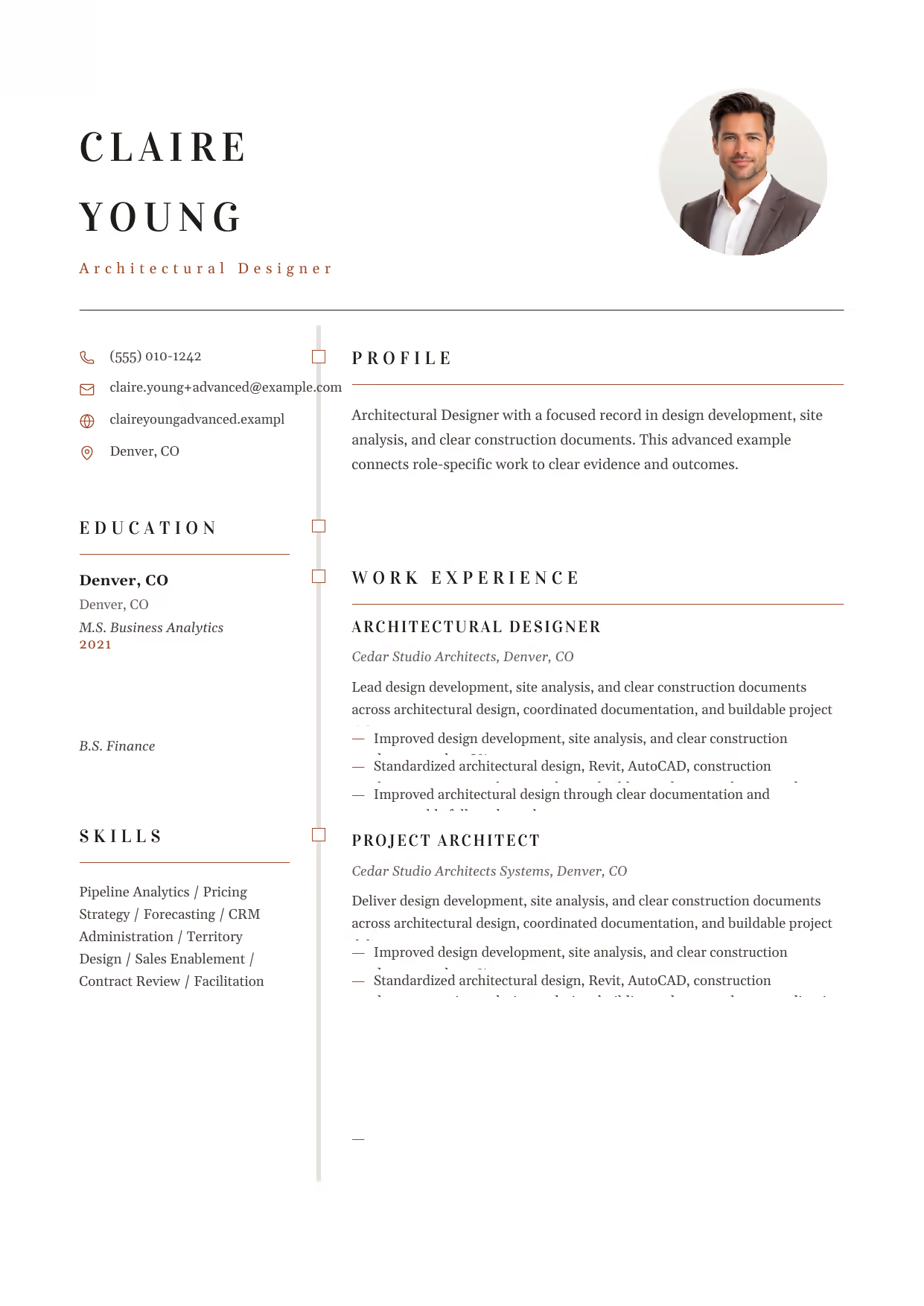
Architectural Designer
A builder-ready advanced Junior Architect example in the Draco template, showing stage-appropriate evidence in a focused, editable resume format.
- Editable role positioning in the Draco layout
- Role-specific evidence and delivery context
- Review the Draco structure with a clean visual hierarchy
View this resume
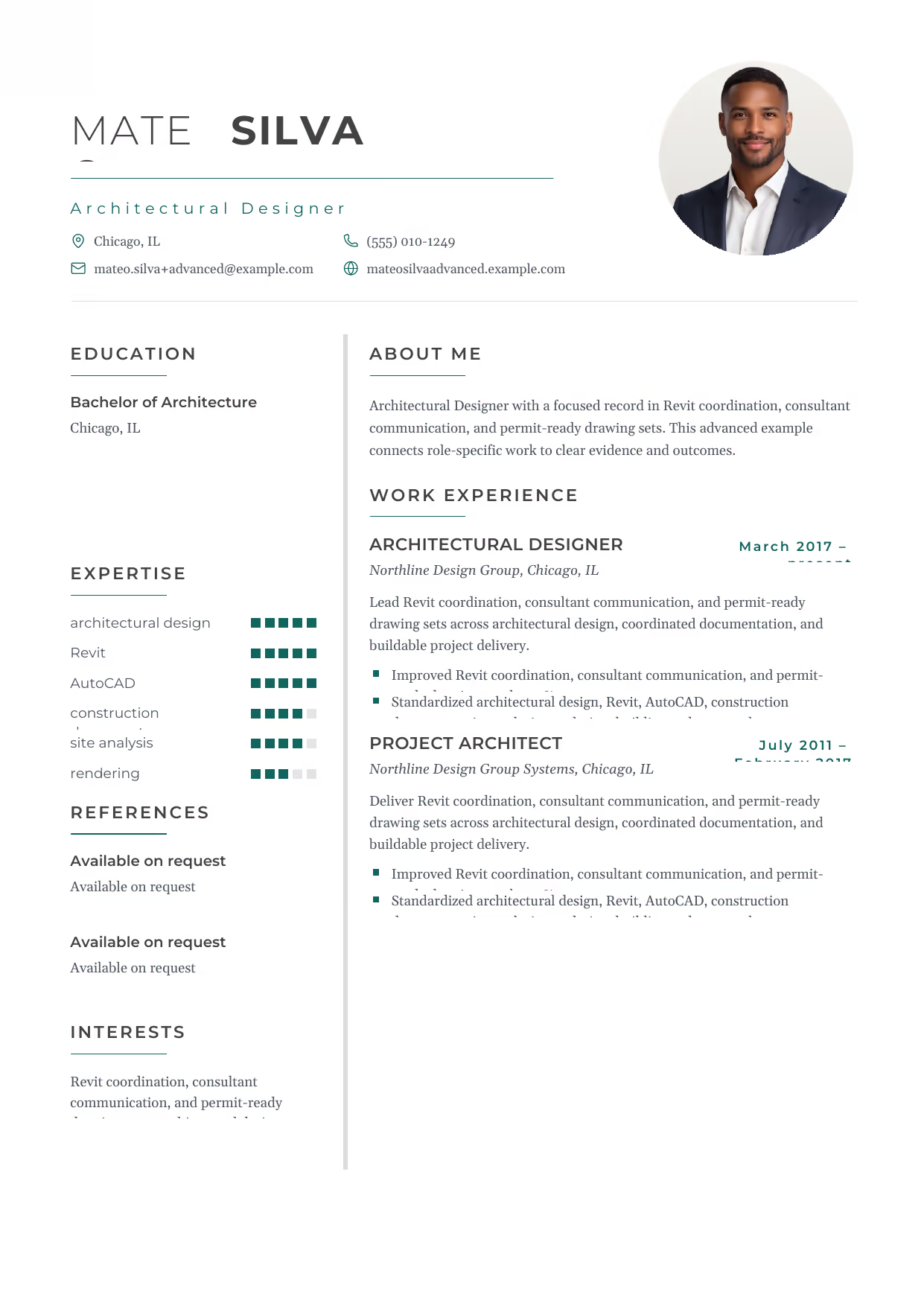
Architectural Designer
A builder-ready advanced Junior Architect example in the Achernar template, showing stage-appropriate evidence in a focused, editable resume format.
- Editable role positioning in the Achernar layout
- Role-specific evidence and delivery context
- Review the Achernar structure with a clean visual hierarchy
View this resume
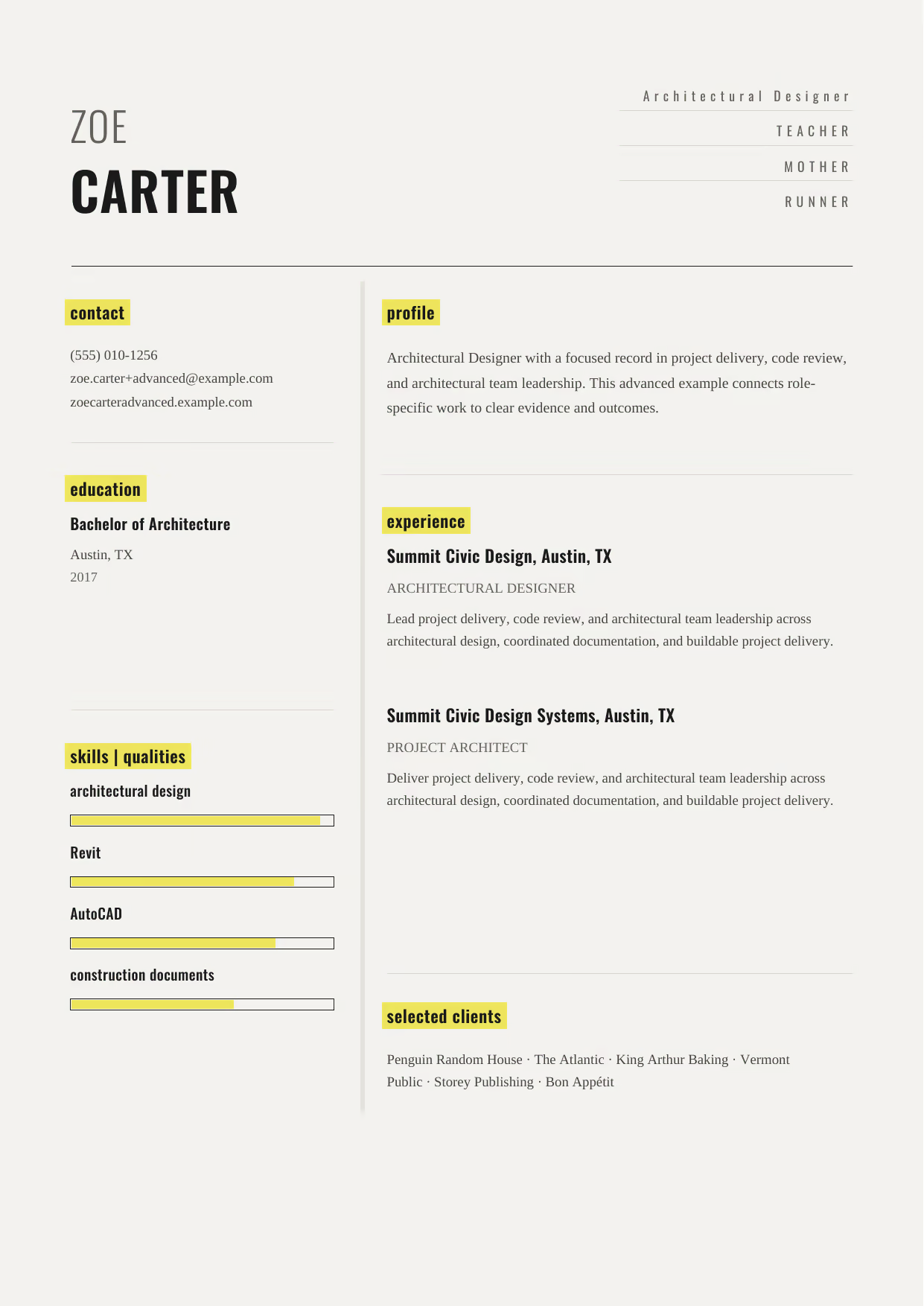
Architectural Designer
A builder-ready advanced Junior Architect example in the Dorado template, showing stage-appropriate evidence in a focused, editable resume format.
- Editable role positioning in the Dorado layout
- Role-specific evidence and delivery context
- Review the Dorado structure with a clean visual hierarchy
View this resume
How to Write a Junior Architect Resume
The Resume Summary
The resume summary is your chance to make a strong first impression. It should be a concise and compelling overview of your skills and experience, tailored to the specific Junior Architect position you’re applying for. Use this formula: [Years of Experience] + [Area of Expertise] + [Key Achievement or Skill] + [Goal]
Entry-Level Example: “Enthusiastic recent graduate with a Bachelor of Architecture degree seeking a Junior Architect position to apply design skills and contribute to innovative projects.”
Mid-Level Example: “Experienced Junior Architect with 5+ years of experience in design development and construction administration, seeking a challenging role to leverage expertise in sustainable design and project management.”
Senior Example: “Senior Junior Architect with 10+ years of experience leading design teams and managing complex projects, seeking a leadership position to drive innovation and deliver exceptional results.”
Work Experience & Action Verbs
It’s crucial to differentiate between listing your duties and highlighting your achievements. Duties are simply a description of your responsibilities, while achievements showcase the impact you made in your role. Focus on quantifying your accomplishments whenever possible.
- Before: Responsible for creating construction documents.
After: Developed detailed construction documents for 3 residential projects, ensuring compliance with building codes and project specifications. - Before: Assisted with design development.
After: Led the design development for a $5M commercial project, resulting in a 15% reduction in construction costs. - Before: Managed project budgets.
After: Managed project budgets for 5 projects, consistently delivering projects on time and within budget. - Before: Conducted site visits.
After: Conducted site visits and prepared detailed field reports, identifying and resolving potential construction issues. - Before: Prepared presentations for client meetings.
After: Prepared and delivered compelling presentations to clients, securing approval for design concepts and project proposals.
Top Skills for Junior Architects
- Hard Skills:
- CAD Software (AutoCAD, Revit)
- BIM (Building Information Modeling)
- Construction Documents
- Sustainable Design
- Building Codes
- Zoning Regulations
- 3D Modeling
- Rendering
- Soft Skills:
- Communication
- Teamwork
- Problem-Solving
- Time Management
- Client Relations
- Project Management
- Leadership
- Negotiation
- Tools/Software:
- Revit
- AutoCAD
- SketchUp
- Rhino
- Adobe Creative Suite
- BIM 360
Education & Certifications
For entry-level candidates, place your education section prominently near the top of your resume. As you gain more experience, move it further down. Include your degree, university name, graduation date, and relevant coursework or GPA (if above 3.5). List any relevant certifications, such as LEED AP, to demonstrate your expertise and commitment to sustainable design.
Recommended Certifications:
- LEED Accredited Professional (LEED AP)
10 Common Junior Architect Resume Mistakes
- Generic Objective Statements: Using a vague objective statement like “Seeking a challenging position” wastes valuable space. Instead, use a strong summary highlighting specific skills and career goals tailored to the Junior Architect role. This will immediately capture the recruiter’s attention and demonstrate your understanding of the industry.
- Lack of Quantifiable Achievements: Listing duties instead of accomplishments fails to showcase your impact. Quantify your achievements whenever possible (e.g., “Reduced construction costs by 15%”, “Managed projects with budgets up to $5M”). This provides concrete evidence of your skills and abilities.
- Ignoring Keywords: Failing to include relevant keywords from the job description can cause your resume to be overlooked by Applicant Tracking Systems (ATS). Carefully review the job description and incorporate keywords related to software (Revit, AutoCAD), technical skills (BIM, construction documents), and soft skills (communication, teamwork).
- Poor Formatting: Using a cluttered or difficult-to-read format can frustrate recruiters and make it hard to find important information. Use clear headings, bullet points, and white space to create a visually appealing and easy-to-scan resume. Choose a professional font and avoid excessive use of colors or graphics.
- Grammar and Spelling Errors: Typos and grammatical errors make you look unprofessional and careless. Proofread your resume carefully before submitting it, or ask a friend or colleague to review it for you. Misspelling Core Industry Terminology: Typos in general are bad, but misspelling critical tools or certifications (like ‘AutoCAD’, ‘LEED’, or ‘BIM’) acts as an immediate red flag regarding your attention to detail.
- Irrelevant Information: Including irrelevant information, such as hobbies or unrelated work experience, can distract from your qualifications. Focus on highlighting the skills and experiences that are most relevant to the Junior Architect position.
- Inconsistent Verb Tense: Using inconsistent verb tense (e.g., mixing past and present tense) can make your resume confusing and difficult to read. Use past tense to describe your accomplishments in previous roles and present tense to describe your current responsibilities.
- Lack of a Skills Section: Failing to include a dedicated skills section makes it harder for recruiters to quickly assess your qualifications. Create a separate skills section and list both your technical skills (software, tools) and soft skills (communication, teamwork).
- Not Tailoring to the Job Description: Submitting a generic resume without tailoring it to the specific job description is a common mistake. Customize your resume for each application, highlighting the skills and experiences that match the requirements of the position.
- Ignoring the Summary Statement: Omitting a career summary/objective or writing a weak one is a missed opportunity. This is your chance to highlight your value proposition. A strong summary statement should clearly articulate your skills, experience, and career goals, and why you are the best candidate for the Junior Architect position.
Frequently Asked Questions (Junior Architect)
- What should a Junior Architect resume emphasize first? Lead with the scope of design development, site analysis, and clear construction documents, then connect your contribution to a clear outcome, tool, or decision.
- Which skills deserve priority on a Junior Architect resume? Prioritize architectural design, Revit, and AutoCAD when they match the role and can be supported by evidence.
- How can a Junior Architect show project scope and impact? Name the environment, scale, constraints, and result; Revit coordination, consultant communication, and permit-ready drawing sets becomes more credible when the context is concrete.
- How should a Junior Architect describe tools and technical decisions? Describe why you selected a method, how you implemented it, and what changed afterward in the Junior Architect role.
- Which achievements matter most for a Junior Architect application? Use outcome-led bullets that show project delivery, code review, and architectural team leadership through delivery quality, measurable scope, or stakeholder value.
- How long should a Junior Architect resume be? Use the shortest length that proves fit; a focused page can work early-career, while broader Junior Architect scope may need more room.
- How can a Junior Architect explain progression between career stages? Group examples by increasing ownership, moving from design development, site analysis, and clear construction documents toward project delivery, code review, and architectural team leadership as responsibility grows.
- Which keywords should a Junior Architect include for screening systems? Mirror truthful language from the posting, especially construction documents, without stuffing unrelated terms.
- How should a Junior Architect present reliability, quality, or safety work? Show how you protected outcomes through site analysis and explain the evidence a hiring team can verify.
- What format makes a Junior Architect resume easy for hiring teams to scan? Use clear headings, readable bullets, and consistent dates so a hiring manager can evaluate Junior Architect fit quickly.
Crafting a compelling Junior Architect resume requires careful attention to detail and a strategic approach. By following the examples and tips in this guide, you can create a resume that showcases your skills, experience, and potential, and helps you land your dream job. Search more Junior Architect resources on our site to further refine your job application!
Editorial review: RockStarCV Editorial Team reviewed this Junior Architect guide for source fidelity, role-specific usefulness, accessibility, builder examples, and question completeness.