Chapter 01
Introduction
This checks whether your interest rests on more than generic praise.
Specific interest is more convincing than corporate admiration. Choose the professional starting point that makes this answer useful now. Name the work, responsibility, or transition before adding background, so the interviewer can understand why the detail belongs in your response.
Company research should open a conversation about the work rather than end in applause. Interest in an organization becomes credible when you connect a verified observation to the work you want to perform. Broad admiration for mission or culture alone offers little evidence. Test the evidence against the vacancy. Keep the facts you can explain in a follow-up, remove biography that does not help the decision, and make the final sentence point toward the role in front of you.
- 01Set the direction
This checks whether your interest rests on more than generic praise.
- 02Choose the proof
Specific interest is more convincing than corporate admiration.
- 03Connect it to the role
Choose the professional starting point that makes this answer useful now.
Chapter 02
Understanding the Question
They want to know what you noticed about this organization and whether it connects to how you work.
Read the question as an assessment, not only a request for information. Decide which judgment, risk, working habit, or motivation the interviewer needs to see, then make that purpose visible through one concrete detail.
They may ask how the public detail you cited would affect your day-to-day choices in this position. If asked how you learned a fact, be able to point to a current company source. Distinguish a public signal from an assumption about an internal team. Prepare for the next question as well as this one. If you mention a result, transition, conflict, or constraint, keep the context and your exact contribution ready so the interviewer can test the claim without weakening it.
- 01What they are testing
They want to know what you noticed about this organization and whether it connects to how you work.
- 02Prepare the follow-up
Read the question as an assessment, not only a request for information.
- 03Keep the evidence ready
Decide which judgment, risk, working habit, or motivation the interviewer needs to see, then make that purpose visible through one concrete detail.
Chapter 03
Preparing Your Answer
Find a concrete product, customer, approach, or recent decision you can discuss honestly.
Verify one company detail from its own material and consider what question that detail raises for you. Build a small evidence bank before rehearsing. Write the setting, the decision you owned, the action you took, and the observable result. That gives you facts to select instead of forcing you to invent polished language under pressure.
Choose one verified company fact and write down why it matters to a customer, colleague, or process. Read a recent product, service, or company update and consider who benefits from it. Then identify where this vacancy could contribute without claiming to know the internal plan. Arrange the answer so the listener never has to guess why a detail matters. Put the strongest evidence near the claim it supports, keep your role precise, and finish with the lesson or relevance to this position.
- 01Build your evidence
Find a concrete product, customer, approach, or recent decision you can discuss honestly.
- 02Shape the sequence
Verify one company detail from its own material and consider what question that detail raises for you.
- 03Keep the evidence ready
Build a small evidence bank before rehearsing.
Chapter 04
Dos and Don’ts
What to do: Say what you noticed and why it matters to your work.
Do
- Say what you noticed and why it matters to your work.
- Do frame your inference as an inference, then invite correction.
Don’t
- Do not flatter the organization with unverified claims.
- Do not repeat a claim from an unverified source as though it were an internal fact.
- Praise should not crowd out curiosity.
- A precise question about how the team handles a challenge shows more preparation than a string of flattering adjectives.
Chapter 05
Example Answers
The examples notice clear help materials, a mix of client sizes, and a quality-review emphasis.
They work because the observation is specific and linked to the candidate's experience. Compare the examples by structure rather than memorizing their wording. Notice where each candidate sets the context, states personal ownership, and closes with a result, lesson, or reason the experience matters to the employer.
“Your public help materials explain exceptions unusually clearly. I have spent time reducing avoidable support contacts, so that attention to the difficult cases stood out. I would like to contribute to a team that treats clarity as part of the service.”
Why it works: Treat this first example as a model for sequence. Replace its workplace, task, people, and result with truthful details of your own while keeping the connection between the claim and the supporting evidence.
“I noticed that your company serves small organizations as well as larger clients. In my current role I learned how different their onboarding needs can be. That mix of customers would make the coordination work here interesting to me.”
Why it works: Use the second example to explore a different route to the same competency. Your version can come from paid work, study, volunteering, or a project, provided you state the context and do not overstate your responsibility.
“The job description puts quality review alongside speed, not after it. That fits how I work: I would rather identify a definition problem before launch than publish a fast answer that needs correction. I would like to learn how your team balances those demands.”
Why it works: Use the third example to test whether your answer sounds recognisably yours. Keep the useful structure, then change every borrowed fact.
Chapter 06
Fine-Tuning Your Answer
Use current, verifiable company facts; do not manufacture inside knowledge.
Do not claim a culture you cannot observe from outside; describe the evidence you did see. Fine-tuning is mainly subtraction and precision. Move the strongest fact earlier, replace labels with actions, and check that the ending answers the question rather than drifting into a second example or an unrelated career summary.
Use ordinary language for your interest; sweeping praise can sound less informed than a precise question. Remove claims such as 'your culture is amazing' unless you have credible evidence. Say what you observed and why that particular choice matters to your work. Record one practice version and listen for the first useful fact. If it arrives late, shorten the setup. Then check every result, number, and claim so the final wording remains accurate when the interviewer asks for detail.
- 01Make it sharper
Use current, verifiable company facts; do not manufacture inside knowledge.
- 02Test the wording
Do not claim a culture you cannot observe from outside; describe the evidence you did see.
- 03Keep the evidence ready
Fine-tuning is mainly subtraction and precision.
Chapter 07
Additional Considerations
A strong follow-up question can demonstrate genuine research better than another compliment.
Adapt the structure to your circumstances without hiding them. Career changes, gaps, early-career evidence, senior scope, confidentiality, and reasonable boundaries may change the example, but they do not remove the need for relevance and honest ownership.
A company can be attractive for reasons that also create challenges; discuss both if you know the evidence. An organization can change rapidly. If the detail you researched may be outdated, frame it as a question rather than treating it as settled fact. Protect credibility where context is sensitive. Use the level of detail you can share, separate team results from your contribution, and explain constraints without disclosing private information or blaming people who are not present.
- 01Adapt the answer
A strong follow-up question can demonstrate genuine research better than another compliment.
- 02Keep it credible
Adapt the structure to your circumstances without hiding them.
- 03Keep the evidence ready
Career changes, gaps, early-career evidence, senior scope, confidentiality, and reasonable boundaries may change the example, but they do not remove the need for relevance and honest ownership.
Chapter 08
Conclusion
Let the organization be more than a name inserted into a prepared answer.
Bring the answer back to one clear message. The interviewer should be able to repeat your main claim, the evidence supporting it, and why it matters to the role without reconstructing the meaning from several disconnected points.
Use the company fact to start a thoughtful conversation, not end one. The employer should hear both why this place stands out and what you hope to learn from the people doing the job. End deliberately. Stop when the question has been answered, the evidence is credible, and the relevance is clear. A concise landing invites a useful follow-up and leaves the listener with the professional judgment you intended to show.
A concise landing invites a useful follow-up and leaves the listener with the professional judgment you intended to show.
Source & adaptation
Built from the RockStarCV interview-question library
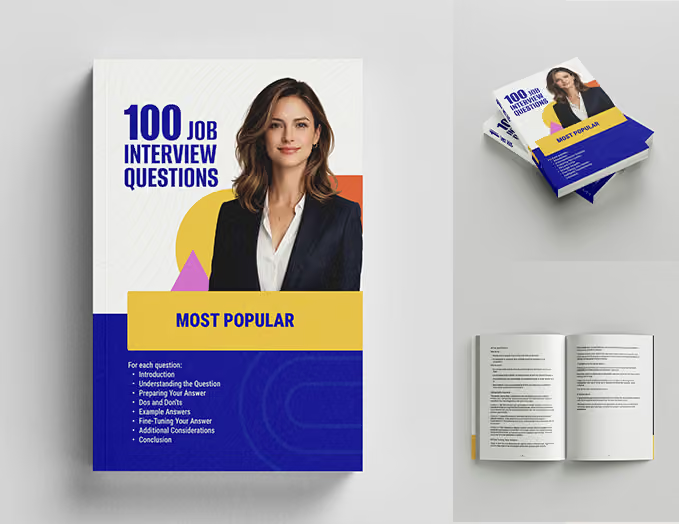
Adapted from the RockStarCV guide 100 Most Popular Job Interview Questions and its long-form narration. The structure and examples have been edited for a practical web reading experience.
Book reference: Question 12