Chapter 01
Introduction
The interviewer wants an adjustment method and willingness to surface bad news.
Changing course is not an admission that the first plan was foolish. Choose the professional starting point that makes this answer useful now. Name the work, responsibility, or transition before adding background, so the interviewer can understand why the detail belongs in your response.
Changing course should be linked to a signal, not personal preference. Plans deserve revision when new evidence makes the original tradeoff irresponsible. Show the signal rather than simply saying you were adaptable. Test the evidence against the vacancy. Keep the facts you can explain in a follow-up, remove biography that does not help the decision, and make the final sentence point toward the role in front of you.
- 01Set the direction
The interviewer wants an adjustment method and willingness to surface bad news.
- 02Choose the proof
Changing course is not an admission that the first plan was foolish.
- 03Connect it to the role
Choose the professional starting point that makes this answer useful now.
Chapter 02
Understanding the Question
They want to know what signal you accepted and how quickly you acted.
Read the question as an assessment, not only a request for information. Decide which judgment, risk, working habit, or motivation the interviewer needs to see, then make that purpose visible through one concrete detail.
The interviewer may ask how much of the first plan you kept and why. Expect a question about whether you raised the concern early enough. Prepare for the next question as well as this one. If you mention a result, transition, conflict, or constraint, keep the context and your exact contribution ready so the interviewer can test the claim without weakening it.
- 01What they are testing
They want to know what signal you accepted and how quickly you acted.
- 02Prepare the follow-up
Read the question as an assessment, not only a request for information.
- 03Keep the evidence ready
Decide which judgment, risk, working habit, or motivation the interviewer needs to see, then make that purpose visible through one concrete detail.
Chapter 03
Preparing Your Answer
Use a case where the original plan had a reasonable basis.
Recall the checkpoint where continuation became less responsible than adjustment. Build a small evidence bank before rehearsing. Write the setting, the decision you owned, the action you took, and the observable result. That gives you facts to select instead of forcing you to invent polished language under pressure.
Name the checkpoint that revealed trouble and the cost of continuing unchanged. Recall the starting assumption, the checkpoint, the new evidence, and the decision to keep, narrow, pause, or replace the plan. Arrange the answer so the listener never has to guess why a detail matters. Put the strongest evidence near the claim it supports, keep your role precise, and finish with the lesson or relevance to this position.
- 01Build your evidence
Use a case where the original plan had a reasonable basis.
- 02Shape the sequence
Recall the checkpoint where continuation became less responsible than adjustment.
- 03Keep the evidence ready
Build a small evidence bank before rehearsing.
Chapter 04
Dos and Don’ts
What to do: Describe the signal that told you to stop or change course.
Do
- Describe the signal that told you to stop or change course.
- Do communicate the revision before downstream work depends on the old promise.
Don’t
- Do not defend sunk effort for its own sake.
- Do not defend a plan simply because the team has invested effort in it.
- Avoid defending a plan because the team has already invested heavily in it.
- Watch for the common trap of sounding complete but not credible.
Chapter 05
Example Answers
The samples adjust a rollout, a campaign, and a supplier recovery plan.
Each preserves what is useful and discards what no longer fits. Compare the examples by structure rather than memorizing their wording. Notice where each candidate sets the context, states personal ownership, and closes with a result, lesson, or reason the experience matters to the employer.
“We planned a single rollout, but pilot users repeatedly misunderstood the exception path. I stopped expansion, reviewed their examples, and split the release into two stages with clearer support material. The delay prevented a wider problem.”
Why it works: Treat this first example as a model for sequence. Replace its workplace, task, people, and result with truthful details of your own while keeping the connection between the claim and the supporting evidence.
“A weekly campaign was producing visits but few applications. I checked the audience and the application step, then changed the message and simplified instructions. We kept the parts that worked and dropped the rest.”
Why it works: Use the second example to explore a different route to the same competency. Your version can come from paid work, study, volunteering, or a project, provided you state the context and do not overstate your responsibility.
“Our supplier recovery plan depended on a delivery date that kept slipping. I raised the risk, secured an approved alternative, and revised the customer commitment. I did not wait until the original plan failed completely.”
Why it works: Use the third example to test whether your answer sounds recognisably yours. Keep the useful structure, then change every borrowed fact.
Chapter 06
Fine-Tuning Your Answer
An early checkpoint makes changing direction less expensive.
Avoid treating sunk effort as a reason to keep scaling the wrong approach. Fine-tuning is mainly subtraction and precision. Move the strongest fact earlier, replace labels with actions, and check that the ending answers the question rather than drifting into a second example or an unrelated career summary.
Separate useful work already done from assumptions that no longer hold. A change of course affects others' commitments, so explain who needed to hear the revised plan first. Record one practice version and listen for the first useful fact. If it arrives late, shorten the setup. Then check every result, number, and claim so the final wording remains accurate when the interviewer asks for detail.
- 01Make it sharper
An early checkpoint makes changing direction less expensive.
- 02Test the wording
Avoid treating sunk effort as a reason to keep scaling the wrong approach.
- 03Keep the evidence ready
Fine-tuning is mainly subtraction and precision.
Chapter 07
Additional Considerations
Preserve the useful parts of a plan when possible; not everything must be discarded.
Adapt the structure to your circumstances without hiding them. Career changes, gaps, early-career evidence, senior scope, confidentiality, and reasonable boundaries may change the example, but they do not remove the need for relevance and honest ownership.
An early, smaller adjustment often preserves more value than a late full reversal. Not every warning requires a complete reversal; a smaller test may be enough to regain confidence. Protect credibility where context is sensitive. Use the level of detail you can share, separate team results from your contribution, and explain constraints without disclosing private information or blaming people who are not present.
- 01Adapt the answer
Preserve the useful parts of a plan when possible; not everything must be discarded.
- 02Keep it credible
Adapt the structure to your circumstances without hiding them.
- 03Keep the evidence ready
Career changes, gaps, early-career evidence, senior scope, confidentiality, and reasonable boundaries may change the example, but they do not remove the need for relevance and honest ownership.
Chapter 08
Conclusion
The key is the decision to revise before the consequences grow.
Bring the answer back to one clear message. The interviewer should be able to repeat your main claim, the evidence supporting it, and why it matters to the role without reconstructing the meaning from several disconnected points.
Show the signal that justified a new plan. End with what the revision protected and what you learned to monitor earlier next time. End deliberately. Stop when the question has been answered, the evidence is credible, and the relevance is clear. A concise landing invites a useful follow-up and leaves the listener with the professional judgment you intended to show.
A concise landing invites a useful follow-up and leaves the listener with the professional judgment you intended to show.
Source & adaptation
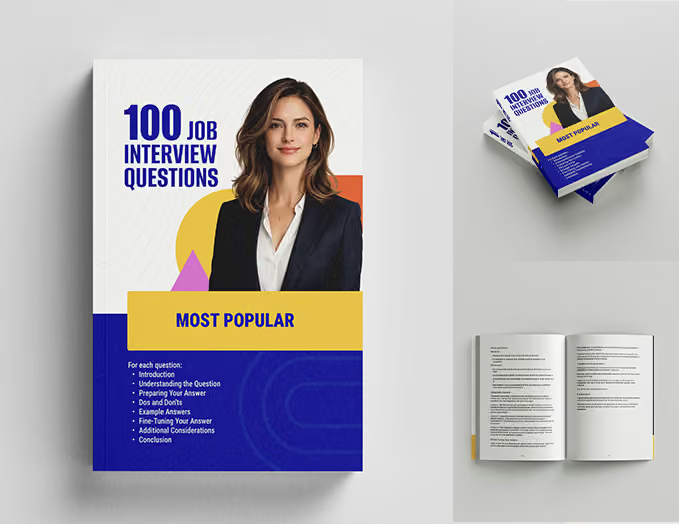
Built from the RockStarCV interview-question library
Adapted from the RockStarCV guide 100 Most Popular Job Interview Questions and its long-form narration. The structure and examples have been edited for a practical web reading experience.
Book reference: Question 50