Chapter 01
Introduction
Use this opening to give the interviewer a useful professional through-line.
Think of your answer as the trailer for your work story. Its job is to make the interviewer curious about the most relevant parts—not to compress your entire life into ninety seconds.
A focused answer identifies the work you do now, offers one piece of evidence that makes your contribution credible, and explains why the position in front of you is a logical next step. Those three moves create direction and give the interviewer productive places to follow up.
- 01Present role
Describe what you do or the value you bring in one clear sentence.
- 02Relevant proof
Choose one contribution, result, or responsibility that supports that description.
- 03Logical next step
Explain why this role makes sense from where you are now.
Chapter 02
Understanding the Question
The interviewer already has your résumé. They want your interpretation of it.
This question helps the interviewer decide which parts of your history deserve a closer look. They are testing judgment as much as biography: can you choose what matters for this role, rather than reciting everything you have done?
Listen to the wording and the context. If the interviewer emphasizes a skill, a transition, or a particular responsibility, bring the most relevant evidence forward. Decide which two ideas you want them to remember after the meeting and make sure your opening points toward them.
- 01Frame the interview
Choose the professional thread you want the conversation to explore.
- 02Choose what matters now
Prioritize recent, role-relevant evidence over a complete chronology.
- 03Invite the right follow-up
Include enough specificity for the interviewer to ask a useful next question.
Chapter 03
Preparing Your Answer
Prepare anchors, not a memorized paragraph.
Choose two relevant career turns, including one that shows growth, and one reason this position is a logical next move. Practice both a forty-second version and a ninety-second version so you can match the pace of the conversation.
Write each part of present, proof, future on a separate card. Speak from the cards with your résumé closed. This keeps the sequence reliable while allowing the language to remain natural.
- 01Present
One sentence about your current work, specialty, or value.
- 02Proof
One result, responsibility, or transition that makes the opening credible.
- 03Future
A precise reason the target role is a sensible next move.
- 04Edit
Remove older dates and details that do not explain the transition.
Chapter 04
Dos and Don’ts
A strong answer feels complete because it has direction, not because it contains everything.
Do
- Lead with the work you do now and the value you bring.
- Use active verbs and one concrete contribution.
- Connect your experience to a responsibility in the vacancy.
- Leave space for a follow-up question.
Don’t
- Begin with childhood or unrelated personal history.
- Repeat your résumé line by line.
- Force every career turn into the opening.
- Rely on job titles to explain what you actually contributed.
Chapter 05
Example Answers
Keep the structure. Replace every fact with evidence from your own experience.
“I work in customer operations, where I turn recurring service problems into clearer processes. Recently I redesigned our escalation notes so colleagues could resolve common cases without handing them off. This role appeals to me because it combines that practical improvement work with a larger customer base.”
Why it works: Current work, a concrete contribution, and a reason the new scope fits.
“My background is in finance and reporting. Over the past few years I have moved from producing monthly packs to helping managers understand the decisions behind the numbers. I am looking for a team where analysis is close to the people who act on it.”
Why it works: A clear progression and a specific preference for the next environment.
“I started in retail, then became the person colleagues asked to train new hires and fix handover gaps. That taught me I enjoy making work easier for others. I am now looking to bring that habit into a dedicated coordination role.”
Why it works: A credible bridge between frontline experience and the target role.
Chapter 06
Fine-Tuning Your Answer
Move your first useful fact earlier and replace labels with observable actions.
Record one practice answer and listen for the first useful fact. If it arrives after twenty seconds, move it forward. Replace vague labels such as strategic, passionate, or results-driven with a task you owned and its effect.
Check the ending. It should land on the role rather than fade into another chapter of your history. Small edits to order usually improve this answer more than adding new content.
- 01Move value forward
Put the most role-relevant contribution near the beginning.
- 02Replace labels
Trade adjectives for a task, decision, or result.
- 03Land on the role
End with the connection between your experience and this opportunity.
Chapter 07
Additional Considerations
Different career situations need different kinds of proof.
For a career change, name the repeated skill that connects your previous work to the target role. For an employment gap, state the relevant fact briefly if it explains the timeline, then return to current readiness.
Early-career candidates can use projects, volunteering, placements, and study as proof. Senior candidates should resist cataloguing every achievement; choose the one that best explains their leadership approach and fit for this mandate.
- 01Career change
Name the bridge and show where you have already practiced it.
- 02Early career
Use projects and placements as evidence, not apologies for limited tenure.
- 03Senior candidate
Choose the achievement that best explains your current leadership value.
Chapter 08
Conclusion
Clear role. Credible proof. Purposeful direction.
Your final check is simple: can a listener describe what you do, one reason to believe you do it well, and why this role follows logically? If yes, the introduction has done its job.
Practice a shorter and a longer version, keep your tone conversational, and stop when the direction is clear. A useful introduction invites a follow-up; it does not answer every possible question.
Say where you are, prove one relevant part of the story, and make the next move easy to understand.
Source & adaptation
Built from the RockStarCV interview-question library
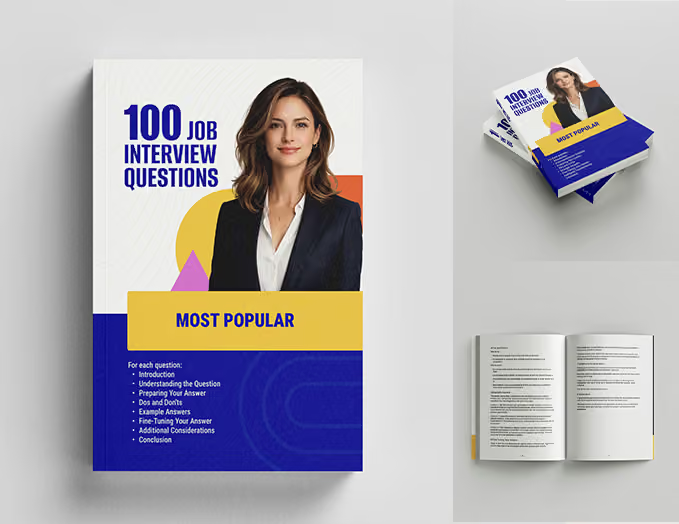
Adapted from the RockStarCV guide 100 Most Popular Job Interview Questions. The structure and examples have been edited for a practical web reading experience.
Book reference: Question 1, pages 6–8