Chapter 01
Introduction
This is your chance to close a gap, not repeat the interview.
The final open invitation is useful only if something material remains unsaid. Choose the professional starting point that makes this answer useful now. Name the work, responsibility, or transition before adding background, so the interviewer can understand why the detail belongs in your response.
The final open invitation is most useful for a missing piece of evidence. The final invitation is a chance to add missing evidence, not repeat your opening pitch. Think about what the interview covered well and what relevant strength or context remains underexplained. Test the evidence against the vacancy. Keep the facts you can explain in a follow-up, remove biography that does not help the decision, and make the final sentence point toward the role in front of you.
- 01Set the direction
This is your chance to close a gap, not repeat the interview.
- 02Choose the proof
The final open invitation is useful only if something material remains unsaid.
- 03Connect it to the role
Choose the professional starting point that makes this answer useful now.
Chapter 02
Understanding the Question
They may be giving you space to address a concern raised during the discussion.
The interviewer may be giving you a chance to address a concern they raised indirectly. Read the question as an assessment, not only a request for information. Decide which judgment, risk, working habit, or motivation the interviewer needs to see, then make that purpose visible through one concrete detail.
The interviewer may be offering a genuine opportunity to clarify a concern. A concise answer can connect an overlooked example to the role or correct a misunderstanding without reopening every earlier question. Prepare for the next question as well as this one. If you mention a result, transition, conflict, or constraint, keep the context and your exact contribution ready so the interviewer can test the claim without weakening it.
- 01What they are testing
They may be giving you space to address a concern raised during the discussion.
- 02Prepare the follow-up
The interviewer may be giving you a chance to address a concern they raised indirectly.
- 03Keep the evidence ready
Read the question as an assessment, not only a request for information.
Chapter 03
Preparing Your Answer
Review what the interviewer may still be uncertain about.
Recall the most relevant evidence you have not yet connected to the role. Recall one requirement you discussed that has not yet been tied to a concrete example. Build a small evidence bank before rehearsing. Write the setting, the decision you owned, the action you took, and the observable result. That gives you facts to select instead of forcing you to invent polished language under pressure.
Before interviews, identify two or three proof points you would want the panel to remember. Near the end, choose only one if it has not surfaced. State the relevance, give a brief piece of evidence, and invite any remaining question. Arrange the answer so the listener never has to guess why a detail matters. Put the strongest evidence near the claim it supports, keep your role precise, and finish with the lesson or relevance to this position.
- 01Build your evidence
Review what the interviewer may still be uncertain about.
- 02Shape the sequence
Recall the most relevant evidence you have not yet connected to the role.
- 03Keep the evidence ready
Recall one requirement you discussed that has not yet been tied to a concrete example.
Chapter 04
Dos and Don’ts
What to do: Add one relevant piece of evidence and end cleanly.
Do
- Add one relevant piece of evidence and end cleanly.
- Do close the gap in a few sentences and then stop.
Don’t
- Do not deliver another full pitch or introduce an unrelated claim.
- Do not repeat every point from the interview as a second sales pitch.
- Add something material and keep it short.
- Do not introduce a major new claim without evidence or turn the close into a monologue.
Chapter 05
Example Answers
An effective closing example might mention a cross-functional result that connects several skills the role needs.
The point is synthesis, not another full STAR story. Compare the examples by structure rather than memorizing their wording. Notice where each candidate sets the context, states personal ownership, and closes with a result, lesson, or reason the experience matters to the employer.
“One point I would add is that I have handled handovers during system changes, not just steady-state work. When our case platform changed, I documented exceptions with the team so service continued. That experience seems relevant to the transition you described.”
Why it works: Treat this first example as a model for sequence. Replace its workplace, task, people, and result with truthful details of your own while keeping the connection between the claim and the supporting evidence.
“I would emphasize how much I enjoy working with the people who use a report. The strongest analysis I have done came from asking what decision the reader needed to make. I would bring that habit here.”
Why it works: Use the second example to explore a different route to the same competency. Your version can come from paid work, study, volunteering, or a project, provided you state the context and do not overstate your responsibility.
“We discussed my limited experience with your exact software. I have learned similar systems through supervised practice and documented the steps for colleagues afterward. I would approach this one the same way, without pretending I know it already.”
Why it works: Use the third example to test whether your answer sounds recognisably yours. Keep the useful structure, then change every borrowed fact.
Chapter 06
Fine-Tuning Your Answer
If nothing important is missing, a sincere concise close is enough.
Avoid restarting the entire interview from the beginning. If no gap remains, a concise thank-you may be the stronger choice. Fine-tuning is mainly subtraction and precision. Move the strongest fact earlier, replace labels with actions, and check that the ending answers the question rather than drifting into a second example or an unrelated career summary.
If you sensed a concern about experience, address it directly and honestly: name the adjacent experience and how you would close the gap. Do not claim mastery you do not have. Record one practice version and listen for the first useful fact. If it arrives late, shorten the setup. Then check every result, number, and claim so the final wording remains accurate when the interviewer asks for detail.
- 01Make it sharper
If nothing important is missing, a sincere concise close is enough.
- 02Test the wording
Avoid restarting the entire interview from the beginning.
- 03Keep the evidence ready
If no gap remains, a concise thank-you may be the stronger choice.
Chapter 07
Additional Considerations
A simple thank-you is enough when the important points are already covered.
Adapt the structure to your circumstances without hiding them. Career changes, gaps, early-career evidence, senior scope, confidentiality, and reasonable boundaries may change the example, but they do not remove the need for relevance and honest ownership.
You can ask whether there is a concern you have not addressed if the conversation allows it. Some interviews end abruptly. Prepare a one-sentence version of your closing point so you can use it without forcing an extended speech. Protect credibility where context is sensitive. Use the level of detail you can share, separate team results from your contribution, and explain constraints without disclosing private information or blaming people who are not present.
- 01Adapt the answer
A simple thank-you is enough when the important points are already covered.
- 02Keep it credible
Adapt the structure to your circumstances without hiding them.
- 03Keep the evidence ready
Career changes, gaps, early-career evidence, senior scope, confidentiality, and reasonable boundaries may change the example, but they do not remove the need for relevance and honest ownership.
Chapter 08
Conclusion
Close one gap, then stop with confidence.
If there is no gap to close, a short sincere ending is enough. Bring the answer back to one clear message. The interviewer should be able to repeat your main claim, the evidence supporting it, and why it matters to the role without reconstructing the meaning from several disconnected points.
Conclude with appreciation and a clear reason the opportunity appeals to you. The last impression should be specific and proportionate to the conversation. End deliberately. Stop when the question has been answered, the evidence is credible, and the relevance is clear. A concise landing invites a useful follow-up and leaves the listener with the professional judgment you intended to show.
A concise landing invites a useful follow-up and leaves the listener with the professional judgment you intended to show.
Source & adaptation
Built from the RockStarCV interview-question library
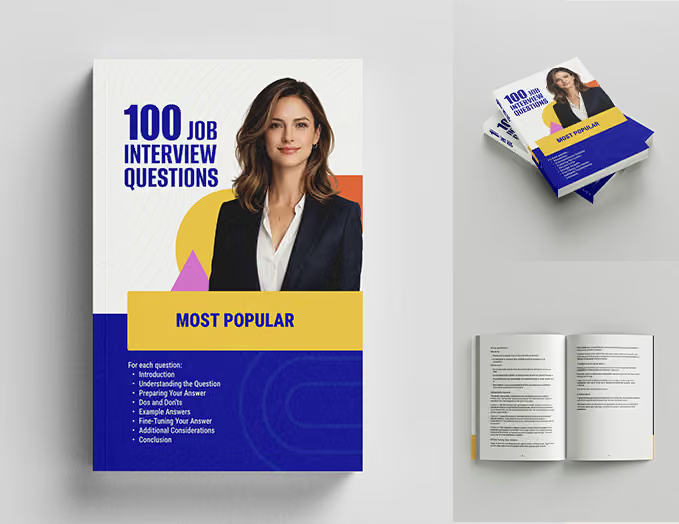
Adapted from the RockStarCV guide 100 Most Popular Job Interview Questions and its long-form narration. The structure and examples have been edited for a practical web reading experience.
Book reference: Question 99