Chapter 01
Introduction
The answer should connect a pattern of learning to the employer's work.
The answer should join your experiences into a capability the role needs. Choose the professional starting point that makes this answer useful now. Name the work, responsibility, or transition before adding background, so the interviewer can understand why the detail belongs in your response.
The point is not that every past role resembles this one, but that each built a relevant part of your judgement. Background is useful when the listener can trace how one experience prepared you for a later demand. A list of varied roles does not make the transfer mechanism visible. Test the evidence against the vacancy. Keep the facts you can explain in a follow-up, remove biography that does not help the decision, and make the final sentence point toward the role in front of you.
- 01Set the direction
The answer should connect a pattern of learning to the employer's work.
- 02Choose the proof
The answer should join your experiences into a capability the role needs.
- 03Connect it to the role
Choose the professional starting point that makes this answer useful now.
Chapter 02
Understanding the Question
A background is persuasive when the link is causal: this task taught you something you later used elsewhere.
A listener may probe the weakest link in your career path. Read the question as an assessment, not only a request for information. Decide which judgment, risk, working habit, or motivation the interviewer needs to see, then make that purpose visible through one concrete detail.
Decide how to explain it without forcing equivalence. The interviewer may test where the analogy breaks. Know which task is genuinely new here and what you would do to learn it safely. Prepare for the next question as well as this one. If you mention a result, transition, conflict, or constraint, keep the context and your exact contribution ready so the interviewer can test the claim without weakening it.
- 01What they are testing
A background is persuasive when the link is causal: this task taught you something you later used elsewhere.
- 02Prepare the follow-up
A listener may probe the weakest link in your career path.
- 03Keep the evidence ready
Read the question as an assessment, not only a request for information.
Chapter 03
Preparing Your Answer
Select a challenge from each of two roles that built the same capability.
Identify a recurring challenge across two settings and how your response improved. Build a small evidence bank before rehearsing. Write the setting, the decision you owned, the action you took, and the observable result. That gives you facts to select instead of forcing you to invent polished language under pressure.
Select two different settings and identify the same capability in a more mature form across them. Choose two roles with different conditions. Identify the same capability in each, then explain how it became more deliberate or more effective over time. Arrange the answer so the listener never has to guess why a detail matters. Put the strongest evidence near the claim it supports, keep your role precise, and finish with the lesson or relevance to this position.
- 01Build your evidence
Select a challenge from each of two roles that built the same capability.
- 02Shape the sequence
Identify a recurring challenge across two settings and how your response improved.
- 03Keep the evidence ready
Build a small evidence bank before rehearsing.
Chapter 04
Dos and Don’ts
What to do: Make the connection explicit without pretending the roles are identical.
Do
- Make the connection explicit without pretending the roles are identical.
- Do distinguish what each setting taught you rather than blending them into one vague claim.
Don’t
- Do not turn this into a second full resume walk-through.
- Do not retell the full resume when a pattern of preparation would be more useful.
- Do not claim that having survived several settings makes you instantly competent in any new one.
- Translate the transferable part and name the specific learning ahead.
Chapter 05
Example Answers
The samples connect support to operations, procurement to project work, and small-team agility to larger-team controls.
Each uses a bridge, not just a broad statement of adaptability. Compare the examples by structure rather than memorizing their wording. Notice where each candidate sets the context, states personal ownership, and closes with a result, lesson, or reason the experience matters to the employer.
“Working in support taught me to recognize recurring pain points; moving into operations taught me to fix their causes. This position asks for both: listening to users and improving the process behind the experience.”
Why it works: Treat this first example as a model for sequence. Replace its workplace, task, people, and result with truthful details of your own while keeping the connection between the claim and the supporting evidence.
“My background combines procurement administration and project coordination. The first taught me to document commitments carefully; the second taught me how to revisit them when priorities change. I would use both when managing vendor-dependent deadlines.”
Why it works: Use the second example to explore a different route to the same competency. Your version can come from paid work, study, volunteering, or a project, provided you state the context and do not overstate your responsibility.
“I have worked in small teams where I had to learn new systems quickly and in larger teams where approvals mattered. That mix prepared me to be practical without bypassing controls.”
Why it works: Use the third example to test whether your answer sounds recognisably yours. Keep the useful structure, then change every borrowed fact.
Chapter 06
Fine-Tuning Your Answer
If your route is unconventional, name the transfer mechanism, not just the similarity.
Remove experiences that add breadth but no evidence of readiness for this vacancy. Fine-tuning is mainly subtraction and precision. Move the strongest fact earlier, replace labels with actions, and check that the ending answers the question rather than drifting into a second example or an unrelated career summary.
If the background is unusual, spell out the mechanism of transfer in plain language. Cut older details that do not explain the current capability. A lean story lets the interviewer spend more attention on the point where your experience meets their need. Record one practice version and listen for the first useful fact. If it arrives late, shorten the setup. Then check every result, number, and claim so the final wording remains accurate when the interviewer asks for detail.
- 01Make it sharper
If your route is unconventional, name the transfer mechanism, not just the similarity.
- 02Test the wording
Remove experiences that add breadth but no evidence of readiness for this vacancy.
- 03Keep the evidence ready
Fine-tuning is mainly subtraction and precision.
Chapter 07
Additional Considerations
An unconventional route may make you adaptable, but illustrate the adaptation rather than claiming it.
Adapt the structure to your circumstances without hiding them. Career changes, gaps, early-career evidence, senior scope, confidentiality, and reasonable boundaries may change the example, but they do not remove the need for relevance and honest ownership.
A gap in direct experience should lead to a realistic learning plan, not a defensive comparison. An unconventional route may give you a perspective the team lacks, but it may also leave a technical gap. Discuss both without presenting either as the whole story. Protect credibility where context is sensitive. Use the level of detail you can share, separate team results from your contribution, and explain constraints without disclosing private information or blaming people who are not present.
- 01Adapt the answer
An unconventional route may make you adaptable, but illustrate the adaptation rather than claiming it.
- 02Keep it credible
Adapt the structure to your circumstances without hiding them.
- 03Keep the evidence ready
Career changes, gaps, early-career evidence, senior scope, confidentiality, and reasonable boundaries may change the example, but they do not remove the need for relevance and honest ownership.
Chapter 08
Conclusion
Bring the story forward to what you can contribute in the first months.
Bring the answer back to one clear message. The interviewer should be able to repeat your main claim, the evidence supporting it, and why it matters to the role without reconstructing the meaning from several disconnected points.
Connect the pattern in your background to the work in front of you. End at an immediate responsibility you could take on, with a credible explanation of how you would handle the unfamiliar parts. End deliberately. Stop when the question has been answered, the evidence is credible, and the relevance is clear. A concise landing invites a useful follow-up and leaves the listener with the professional judgment you intended to show.
A concise landing invites a useful follow-up and leaves the listener with the professional judgment you intended to show.
Source & adaptation
Built from the RockStarCV interview-question library
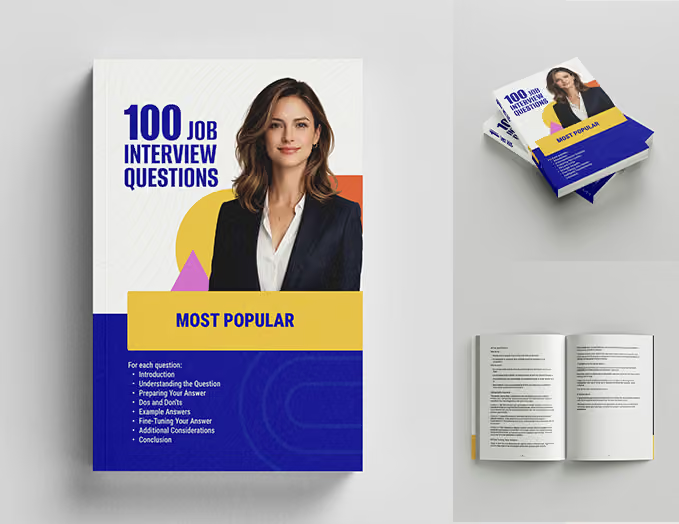
Adapted from the RockStarCV guide 100 Most Popular Job Interview Questions and its long-form narration. The structure and examples have been edited for a practical web reading experience.
Book reference: Question 10