Chapter 01
Introduction
The employer wants proof that speed does not remove critical controls.
Fast work needs a short list of controls that cannot be removed. Moving fast should simplify scope before it weakens a necessary control. Choose the professional starting point that makes this answer useful now. Name the work, responsibility, or transition before adding background, so the interviewer can understand why the detail belongs in your response.
Quality under speed requires explicit controls, not a promise to be careful. Choose a deliverable with a short turnaround and explain which checks were essential, which could be simplified, and who approved the tradeoff. Test the evidence against the vacancy. Keep the facts you can explain in a follow-up, remove biography that does not help the decision, and make the final sentence point toward the role in front of you.
- 01Set the direction
The employer wants proof that speed does not remove critical controls.
- 02Choose the proof
Fast work needs a short list of controls that cannot be removed.
- 03Connect it to the role
Moving fast should simplify scope before it weakens a necessary control.
Chapter 02
Understanding the Question
They are testing whether you can simplify delivery without weakening essential checks.
A follow-up may ask which check could not be skipped and why. Read the question as an assessment, not only a request for information. Decide which judgment, risk, working habit, or motivation the interviewer needs to see, then make that purpose visible through one concrete detail.
The interviewer is asking whether you recognize failure modes and can design a faster path without removing the safeguards that make the result trustworthy. Prepare for the next question as well as this one. If you mention a result, transition, conflict, or constraint, keep the context and your exact contribution ready so the interviewer can test the claim without weakening it.
- 01What they are testing
They are testing whether you can simplify delivery without weakening essential checks.
- 02Prepare the follow-up
A follow-up may ask which check could not be skipped and why.
- 03Keep the evidence ready
Read the question as an assessment, not only a request for information.
Chapter 03
Preparing Your Answer
Choose a case where you simplified scope or review, not standards.
Prepare one decision to narrow scope and one verification step you preserved. Write the risk of a wrong result, the smallest useful delivery, and the validation step. Build a small evidence bank before rehearsing. Write the setting, the decision you owned, the action you took, and the observable result. That gives you facts to select instead of forcing you to invent polished language under pressure.
Prepare an example with a deadline and a measurable quality risk. Describe the critical checks, the work you batched or automated, the review point, and the decision you would make if the check failed. State the actual result. Arrange the answer so the listener never has to guess why a detail matters. Put the strongest evidence near the claim it supports, keep your role precise, and finish with the lesson or relevance to this position.
- 01Build your evidence
Choose a case where you simplified scope or review, not standards.
- 02Shape the sequence
Prepare one decision to narrow scope and one verification step you preserved.
- 03Keep the evidence ready
Write the risk of a wrong result, the smallest useful delivery, and the validation step.
Chapter 04
Dos and Don’ts
What to do: Identify the checks that remained non-negotiable.
Do
- Identify the checks that remained non-negotiable.
- Do make uncertainty visible when the fast answer is provisional.
Don’t
- Do not claim a rushed deliverable has no increased risk.
- Do not describe an on-time release as high quality without examining its effects.
- Protect high-consequence checks even when the schedule is uncomfortable.
- Do not imply that a skipped approval or test is acceptable because the final result happened to be fine.
Chapter 05
Example Answers
A good story may include a two-stage release: a correct core deliverable by the deadline, then lower-priority polish afterward.
Name which parts were safe to defer and why. Compare the examples by structure rather than memorizing their wording. Notice where each candidate sets the context, states personal ownership, and closes with a result, lesson, or reason the experience matters to the employer.
“For an urgent report, I narrowed it to three verified figures and left the less reliable cuts for a later update. I still reconciled the totals and marked the time period clearly. The decision makers got a fast, trustworthy answer.”
Why it works: Treat this first example as a model for sequence. Replace its workplace, task, people, and result with truthful details of your own while keeping the connection between the claim and the supporting evidence.
“We had to issue customer instructions quickly after a policy change. I wrote a short version, had the policy owner verify the exception route, and tested it with one support colleague before sending it widely.”
Why it works: Use the second example to explore a different route to the same competency. Your version can come from paid work, study, volunteering, or a project, provided you state the context and do not overstate your responsibility.
“A launch was accelerated, so I removed optional visuals but kept the accessibility and legal review. We delivered a simpler version on time and scheduled enhancements for the next release.”
Why it works: Use the third example to test whether your answer sounds recognisably yours. Keep the useful structure, then change every borrowed fact.
Chapter 06
Fine-Tuning Your Answer
Quality controls should match the risk of an error, not the size of the document.
Avoid presenting a rushed output as flawless just because it arrived on time. Fine-tuning is mainly subtraction and precision. Move the strongest fact earlier, replace labels with actions, and check that the ending answers the question rather than drifting into a second example or an unrelated career summary.
Protect different checks for different risks; one universal checklist is not enough. If someone else pushed for speed, show how you explained the risk in terms of impact and options rather than just saying no. That is a senior answer to a common operational tension. Record one practice version and listen for the first useful fact. If it arrives late, shorten the setup. Then check every result, number, and claim so the final wording remains accurate when the interviewer asks for detail.
- 01Make it sharper
Quality controls should match the risk of an error, not the size of the document.
- 02Test the wording
Avoid presenting a rushed output as flawless just because it arrived on time.
- 03Keep the evidence ready
Fine-tuning is mainly subtraction and precision.
Chapter 07
Additional Considerations
The right control depends on the harm a mistake could cause.
Adapt the structure to your circumstances without hiding them. Career changes, gaps, early-career evidence, senior scope, confidentiality, and reasonable boundaries may change the example, but they do not remove the need for relevance and honest ownership.
A later enhancement plan should not be used to excuse an unsafe first version. Some work has non-negotiable legal, safety, or privacy controls. State the boundary plainly instead of treating all quality criteria as flexible preferences. Protect credibility where context is sensitive. Use the level of detail you can share, separate team results from your contribution, and explain constraints without disclosing private information or blaming people who are not present.
- 01Adapt the answer
The right control depends on the harm a mistake could cause.
- 02Keep it credible
Adapt the structure to your circumstances without hiding them.
- 03Keep the evidence ready
Career changes, gaps, early-career evidence, senior scope, confidentiality, and reasonable boundaries may change the example, but they do not remove the need for relevance and honest ownership.
Chapter 08
Conclusion
Tell the interviewer what you deliberately left for later.
Speed should shorten the path, not remove the control that matters. Bring the answer back to one clear message. The interviewer should be able to repeat your main claim, the evidence supporting it, and why it matters to the role without reconstructing the meaning from several disconnected points.
Conclude with the delivered outcome and the reusable safeguard. Sustainable speed comes from a clearer process, not from accepting invisible risk. End deliberately. Stop when the question has been answered, the evidence is credible, and the relevance is clear. A concise landing invites a useful follow-up and leaves the listener with the professional judgment you intended to show.
A concise landing invites a useful follow-up and leaves the listener with the professional judgment you intended to show.
Source & adaptation
Built from the RockStarCV interview-question library
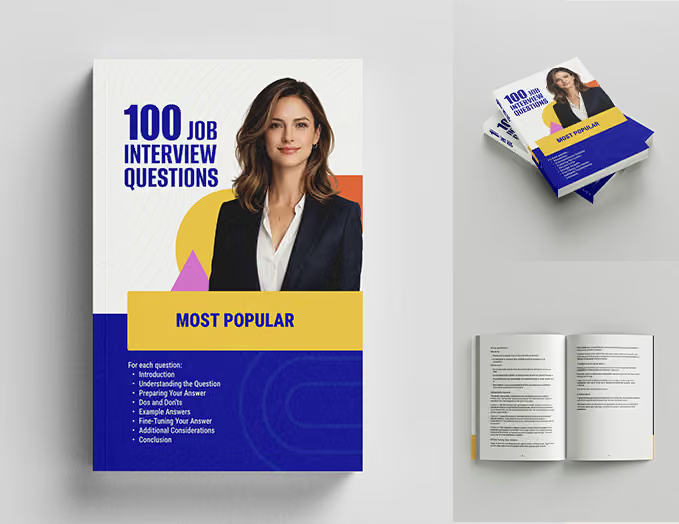
Adapted from the RockStarCV guide 100 Most Popular Job Interview Questions and its long-form narration. The structure and examples have been edited for a practical web reading experience.
Book reference: Question 80