Chapter 01
Introduction
This checks whether you distribute ownership without abandoning standards.
Delegation succeeds when context and authority travel with the task. Delegation is fair only when the task comes with context, authority, and review. Choose the professional starting point that makes this answer useful now. Name the work, responsibility, or transition before adding background, so the interviewer can understand why the detail belongs in your response.
Delegation is a way to match authority and support to a result, not to offload tasks. The best explanation covers what you retained, what you transferred, and how you set up the other person to make decisions. Test the evidence against the vacancy. Keep the facts you can explain in a follow-up, remove biography that does not help the decision, and make the final sentence point toward the role in front of you.
- 01Set the direction
This checks whether you distribute ownership without abandoning standards.
- 02Choose the proof
Delegation succeeds when context and authority travel with the task.
- 03Connect it to the role
Delegation is fair only when the task comes with context, authority, and review.
Chapter 02
Understanding the Question
They are asking whether you trust people while keeping appropriate review.
The interviewer may ask how you responded when the result differed from your preferred method. Read the question as an assessment, not only a request for information. Decide which judgment, risk, working habit, or motivation the interviewer needs to see, then make that purpose visible through one concrete detail.
The interviewer wants to know whether you calibrate responsibility to skill, capacity, risk, and development. They may also be checking whether you can tolerate a different working style when the quality bar is met. Prepare for the next question as well as this one. If you mention a result, transition, conflict, or constraint, keep the context and your exact contribution ready so the interviewer can test the claim without weakening it.
- 01What they are testing
They are asking whether you trust people while keeping appropriate review.
- 02Prepare the follow-up
The interviewer may ask how you responded when the result differed from your preferred method.
- 03Keep the evidence ready
Read the question as an assessment, not only a request for information.
Chapter 03
Preparing Your Answer
Prepare a case with a clear outcome and checkpoints.
Recall the outcome you agreed, the freedom you gave, and the checkpoint you set. Build a small evidence bank before rehearsing. Write the setting, the decision you owned, the action you took, and the observable result. That gives you facts to select instead of forcing you to invent polished language under pressure.
Recall why the colleague was a good owner and what standard you agreed at the start. Prepare an example with a clear deliverable. Describe why that person was suitable, what outcome and guardrails you agreed, what decisions they could make independently, and the checkpoints that caught problems without micromanaging. Arrange the answer so the listener never has to guess why a detail matters. Put the strongest evidence near the claim it supports, keep your role precise, and finish with the lesson or relevance to this position.
- 01Build your evidence
Prepare a case with a clear outcome and checkpoints.
- 02Shape the sequence
Recall the outcome you agreed, the freedom you gave, and the checkpoint you set.
- 03Keep the evidence ready
Build a small evidence bank before rehearsing.
Chapter 04
Dos and Don’ts
What to do: Match the task to capability and explain why it matters.
Do
- Match the task to capability and explain why it matters.
- Do make the checkpoint proportionate to the risk, not your anxiety.
Don’t
- Do not delegate only the tedious work or prescribe every move.
- Do not give responsibility without access to the information needed to complete it.
- Define the result and escalation points up front.
- Do not equate delegation with disappearing until the deadline, and do not take the work back at the first different approach.
Chapter 05
Example Answers
A credible example distinguishes the method from the standard.
The colleague may choose their own route, while you remain explicit about deadline, quality, customer, and approval boundaries. Compare the examples by structure rather than memorizing their wording. Notice where each candidate sets the context, states personal ownership, and closes with a result, lesson, or reason the experience matters to the employer.
“I asked a colleague to own the first draft of a supplier tracker because they knew the incoming requests best. We agreed the essential fields and a review date, then I let them design the layout. Their version was simpler than mine would have been.”
Why it works: Treat this first example as a model for sequence. Replace its workplace, task, people, and result with truthful details of your own while keeping the connection between the claim and the supporting evidence.
“During a reporting cycle, I delegated source checks to the people closest to each system. I gave them the definition and exception threshold, then reviewed the combined results. That made the checks more reliable than one person trying to verify everything.”
Why it works: Use the second example to explore a different route to the same competency. Your version can come from paid work, study, volunteering, or a project, provided you state the context and do not overstate your responsibility.
“I gave a new team member responsibility for a routine client update after practicing one together. I remained available for unusual questions, but they sent the next update themselves. Their confidence grew and the client had a consistent contact.”
Why it works: Use the third example to test whether your answer sounds recognisably yours. Keep the useful structure, then change every borrowed fact.
Chapter 06
Fine-Tuning Your Answer
Delegation needs enough context and authority to be fair.
Avoid handing off only low-value tasks or retaining every meaningful decision. Fine-tuning is mainly subtraction and precision. Move the strongest fact earlier, replace labels with actions, and check that the ending answers the question rather than drifting into a second example or an unrelated career summary.
Describe where you stepped back and where you remained accountable. When capacity is tight, delegation may require removing other work rather than adding one more request. Explain how you checked workload and adjusted priority before assigning the task. Record one practice version and listen for the first useful fact. If it arrives late, shorten the setup. Then check every result, number, and claim so the final wording remains accurate when the interviewer asks for detail.
- 01Make it sharper
Delegation needs enough context and authority to be fair.
- 02Test the wording
Avoid handing off only low-value tasks or retaining every meaningful decision.
- 03Keep the evidence ready
Fine-tuning is mainly subtraction and precision.
Chapter 07
Additional Considerations
The right level of oversight changes with risk and experience.
The person's independent success is a stronger outcome than your own freed time. Adapt the structure to your circumstances without hiding them. Career changes, gaps, early-career evidence, senior scope, confidentiality, and reasonable boundaries may change the example, but they do not remove the need for relevance and honest ownership.
If the assignment went poorly, describe whether the problem was unclear scope, insufficient skill, missing authority, or a late checkpoint. The lesson should improve your delegation practice, not blame the person. Protect credibility where context is sensitive. Use the level of detail you can share, separate team results from your contribution, and explain constraints without disclosing private information or blaming people who are not present.
- 01Adapt the answer
The right level of oversight changes with risk and experience.
- 02Keep it credible
The person's independent success is a stronger outcome than your own freed time.
- 03Keep the evidence ready
Adapt the structure to your circumstances without hiding them.
Chapter 08
Conclusion
Show both the colleague's ownership and your responsibility for the result.
The colleague needs enough context to own the outcome fairly. Bring the answer back to one clear message. The interviewer should be able to repeat your main claim, the evidence supporting it, and why it matters to the role without reconstructing the meaning from several disconnected points.
Conclude with what the person delivered and what they could own next time. Effective delegation increases team capability while keeping the result dependable. End deliberately. Stop when the question has been answered, the evidence is credible, and the relevance is clear. A concise landing invites a useful follow-up and leaves the listener with the professional judgment you intended to show.
A concise landing invites a useful follow-up and leaves the listener with the professional judgment you intended to show.
Source & adaptation
Built from the RockStarCV interview-question library
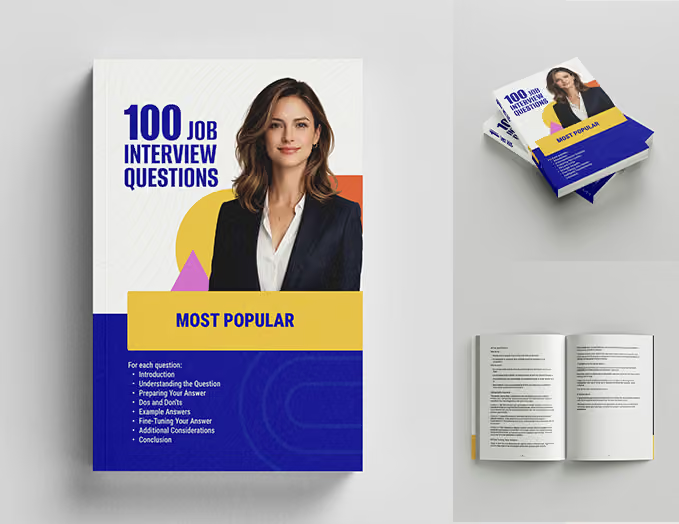
Adapted from the RockStarCV guide 100 Most Popular Job Interview Questions and its long-form narration. The structure and examples have been edited for a practical web reading experience.
Book reference: Question 62