Skip to interview
RockStarCV.com
Toggle Navigation

Social Worker Mock Interview: The Developing Candidate

Watch a credible Social Worker candidate whose answers need clearer decisions, ownership, and verification.

Developing candidate pathInteractive simulation16 chapters
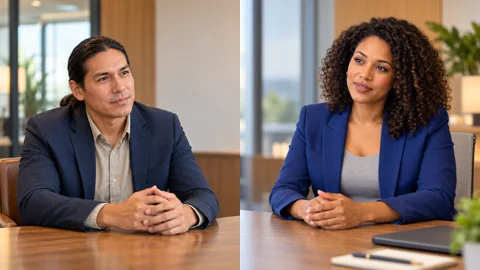
Claire Bennett, fictional Social Worker candidate, seated on the left and facing toward the article center
Claire BennettSocial Worker candidate

Watch and practise

Run the complete interview

Complete transcript

RockStarCV NarratorIntroduction

What does a Social Worker interview sound like? Let us step inside the conversation and listen for the decisions that make each answer credible.

RockStarCV NarratorMeet Grace Kim and Claire Bennett

Your interviewer is Grace Kim, Director of Social Services. Your candidate is Claire Bennett, presenting the developing-candidate path. After the conversation, we will turn the evidence into a practical preparation framework.

Grace KimWelcome

Hi, Claire. Thank you for making the time. How is your day going?

Claire BennettWelcome

It is going well, thank you. I appreciate the chance to speak with you.

Grace KimWelcome

We will spend about half an hour on your background and several social worker scenarios, then leave time for your questions. Does that work for you?

Claire BennettWelcome

Yes, that sounds good.

Grace KimCareer story

Walk me through your experience as a Social Worker.

Claire BennettCareer story

I have several years of related experience and have handled person-in-environment assessment, advocacy, resource coordination, safeguarding, documentation, interdisciplinary work, and ethical boundaries. I am comfortable with the normal daily responsibilities.

Grace KimCareer story

What scope did you personally own?

Claire BennettCareer story

I usually work with the team, follow the established process, and keep my manager informed when something changes.

Grace KimCareer story

Which result best represents your approach?

Claire BennettCareer story

My work has generally gone well. I would need to review the records to give a specific result and denominator.

Grace KimMotivation

Why are you interested in this Social Worker role?

Claire BennettMotivation

I enjoy this type of work and your organization appears to offer a good next step. I am looking for growth and a new challenge.

Grace KimMotivation

What about this operating environment matters to you?

Claire BennettMotivation

The responsibilities are familiar to me, and I think I could learn the differences quickly.

Grace KimMotivation

What would you learn first?

Claire BennettMotivation

I would learn the tools, meet the team, and start with the assigned work.

Grace KimSafeguarding

Tell me about a time you had to receive information suggesting immediate risk.

Claire BennettSafeguarding

I have handled situations where I needed to receive information suggesting immediate risk. I stayed organized, communicated with the team, and tried to keep the work moving.

Grace KimSafeguarding

What decision did you personally make, and what evidence did you use?

Claire BennettSafeguarding

I normally use needs assessments and ask someone for help when the issue becomes complicated. The team usually works together and we find a solution.

Grace KimSafeguarding

How did you respect your authority boundary and verify the outcome?

Claire BennettSafeguarding

The situation was resolved. I would need to check the record for the exact result, and I could make my own decision and the authority boundary clearer.

Grace KimResource coordination

Tell me about a time you had to help a client facing several access barriers.

Claire BennettResource coordination

I have handled situations where I needed to help a client facing several access barriers. I stayed organized, communicated with the team, and tried to keep the work moving.

Grace KimResource coordination

What decision did you personally make, and what evidence did you use?

Claire BennettResource coordination

I normally use care or service plans and ask someone for help when the issue becomes complicated. The team usually works together and we find a solution.

Grace KimResource coordination

How did you respect your authority boundary and verify the outcome?

Claire BennettResource coordination

The situation was resolved. I would need to check the record for the exact result, and I could make my own decision and the authority boundary clearer.

Grace KimSelf-determination

Tell me about a time you had to disagree with a client choice.

Claire BennettSelf-determination

I have handled situations where I needed to disagree with a client choice. I stayed organized, communicated with the team, and tried to keep the work moving.

Grace KimSelf-determination

What decision did you personally make, and what evidence did you use?

Claire BennettSelf-determination

I normally use resource records and ask someone for help when the issue becomes complicated. The team usually works together and we find a solution.

Grace KimSelf-determination

How did you respect your authority boundary and verify the outcome?

Claire BennettSelf-determination

The situation was resolved. I would need to check the record for the exact result, and I could make my own decision and the authority boundary clearer.

Grace KimConfidentiality

Tell me about a time you had to handle a request for client information.

Claire BennettConfidentiality

I have handled situations where I needed to handle a request for client information. I stayed organized, communicated with the team, and tried to keep the work moving.

Grace KimConfidentiality

What decision did you personally make, and what evidence did you use?

Claire BennettConfidentiality

I normally use case notes and ask someone for help when the issue becomes complicated. The team usually works together and we find a solution.

Grace KimConfidentiality

How did you respect your authority boundary and verify the outcome?

Claire BennettConfidentiality

The situation was resolved. I would need to check the record for the exact result, and I could make my own decision and the authority boundary clearer.

Grace KimCaseload

Tell me about a time you had to prioritize competing urgent cases.

Claire BennettCaseload

I have handled situations where I needed to prioritize competing urgent cases. I stayed organized, communicated with the team, and tried to keep the work moving.

Grace KimCaseload

What decision did you personally make, and what evidence did you use?

Claire BennettCaseload

I normally use supervisory consultation and ask someone for help when the issue becomes complicated. The team usually works together and we find a solution.

Grace KimCaseload

How did you respect your authority boundary and verify the outcome?

Claire BennettCaseload

The situation was resolved. I would need to check the record for the exact result, and I could make my own decision and the authority boundary clearer.

Grace KimCandidate questions

What questions would you like to ask us?

Claire BennettCandidate questions

How would you describe the team culture?

Grace KimCandidate questions

The team is collaborative and direct. People are expected to ask for help early and follow through on commitments.

Claire BennettCandidate questions

What is the usual path for growth from this role?

Grace KimCandidate questions

Growth depends on consistent performance, broader judgment, and the needs of the organization. We discuss development during regular reviews.

Claire BennettCandidate questions

Thank you. That is helpful.

Grace KimClose

Those are all my questions. Thank you, Claire. We will follow up after the remaining interviews.

Claire BennettClose

Thank you for the conversation. I appreciate your time.

RockStarCV NarratorOutro 1 · Verdict

Claire Bennett remained credible and employable, but several answers stopped at activity. The missing layer was the decision rule, personal ownership, and verified outcome.

RockStarCV NarratorOutro 2 · Evidence

These are coachable gaps. A more specific example and one honest boundary would strengthen the same experience.

RockStarCV NarratorOutro 2 · Evidence

The recurring evidence was receive information suggesting immediate risk, help a client facing several access barriers, explain risk and options without replacing a capacitated decision, and only authorized relevant information was shared.

RockStarCV NarratorOutro 2 · Evidence

Notice that the examples are fictional composites. The teaching principles come from the cited occupation and practice sources, not from invented outcomes.

RockStarCV NarratorOutro 3 · Framework

Prepare your own answer with five lines: context, evidence, decision, boundary, verification.

RockStarCV NarratorOutro 3 · Framework

Keep each line short enough to say naturally, then let the interviewer decide where to probe.

RockStarCV NarratorOutro 4 · Practice

Pause here and rehearse one real social worker example. Replace team language with the decision you personally owned, and do not claim an outcome you cannot verify.

RockStarCV NarratorOutro 4 · Practice

Prepare with evidence. Interview with confidence.

Use Play to hear the conversation, move one slide at a time, or jump directly to a chapter. Captions follow the active speaker.

What to expect

How the interview is likely to unfold

A senior social worker interview usually moves from your career story into evidence of judgment, then closes with your questions.

  1. Career story

    Walk me through your experience as a Social Worker.

  2. Motivation

    Why are you interested in this Social Worker role?

  3. Safeguarding

    Tell me about a time you had to receive information suggesting immediate risk.

  4. Resource coordination

    Tell me about a time you had to help a client facing several access barriers.

  5. Self-determination

    Tell me about a time you had to disagree with a client choice.

  6. Confidentiality

    Tell me about a time you had to handle a request for client information.

  7. Caseload

    Tell me about a time you had to prioritize competing urgent cases.

Who might interview you

Different people are testing different things

Listen to the role behind the question. The same example may need a different emphasis for each interviewer.

Director of Social Services

Their purpose
Evaluate role judgment, ownership, boundaries, and evidence.
They look for
receive information suggesting immediate risk, help a client facing several access barriers, explain risk and options without replacing a capacitated decision

Cross-functional partner

Their purpose
Understand collaboration and escalation.
They look for
A clear decision path and honest operating boundary.

Senior peer

Their purpose
Test realistic execution detail.
They look for
Specific examples and verification.

What they are assessing

Make your judgment easy to see

What interviewers need to learn

  • Do you make receive information suggesting immediate risk visible?
  • Do you make help a client facing several access barriers visible?
  • Do you make explain risk and options without replacing a capacitated decision visible?
  • Do you make only authorized relevant information was shared visible?
  • Do you make prioritize competing urgent cases visible?

Accentuate

  • Context: Define the affected people, system, and consequence in Social Worker work.
  • Evidence: Use needs assessments, care or service plans, resource records, case notes, and supervisory consultation to verify the condition before acting.
  • Decision: Name the decision you personally owned and the trade-off you accepted.
  • Boundary: State what required approval, licensed judgment, or accountable escalation.
  • Verification: Close with the reviewed result, denominator, or completed handoff.

Leave out

  • Unbounded team language with no personal decision.
  • Activity presented as an outcome.
  • A promise outside your authority.
  • A number you cannot verify.

Difficult questions

Prepare the evidence, not a script

Use these prompts to choose a truthful example and reconstruct the decision. Your delivery should still sound like you.

Tell me about a time you had to receive information suggesting immediate risk.

Why they ask: They are testing safeguarding judgment.

Prepare: I used needs assessments to verify the condition, documented the trade-off, and made the next owner explicit. I also follow required safety and reporting routes without conducting an unauthorized investigation, so the work moved without creating a promise or decision outside my authority.

Tell me about a time you had to help a client facing several access barriers.

Why they ask: They are testing resource coordination judgment.

Prepare: I used care or service plans to verify the condition, documented the trade-off, and made the next owner explicit. I also prioritize the client goal and confirm actual service acceptance, so the work moved without creating a promise or decision outside my authority.

Tell me about a time you had to disagree with a client choice.

Why they ask: They are testing self-determination judgment.

Prepare: I used resource records to verify the condition, documented the trade-off, and made the next owner explicit. I also explain risk and options without replacing a capacitated decision, so the work moved without creating a promise or decision outside my authority.

Tell me about a time you had to handle a request for client information.

Why they ask: They are testing confidentiality judgment.

Prepare: I used case notes to verify the condition, documented the trade-off, and made the next owner explicit. I also verify consent legal basis and minimum necessary scope, so the work moved without creating a promise or decision outside my authority.

Tell me about a time you had to prioritize competing urgent cases.

Why they ask: They are testing caseload judgment.

Prepare: I used supervisory consultation to verify the condition, documented the trade-off, and made the next owner explicit. I also use safety vulnerability deadlines and available intervention, so the work moved without creating a promise or decision outside my authority.

100 interview questions

Social Worker Interview Questions: 100 Answers

Keep preparing with the complete question book created for Social Worker interviews.

View the question book
Front-facing 3D book mockup of Social Worker 100 Job Interview Questions, an interview question book from RockStarCV.com.

How to use this simulation

Listen for decisions, not polished phrases

Pause after each question and form your own answer before Claire Bennett responds. Then compare the evidence provided: the constraint, the decision, the personal contribution, the trade-off, and the result.

Grace Kim and Claire Bennett are fictional composite characters. Their employers, social worker examples, figures, and outcomes were created for teaching purposes.

Take the interview with you

Your social worker interview playbook

Use the printable framework to prepare examples, test your evidence, and rehearse stronger answers away from the screen.

  • Question prompts
  • Evidence checklist
  • Practice notes
Download the PDF playbook

What to notice

A practical viewing checklist

  1. 01

    Notice where activity replaces evidence.

  2. 02

    Add the decision rule and personal action.

  3. 03

    State the boundary you respected.

  4. 04

    Verify what changed.

Interviewer scorecard

The signals behind a credible answer

Context
Define the affected people, system, and consequence in Social Worker work.
Evidence
Use needs assessments, care or service plans, resource records, case notes, and supervisory consultation to verify the condition before acting.
Decision
Name the decision you personally owned and the trade-off you accepted.

Research foundation

Sources behind the teaching principles

The sources support the interview guidance, not the fictional candidate’s invented employers, budgets, dates, or outcomes.

Similar interviews

Explore related mock interviews

More from RockStarCV

Build your complete career toolkit