Skip to interview
RockStarCV.com
Toggle Navigation

Graphic Designer Mock Interview: The Strong Candidate

Hear a complete Graphic Designer interview in which Talia Morgan makes judgment, boundaries, and results inspectable.

Strong candidate pathInteractive simulation16 chapters
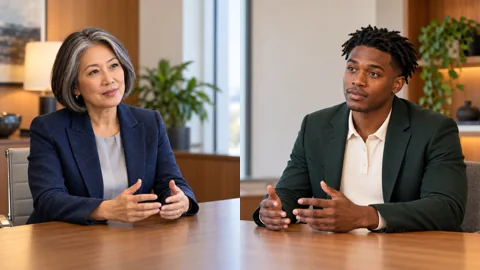
Talia Morgan, fictional Graphic Designer candidate, seated on the right and facing toward the article center
Talia MorganGraphic Designer candidate

Watch and practise

Run the complete interview

Complete transcript

RockStarCV NarratorIntroduction

What does a Graphic Designer interview sound like? Let us step inside the conversation and listen for the decisions that make each answer credible.

RockStarCV NarratorMeet Noah Whitecloud and Talia Morgan

Your interviewer is Noah Whitecloud, Creative Director. Your candidate is Talia Morgan, presenting the strong-candidate path. After the conversation, we will turn the evidence into a practical preparation framework.

Noah WhitecloudWelcome

Hi, Talia. Thank you for making the time. How is your day going?

Talia MorganWelcome

It is going well, thank you. I appreciate the chance to speak with you.

Noah WhitecloudWelcome

We will spend about half an hour on your background and several graphic designer scenarios, then leave time for your questions. Does that work for you?

Talia MorganWelcome

Yes, that sounds good.

Noah WhitecloudCareer story

Walk me through your experience as a Graphic Designer.

Talia MorganCareer story

I have built my experience around visual concepts, typography, layout, production files, brand systems, stakeholder feedback, and accessible communication. My recent work has required both dependable execution and clear judgment when the normal path no longer fit.

Noah WhitecloudCareer story

What scope did you personally own?

Talia MorganCareer story

I personally owned the record, decision path, and follow-through inside my role. I used creative briefs, design software, proofing workflows, brand standards, and accessibility checks so another person could inspect what I knew, what I decided, and where I escalated.

Noah WhitecloudCareer story

Which result best represents your approach?

Talia MorganCareer story

The result I value most is a more reliable operating loop: fewer ownerless handoffs, earlier risk visibility, and evidence that the intended outcome was actually reached.

Noah WhitecloudMotivation

Why are you interested in this Graphic Designer role?

Talia MorganMotivation

I am interested because I want to create clear, distinctive communication by connecting visual choices to audience, content, and production constraints. The role combines practical execution with judgment, and that is the responsibility I have been building toward.

Noah WhitecloudMotivation

What about this operating environment matters to you?

Talia MorganMotivation

I am especially drawn to an environment where clarify audience, message, format, and approval. That makes the quality of the decision as important as the amount of activity.

Noah WhitecloudMotivation

What would you learn first?

Talia MorganMotivation

I would first learn the approved decision rights, the systems of record, the most consequential failure modes, and how this team verifies success before I suggest changes.

Noah WhitecloudCreative brief

Tell me about a time you had to turn a vague request into a design direction.

Talia MorganCreative brief

In a fictional US employer example, I had to turn a vague request into a design direction while the team was under normal operating pressure. I first clarified the affected people, the consequence of delay, and the decision that actually belonged to my role.

Noah WhitecloudCreative brief

What decision did you personally make, and what evidence did you use?

Talia MorganCreative brief

I used creative briefs to verify the condition, documented the trade-off, and made the next owner explicit. I also clarify audience, message, format, and approval, so the work moved without creating a promise or decision outside my authority.

Noah WhitecloudCreative brief

How did you respect your authority boundary and verify the outcome?

Talia MorganCreative brief

I closed the loop by confirming that the concept review evaluated the right problem. The useful evidence was the completed handoff and reviewed operating result, not simply that the team had been busy.

Noah WhitecloudHierarchy

Tell me about a time you had to repair a content-heavy layout.

Talia MorganHierarchy

In a fictional US employer example, I had to repair a content-heavy layout while the team was under normal operating pressure. I first clarified the affected people, the consequence of delay, and the decision that actually belonged to my role.

Noah WhitecloudHierarchy

What decision did you personally make, and what evidence did you use?

Talia MorganHierarchy

I used design software to verify the condition, documented the trade-off, and made the next owner explicit. I also prioritize reading order and information weight, so the work moved without creating a promise or decision outside my authority.

Noah WhitecloudHierarchy

How did you respect your authority boundary and verify the outcome?

Talia MorganHierarchy

I closed the loop by confirming that the audience could find the primary action quickly. The useful evidence was the completed handoff and reviewed operating result, not simply that the team had been busy.

Noah WhitecloudFeedback

Tell me about a time you had to resolve contradictory stakeholder comments.

Talia MorganFeedback

In a fictional US employer example, I had to resolve contradictory stakeholder comments while the team was under normal operating pressure. I first clarified the affected people, the consequence of delay, and the decision that actually belonged to my role.

Noah WhitecloudFeedback

What decision did you personally make, and what evidence did you use?

Talia MorganFeedback

I used proofing workflows to verify the condition, documented the trade-off, and made the next owner explicit. I also return to objectives and name the decision owner, so the work moved without creating a promise or decision outside my authority.

Noah WhitecloudFeedback

How did you respect your authority boundary and verify the outcome?

Talia MorganFeedback

I closed the loop by confirming that the revision stopped subjective iteration. The useful evidence was the completed handoff and reviewed operating result, not simply that the team had been busy.

Noah WhitecloudProduction

Tell me about a time you had to prepare artwork for multiple formats.

Talia MorganProduction

In a fictional US employer example, I had to prepare artwork for multiple formats while the team was under normal operating pressure. I first clarified the affected people, the consequence of delay, and the decision that actually belonged to my role.

Noah WhitecloudProduction

What decision did you personally make, and what evidence did you use?

Talia MorganProduction

I used brand standards to verify the condition, documented the trade-off, and made the next owner explicit. I also protect crop, color, typography, and asset rights, so the work moved without creating a promise or decision outside my authority.

Noah WhitecloudProduction

How did you respect your authority boundary and verify the outcome?

Talia MorganProduction

I closed the loop by confirming that final exports matched each channel specification. The useful evidence was the completed handoff and reviewed operating result, not simply that the team had been busy.

Noah WhitecloudAccessibility

Tell me about a time you had to improve low-contrast branded material.

Talia MorganAccessibility

In a fictional US employer example, I had to improve low-contrast branded material while the team was under normal operating pressure. I first clarified the affected people, the consequence of delay, and the decision that actually belonged to my role.

Noah WhitecloudAccessibility

What decision did you personally make, and what evidence did you use?

Talia MorganAccessibility

I used accessibility checks to verify the condition, documented the trade-off, and made the next owner explicit. I also retain brand character while meeting readable contrast, so the work moved without creating a promise or decision outside my authority.
Noah WhitecloudAccessibility

How did you respect your authority boundary and verify the outcome?

Talia MorganAccessibility

I closed the loop by confirming that the approved asset worked across intended contexts. The useful evidence was the completed handoff and reviewed operating result, not simply that the team had been busy.

Noah WhitecloudCandidate questions

What questions would you like to ask us?

Talia MorganCandidate questions

What would make someone in this role demonstrably successful after six months?

Noah WhitecloudCandidate questions

Success means reliable judgment, clear ownership, and evidence that the work improves the customer or patient outcome. We would agree the exact measures during onboarding.

Talia MorganCandidate questions

Which decisions would I own, and which should I escalate?

Noah WhitecloudCandidate questions

You would own routine decisions inside the role and use documented escalation paths when risk, scope, or authority changes. We value early escalation with a clear recommendation.

Talia MorganCandidate questions

Thank you. That is helpful.

Noah WhitecloudClose

Those are all my questions. Thank you, Talia. We will follow up after the remaining interviews.

Talia MorganClose

Thank you for the conversation. I appreciate your time.

RockStarCV NarratorOutro 1 · Verdict

Talia Morgan made judgment visible instead of asking the interviewer to infer it. The answers connected a constraint, a personal decision, and a verifiable result.

RockStarCV NarratorOutro 2 · Evidence

Strong does not mean perfect. It means the interviewer can inspect how the candidate thought and what changed.

RockStarCV NarratorOutro 2 · Evidence

The recurring evidence was turn a vague request into a design direction, repair a content-heavy layout, return to objectives and name the decision owner, and final exports matched each channel specification.

RockStarCV NarratorOutro 2 · Evidence

Notice that the examples are fictional composites. The teaching principles come from the cited occupation and practice sources, not from invented outcomes.

RockStarCV NarratorOutro 3 · Framework

Prepare your own answer with five lines: context, evidence, decision, boundary, verification.

RockStarCV NarratorOutro 3 · Framework

Keep each line short enough to say naturally, then let the interviewer decide where to probe.

RockStarCV NarratorOutro 4 · Practice

Pause here and rehearse one real graphic designer example. Replace team language with the decision you personally owned, and do not claim an outcome you cannot verify.

RockStarCV NarratorOutro 4 · Practice

Prepare with evidence. Interview with confidence.

Use Play to hear the conversation, move one slide at a time, or jump directly to a chapter. Captions follow the active speaker.

What to expect

How the interview is likely to unfold

A senior graphic designer interview usually moves from your career story into evidence of judgment, then closes with your questions.

  1. Career story

    Walk me through your experience as a Graphic Designer.

  2. Motivation

    Why are you interested in this Graphic Designer role?

  3. Creative brief

    Tell me about a time you had to turn a vague request into a design direction.

  4. Hierarchy

    Tell me about a time you had to repair a content-heavy layout.

  5. Feedback

    Tell me about a time you had to resolve contradictory stakeholder comments.

  6. Production

    Tell me about a time you had to prepare artwork for multiple formats.

  7. Accessibility

    Tell me about a time you had to improve low-contrast branded material.

Who might interview you

Different people are testing different things

Listen to the role behind the question. The same example may need a different emphasis for each interviewer.

Creative Director

Their purpose
Evaluate role judgment, ownership, boundaries, and evidence.
They look for
turn a vague request into a design direction, repair a content-heavy layout, return to objectives and name the decision owner

Cross-functional partner

Their purpose
Understand collaboration and escalation.
They look for
A clear decision path and honest operating boundary.

Senior peer

Their purpose
Test realistic execution detail.
They look for
Specific examples and verification.

What they are assessing

Make your judgment easy to see

What interviewers need to learn

  • Do you make turn a vague request into a design direction visible?
  • Do you make repair a content-heavy layout visible?
  • Do you make return to objectives and name the decision owner visible?
  • Do you make final exports matched each channel specification visible?
  • Do you make improve low-contrast branded material visible?

Accentuate

  • Context: Define the affected people, system, and consequence in Graphic Designer work.
  • Evidence: Use creative briefs, design software, proofing workflows, brand standards, and accessibility checks to verify the condition before acting.
  • Decision: Name the decision you personally owned and the trade-off you accepted.
  • Boundary: State what required approval, licensed judgment, or accountable escalation.
  • Verification: Close with the reviewed result, denominator, or completed handoff.

Leave out

  • Unbounded team language with no personal decision.
  • Activity presented as an outcome.
  • A promise outside your authority.
  • A number you cannot verify.

Difficult questions

Prepare the evidence, not a script

Use these prompts to choose a truthful example and reconstruct the decision. Your delivery should still sound like you.

Tell me about a time you had to turn a vague request into a design direction.

Why they ask: They are testing creative brief judgment.

Prepare: I used creative briefs to verify the condition, documented the trade-off, and made the next owner explicit. I also clarify audience, message, format, and approval, so the work moved without creating a promise or decision outside my authority.

Tell me about a time you had to repair a content-heavy layout.

Why they ask: They are testing hierarchy judgment.

Prepare: I used design software to verify the condition, documented the trade-off, and made the next owner explicit. I also prioritize reading order and information weight, so the work moved without creating a promise or decision outside my authority.

Tell me about a time you had to resolve contradictory stakeholder comments.

Why they ask: They are testing feedback judgment.

Prepare: I used proofing workflows to verify the condition, documented the trade-off, and made the next owner explicit. I also return to objectives and name the decision owner, so the work moved without creating a promise or decision outside my authority.

Tell me about a time you had to prepare artwork for multiple formats.

Why they ask: They are testing production judgment.

Prepare: I used brand standards to verify the condition, documented the trade-off, and made the next owner explicit. I also protect crop, color, typography, and asset rights, so the work moved without creating a promise or decision outside my authority.

Tell me about a time you had to improve low-contrast branded material.

Why they ask: They are testing accessibility judgment.

Prepare: I used accessibility checks to verify the condition, documented the trade-off, and made the next owner explicit. I also retain brand character while meeting readable contrast, so the work moved without creating a promise or decision outside my authority.

100 interview questions

Graphic Designer Interview Questions: 100 Answers

Keep preparing with the complete question book created for Graphic Designer interviews.

View the question book
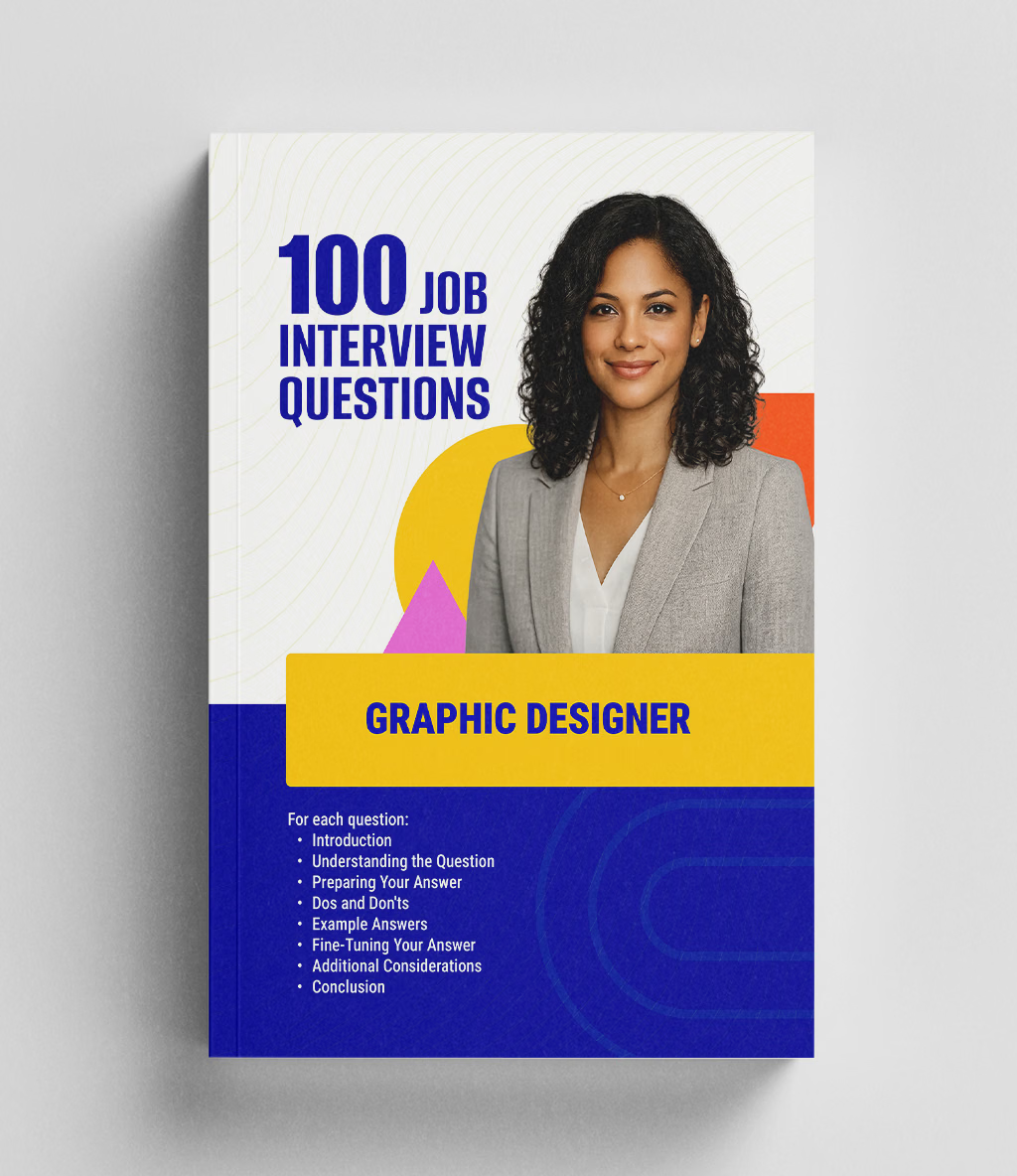
Front-facing 3D book mockup of Graphic Designer 100 Job Interview Questions, an interview question book from RockStarCV.com.

How to use this simulation

Listen for decisions, not polished phrases

Pause after each question and form your own answer before Talia Morgan responds. Then compare the evidence provided: the constraint, the decision, the personal contribution, the trade-off, and the result.

Noah Whitecloud and Talia Morgan are fictional composite characters. Their employers, graphic designer examples, figures, and outcomes were created for teaching purposes.

Take the interview with you

Your graphic designer interview playbook

Use the printable framework to prepare examples, test your evidence, and rehearse stronger answers away from the screen.

  • Question prompts
  • Evidence checklist
  • Practice notes
Download the PDF playbook

What to notice

A practical viewing checklist

  1. 01

    Listen for turn a vague request into a design direction.

  2. 02

    Listen for repair a content-heavy layout.

  3. 03

    Listen for return to objectives and name the decision owner.

  4. 04

    Listen for final exports matched each channel specification.

  5. 05

    Listen for improve low-contrast branded material.

Interviewer scorecard

The signals behind a credible answer

Research foundation

Sources behind the teaching principles

The sources support the interview guidance, not the fictional candidate’s invented employers, budgets, dates, or outcomes.

Similar interviews

Explore related mock interviews

More from RockStarCV

Build your complete career toolkit