Skip to interview
RockStarCV.com
Toggle Navigation

Customer Service Representative Mock Interview: The Strong Candidate

Watch a complete Customer Service Representative interview where Riley makes queue judgment, service recovery, safety escalation, data boundaries, and measurement evidence visible.

Strong candidate pathInteractive simulation16 chapters
Riley Morgan, the fictional Customer Service Representative candidate, seated on the right and facing toward the article center
Riley MorganCustomer Service Representative candidate

Watch and practise

Run the complete interview

Complete transcript

RockStarCV NarratorIntroduction

What does a strong Customer Service Representative interview sound like? Let's step inside the conversation and listen for the decisions that make each answer credible.

RockStarCV NarratorMeet Dana and Riley

Listen for how Riley verifies the customer need, prioritizes risk, stays inside authority, and closes the loop with evidence.

Dana BrooksThe room

Hi, Riley. I'm Dana. Thanks for making the time today. How's your morning going?

Riley MorganThe room

Hi, Dana. It's going well, thank you. I appreciate the invitation. I spent a little time looking through the service information on the Juniper Ridge site, so I'm glad to be here.

Dana BrooksThe room

Good. We have about thirty minutes. I'll ask about your background, how you handle busy queues and difficult contacts, and a couple of safety and quality scenarios. Then I'll leave time for your questions.

Riley MorganThe room

That sounds great.

Dana BrooksCustomer service experience

Let's start with your background. Tell me about your customer service experience.

Riley MorganCustomer service experience

I've spent three and a half years with Cedar Lane Market, a US online retailer. I support customers by phone, live chat, and email, usually with orders, delivery changes, returns, billing questions, and product issues. On a typical week I handle about sixty-two contacts per day, although the mix changes during promotions and holidays.

Riley MorganCustomer service experience

I work in a CRM beside our order-management system, knowledge base, and contact-center console. My habit is to verify the account, restate the need, check the order or policy evidence, and leave the next representative a useful record. I don't consider a case complete just because the call ended.

Riley MorganCustomer service experience

Over the last six months, my customer satisfaction average was four point eight out of five across four hundred ten returned surveys. My first-contact resolution for eligible cases was eighty-four percent last quarter. I'm proud of those numbers, but I'm more interested in why a customer had to contact us again when we could have prevented it.

Dana BrooksCustomer service experience

What do you mean by an eligible case for first-contact resolution?

Riley MorganCustomer service experience

We exclude contacts that require a carrier investigation, manufacturer review, fraud review, or another team to complete the work. For the cases I can resolve within my access and authority, the measure checks whether the customer contacts us again about the same issue within seven days.

Dana BrooksWhy this service role

Why are you interested in this role at Juniper Ridge Home?

Riley MorganWhy this service role

The channel mix is familiar, but the products create more complex service moments than the smaller items I support now. A delayed lamp is frustrating; a damaged appliance, installation issue, or possible safety concern requires better fact gathering and cleaner handoffs. I want that level of responsibility.

Riley MorganWhy this service role

I also noticed that the role connects customer care with fulfillment and product teams. In my current job I started a small feedback routine for repeat delivery questions, and I enjoyed turning case patterns into a change the operations team could use. This role appears to value that, not just contact volume.

Dana BrooksWhy this service role

So you still want to be customer-facing, but with more product and process judgment?

Riley MorganWhy this service role

Exactly. I like the conversation itself, and I want to become stronger at preventing the next avoidable contact.

Dana BrooksQueue judgment

Imagine it's the week before a major holiday. Phone, chat, and email queues are all above target. How do you decide what to work first?

Riley MorganQueue judgment

I start with risk and customer impact, not simply the oldest timestamp. A report of smoke, injury, suspected fraud, or another safety or security concern follows the urgent route immediately. Next I look for time-sensitive commitments, such as an address change before a fulfillment cutoff or a promised callback due now.

Riley MorganQueue judgment

For the remaining work, I use the contact-center view to see queue age, channel service levels, and whether a case already has an owner. I avoid pulling an email into progress if I can't move it, because that can hide it from the team. If priorities change, I document the reason and set the next action.

Dana BrooksQueue judgment

Wouldn't that hurt your average handle time?

Riley MorganQueue judgment

It can affect it, which is why I treat handle time as a diagnostic. If mine rises, I want to know whether I'm searching too slowly, writing unclear notes, handling an unusual case mix, or doing required safety work. I wouldn't shorten a safety intake or skip verification to protect the average.

Dana BrooksQueue judgment

Give me a quick example of a handoff that still feels like ownership.

Riley MorganQueue judgment

If a carrier trace is required, I explain what I can confirm now, create the trace while the customer is with me, give the case number and next update time, and record the promised owner. If the next team misses that time, the customer shouldn't have to start over or guess who has the case.

Dana BrooksService recovery

Tell me about a dissatisfied customer you couldn't simply give everything they requested.

Riley MorganService recovery

A customer received a damaged desk two days before a scheduled home-office setup. She wanted a full refund, to keep the desk, and reimbursement for a two-hundred-fifty-dollar assembly appointment. I first let her explain the sequence, because three previous contacts had focused on policy before acknowledging that her work setup was affected.

Riley MorganService recovery

I verified the order, photos, delivery scan, and prior promises in the CRM. My authority covered an expedited replacement and up to a fifty-dollar service credit, but not a full refund without return or the full assembly expense. I said that plainly instead of suggesting I could approve it later.

Riley MorganService recovery

I offered two immediate options: a replacement shipped that day with a forty-five-dollar credit, or a carrier pickup followed by a full refund once the return scan appeared. I also offered a supervisor review of the documented assembly expense, with no promise about the outcome.

Dana BrooksService recovery

Which option did she choose?

Riley MorganService recovery

She chose the expedited replacement. I placed it while we were on the phone, emailed the confirmation, and scheduled a callback for the next afternoon. The replacement arrived before the rescheduled assembly visit. I recorded the original damage, the options, her choice, the credit, and the follow-up so the next person could see the full decision trail.

Dana BrooksService recovery

What made that a strong outcome if she didn't receive everything she wanted?

Riley MorganService recovery

She received a usable desk before the new appointment and didn't have to repeat the story. I stayed within authority, but I didn't use policy as a shield. The useful outcome was clarity, a choice she could act on, and a promise we kept.

Dana BrooksProduct safety

Let's switch to safety. A customer calls and says a new electric kettle began smoking at the base. What do you do?

Riley MorganProduct safety

I would treat that as a possible product-safety report, not a routine return. I would use the approved safety script. If the script directs it and the customer can do so safely, I would ask them to stop using and unplug the kettle. If there is an active fire, injury, or immediate danger, the script would direct them to emergency help first.

Riley MorganProduct safety

Then I would capture the customer's exact observations: what they saw, heard, or smelled; when it happened; whether anyone was injured or property was damaged; and the product name, model, lot or serial information, purchase date, and order number. I would use their words rather than write that I had confirmed a defect.

Dana BrooksProduct safety

What if you think it was probably just steam?

Riley MorganProduct safety

I wouldn't diagnose it. The customer said smoke at the base, so I would preserve that report, flag the case, and escalate immediately through the internal product-safety path. The safety team decides what investigation or external reporting is required. I wouldn't promise a recall, replacement, or refund until the authorized process determines the next step.

Dana BrooksProduct safety

Would you keep the customer on the line?

Riley MorganProduct safety

If the internal process supports a warm transfer, yes. Otherwise I would tell them exactly who now owns the case and when they should expect contact, then make sure the safety alert is acknowledged before I close my task. I wouldn't leave an urgent flag sitting in a general queue.

Dana BrooksProduct safety

Suppose the next step includes a payment adjustment. The customer starts reading a card number and security code while you type notes. What do you do?

Riley MorganProduct safety

I stop them politely and move the payment into the employer-approved secure flow configured for that channel. Depending on the company, that might be an approved payment screen, IVR, or secure link, but I follow the actual procedure. I never place a card number or card verification value in CRM notes. I verify only what the process requires and keep the case note focused on the service decision and next action.

Dana BrooksCustomer data

Good. That's the level of boundary I'm looking for.

Riley MorganCustomer data

Understood. The record should help the team resolve the case without creating a second risk.

Dana BrooksService measurement

How do you measure whether you're providing good customer service?

Riley MorganService measurement

I use a small scorecard rather than one headline number. For the last quarter, I looked at first-contact resolution for eligible cases, repeat contact within seven days, QA results from forty sampled interactions, transfer or escalation rate, and response performance by channel. I pair those with customer satisfaction when enough surveys are returned.

Riley MorganService measurement

The measures answer different questions. QA tells me whether I followed the process and communicated clearly. Repeat contact tells me whether the resolution held. Transfers can show a knowledge or authority gap. Handle time can show friction, but a low number isn't automatically good if customers call back.

Dana BrooksService measurement

Tell me about a metric that changed how you worked.

Riley MorganService measurement

Eight weeks ago, our team saw repeat contacts on where-is-my-order cases at eighteen percent across one thousand two hundred forty contacts. I reviewed twenty of my reopened cases and found that we were quoting the current carrier scan but not explaining the next checkpoint or when to contact us again.

Riley MorganService measurement

I drafted a short response pattern: current evidence, next expected scan, the time at which we would open a trace, and who owned that action. My supervisor tested it with the team and added it to the knowledge base.

Riley MorganService measurement

Over the following eight weeks, repeat contact for that category fell from eighteen percent to eleven percent across one thousand three hundred ten contacts. That doesn't prove the wording was the only cause, but it was a useful operational signal, and the QA sample showed representatives were setting clearer expectations.

Dana BrooksService measurement

I appreciate the qualification. What would you watch if repeat contacts fell but satisfaction also fell?

Riley MorganService measurement

I would sample the contacts before celebrating. Customers may have given up, the survey mix may have changed, or we may be closing cases too early. I would compare the case notes, survey comments, QA findings, and contact reasons, then test the explanation rather than force one metric to tell the whole story.

Dana BrooksCandidate questions

Thank you. What questions do you have for me?

Riley MorganCandidate questions

Which customer problems create the most repeat contacts for the team today, and what authority would this role have to resolve them?

Dana BrooksCandidate questions

Delivery changes and damaged-item cases are our biggest repeat drivers. Representatives can resolve standard replacements and credits within limits. We coach them to involve a lead early when several orders or a possible safety issue points to a wider pattern.

Riley MorganCandidate questions

That's helpful. How do customer care, fulfillment, and product safety share ownership when an issue crosses teams?

Dana BrooksCandidate questions

Customer care owns the customer communication until a named specialist accepts it. Fulfillment owns the physical order investigation. Product safety owns hazard assessment. The CRM case keeps the timeline and commitments visible to all three.

Riley MorganCandidate questions

That shared timeline is important to me. Thank you.

Dana BrooksClosing the interview

Those are all my questions. We'll complete interviews this week and contact candidates by Tuesday. Is there anything brief you'd like to add?

Riley MorganClosing the interview

Only that the combination of customer conversation and cross-team follow-through is exactly what I'm looking for. I appreciate how specific you've been about the role.

Dana BrooksClosing the interview

Thank you, Riley. It was good meeting you.

Riley MorganClosing the interview

Thank you, Dana. You too.

RockStarCV NarratorOutro 1 · Verdict

Riley's answers were strong because the evidence was inspectable. The interview did not depend on warmth alone. We heard the channel mix, the systems, the authority boundary, the record, the next action, and a result with a defined window.

RockStarCV NarratorOutro 2 · Evidence

For the queue question, remember four filters: immediate risk, customer impact, an existing promise, and current service-level evidence. Speed matters, but not more than safety, verification, or a handoff the customer can follow.

RockStarCV NarratorOutro 2 · Evidence

For service recovery, use this sequence: listen, verify, name the authority boundary, offer real options, record the choice, and close the loop. You do not need unlimited discretion to demonstrate ownership.

RockStarCV NarratorOutro 2 · Evidence

For a possible product hazard, do not improvise a diagnosis. Follow the approved safety script, capture exact observations and product details, escalate through the employer's safety path, and avoid promises that belong to an authorized team.

RockStarCV NarratorOutro 3 · Framework

For payment and personal data, use approved secure flows and collect only what the task requires. A complete service record should reduce customer effort without turning the CRM into a store of sensitive information.

RockStarCV NarratorOutro 3 · Framework

Finally, define your metrics. Say the period, the eligible population or sample, and what the measure changed. Use handle time to find friction, not to prove that shorter conversations are always better.

RockStarCV NarratorOutro 4 · Practice

Now choose one real customer case of your own. Write six lines: the need, the evidence, your authority, your action, the handoff or follow-up, and the outcome. Then practise explaining it as a conversation, not a script.

RockStarCV NarratorOutro 4 · Practice

Prepare with evidence. Interview with confidence. Continue your preparation at Rock Star C V dot com.

Use Play to hear the conversation, move one slide at a time, or jump directly to a chapter. Captions follow the active speaker.

What to expect

How the interview is likely to unfold

A senior customer service representative interview usually moves from your career story into evidence of judgment, then closes with your questions.

  1. Welcome and framing

    Expect brief rapport, an interview agenda, and an opening that establishes the service channels and customer context.

  2. Your service story

    Connect your experience to channel mix, case ownership, accurate records, and a defined customer or operating result.

  3. Queue judgment

    Show how safety, customer impact, existing promises, and visible service-level evidence determine priority.

  4. Service recovery

    Demonstrate calm listening, an explicit authority boundary, realistic options, complete notes, and closed-loop follow-up.

  5. Safety and customer data

    Use the approved script and escalation route, capture exact observations, and keep payment and identity handling inside approved systems.

  6. Measurement and close

    Balance customer, resolution, quality, repeat-contact, escalation, and response measures before asking informed questions.

Who might interview you

Different people are testing different things

Listen to the role behind the question. The same example may need a different emphasis for each interviewer.

Recruiter or talent partner

Their purpose
Confirm communication, motivation, schedule fit, and the scope of your service experience.
They look for
A coherent service story, clear examples, professional energy, and realistic expectations.

Customer care manager

Their purpose
Decide whether you can own a customer contact from diagnosis through resolution or a responsible handoff.
They look for
Listening, judgment, documentation, authority awareness, and a credible closed loop.

Quality or operations partner

Their purpose
Test how you prioritize competing queues and use systems without treating speed as the only goal.
They look for
Visible triage logic, accurate case records, channel continuity, and balanced measures.

Safety, fraud, or data specialist

Their purpose
Understand whether you recognize boundaries and escalate risk without improvising beyond your role.
They look for
Exact observation capture, approved scripts and systems, minimum necessary data, and prompt escalation.

What they are assessing

Make your judgment easy to see

What interviewers need to learn

  • Can you listen, verify the issue, and create an accurate service record before proposing a resolution?
  • Can you prioritize by safety, impact, promises, and service evidence instead of speed alone?
  • Can you state your authority boundary and preserve ownership through a handoff?
  • Can you connect service quality to a defined mix of customer, resolution, quality, and response measures?

Accentuate

  • The customer's actual need, what you verified, and the record you created.
  • The decision you personally made and the authority boundary that shaped it.
  • What you told the customer, who owned the next step, and how you closed the loop.
  • The measurement window, denominator, comparison, and action that followed the result.

Leave out

  • A duty list that never shows a representative case, decision, or result.
  • Oldest-first or fastest-first queue language without safety, impact, or promise checks.
  • A calm tone presented as the complete recovery process without options, notes, or follow-up.
  • Handle time or customer satisfaction cited without a definition, window, denominator, or balancing measure.

Difficult questions

Prepare the evidence, not a script

Use these prompts to choose a truthful example and reconstruct the decision. Your delivery should still sound like you.

How do you prioritize when phone, chat, and email queues are all busy?

Why they ask: They are testing whether your speed remains bounded by safety, customer impact, promises, and ownership.

Prepare: The evidence you check, your triage order, the service promise you communicate, and how a handoff stays visible.

Tell me about a dissatisfied customer you could not simply give everything they requested.

Why they ask: They need to hear empathy and action without false promises or authority overreach.

Prepare: The customer's need, your authority limit, approved options, case notes, escalation point, and closed-loop follow-up.

A customer says an appliance began smoking. What do you do?

Why they ask: They are testing immediate safety recognition and disciplined escalation rather than improvised diagnosis.

Prepare: The approved safety script, exact observations, product identifiers, no-causation boundary, and internal escalation route.

What customer or payment information do you record?

Why they ask: They want proof that convenience does not override approved systems or purpose-limited handling.

Prepare: Approved identity and payment flows, minimum necessary notes, prohibited authentication data, and who receives an exception.

How do you measure good customer service?

Why they ask: Familiar metric names are not enough unless they support a decision and remain balanced.

Prepare: Customer, resolution, repeat-contact, quality, escalation, and response measures with a window, denominator, and action.

Tell me about a service trend you helped improve.

Why they ask: They are separating personal ownership from general team activity.

Prepare: The pattern you noticed, evidence you checked, change you proposed, partners involved, measured result, and next adjustment.
100 interview questions

Customer Service Representative Interview Questions: 100 Answers

Keep preparing with the complete question book created for Customer Service Representative interviews.

View the question book
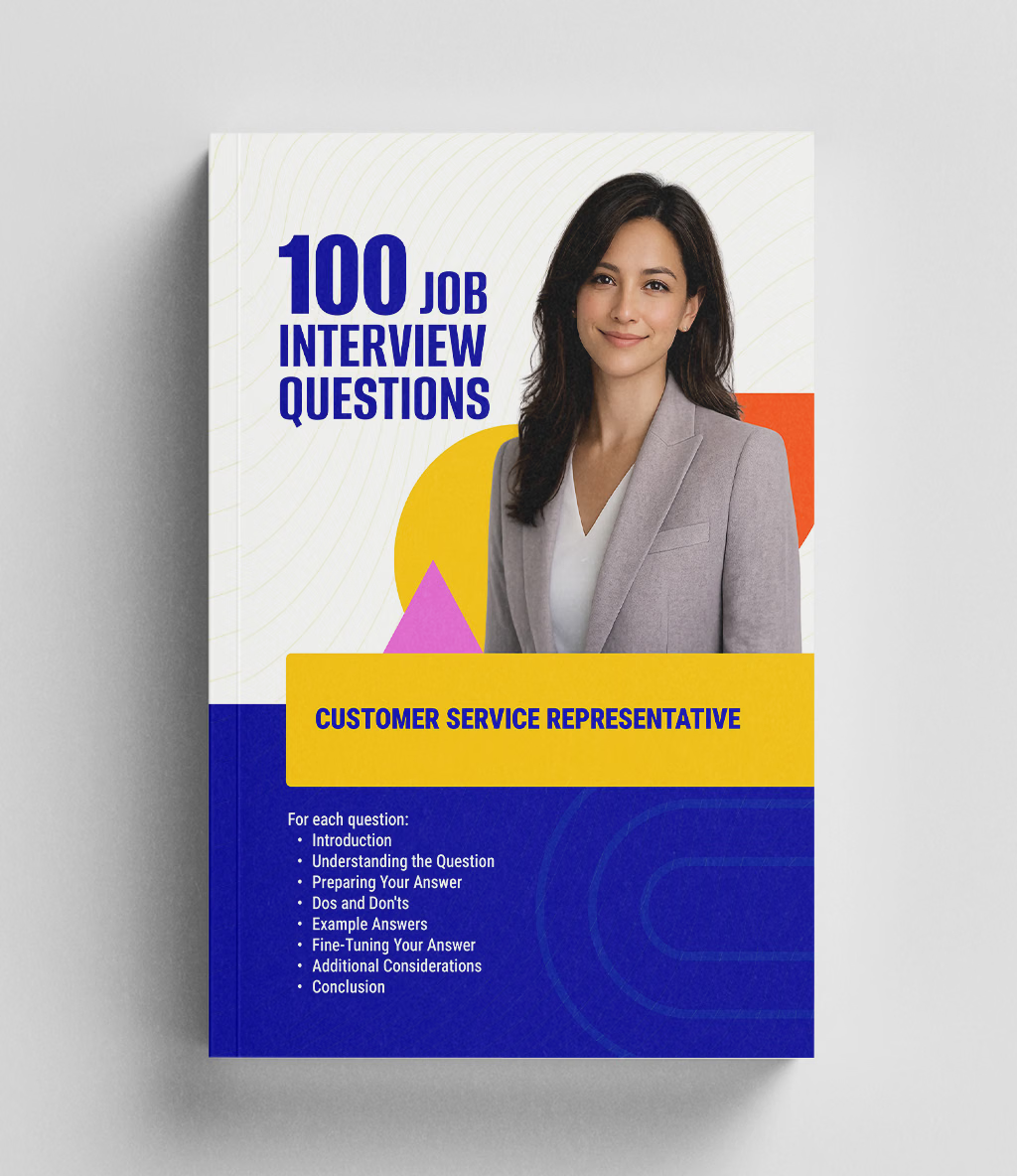
Front-facing 3D book mockup of Customer Service Representative 100 Job Interview Questions, an interview question book from RockStarCV.com.

How to use this simulation

Listen for decisions, not polished phrases

Pause after each question and form your own answer before Riley Morgan responds. Then compare the evidence provided: the constraint, the decision, the personal contribution, the trade-off, and the result.

Dana Brooks and Riley Morgan are fictional composite characters. Their employers, customer service representative examples, figures, and outcomes were created for teaching purposes.

Take the interview with you

Your customer service representative interview playbook

Use the printable framework to prepare examples, test your evidence, and rehearse stronger answers away from the screen.

  • Question prompts
  • Evidence checklist
  • Practice notes
Download the PDF playbook

What to notice

A practical viewing checklist

  1. 01

    Notice how Riley verifies the customer need and leaves an accurate record before moving to a resolution.

  2. 02

    Track how safety, customer impact, existing promises, and service evidence change the queue order.

  3. 03

    Listen for an explicit authority boundary, approved options, an owner, and a closed-loop follow-up.

  4. 04

    Compare familiar service metrics with the window, denominator, balancing measure, and action they support.

Interviewer scorecard

The signals behind a credible answer

Triage
Riley prioritizes by safety, impact, promises, and visible queue evidence.
Ownership
The answer names the decision, authority boundary, record, handoff, and customer follow-up.
Measurement
The result includes a defined window and denominator plus a balancing quality measure.

Research foundation

Sources behind the teaching principles

The sources support the interview guidance, not the fictional candidate’s invented employers, budgets, dates, or outcomes.

Similar interviews

Explore related mock interviews

More from RockStarCV

Build your complete career toolkit