Hydrogeologist Resume Examples & Guide
Landing a Hydrogeologist position can be challenging in today’s competitive job market. With Applicant Tracking Systems (ATS) filtering through countless applications, standing out requires a strategic resume. This guide provides hydrogeologist resume examples for every experience level, from entry-level graduates to seasoned industry professionals, ensuring you present your best self.
- Quantify Achievements: Use numbers and data to demonstrate the impact of your work.
- Highlight Relevant Skills: Emphasize field investigation, groundwater modeling, GIS, technical reporting, and other skills directly relevant to hydrogeology.
- Tailor to Job Description: Customize your resume for each application, matching the specific requirements of the role.
- Optimize for ATS: Use keywords from the job description and a clean, ATS-friendly format.
- Use Action Verbs: Start each bullet point with a strong action verb to showcase your accomplishments.
- Showcase Problem-Solving: Highlight situations where you successfully addressed hydrogeological challenges.
Ready to explore some effective resume examples?
Explore editable Hydrogeologist resume examples by career stage. Each sample opens in the RockStarCV builder so you can study the structure and make your own version.
Entry-Level Hydrogeologist Resume (0-2 Years Experience)
Use these entry-level examples to compare the scope, evidence, and language expected for Hydrogeologist roles at this stage.
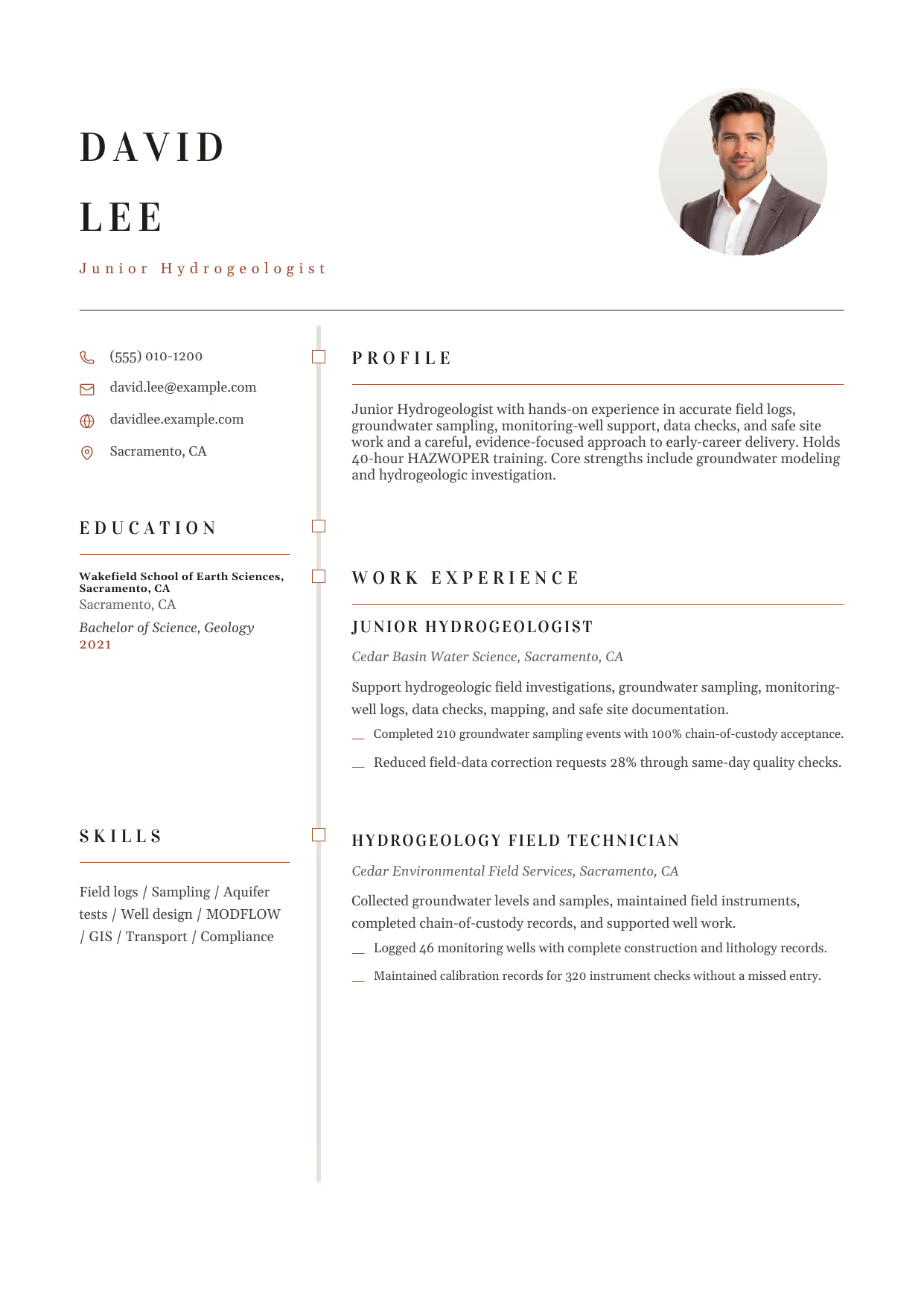
Junior Hydrogeologist
A builder-ready entry-level Hydrogeologist example in the Draco template, showing stage-appropriate evidence in a focused, editable resume format.
- Editable role positioning in the Draco layout
- Role-specific evidence and delivery context
- Review the Draco structure with a clean visual hierarchy
View this resume
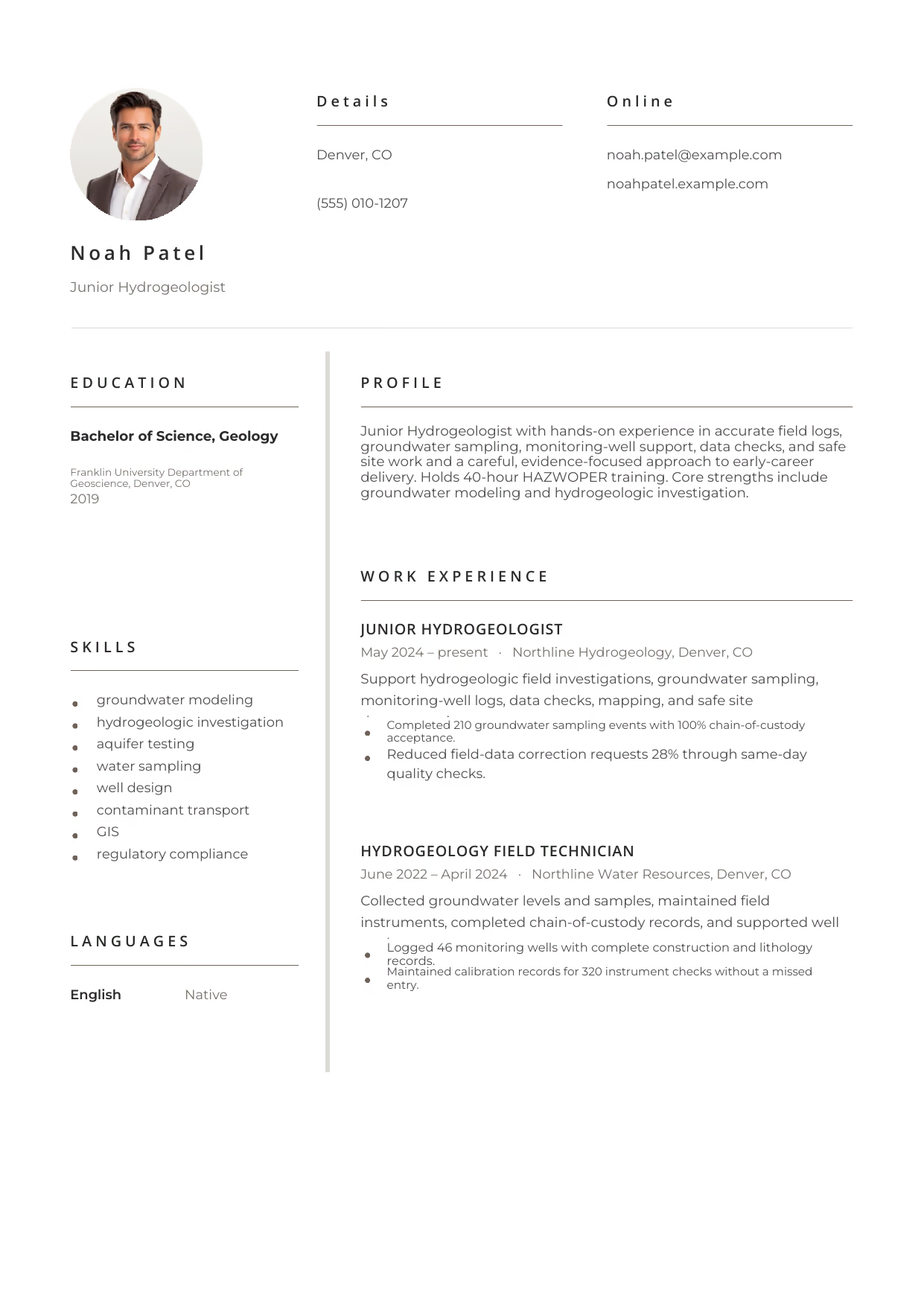
Junior Hydrogeologist
A builder-ready entry-level Hydrogeologist example in the Pictor template, showing stage-appropriate evidence in a focused, editable resume format.
- Editable role positioning in the Pictor layout
- Role-specific evidence and delivery context
- Review the Pictor structure with a clean visual hierarchy
View this resume
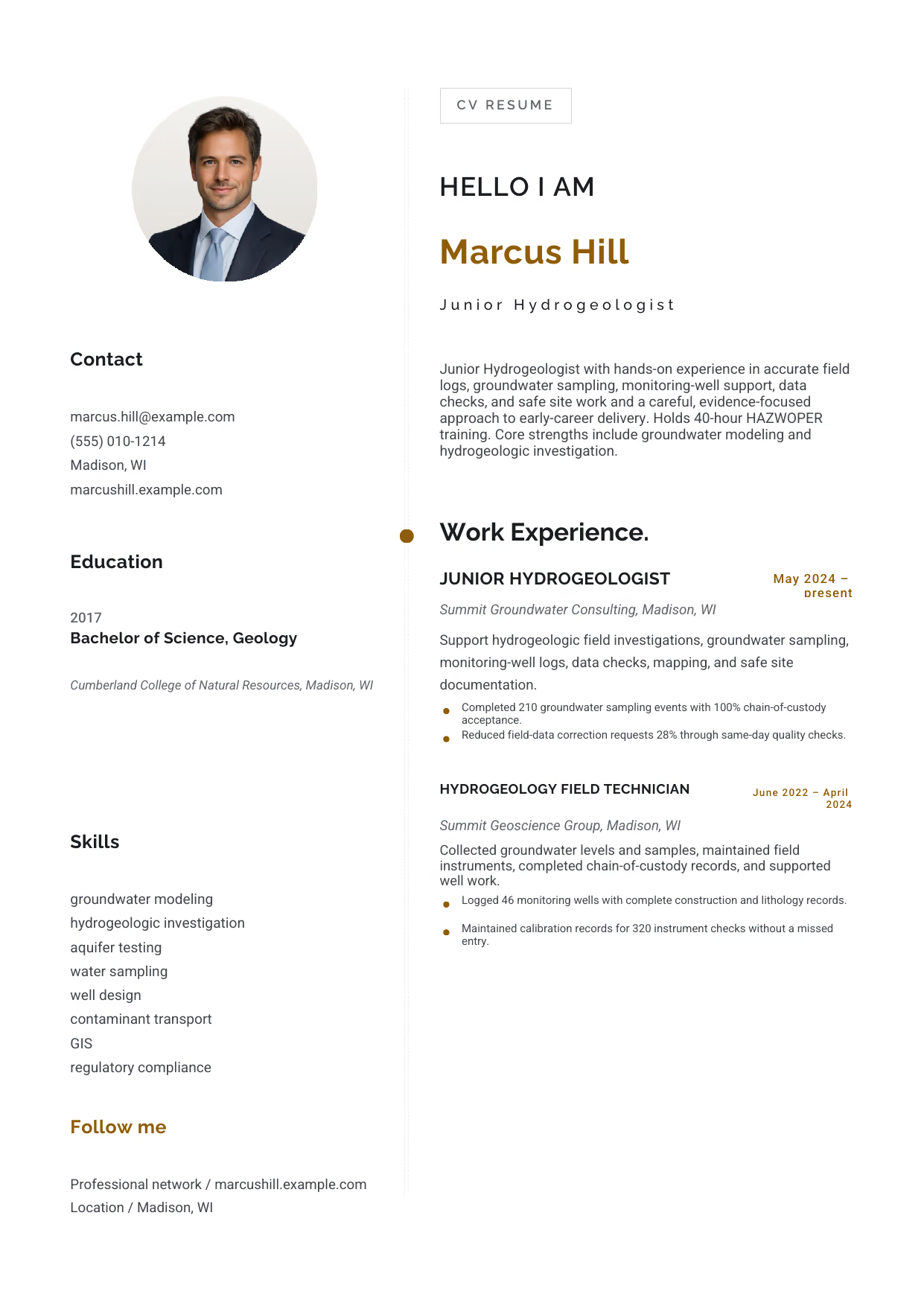
Junior Hydrogeologist
A builder-ready entry-level Hydrogeologist example in the Eridanus template, showing stage-appropriate evidence in a focused, editable resume format.
- Editable role positioning in the Eridanus layout
- Role-specific evidence and delivery context
- Review the Eridanus structure with a clean visual hierarchy
View this resume
Mid-Level Hydrogeologist Resume (3-7 Years Experience)
Use these mid-level examples to compare the scope, evidence, and language expected for Hydrogeologist roles at this stage.

Hydrogeologist
A builder-ready mid-level Hydrogeologist example in the Bootes template, showing stage-appropriate evidence in a focused, editable resume format.
- Editable role positioning in the Bootes layout
- Role-specific evidence and delivery context
- Review the Bootes structure with a clean visual hierarchy
View this resume
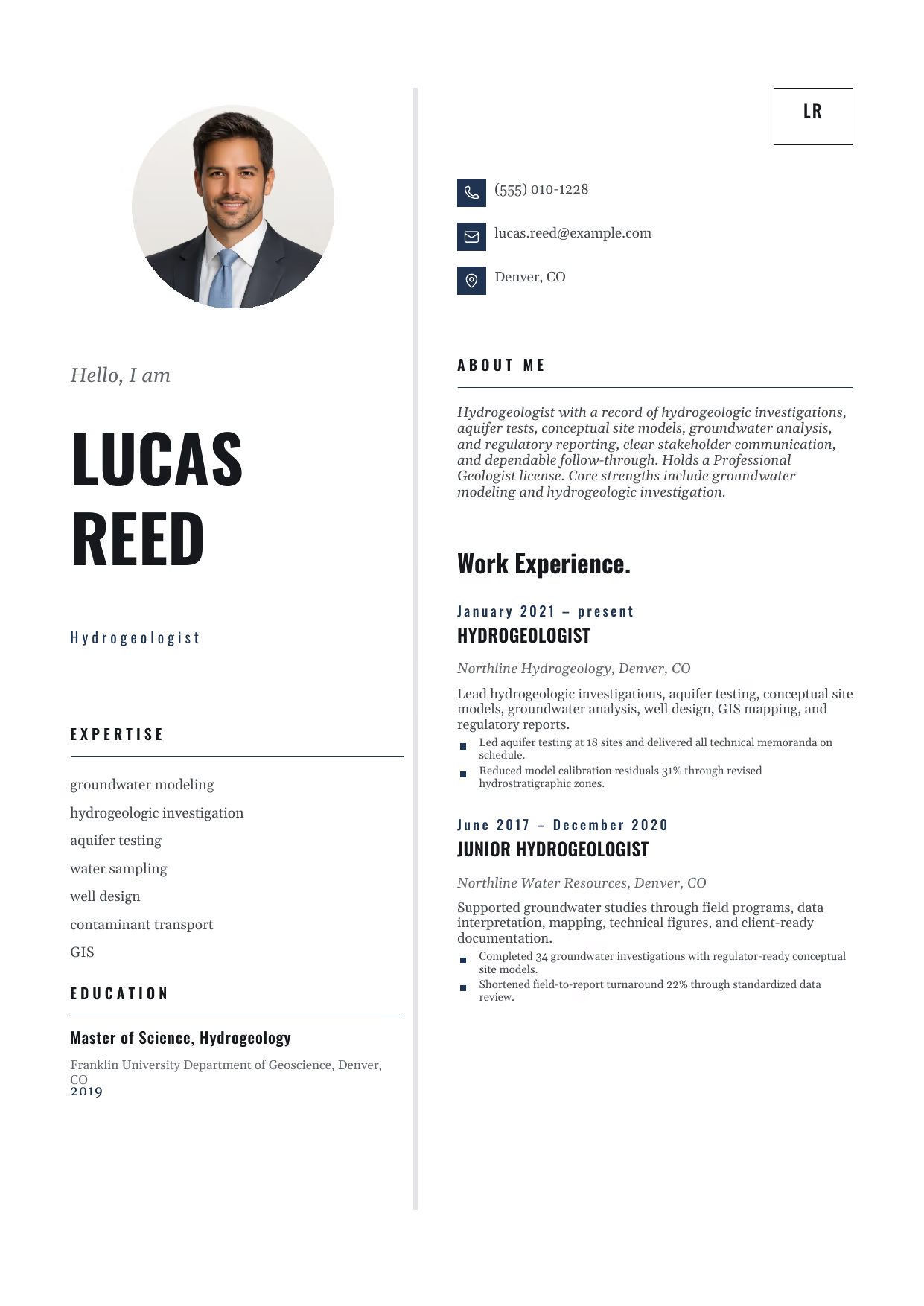
Hydrogeologist
A builder-ready mid-level Hydrogeologist example in the Equuleus template, showing stage-appropriate evidence in a focused, editable resume format.
- Editable role positioning in the Equuleus layout
- Role-specific evidence and delivery context
- Review the Equuleus structure with a clean visual hierarchy
View this resume

Hydrogeologist
A builder-ready mid-level Hydrogeologist example in the Hydra template, showing stage-appropriate evidence in a focused, editable resume format.
- Editable role positioning in the Hydra layout
- Role-specific evidence and delivery context
- Review the Hydra structure with a clean visual hierarchy
View this resume
Senior Hydrogeologist Resume (8+ Years / Management)
Use these advanced examples to compare the scope, evidence, and language expected for Hydrogeologist roles at this stage.
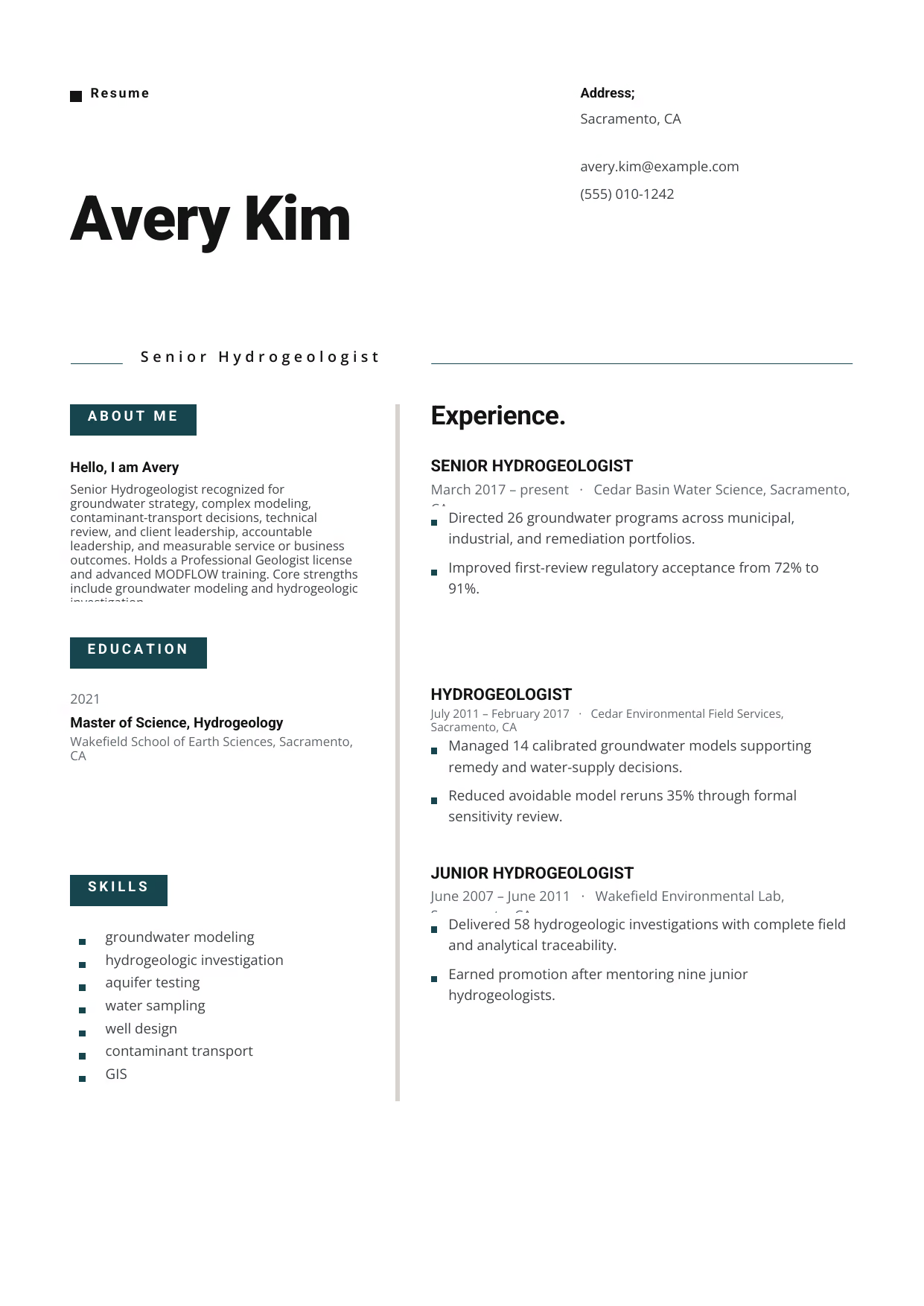
Senior Hydrogeologist
A builder-ready advanced Hydrogeologist example in the Indus template, showing stage-appropriate evidence in a focused, editable resume format.
- Editable role positioning in the Indus layout
- Role-specific evidence and delivery context
- Review the Indus structure with a clean visual hierarchy
View this resume

Senior Hydrogeologist
A builder-ready advanced Hydrogeologist example in the Andromeda template, showing stage-appropriate evidence in a focused, editable resume format.
- Editable role positioning in the Andromeda layout
- Role-specific evidence and delivery context
- Review the Andromeda structure with a clean visual hierarchy
View this resume

Senior Hydrogeologist
A builder-ready advanced Hydrogeologist example in the Aquila template, showing stage-appropriate evidence in a focused, editable resume format.
- Editable role positioning in the Aquila layout
- Role-specific evidence and delivery context
- Review the Aquila structure with a clean visual hierarchy
View this resume
How to Write a Hydrogeologist Resume
The Resume Summary
The resume summary is your first chance to make a strong impression. It should be a concise overview of your qualifications and career goals.
Formula: Years of Experience + Key Skills + Notable Achievement + Career Goal
Entry-Level Example:
Enthusiastic recent graduate with a strong foundation in hydrogeology seeking an entry-level position to apply theoretical knowledge and contribute to groundwater management projects.
Mid-Level Example:
Experienced Hydrogeologist with 5+ years of experience in groundwater modeling and environmental remediation, seeking a challenging role to leverage expertise and contribute to sustainable water resource management.
Senior Example:
Results-oriented Senior Hydrogeologist with 15+ years of experience in water resource management and regulatory compliance, seeking a leadership position to drive strategic initiatives and deliver successful outcomes on complex projects.
Work Experience & Action Verbs
The work experience section is where you demonstrate your skills and accomplishments. Focus on achievements rather than just listing duties.
Duties describe what you were responsible for, while achievements highlight the impact of your work.
- Before: Responsible for groundwater sampling. After: Conducted groundwater sampling, ensuring compliance with regulatory standards and resulting in a 10% improvement in data accuracy.
- Before: Assisted with aquifer testing. After: Assisted with aquifer testing, analyzing data to determine aquifer properties and groundwater flow patterns, contributing to a 15% reduction in project timelines.
- Before: Prepared technical reports. After: Prepared technical reports for clients and regulatory agencies, ensuring clear and concise communication of project findings and recommendations.
- Before: Managed environmental remediation projects. After: Managed environmental remediation projects, implementing innovative solutions that reduced contaminant levels by 20%.
- Before: Monitored groundwater quality. After: Monitored groundwater quality, identifying potential sources of contamination and developing effective mitigation strategies.
Top Skills for Hydrogeologists
Highlight your skills to demonstrate your qualifications for the job.
Hard Skills
- Groundwater Modeling
- Aquifer Testing
- Environmental Remediation
- Data Analysis
- GIS Software
- Hydrological Modeling
- Water Resource Management
Soft Skills
- Problem-Solving
- Communication
- Teamwork
- Analytical Thinking
- Critical Thinking
- Attention to Detail
Tools/Software
- MODFLOW
- HydroGeoSphere
- ArcGIS
- QGIS
- Aqtesolv
Education & Certifications
List your education and certifications to demonstrate your qualifications and expertise.
For recent graduates, list your education first, highlighting relevant coursework and academic achievements. For experienced professionals, list your education after your work experience.
Recommended Certifications:
- Professional Geologist (PG)
- Certified Hydrogeologist (CHG)
- OSHA Safety Training
10 Common Hydrogeologist Resume Mistakes
- Generic Resume Summary: A vague, uninspired summary wastes valuable real estate. Instead, craft a compelling narrative showcasing your unique skills, years of experience, and notable achievements as they relate to the specific hydrogeologist position, immediately capturing the recruiter’s attention.
- Listing Duties Instead of Impact: Recruiters know what a Hydrogeologist does; they want to know how well you did it. Replace passive phrases like ‘Responsible for groundwater sampling’ with quantified wins like ‘Improved sampling accuracy by 15% through the implementation of new QA/QC procedures.’
- Ignoring ATS Keywords: Failing to incorporate relevant keywords from the job description will cause your resume to be overlooked by Applicant Tracking Systems (ATS). Carefully analyze the job posting and strategically integrate terms like ‘groundwater modeling’, ‘aquifer testing’, or ‘environmental remediation’ throughout your resume.
- Neglecting Soft Skills: While technical skills are crucial, soft skills like communication, problem-solving, and teamwork are equally important. Showcase these skills by providing concrete examples of how you’ve used them to overcome challenges and achieve success in your hydrogeological projects.
- Poor Formatting and Layout: A cluttered, disorganized resume is difficult to read and reflects poorly on your attention to detail. Use a clean, professional template with clear headings, bullet points, and ample white space to ensure readability and highlight your key qualifications.
- Grammatical Errors and Typos: Even minor errors can undermine your credibility and suggest a lack of attention to detail. Proofread your resume carefully, or better yet, have a friend or colleague review it for grammar, spelling, and punctuation errors.
- Omitting Relevant Certifications: Certifications like Professional Geologist (PG) or Certified Hydrogeologist (CHG) demonstrate your expertise and commitment to the profession. Be sure to prominently display any relevant certifications on your resume.
- Failing to Tailor Your Resume: Submitting a generic resume for every job application is a surefire way to get rejected. Customize your resume for each position, highlighting the skills and experience that are most relevant to the specific requirements of the role.
- Ignoring the Education Section: Failing to provide sufficient details about your educational background can leave recruiters with unanswered questions. Include your degree, major, university, and graduation date, as well as any relevant coursework, honors, or awards.
- Lack of a Professional Online Presence: In today’s digital age, your online presence is an extension of your resume. Ensure that your LinkedIn profile is up-to-date and consistent with your resume, and consider creating a professional website or portfolio to showcase your work.
Frequently Asked Questions (Hydrogeologist)
- What should a Hydrogeologist resume emphasize first? Lead with the scope of accurate field logs, groundwater sampling, monitoring-well support, data checks, and safe site work, then connect your contribution to a clear outcome, tool, or decision.
- Which skills deserve priority on a Hydrogeologist resume? Prioritize groundwater modeling, hydrogeologic investigation, and aquifer testing when they match the role and can be supported by evidence.
- How can a Hydrogeologist show project scope and impact? Name the environment, scale, constraints, and result; hydrogeologic investigations, aquifer tests, conceptual site models, groundwater analysis, and regulatory reporting becomes more credible when the context is concrete.
- How should a Hydrogeologist describe tools and technical decisions? Describe why you selected a method, how you implemented it, and what changed afterward in the Hydrogeologist role.
- Which achievements matter most for a Hydrogeologist application? Use outcome-led bullets that show groundwater strategy, complex modeling, contaminant-transport decisions, technical review, and client leadership through delivery quality, measurable scope, or stakeholder value.
- How long should a Hydrogeologist resume be? Use the shortest length that proves fit; a focused page can work early-career, while broader Hydrogeologist scope may need more room.
- How can a Hydrogeologist explain progression between career stages? Group examples by increasing ownership, moving from accurate field logs, groundwater sampling, monitoring-well support, data checks, and safe site work toward groundwater strategy, complex modeling, contaminant-transport decisions, technical review, and client leadership as responsibility grows.
- Which keywords should a Hydrogeologist include for screening systems? Mirror truthful language from the posting, especially water sampling, without stuffing unrelated terms.
- How should a Hydrogeologist present reliability, quality, or safety work? Show how you protected outcomes through well design and explain the evidence a hiring team can verify.
- What format makes a Hydrogeologist resume easy for hiring teams to scan? Use clear headings, readable bullets, and consistent dates so a hiring manager can evaluate Hydrogeologist fit quickly.
Creating a compelling hydrogeologist resume requires careful planning and attention to detail. By following the tips and examples in this guide, you can create a resume that showcases your skills, experience, and qualifications, and helps you stand out from the competition.
To find more resources and templates, Search more Hydrogeologist resources on our site!
RockStarCV Editorial Team