Home Health Nurse Resume Examples & Guide
Landing a Home Health Nurse position can be challenging. Applicant Tracking Systems (ATS) filter out many qualified candidates, and you face fierce competition. This guide provides Home Health Nurse resume examples for every experience level, offering strategies to beat the bots and impress hiring managers.
- Quantify Achievements: Use numbers and metrics to demonstrate the impact of your work.
- Highlight Relevant Skills: Showcase skills like navigation, electronic health record (EHR) software proficiency, and patient communication.
- Tailor to Job Description: Customize your resume to match the specific requirements of each job you apply for.
- Optimize for ATS: Use keywords from the job description to ensure your resume passes ATS scans.
- Use Action Verbs: Start your bullet points with strong action verbs to describe your accomplishments.
- Showcase Empathy: Highlight your ability to connect with patients and their families on an emotional level.
Let’s explore some winning Home Health Nurse resume examples.
Explore editable Home Health Nurse resume examples by career stage. Each sample opens in the RockStarCV builder so you can study the structure and make your own version. Every example includes role-relevant education, skills, credentials, and work history—not just a matching headline. As you compare them, look for truthful evidence of patient education, clinical documentation, and infection prevention at the seniority level shown.
Entry-Level Home Health Nurse Resume (0-2 Years Experience)
Use these entry-level examples to compare the scope, evidence, and language expected for Home Health Nurse roles at this stage.

Home Health Registered Nurse
A builder-ready entry-level Home Health Nurse example in the Andromeda template, showing stage-appropriate evidence in a focused, editable resume format.
- Editable role positioning in the Andromeda layout
- Role-specific evidence and delivery context
- Review the Andromeda structure with a clean visual hierarchy
View this resume

Home Health Registered Nurse
A builder-ready entry-level Home Health Nurse example in the Bootes template, showing stage-appropriate evidence in a focused, editable resume format.
- Editable role positioning in the Bootes layout
- Role-specific evidence and delivery context
- Review the Bootes structure with a clean visual hierarchy
View this resume

Home Health Registered Nurse
A builder-ready entry-level Home Health Nurse example in the Cetus template, showing stage-appropriate evidence in a focused, editable resume format.
- Editable role positioning in the Cetus layout
- Role-specific evidence and delivery context
- Review the Cetus structure with a clean visual hierarchy
View this resume
Mid-Level Home Health Nurse Resume (3-7 Years Experience)
Use these mid-level examples to compare the scope, evidence, and language expected for Home Health Nurse roles at this stage.
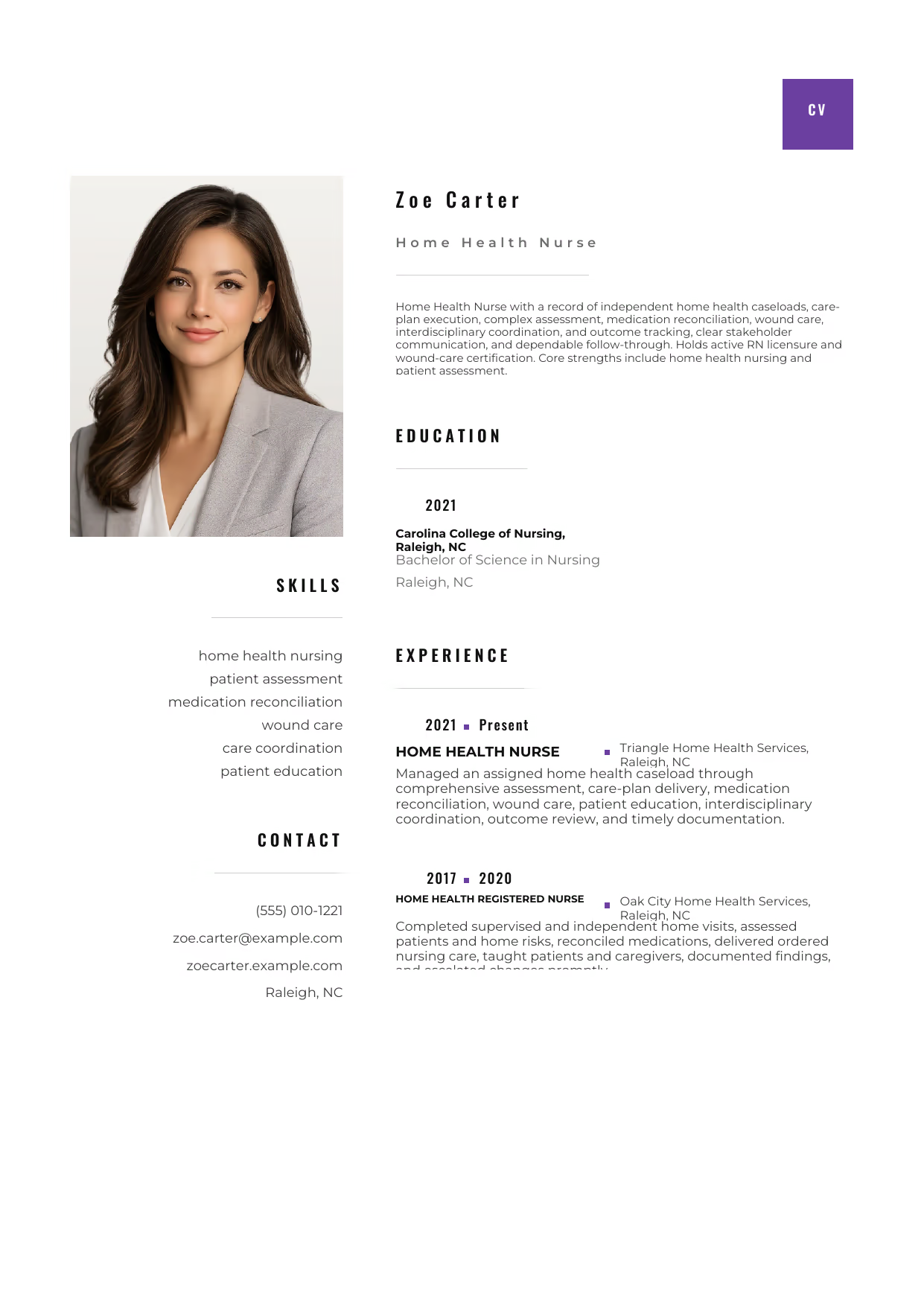
Home Health Nurse
A builder-ready mid-level Home Health Nurse example in the Pyxis template, showing stage-appropriate evidence in a focused, editable resume format.
- Editable role positioning in the Pyxis layout
- Role-specific evidence and delivery context
- Review the Pyxis structure with a clean visual hierarchy
View this resume

Home Health Nurse
A builder-ready mid-level Home Health Nurse example in the Norma template, showing stage-appropriate evidence in a focused, editable resume format.
- Editable role positioning in the Norma layout
- Role-specific evidence and delivery context
- Review the Norma structure with a clean visual hierarchy
View this resume
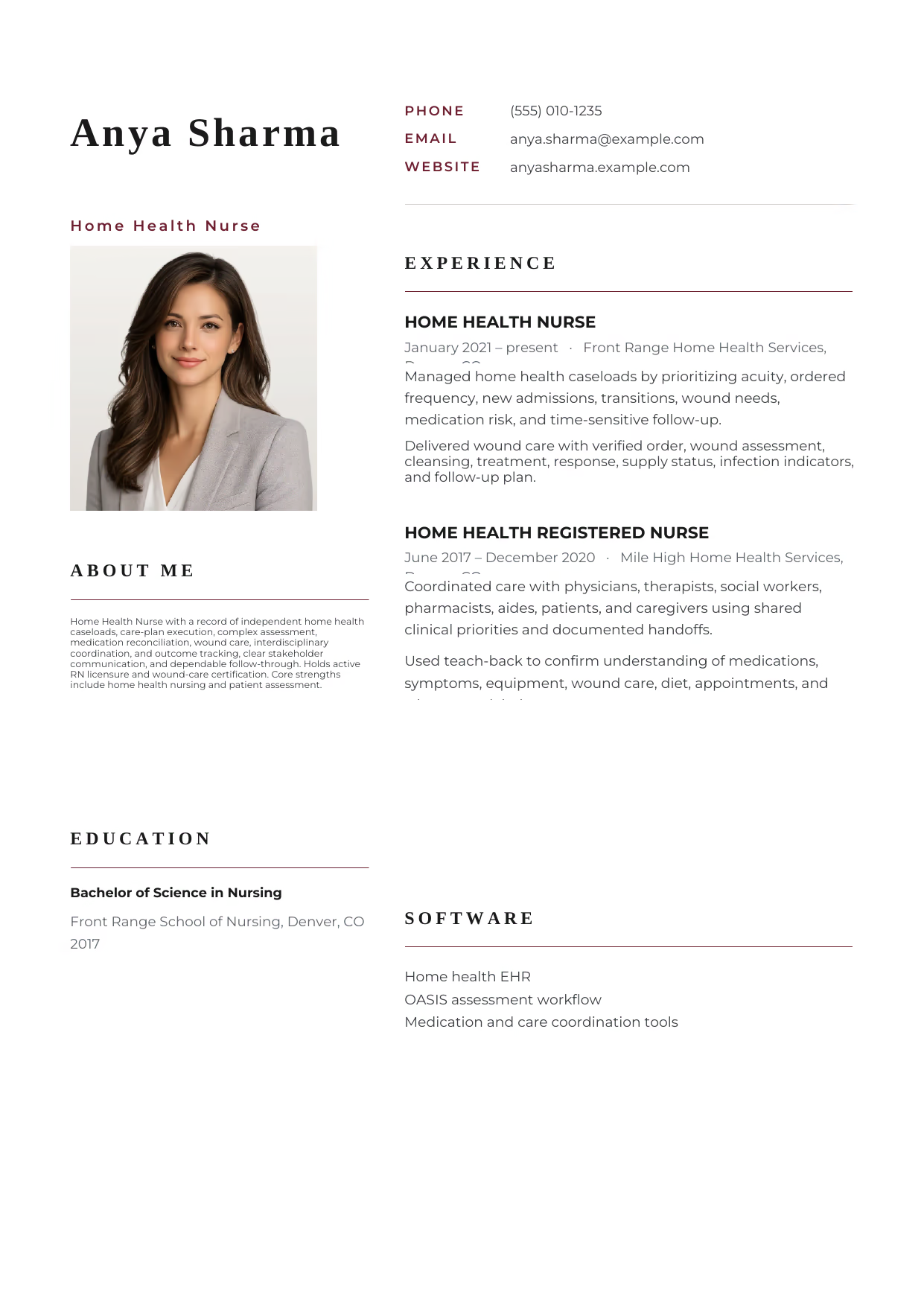
Home Health Nurse
A builder-ready mid-level Home Health Nurse example in the Hydra template, showing stage-appropriate evidence in a focused, editable resume format.
- Editable role positioning in the Hydra layout
- Role-specific evidence and delivery context
- Review the Hydra structure with a clean visual hierarchy
View this resume
Senior Home Health Nurse Resume (8+ Years / Management)
Use these advanced examples to compare the scope, evidence, and language expected for Home Health Nurse roles at this stage.
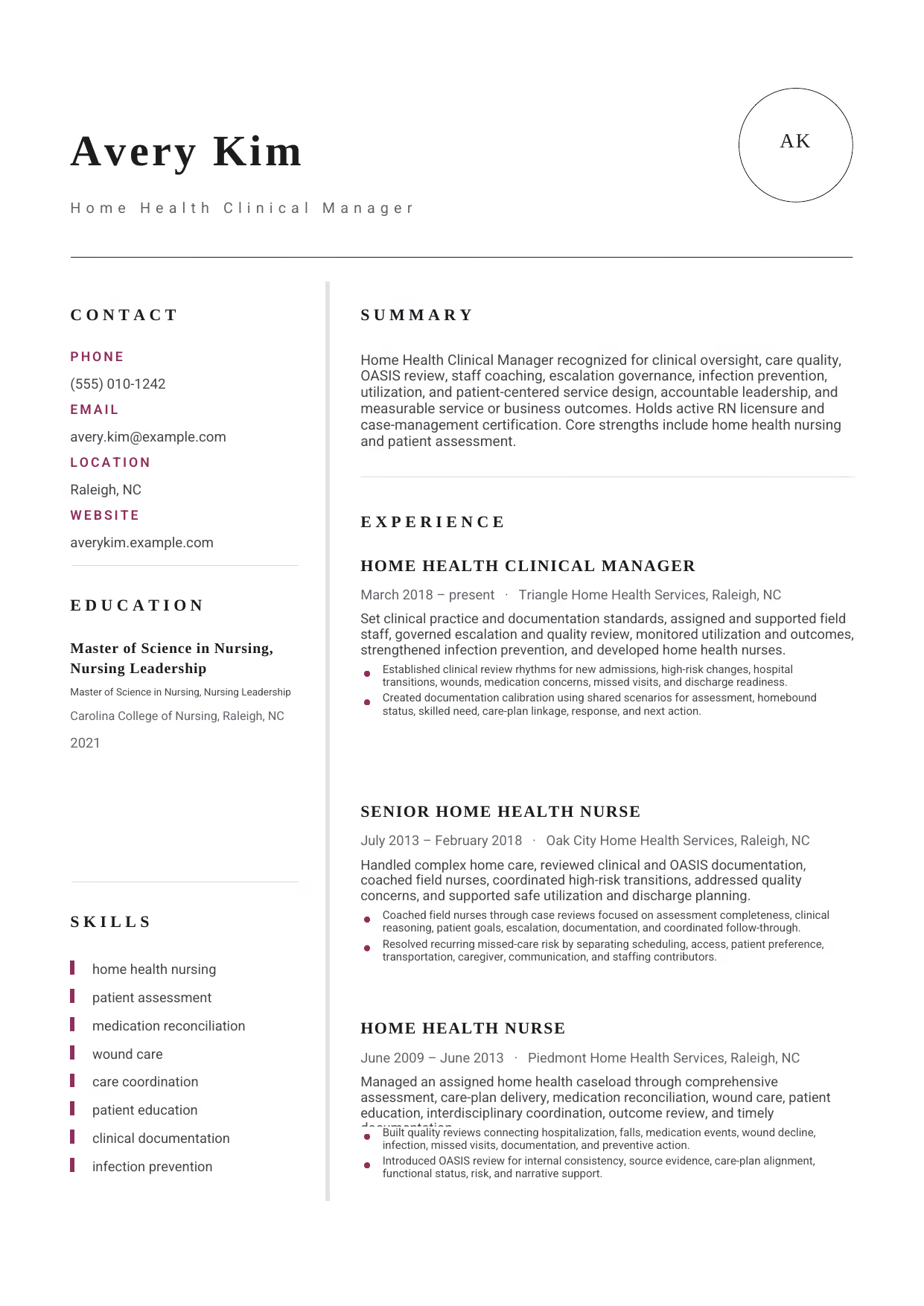
Home Health Clinical Manager
A builder-ready advanced Home Health Nurse example in the Grus template, showing stage-appropriate evidence in a focused, editable resume format.
- Editable role positioning in the Grus layout
- Role-specific evidence and delivery context
- Review the Grus structure with a clean visual hierarchy
View this resume
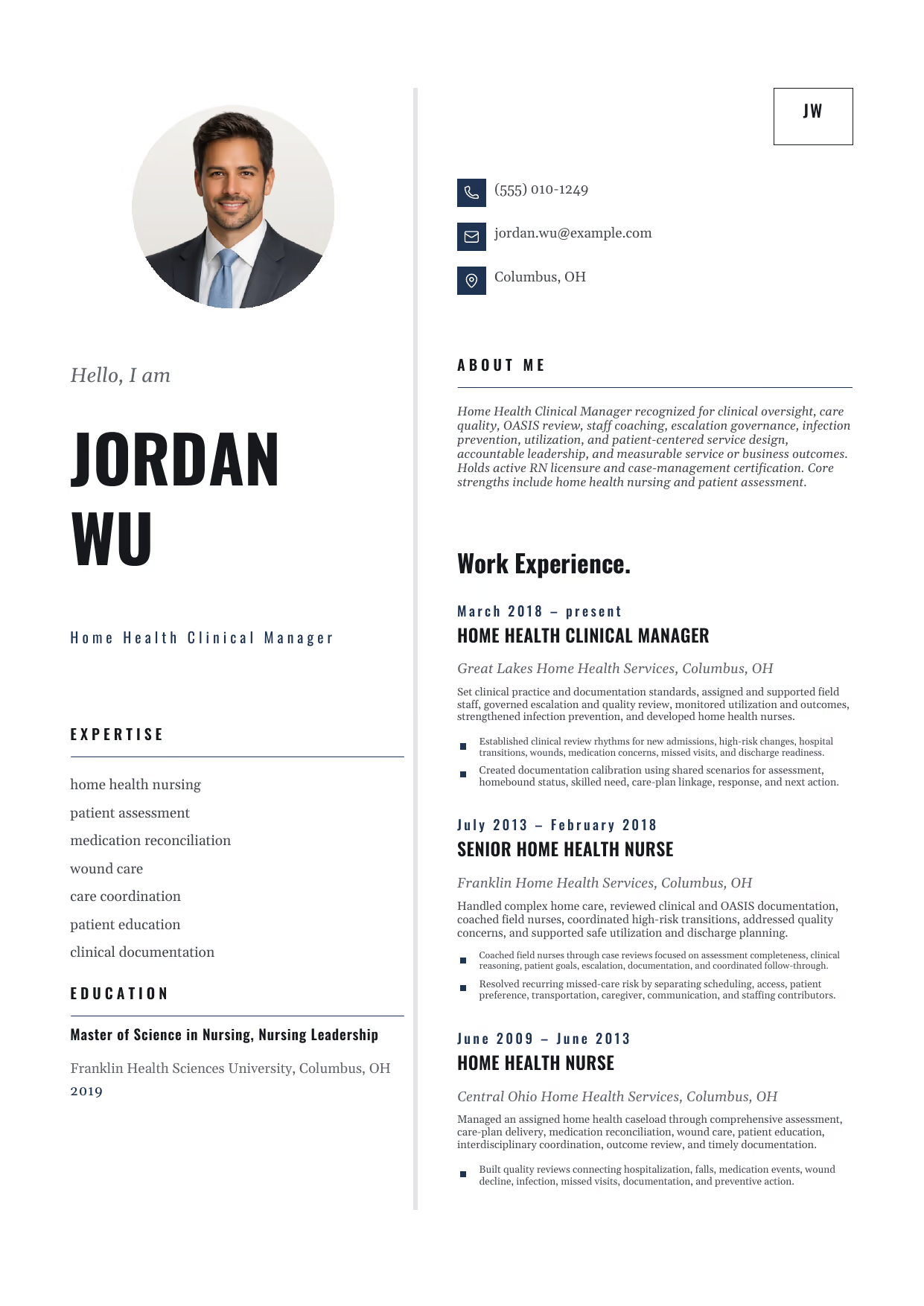
Home Health Clinical Manager
A builder-ready advanced Home Health Nurse example in the Equuleus template, showing stage-appropriate evidence in a focused, editable resume format.
- Editable role positioning in the Equuleus layout
- Role-specific evidence and delivery context
- Review the Equuleus structure with a clean visual hierarchy
View this resume

Home Health Clinical Manager
A builder-ready advanced Home Health Nurse example in the Aquila template, showing stage-appropriate evidence in a focused, editable resume format.
- Editable role positioning in the Aquila layout
- Role-specific evidence and delivery context
- Review the Aquila structure with a clean visual hierarchy
View this resume
How to Write a Home Health Nurse Resume
The Resume Summary
The resume summary is your chance to make a strong first impression. It should highlight your key skills and experience and explain why you are a good fit for the job. Use this formula: [Years of Experience] + [Your Title] + [Key Skills] + [Quantifiable Achievement] + [Goal]
Entry-Level Example: Compassionate and dedicated Registered Nurse with a Bachelor of Science in Nursing seeking a Home Health Nurse position. Eager to apply strong clinical skills and a patient-centered approach to provide high-quality care in a home setting. Committed to promoting patient well-being and independence.
Mid-Level Example: Experienced and compassionate Registered Nurse with 5+ years of experience providing comprehensive home healthcare services. Proven ability to develop and implement individualized care plans, manage medications, and educate patients and families. Dedicated to improving patient outcomes and promoting independence.
Senior-Level Example: Strategic and results-oriented Home Health Nurse Executive with 10+ years of experience leading and managing high-performing home healthcare teams. Proven ability to develop and implement innovative programs, improve patient outcomes, and drive organizational growth. Certified Home Health Executive (CHCE) with a passion for excellence in home healthcare.
Work Experience & Action Verbs
Focus on achievements, not just duties. Instead of listing tasks, quantify your accomplishments and demonstrate the impact you made.
- Before: Responsible for administering medications. After: Administered medications to an average of 20 patients daily, ensuring accurate dosages and timely delivery.
- Before: Provided patient education. After: Developed and delivered patient education materials on disease management, resulting in a 10% improvement in patient adherence to treatment plans.
- Before: Assisted with wound care. After: Provided wound care to patients with chronic ulcers, achieving a 15% reduction in healing time through advanced wound care techniques.
- Before: Monitored vital signs. After: Monitored vital signs and promptly reported any abnormalities to physicians, preventing potential complications and hospitalizations for 5% of patients.
- Before: Documented patient information. After: Maintained accurate and up-to-date patient records using Electronic Health Records (EHR) systems, ensuring compliance with regulatory requirements and facilitating seamless communication among healthcare providers.
Top Skills for Home Health Nurses
Hard Skills
- Wound Care
- Medication Management
- Vital Signs Monitoring
- Care Plan Development
- EHR Documentation
- Infection Control
- Patient Assessment
Soft Skills
- Communication
- Empathy
- Problem-Solving
- Time Management
- Critical Thinking
- Adaptability
- Active Listening
Tools/Software
- Electronic Health Records (EHR) Systems (e.g., Epic, Cerner)
- Medication Administration Software
- Telehealth Platforms
- Mobile Health Apps
- Microsoft Office Suite
Education & Certifications
List your education in reverse chronological order. For entry-level candidates, highlight relevant coursework. For experienced candidates, focus on advanced degrees and certifications.
Required or Recommended Certifications:
- Registered Nurse (RN)
- Basic Life Support (BLS)
- Certified Home Health Executive (CHCE)
- Advanced Cardiac Life Support (ACLS)
10 Common Home Health Nurse Resume Mistakes
- Generic Objective Statements: Using a vague objective statement fails to capture a recruiter’s attention. Instead, tailor your summary to the specific job, highlighting relevant skills and quantifiable achievements to demonstrate your value proposition.
- Listing Duties Instead of Impact: Recruiters want to know *how well* you performed your duties, not just *what* you did. Replace passive phrases like ‘Responsible for patient care’ with quantified wins like ‘Improved patient satisfaction scores by 18% through personalized care plans.’
- Ignoring Keywords: Applicant Tracking Systems (ATS) scan resumes for specific keywords related to Home Health Nursing. Failing to include relevant terms like ‘Geriatric Care’, ‘Medication Reconciliation’, or ‘Wound Debridement’ can lead to your resume being automatically rejected.
- Poor Formatting: A cluttered, disorganized resume is difficult to read and can make you appear unprofessional. Use clear headings, bullet points, and white space to create a visually appealing and easy-to-scan document.
- Grammar and Spelling Errors: Mistakes in grammar and spelling suggest a lack of attention to detail. Proofread your resume carefully before submitting it, or ask a friend or colleague to review it for you.
- Inconsistent Tense: Switching between past and present tense within the same bullet point creates confusion. Use past tense to describe previous roles and accomplishments, and present tense to describe your current role.
- Omitting Relevant Skills: Failing to list essential skills for a Home Health Nurse, such as ‘Patient Assessment’, ‘IV Therapy’, or ‘Home Safety Evaluation’, can make you appear unqualified. Review the job description carefully and include all relevant skills on your resume.
- Lack of Quantifiable Results: Without numbers to back up your claims, your achievements lack credibility. Use metrics to demonstrate the impact you made in previous roles, such as ‘Reduced hospital readmission rates by 12%‘ or ‘Improved patient medication adherence by 20%‘.
- Ignoring ATS Optimization: Using tables, images, or unusual fonts can prevent your resume from being properly scanned by ATS. Use a simple, text-based format and avoid graphics to ensure your resume is readable by the system.
- Not Tailoring to the Specific Job: Sending the same generic resume to every job posting is a common mistake. Customize your resume to match the specific requirements and keywords of each job you apply for to increase your chances of getting an interview.
Frequently Asked Questions (Home Health Nurse)
- What should a Home Health Nurse resume emphasize first? Lead with the scope of supervised home visits, focused assessment, medication review, wound support, patient teaching, safety checks, documentation, and timely escalation, then connect your contribution to a clear outcome, tool, or decision.
- Which skills deserve priority on a Home Health Nurse resume? Prioritize home health nursing, patient assessment, and medication reconciliation when they match the role and can be supported by evidence.
- How can a Home Health Nurse show project scope and impact? Name the environment, scale, constraints, and result; independent home health caseloads, care-plan execution, complex assessment, medication reconciliation, wound care, interdisciplinary coordination, and outcome tracking becomes more credible when the context is concrete.
- How should a Home Health Nurse describe tools and technical decisions? Describe why you selected a method, how you implemented it, and what changed afterward in the Home Health Nurse role.
- Which achievements matter most for a Home Health Nurse application? Use outcome-led bullets that show clinical oversight, care quality, OASIS review, staff coaching, escalation governance, infection prevention, utilization, and patient-centered service design through delivery quality, measurable scope, or stakeholder value.
- How long should a Home Health Nurse resume be? Use the shortest length that proves fit; a focused page can work early-career, while broader Home Health Nurse scope may need more room.
- How can a Home Health Nurse explain progression between career stages? Group examples by increasing ownership, moving from supervised home visits, focused assessment, medication review, wound support, patient teaching, safety checks, documentation, and timely escalation toward clinical oversight, care quality, OASIS review, staff coaching, escalation governance, infection prevention, utilization, and patient-centered service design as responsibility grows.
- Which keywords should a Home Health Nurse include for screening systems? Mirror truthful language from the posting, especially wound care, without stuffing unrelated terms.
- How should a Home Health Nurse present reliability, quality, or safety work? Show how you protected outcomes through care coordination and explain the evidence a hiring team can verify.
- What format makes a Home Health Nurse resume easy for hiring teams to scan? Use clear headings, readable bullets, and consistent dates so a hiring manager can evaluate Home Health Nurse fit quickly.
A well-crafted Home Health Nurse resume is your ticket to landing your dream job. By following the tips and examples in this guide, you can create a resume that showcases your skills, experience, and dedication to patient care.
Search more Home Health Nurse resources on our site to find more templates and examples to help you land your dream job. Search more Home Health Nurse resources
RockStarCV Editorial Team