

DevOps Engineer Resume Examples & Guide
Landing a DevOps Engineer job can be tough. Applicant Tracking Systems (ATS) filter out many resumes, and you face fierce competition. This guide provides DevOps Engineer resume examples for entry-level, mid-level, and senior-level candidates, helping you create a resume that stands out.
- Quantify Achievements: Use numbers to showcase the impact of your work.
- Highlight Relevant Skills: Showcase skills like cloud computing, automation, and scripting.
- Tailor to Job Description: Customize your resume to match the specific requirements of each job.
- Optimize for ATS: Use keywords and formatting that are easily readable by ATS software.
- Use Action Verbs: Start your bullet points with strong action verbs to highlight your accomplishments.
- Showcase Collaboration: Emphasize your ability to work effectively with development and operations teams.
- Certifications Matter: Highlight industry-recognized certifications.
Ready to see how these tips translate into winning resumes? Let’s dive into some examples.
Explore editable DevOps Engineer resume examples by career stage. Each sample opens in the RockStarCV builder so you can study the structure and make your own version.
Entry-Level DevOps Engineer Resume (0-2 Years Experience)
Use these entry-level examples to compare the scope, evidence, and language expected for DevOps Engineer roles at this stage.
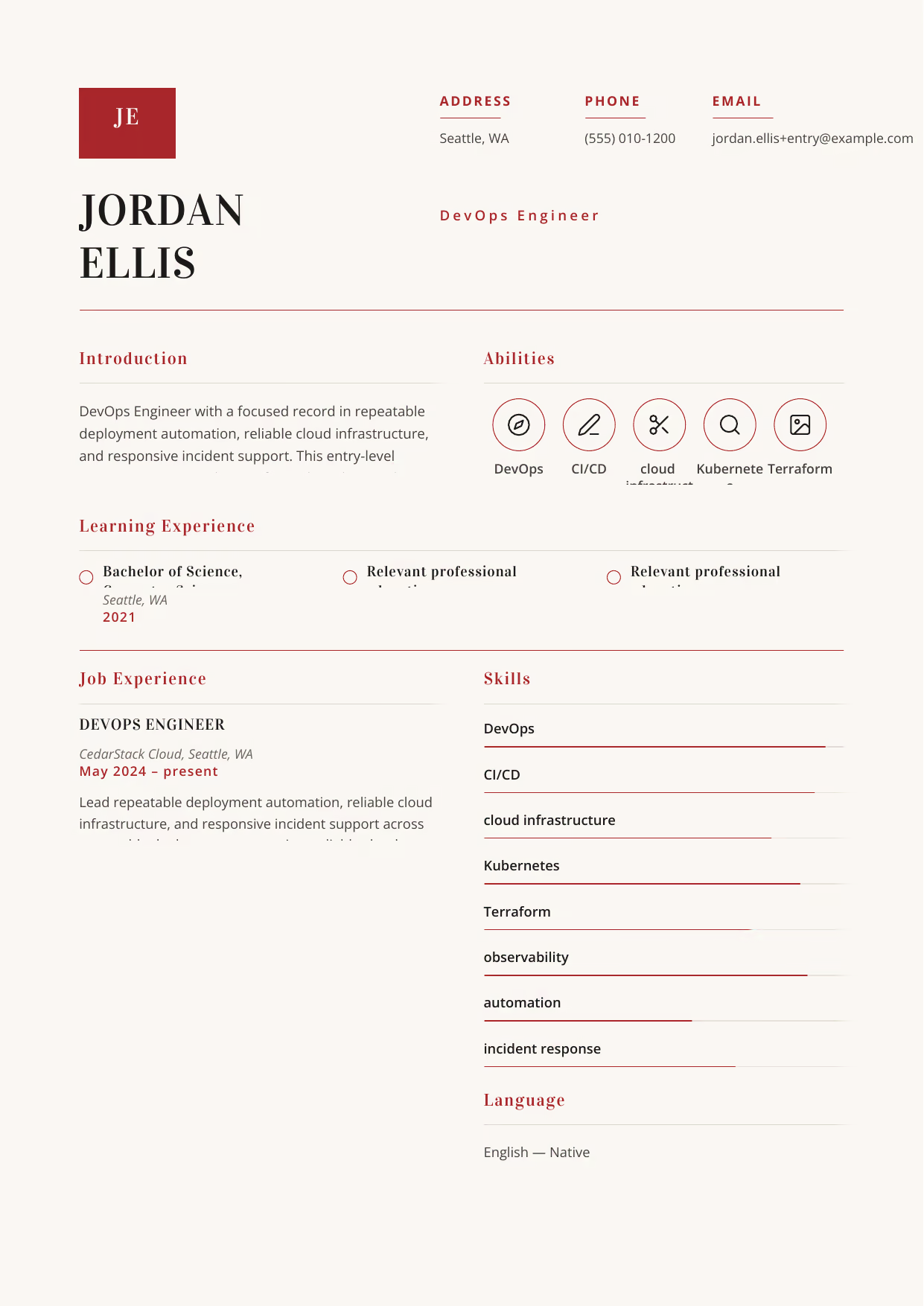
DevOps Engineer
A builder-ready entry-level DevOps Engineer example in the Delphinus template, showing stage-appropriate evidence in a focused, editable resume format.
- Editable role positioning in the Delphinus layout
- Role-specific evidence and delivery context
- Review the Delphinus structure with a clean visual hierarchy
View this resume
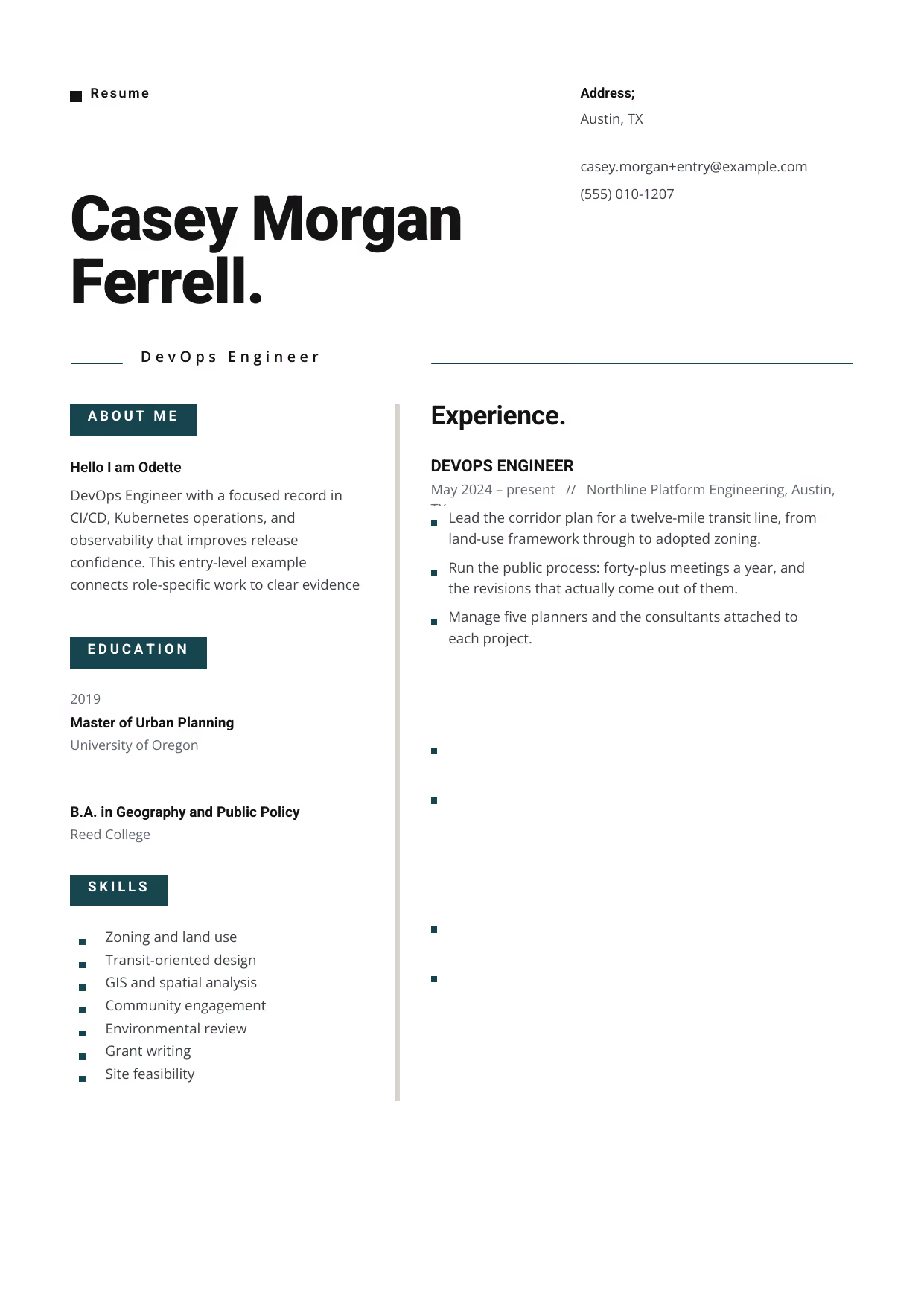
DevOps Engineer
A builder-ready entry-level DevOps Engineer example in the Indus template, showing stage-appropriate evidence in a focused, editable resume format.
- Editable role positioning in the Indus layout
- Role-specific evidence and delivery context
- Review the Indus structure with a clean visual hierarchy
View this resume

DevOps Engineer
A builder-ready entry-level DevOps Engineer example in the Grus template, showing stage-appropriate evidence in a focused, editable resume format.
- Editable role positioning in the Grus layout
- Role-specific evidence and delivery context
- Review the Grus structure with a clean visual hierarchy
View this resume
Mid-Level DevOps Engineer Resume (3-7 Years Experience)
Use these mid-level examples to compare the scope, evidence, and language expected for DevOps Engineer roles at this stage.
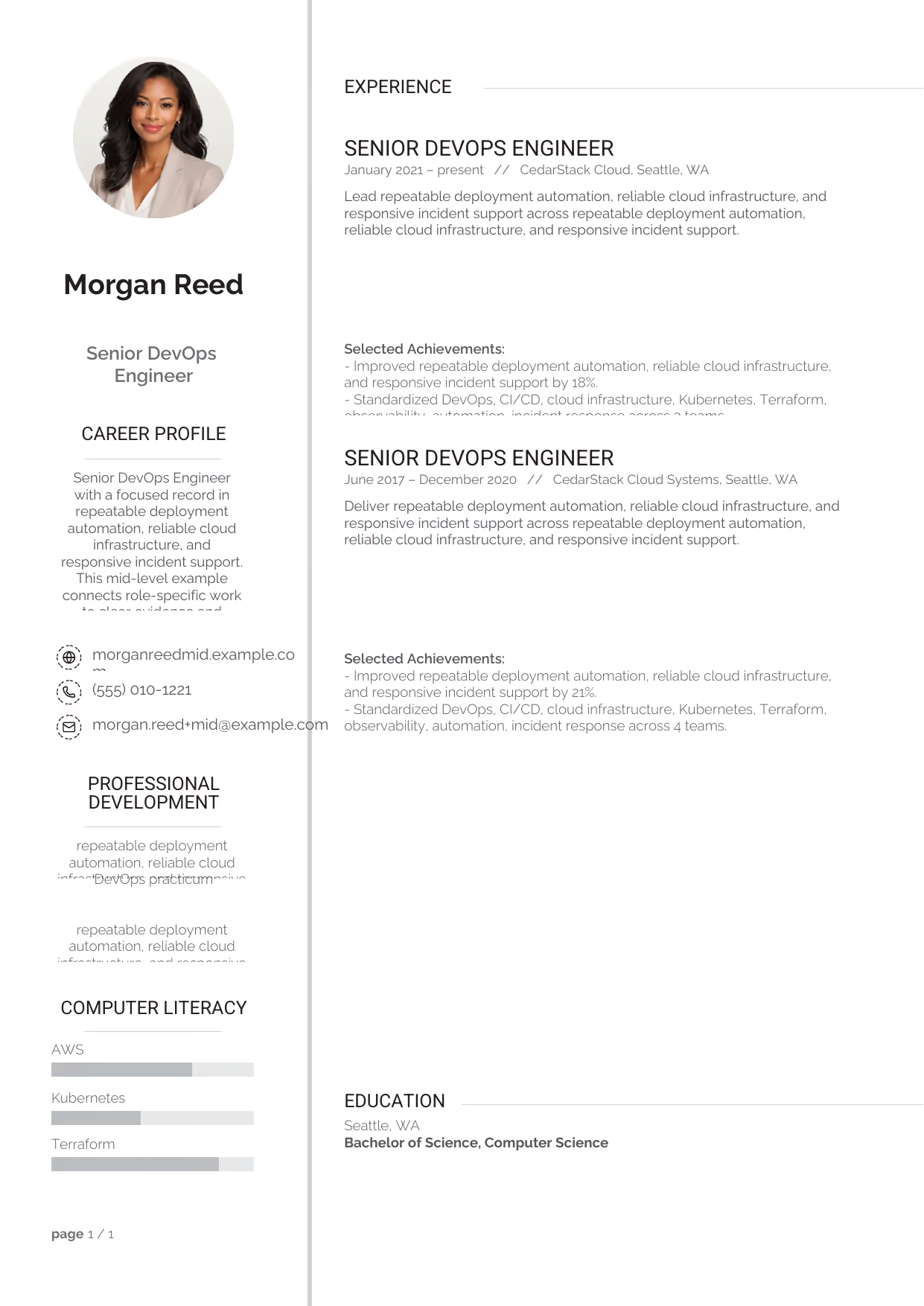
Senior DevOps Engineer
A builder-ready mid-level DevOps Engineer example in the Synnove template, showing stage-appropriate evidence in a focused, editable resume format.
- Editable role positioning in the Synnove layout
- Role-specific evidence and delivery context
- Review the Synnove structure with a clean visual hierarchy
View this resume
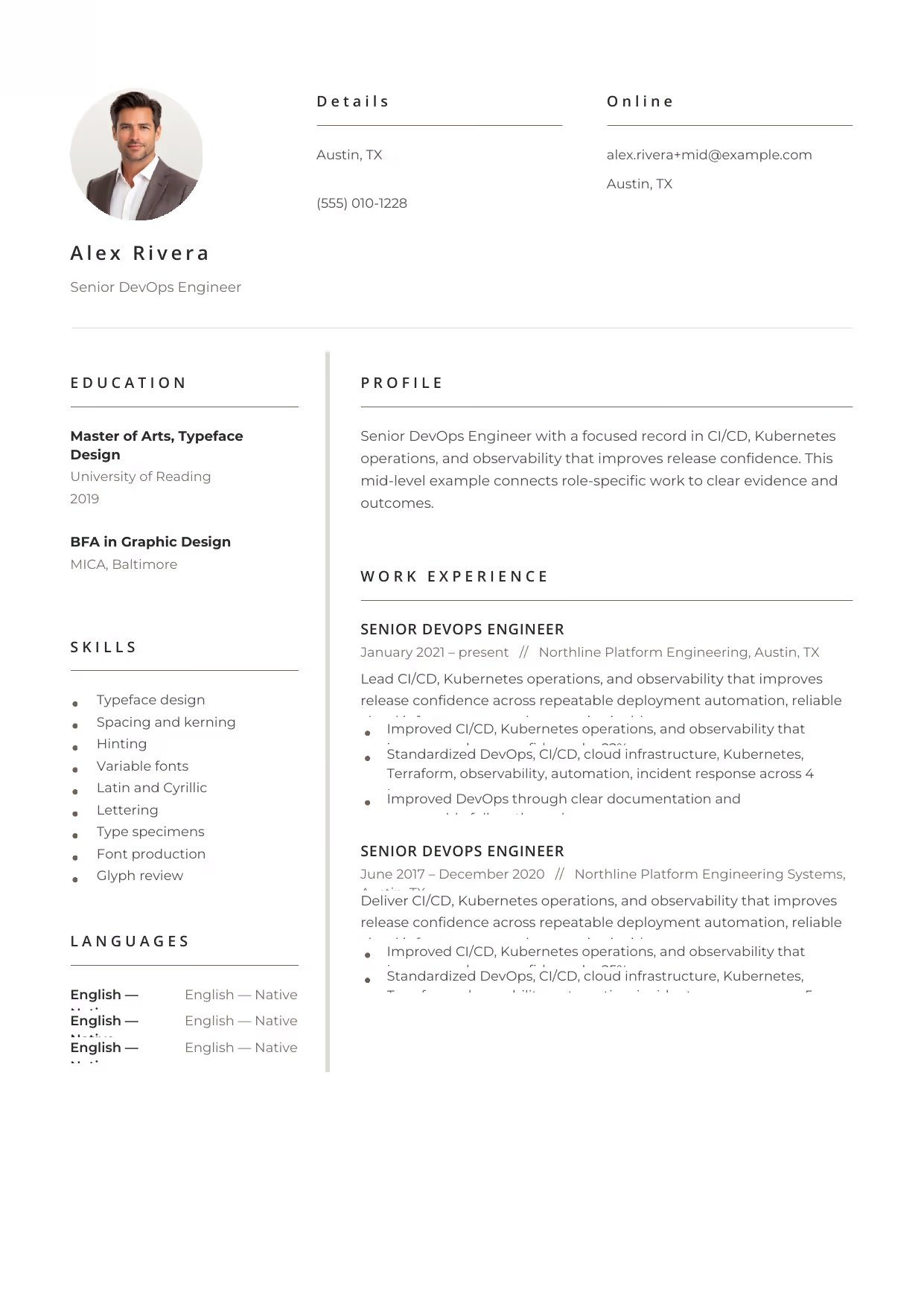
Senior DevOps Engineer
A builder-ready mid-level DevOps Engineer example in the Pictor template, showing stage-appropriate evidence in a focused, editable resume format.
- Editable role positioning in the Pictor layout
- Role-specific evidence and delivery context
- Review the Pictor structure with a clean visual hierarchy
View this resume
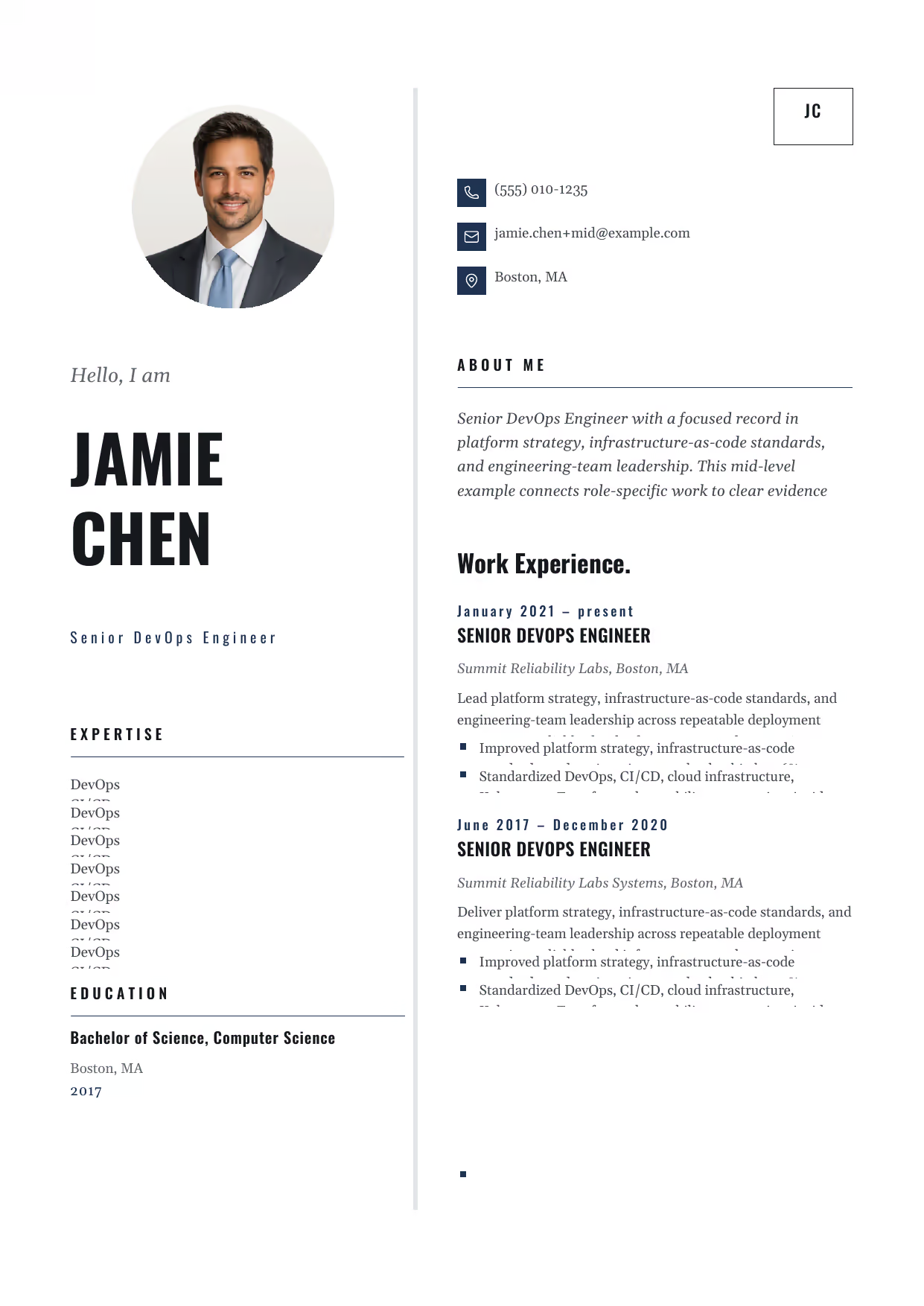
Senior DevOps Engineer
A builder-ready mid-level DevOps Engineer example in the Equuleus template, showing stage-appropriate evidence in a focused, editable resume format.
- Editable role positioning in the Equuleus layout
- Role-specific evidence and delivery context
- Review the Equuleus structure with a clean visual hierarchy
View this resume
Senior DevOps Engineer Resume (8+ Years / Management)
Use these advanced examples to compare the scope, evidence, and language expected for DevOps Engineer roles at this stage.

Platform Engineering Manager
A builder-ready advanced DevOps Engineer example in the Pavo template, showing stage-appropriate evidence in a focused, editable resume format.
- Editable role positioning in the Pavo layout
- Role-specific evidence and delivery context
- Review the Pavo structure with a clean visual hierarchy
View this resume

Platform Engineering Manager
A builder-ready advanced DevOps Engineer example in the Caelum template, showing stage-appropriate evidence in a focused, editable resume format.
- Editable role positioning in the Caelum layout
- Role-specific evidence and delivery context
- Review the Caelum structure with a clean visual hierarchy
View this resume
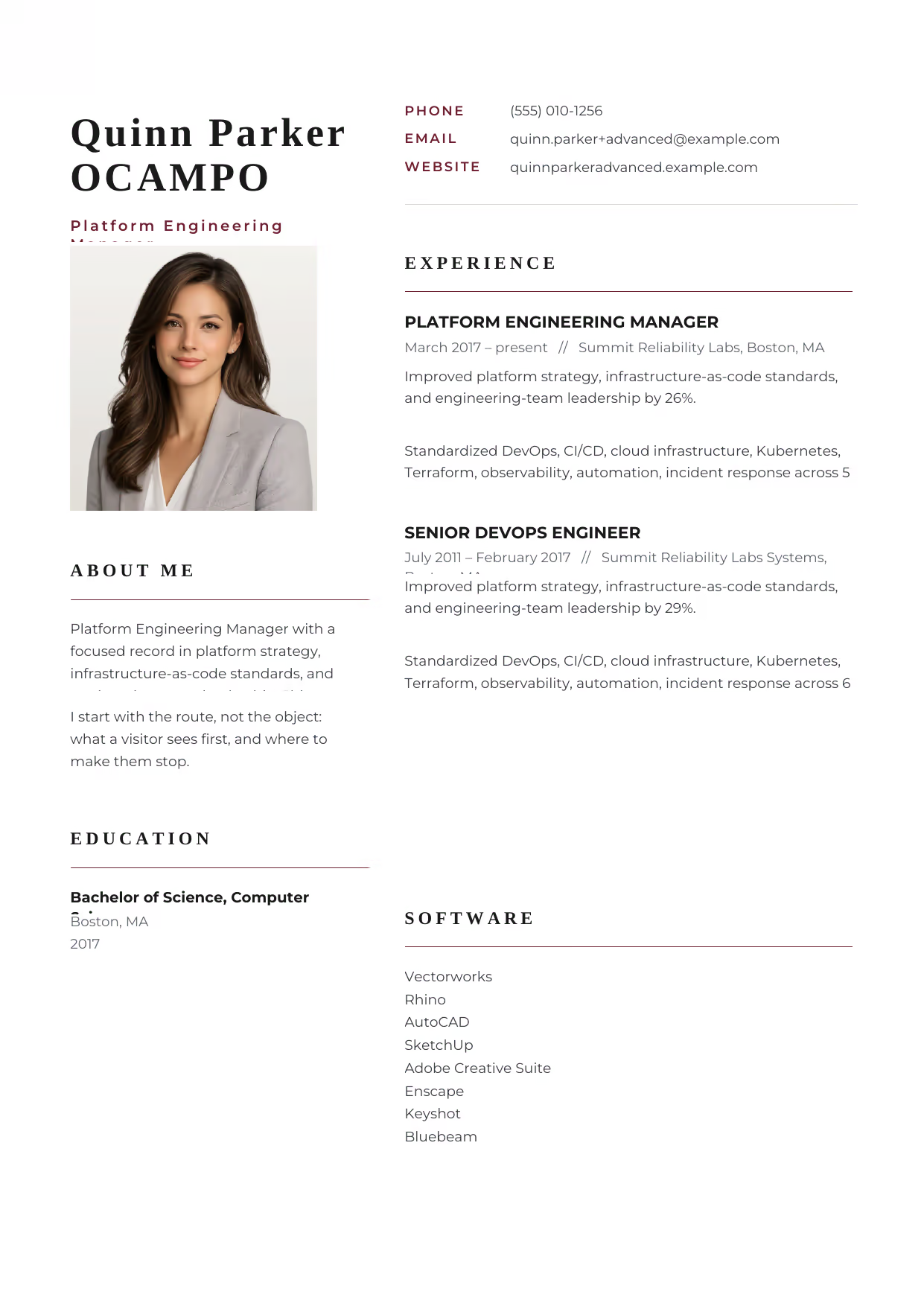
Platform Engineering Manager
A builder-ready advanced DevOps Engineer example in the Hydra template, showing stage-appropriate evidence in a focused, editable resume format.
- Editable role positioning in the Hydra layout
- Role-specific evidence and delivery context
- Review the Hydra structure with a clean visual hierarchy
View this resume
How to Write a DevOps Engineer Resume
The Resume Summary
The resume summary is your first chance to make a strong impression. It should highlight your key skills, experience, and achievements. Use this formula: Years of Experience + Key Skills + Top Achievement + Career Goal
Entry-Level Example: “Enthusiastic Computer Science graduate with a strong foundation in cloud computing and automation. Eager to apply theoretical knowledge to contribute to a dynamic DevOps team.”
Mid-Level Example: “Results-driven DevOps Engineer with 5+ years of experience in designing and implementing cloud infrastructure and automation solutions. Reduced deployment time by 30% using Jenkins and Docker.”
Senior-Level Example: “Highly accomplished Senior DevOps Engineer with 10+ years of experience in leading and managing cloud infrastructure and automation initiatives. Proven ability to reduce costs and improve efficiency.”
Work Experience & Action Verbs
The work experience section is where you showcase your accomplishments. Focus on achievements rather than just listing duties. Use strong action verbs to highlight your impact.
- Before: Responsible for managing cloud infrastructure. After: Managed cloud infrastructure, resulting in a 15% reduction in infrastructure costs.
- Before: Assisted with the implementation of CI/CD pipelines. After: Implemented automated CI/CD pipelines using Jenkins, reducing deployment time by 20%.
- Before: Monitored system performance. After: Monitored system performance using Prometheus and Grafana, identifying and resolving performance bottlenecks that improved system uptime by 10%.
- Before: Troubleshooted system issues. After: Troubleshooted and resolved critical system issues, minimizing downtime and ensuring business continuity.
- Before: Worked with development and operations teams. After: Collaborated with development and operations teams to streamline processes and improve communication, resulting in a 25% increase in team productivity.
Top Skills for DevOps Engineers
Hard Skills
- Cloud Computing (AWS, Azure, GCP)
- Containerization (Docker, Kubernetes)
- Automation (Jenkins, Ansible, Terraform)
- Scripting (Python, Bash)
- Monitoring (Prometheus, Grafana)
- Infrastructure as Code (Terraform, CloudFormation)
- Configuration Management (Chef, Puppet)
Soft Skills
- Problem-solving
- Communication
- Teamwork
- Time Management
- Adaptability
- Leadership
- Critical Thinking
Tools/Software
- AWS CloudFormation
- Azure DevOps
- Google Cloud Deployment Manager
- Docker
- Kubernetes
- Jenkins
- Ansible
- Terraform
- Prometheus
- Grafana
Education & Certifications
For entry-level candidates, list your education prominently, including relevant coursework and GPA. For mid-level and senior-level candidates, focus on certifications and degrees relevant to DevOps.
Recommended Certifications:
- AWS Certified DevOps Engineer – Professional
- Microsoft Certified: Azure DevOps Engineer Expert
- Google Cloud Certified Professional Cloud Architect
- Certified Kubernetes Administrator (CKA)
- Certified Kubernetes Application Developer (CKAD)
10 Common DevOps Engineer Resume Mistakes
- Lack of Quantifiable Achievements: Vague descriptions fail to demonstrate your impact. Instead of saying ‘Improved system performance’, specify ‘Improved system uptime by 15%‘. Recruiters want to see tangible results, and failing to provide metrics makes it difficult to assess your contributions.
- Ignoring ATS Optimization: Using fancy fonts or complex formatting can confuse Applicant Tracking Systems (ATS). Stick to a clean, simple format with standard fonts and clear headings to ensure your resume is properly parsed and not discarded due to technical issues.
- Failing to Tailor to the Job Description: Generic resumes get overlooked. Customize your resume to match the specific requirements of each job description, highlighting the skills and experiences that are most relevant to the position and showcase your understanding of the role’s unique demands.
- Neglecting Soft Skills: While technical skills are crucial, soft skills like communication and teamwork are equally important for DevOps Engineers. Mention soft skills and provide examples of how you’ve used them to collaborate effectively with development and operations teams.
- Poorly Written Summary/Objective: A weak summary fails to capture the reader’s attention. Craft a concise and compelling summary that highlights your key skills, experience, and career goals, demonstrating your value proposition and setting the stage for the rest of your resume.
- Listing Duties Instead of Impact: Recruiters know what a DevOps Engineer does; they want to know how well you did it. Replace passive phrases like ‘Responsible for managing cloud infrastructure’ with quantified wins like ‘Managed cloud infrastructure, reducing costs by 20% and improving uptime by 10%‘.
- Inconsistent Formatting: Inconsistent formatting makes your resume look unprofessional and sloppy. Maintain consistent formatting throughout your resume, including font size, spacing, and bullet point style, to create a visually appealing and easy-to-read document.
- Grammar and Spelling Errors: Misspelling Core Industry Terminology: Typos in general are bad, but misspelling critical tools or certifications (like ‘Kubernetes’, ‘Terraform’, or ‘AWS’) acts as an immediate red flag regarding your attention to detail, showcasing a lack of care and potentially undermining your credibility.
- Omitting Relevant Projects: Failing to include personal or academic projects that demonstrate your skills and experience. Showcase projects that highlight your expertise in cloud computing, automation, and scripting, even if they are not from professional work experience.
- Lack of Certifications: Failing to highlight industry-recognized certifications like AWS Certified DevOps Engineer or Microsoft Certified: Azure DevOps Engineer Expert. These certifications demonstrate your expertise and commitment to continuous learning, making you a more attractive candidate to potential employers.
Frequently Asked Questions (DevOps Engineer)
- What should a DevOps Engineer resume emphasize first? Lead with the scope of repeatable deployment automation, reliable cloud infrastructure, and responsive incident support, then connect your contribution to a clear outcome, tool, or decision.
- Which skills deserve priority on a DevOps Engineer resume? Prioritize DevOps, CI/CD, and cloud infrastructure when they match the role and can be supported by evidence.
- How can a DevOps Engineer show project scope and impact? Name the environment, scale, constraints, and result; CI/CD, Kubernetes operations, and observability that improves release confidence becomes more credible when the context is concrete.
- How should a DevOps Engineer describe tools and technical decisions? Describe why you selected a method, how you implemented it, and what changed afterward in the DevOps Engineer role.
- Which achievements matter most for a DevOps Engineer application? Use outcome-led bullets that show platform strategy, infrastructure-as-code standards, and engineering-team leadership through delivery quality, measurable scope, or stakeholder value.
- How long should a DevOps Engineer resume be? Use the shortest length that proves fit; a focused page can work early-career, while broader DevOps Engineer scope may need more room.
- How can a DevOps Engineer explain progression between career stages? Group examples by increasing ownership, moving from repeatable deployment automation, reliable cloud infrastructure, and responsive incident support toward platform strategy, infrastructure-as-code standards, and engineering-team leadership as responsibility grows.
- Which keywords should a DevOps Engineer include for screening systems? Mirror truthful language from the posting, especially Kubernetes, without stuffing unrelated terms.
- How should a DevOps Engineer present reliability, quality, or safety work? Show how you protected outcomes through Terraform and explain the evidence a hiring team can verify.
- What format makes a DevOps Engineer resume easy for hiring teams to scan? Use clear headings, readable bullets, and consistent dates so a hiring manager can evaluate DevOps Engineer fit quickly.
Creating a compelling DevOps Engineer resume requires careful attention to detail and a strategic approach. By following the tips and examples in this guide, you can craft a resume that showcases your skills, experience, and achievements, and helps you land your dream job.
For more tips and resources, Search more DevOps Engineer resources.
Editorial review: RockStarCV Editorial Team reviewed this DevOps Engineer guide for source fidelity, role-specific usefulness, accessibility, builder examples, and question completeness.


