Critical Care Technician Resume Examples & Guide
Landing a Critical Care Technician position can be challenging in today’s competitive job market. Applicant Tracking Systems (ATS) filter out many qualified candidates. This guide provides resume examples for entry-level, mid-level, and senior-level Critical Care Technicians, helping you craft a resume that stands out.
- Quantify Achievements: Use numbers to showcase the impact of your work.
- Highlight Relevant Skills: Emphasize skills like patient monitoring, equipment maintenance, and electronic health record navigation.
- Tailor to Job Description: Customize your resume for each specific job application, using keywords from the posting.
- Optimize for ATS: Use a clean, ATS-friendly format to ensure your resume is properly scanned and parsed.
- Use Action Verbs: Start your bullet points with strong action verbs to describe your accomplishments.
- Showcase Certifications: Highlight any relevant certifications such as Basic Life Support (BLS) or Advanced Cardiac Life Support (ACLS).
Let’s explore some Critical Care Technician resume examples tailored for different experience levels.
Explore editable Critical Care Technician resume examples by career stage. Each sample opens in the RockStarCV builder so you can study the structure and make your own version.
Entry-Level Critical Care Technician Resume (0-2 Years Experience)
Use these entry-level examples to compare the scope, evidence, and language expected for Critical Care Technician roles at this stage.
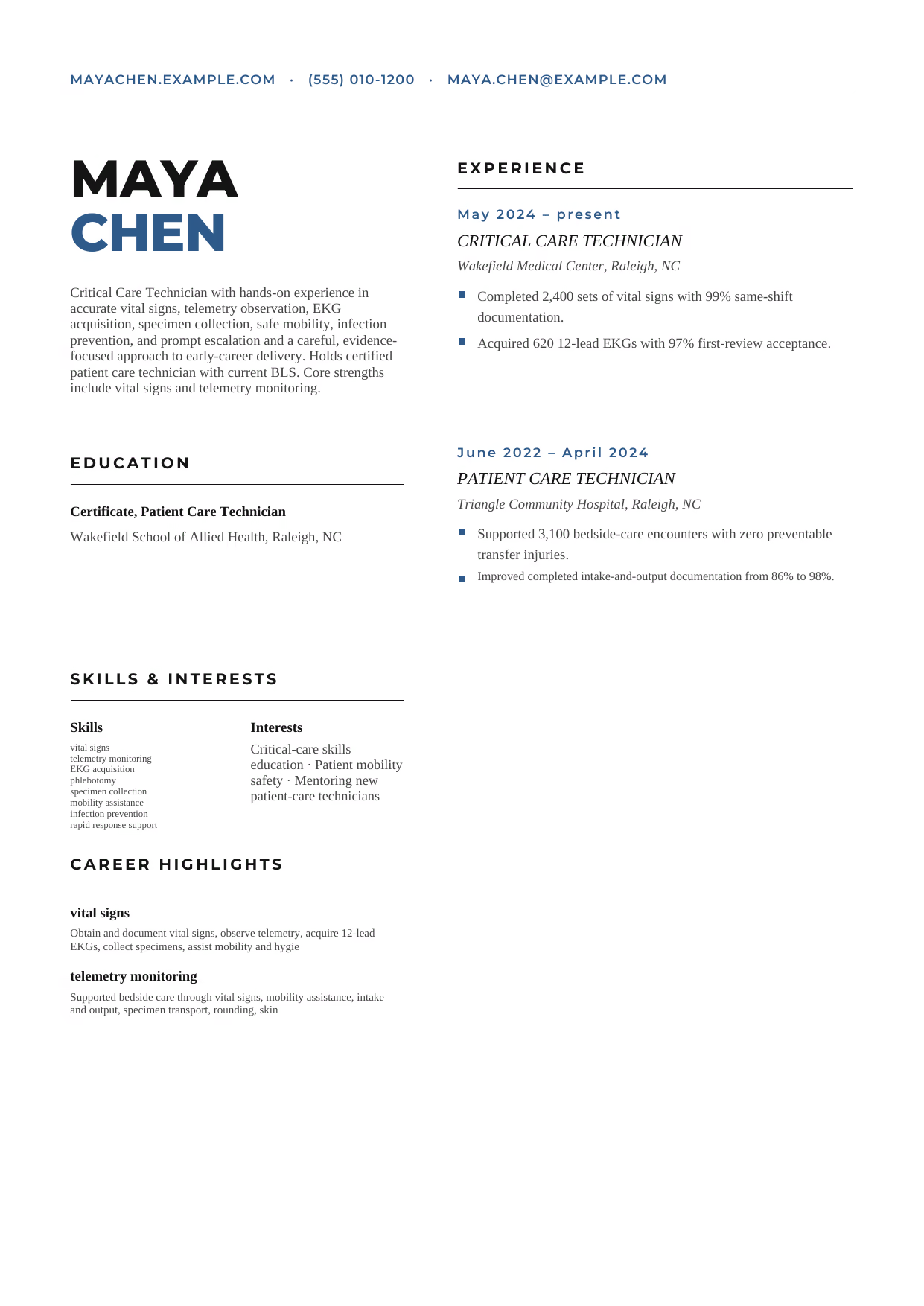
Critical Care Technician
A builder-ready entry-level Critical Care Technician example in the Bootes template, showing stage-appropriate evidence in a focused, editable resume format.
- Editable role positioning in the Bootes layout
- Role-specific evidence and delivery context
- Review the Bootes structure with a clean visual hierarchy
View this resume

Critical Care Technician
A builder-ready entry-level Critical Care Technician example in the Puppis template, showing stage-appropriate evidence in a focused, editable resume format.
- Editable role positioning in the Puppis layout
- Role-specific evidence and delivery context
- Review the Puppis structure with a clean visual hierarchy
View this resume
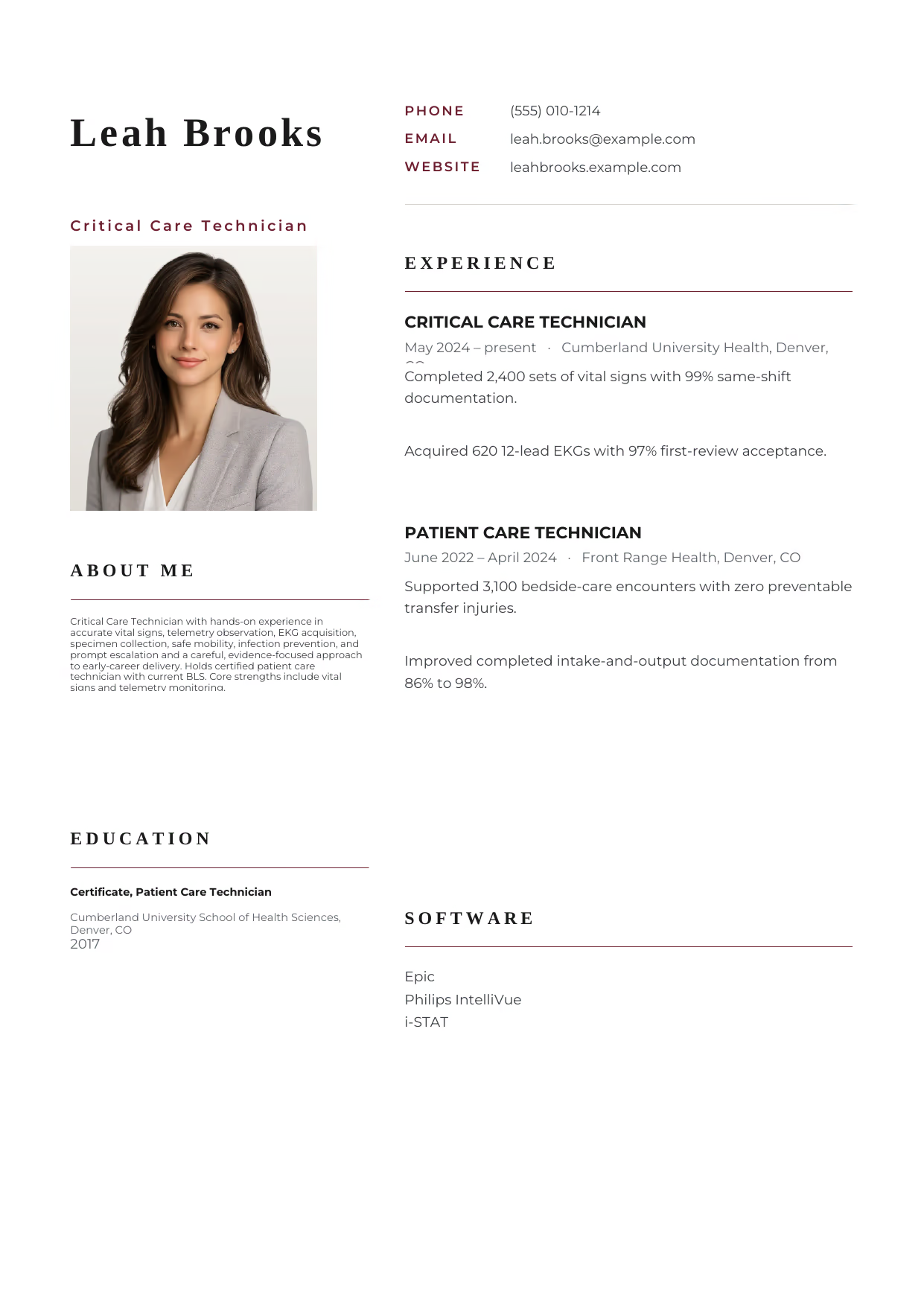
Critical Care Technician
A builder-ready entry-level Critical Care Technician example in the Hydra template, showing stage-appropriate evidence in a focused, editable resume format.
- Editable role positioning in the Hydra layout
- Role-specific evidence and delivery context
- Review the Hydra structure with a clean visual hierarchy
View this resume
Mid-Level Critical Care Technician Resume (3-7 Years Experience)
Use these mid-level examples to compare the scope, evidence, and language expected for Critical Care Technician roles at this stage.
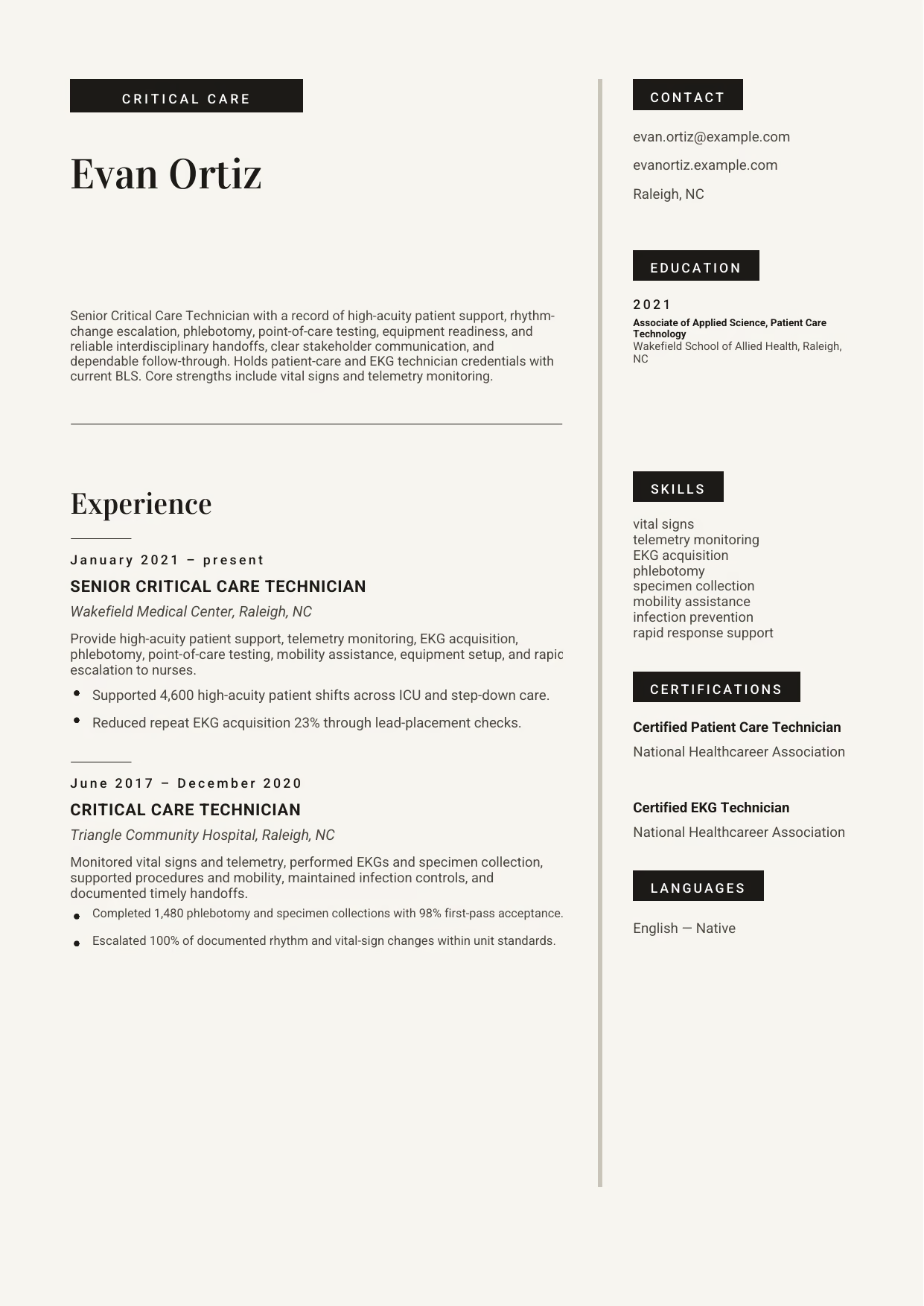
Senior Critical Care Technician
A builder-ready mid-level Critical Care Technician example in the Aquila template, showing stage-appropriate evidence in a focused, editable resume format.
- Editable role positioning in the Aquila layout
- Role-specific evidence and delivery context
- Review the Aquila structure with a clean visual hierarchy
View this resume
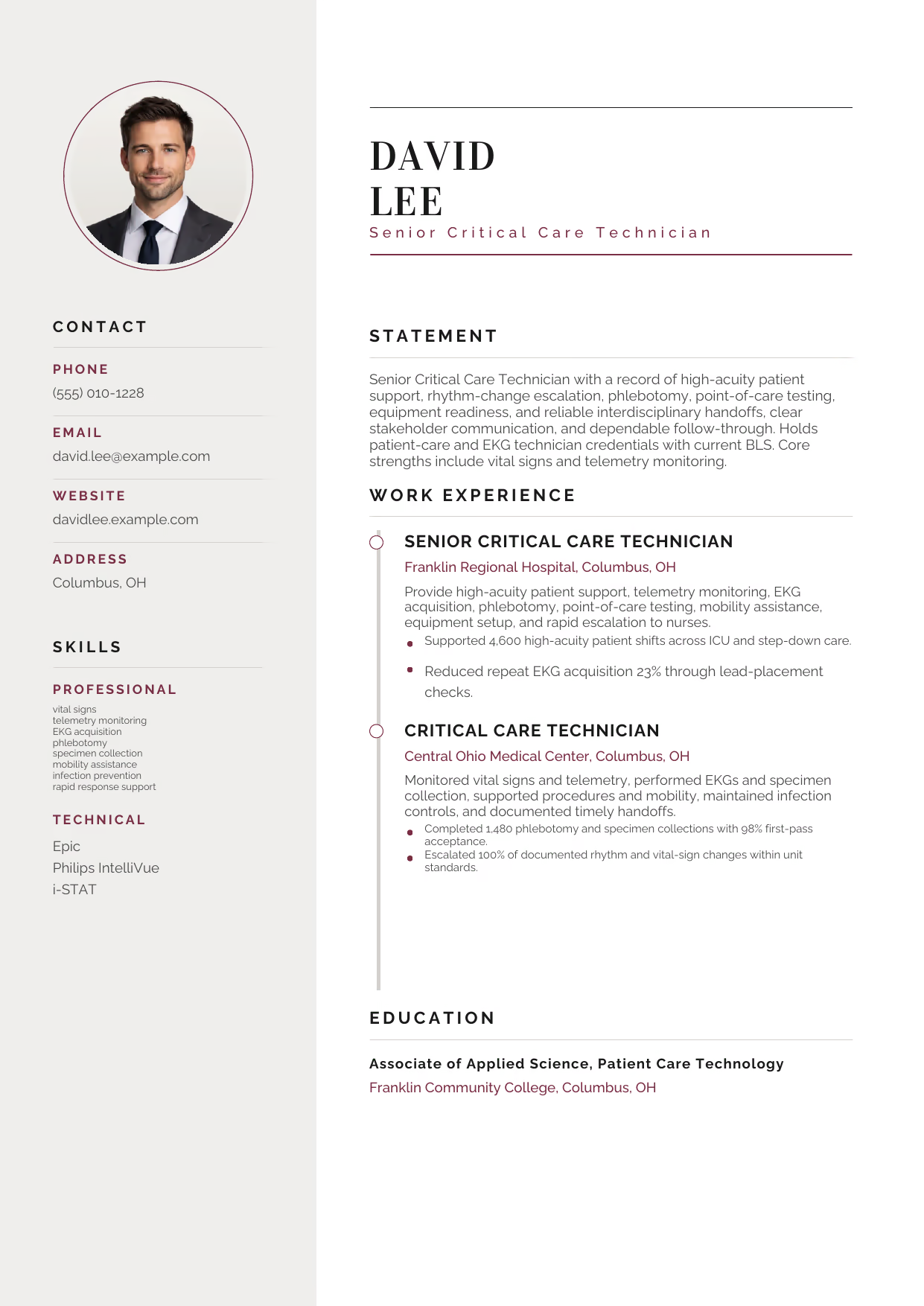
Senior Critical Care Technician
A builder-ready mid-level Critical Care Technician example in the Cetus template, showing stage-appropriate evidence in a focused, editable resume format.
- Editable role positioning in the Cetus layout
- Role-specific evidence and delivery context
- Review the Cetus structure with a clean visual hierarchy
View this resume
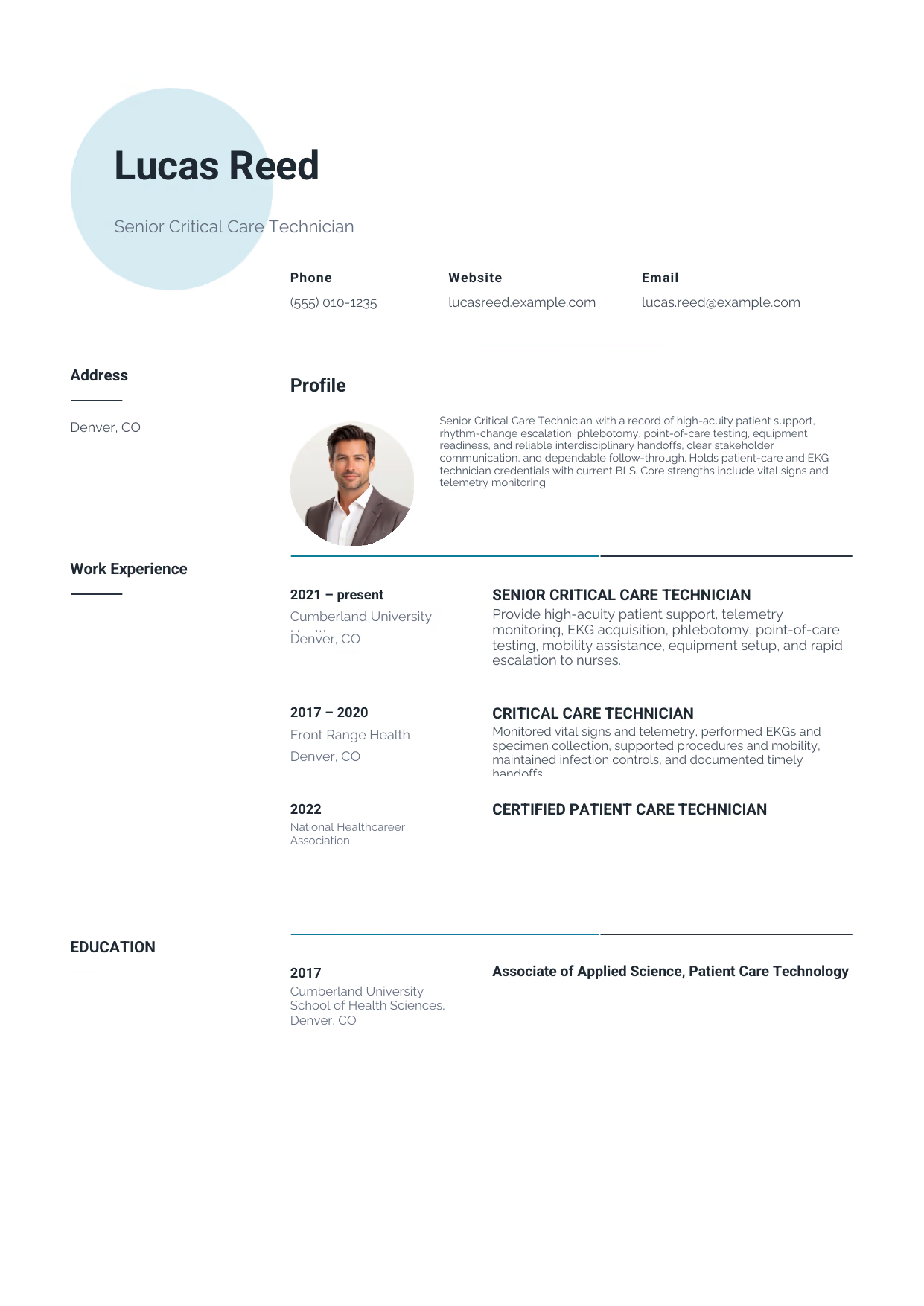
Senior Critical Care Technician
A builder-ready mid-level Critical Care Technician example in the Pavo template, showing stage-appropriate evidence in a focused, editable resume format.
- Editable role positioning in the Pavo layout
- Role-specific evidence and delivery context
- Review the Pavo structure with a clean visual hierarchy
View this resume
Senior Critical Care Technician Resume (8+ Years / Management)
Use these advanced examples to compare the scope, evidence, and language expected for Critical Care Technician roles at this stage.
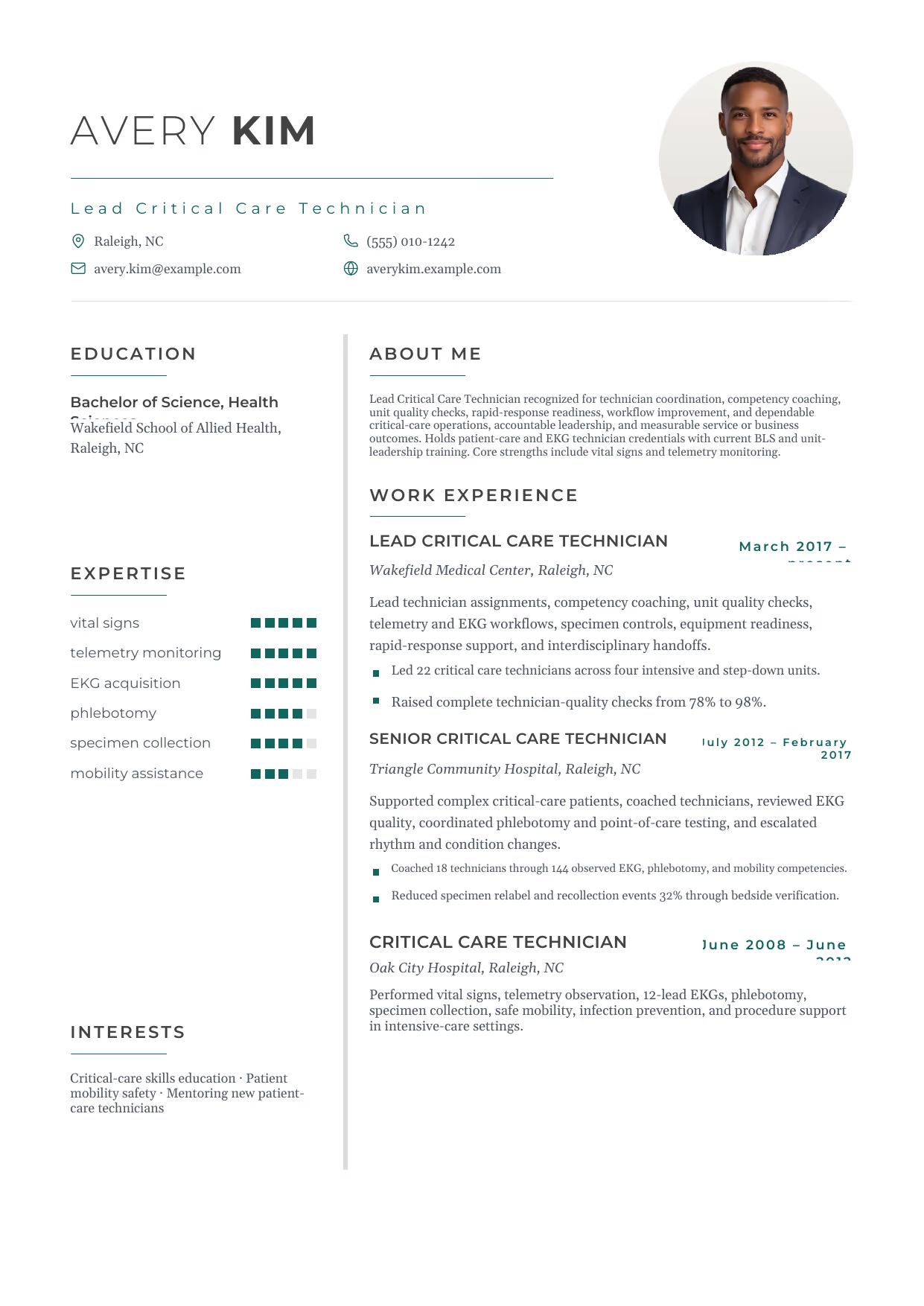
Lead Critical Care Technician
A builder-ready advanced Critical Care Technician example in the Achernar template, showing stage-appropriate evidence in a focused, editable resume format.
- Editable role positioning in the Achernar layout
- Role-specific evidence and delivery context
- Review the Achernar structure with a clean visual hierarchy
View this resume
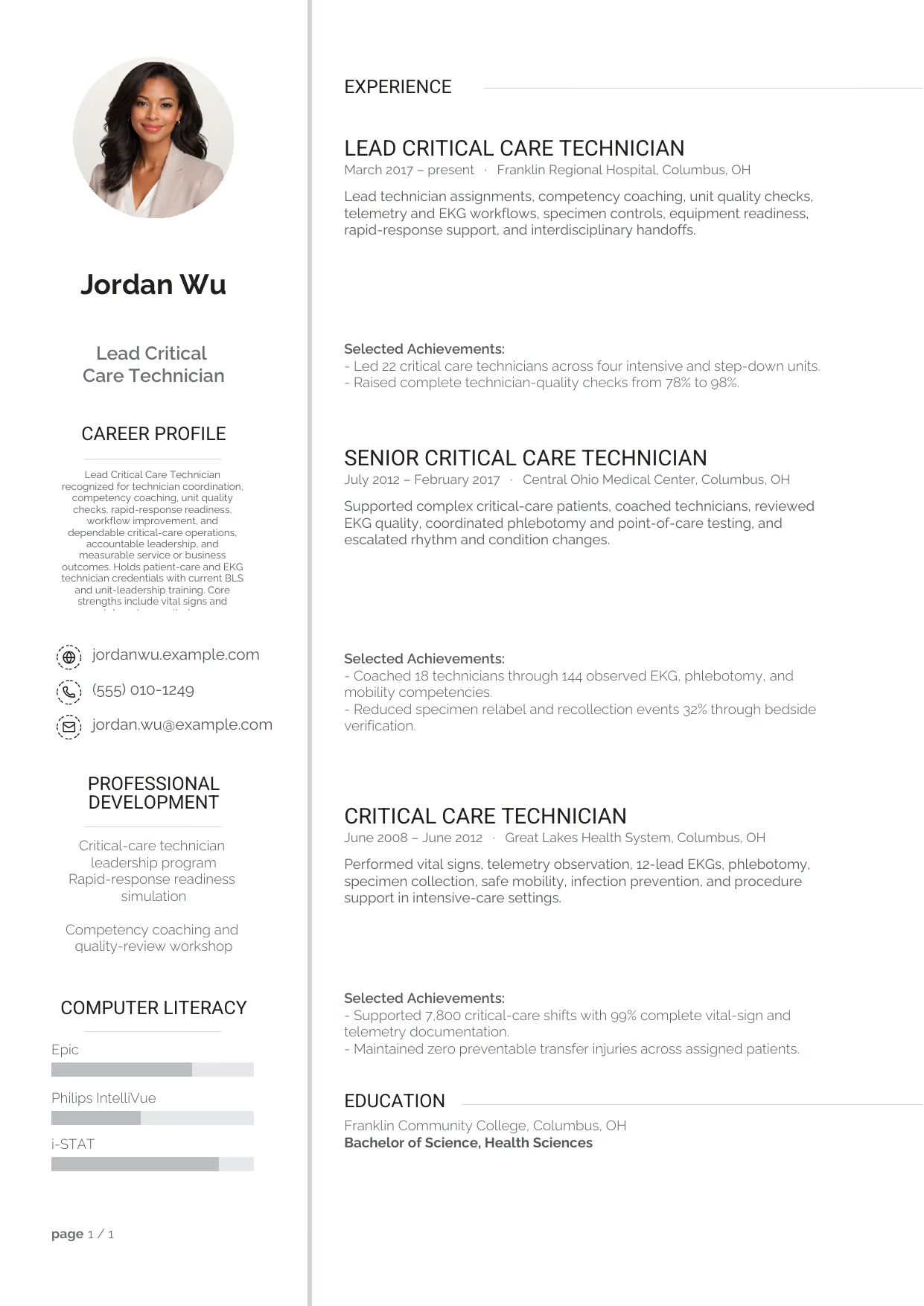
Lead Critical Care Technician
A builder-ready advanced Critical Care Technician example in the Synnove template, showing stage-appropriate evidence in a focused, editable resume format.
- Editable role positioning in the Synnove layout
- Role-specific evidence and delivery context
- Review the Synnove structure with a clean visual hierarchy
View this resume

Lead Critical Care Technician
A builder-ready advanced Critical Care Technician example in the Draco template, showing stage-appropriate evidence in a focused, editable resume format.
- Editable role positioning in the Draco layout
- Role-specific evidence and delivery context
- Review the Draco structure with a clean visual hierarchy
View this resume
How to Write a Critical Care Technician Resume
The Resume Summary
The resume summary is your first impression. Make it count!
Formula: Years of Experience + Top Skills + Key Achievement + Career Goal
Entry-Level Example: Recent nursing assistant graduate seeking a Critical Care Technician position to apply theoretical knowledge and strong interpersonal skills in a fast-paced environment.
Mid-Level Example: Dedicated Critical Care Technician with 5+ years of experience providing exceptional patient care and a proven ability to reduce patient fall incidents.
Senior-Level Example: Results-oriented Critical Care Technician with 10+ years of experience leading teams, improving patient outcomes, and managing budgets effectively.
Work Experience & Action Verbs
Focus on achievements, not just duties. Achievements demonstrate impact and value.
- Before: Responsible for monitoring patient vital signs. After: Monitored patient vital signs, alerting nurses to critical changes, contributing to quicker intervention times.
- Before: Assisted with medical procedures. After: Assisted with intubation and central line placement, ensuring sterile technique and patient comfort.
- Before: Administered medications. After: Administered medications and treatments as directed, adhering to strict protocols and minimizing medication errors.
- Before: Maintained a clean environment. After: Maintained a clean and organized patient care environment, reducing the risk of infection.
- Before: Communicated with patients. After: Communicated with patients and families, providing emotional support and answering questions, improving patient satisfaction scores.
Top Skills for Critical Care Technicians
Highlight both hard and soft skills to showcase your capabilities.
Hard Skills
- Vital Signs Monitoring
- Blood Draws
- Wound Care
- Ventilator Management
- Cardiac Monitoring
- Medication Administration
Soft Skills
- Communication
- Teamwork
- Empathy
- Problem-Solving
- Critical Thinking
- Attention to Detail
Tools/Software
- Electronic Health Records (EHR)
- Patient Monitoring Systems
- Defibrillators
- Ventilators
- Infusion Pumps
Education & Certifications
List your education and certifications in reverse chronological order. For entry-level candidates, emphasize relevant coursework. For experienced candidates, highlight advanced certifications.
Recommended Certifications:
- Basic Life Support (BLS)
- Advanced Cardiac Life Support (ACLS)
- Certified Critical Care Technician (CCCT)
10 Common Critical Care Technician Resume Mistakes
- Generic Objective Statements: Recruiters skip over generic objectives. Instead, use a compelling summary highlighting your skills and career goals tailored to the specific Critical Care Technician position. This grabs their attention immediately and proves you understand the role.
- Listing Duties Instead of Impact: Recruiters know what a Critical Care Technician does; they want to know how well you did it. Replace passive phrases like ‘Responsible for patient care’ with quantified wins like ‘Improved patient satisfaction scores by 12% through proactive care’.
- Ignoring Keywords from the Job Description: Applicant Tracking Systems (ATS) scan for specific keywords. Failing to include them means your resume might not even reach a human. Scrutinize the job description and weave those keywords naturally into your skills and experience sections.
- Neglecting Soft Skills: While technical skills are important, soft skills like communication and empathy are crucial in patient care. Highlight these skills with specific examples of how you’ve used them to improve patient outcomes or team collaboration.
- Poor Formatting and Typos: A cluttered or poorly formatted resume reflects poorly on your attention to detail. Use a clean, professional template and proofread carefully for typos and grammatical errors, as these can be immediate deal-breakers.
- Omitting Relevant Certifications: Certifications like BLS, ACLS, and CCCT are essential for Critical Care Technicians. Failing to list these can make you appear underqualified, even if you have the experience. Ensure your certifications are prominently displayed.
- Inconsistent Dates and Job Titles: Discrepancies in dates or job titles raise red flags about your honesty and attention to detail. Double-check all dates and job titles to ensure they match your employment records and provide a consistent narrative.
- Lack of Specificity in Skills: Listing generic skills like ‘patient care’ is less effective than specifying the types of patient care you’ve provided, such as ‘wound care’, ‘vital signs monitoring’, or ‘medication administration’. Be specific and provide context.
- Not Tailoring to the Specific Role: Sending the same generic resume for every Critical Care Technician position is a common mistake. Customize your resume for each application, highlighting the skills and experience most relevant to the specific requirements of the job.
- Failing to Quantify Achievements: Numbers speak louder than words. Whenever possible, quantify your achievements with metrics like ‘Reduced patient fall incidents by 15%’ or ‘Improved patient satisfaction scores by 10%’. This demonstrates the tangible impact of your work.
Frequently Asked Questions (Critical Care Technician)
- What should a Critical Care Technician resume emphasize first? Lead with the scope of accurate vital signs, telemetry observation, EKG acquisition, specimen collection, safe mobility, infection prevention, and prompt escalation, then connect your contribution to a clear outcome, tool, or decision.
- Which skills deserve priority on a Critical Care Technician resume? Prioritize vital signs, telemetry monitoring, and EKG acquisition when they match the role and can be supported by evidence.
- How can a Critical Care Technician show project scope and impact? Name the environment, scale, constraints, and result; high-acuity patient support, rhythm-change escalation, phlebotomy, point-of-care testing, equipment readiness, and reliable interdisciplinary handoffs becomes more credible when the context is concrete.
- How should a Critical Care Technician describe tools and technical decisions? Describe why you selected a method, how you implemented it, and what changed afterward in the Critical Care Technician role.
- Which achievements matter most for a Critical Care Technician application? Use outcome-led bullets that show technician coordination, competency coaching, unit quality checks, rapid-response readiness, workflow improvement, and dependable critical-care operations through delivery quality, measurable scope, or stakeholder value.
- How long should a Critical Care Technician resume be? Use the shortest length that proves fit; a focused page can work early-career, while broader Critical Care Technician scope may need more room.
- How can a Critical Care Technician explain progression between career stages? Group examples by increasing ownership, moving from accurate vital signs, telemetry observation, EKG acquisition, specimen collection, safe mobility, infection prevention, and prompt escalation toward technician coordination, competency coaching, unit quality checks, rapid-response readiness, workflow improvement, and dependable critical-care operations as responsibility grows.
- Which keywords should a Critical Care Technician include for screening systems? Mirror truthful language from the posting, especially phlebotomy, without stuffing unrelated terms.
- How should a Critical Care Technician present reliability, quality, or safety work? Show how you protected outcomes through specimen collection and explain the evidence a hiring team can verify.
- What format makes a Critical Care Technician resume easy for hiring teams to scan? Use clear headings, readable bullets, and consistent dates so a hiring manager can evaluate Critical Care Technician fit quickly.
Crafting a compelling Critical Care Technician resume requires careful attention to detail and a strategic approach. By following the examples and tips in this guide, you can create a resume that showcases your skills, experience, and qualifications, and increases your chances of landing an interview.
To find even more ways to make your resume stand out, Search more Critical Care Technician resources on our site.
RockStarCV Editorial Team