Automation Engineer Resume Examples & Guide
Landing an Automation Engineer role in today’s market is tough. Applicant Tracking Systems (ATS) filter out countless resumes, and you face fierce competition. This guide provides Automation Engineer resume examples for every experience level, offering actionable strategies to help you stand out.
- Quantify Achievements: Use numbers to showcase the impact of your work (e.g., Reduced testing time by 15%).
- Highlight Relevant Skills: Emphasize key skills like scripting, testing frameworks, and configuration management tools.
- Tailor to Job Description: Customize your resume to match the specific requirements and keywords of each job posting.
- Optimize for ATS: Use a clean, ATS-friendly format and incorporate relevant keywords throughout your resume.
- Use Action Verbs: Start each bullet point with strong action verbs to describe your accomplishments (e.g., Developed, Implemented, Automated).
Let’s explore some Automation Engineer resume examples to get you started.
Explore editable Automation Engineer resume examples by career stage. Each sample opens in the RockStarCV builder so you can study the structure and make your own version.
Entry-Level Automation Engineer Resume (0-2 Years Experience)
Use these entry-level examples to compare the scope, evidence, and language expected for Automation Engineer roles at this stage.
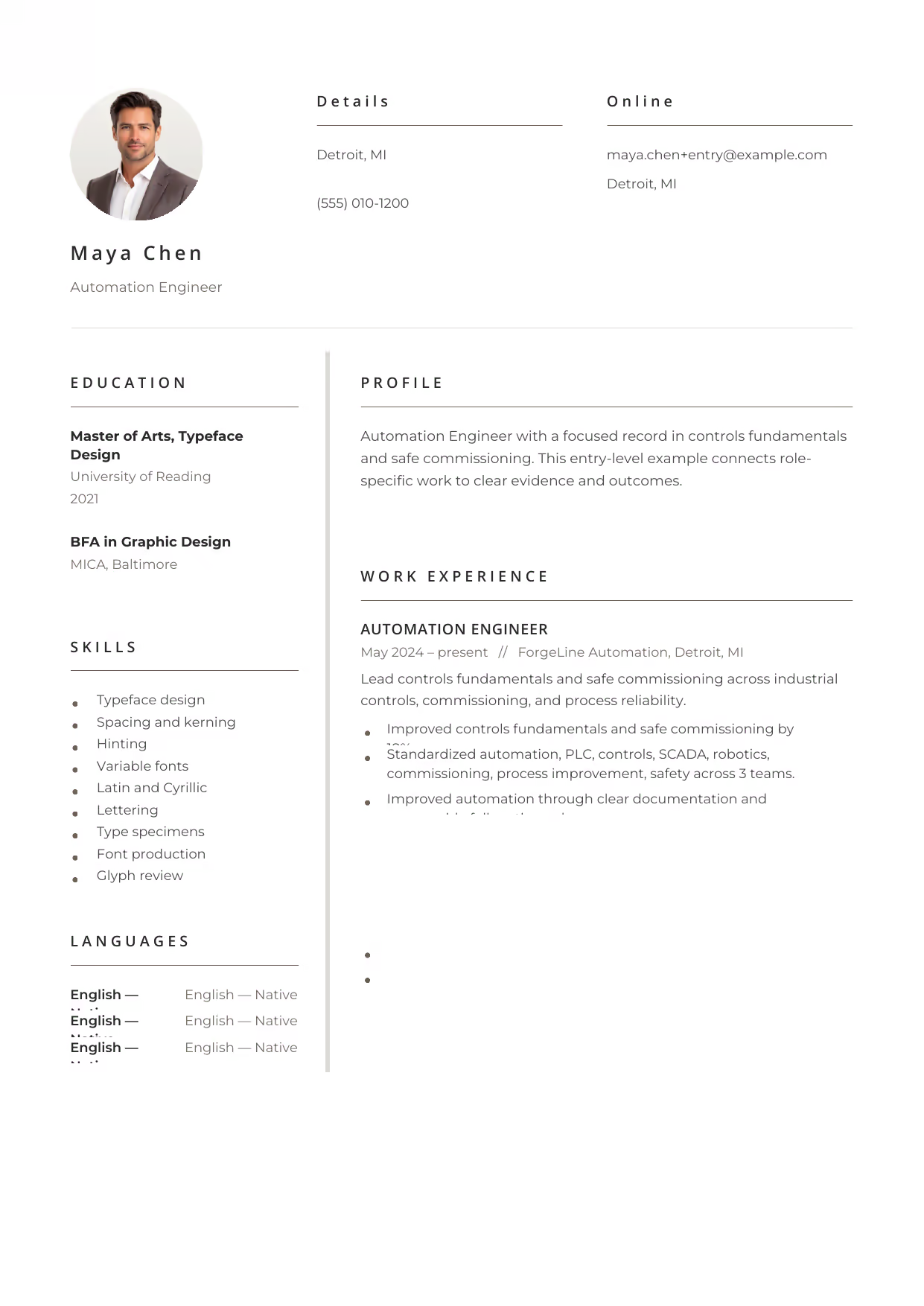
Automation Engineer
A builder-ready entry-level Automation Engineer example in the Pictor template, showing stage-appropriate evidence in a focused, editable resume format.
- Editable role positioning in the Pictor layout
- Role-specific evidence and delivery context
- Review the Pictor structure with a clean visual hierarchy
View this resume
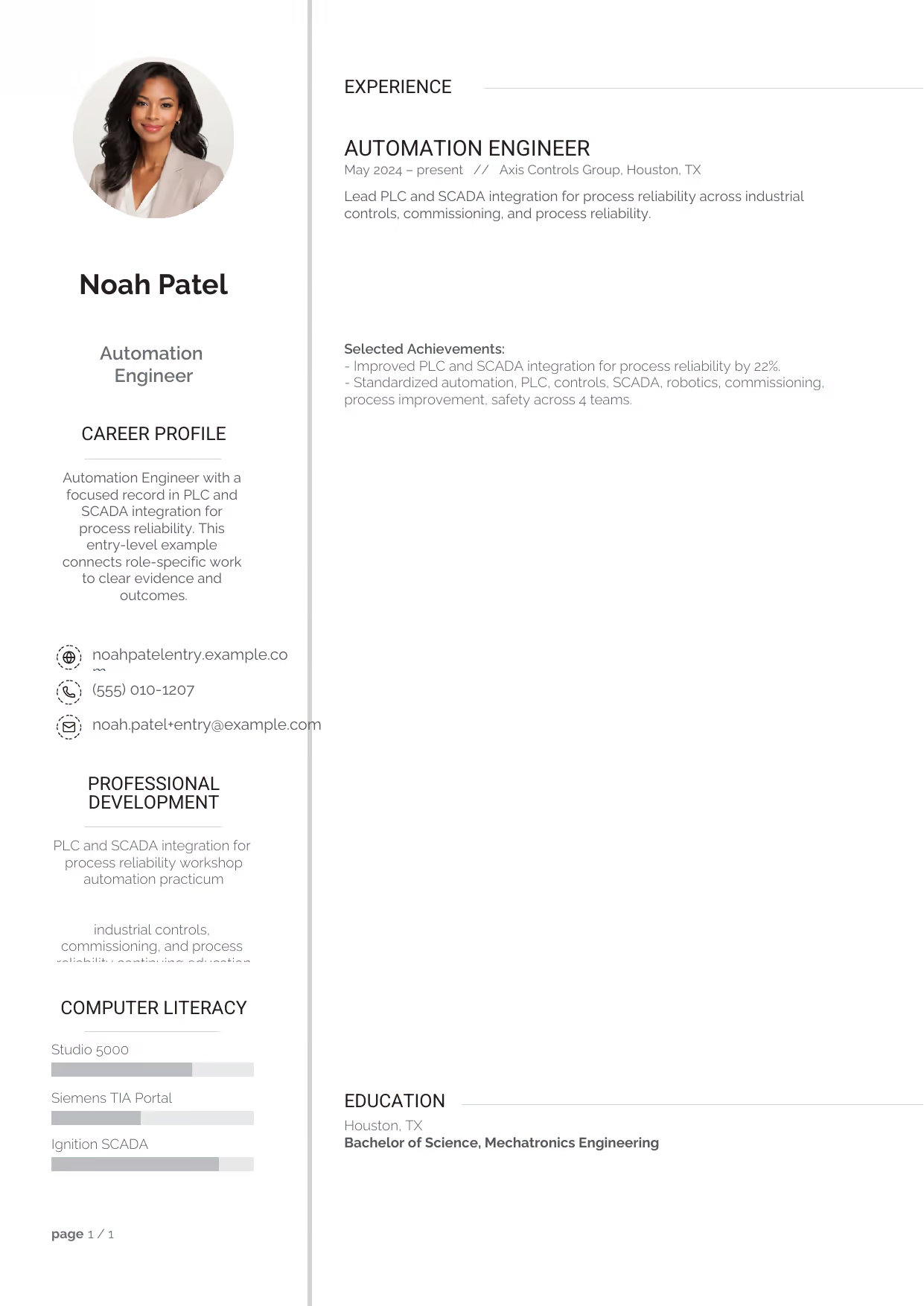
Automation Engineer
A builder-ready entry-level Automation Engineer example in the Synnove template, showing stage-appropriate evidence in a focused, editable resume format.
- Editable role positioning in the Synnove layout
- Role-specific evidence and delivery context
- Review the Synnove structure with a clean visual hierarchy
View this resume

Automation Engineer
A builder-ready entry-level Automation Engineer example in the Pegasus template, showing stage-appropriate evidence in a focused, editable resume format.
- Editable role positioning in the Pegasus layout
- Role-specific evidence and delivery context
- Review the Pegasus structure with a clean visual hierarchy
View this resume
Mid-Level Automation Engineer Resume (3-7 Years Experience)
Use these mid-level examples to compare the scope, evidence, and language expected for Automation Engineer roles at this stage.
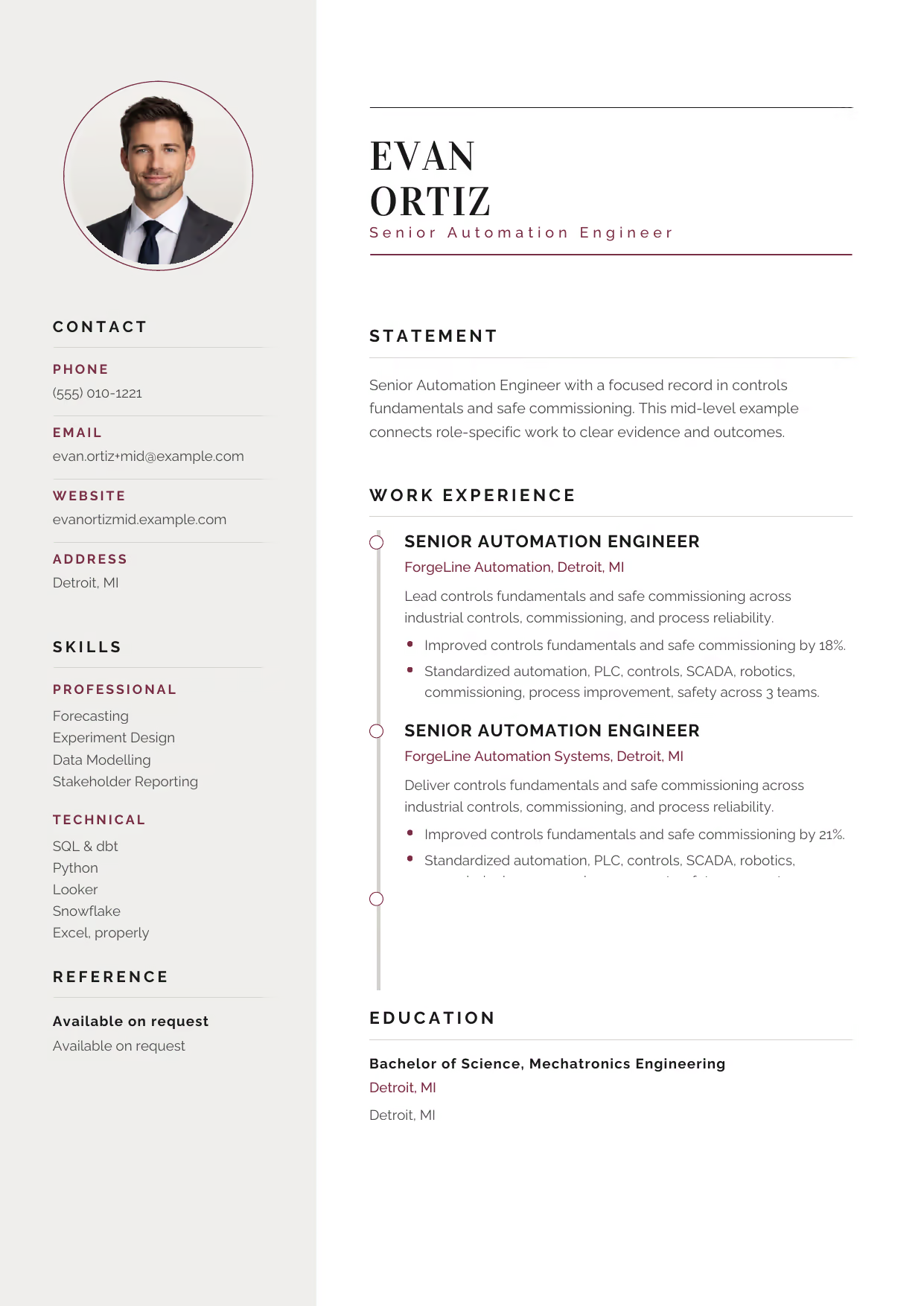
Senior Automation Engineer
A builder-ready mid-level Automation Engineer example in the Cetus template, showing stage-appropriate evidence in a focused, editable resume format.
- Editable role positioning in the Cetus layout
- Role-specific evidence and delivery context
- Review the Cetus structure with a clean visual hierarchy
View this resume

Senior Automation Engineer
A builder-ready mid-level Automation Engineer example in the Aquila template, showing stage-appropriate evidence in a focused, editable resume format.
- Editable role positioning in the Aquila layout
- Role-specific evidence and delivery context
- Review the Aquila structure with a clean visual hierarchy
View this resume

Senior Automation Engineer
A builder-ready mid-level Automation Engineer example in the Achernar template, showing stage-appropriate evidence in a focused, editable resume format.
- Editable role positioning in the Achernar layout
- Role-specific evidence and delivery context
- Review the Achernar structure with a clean visual hierarchy
View this resume
Senior Automation Engineer Resume (8+ Years / Management)
Use these advanced examples to compare the scope, evidence, and language expected for Automation Engineer roles at this stage.
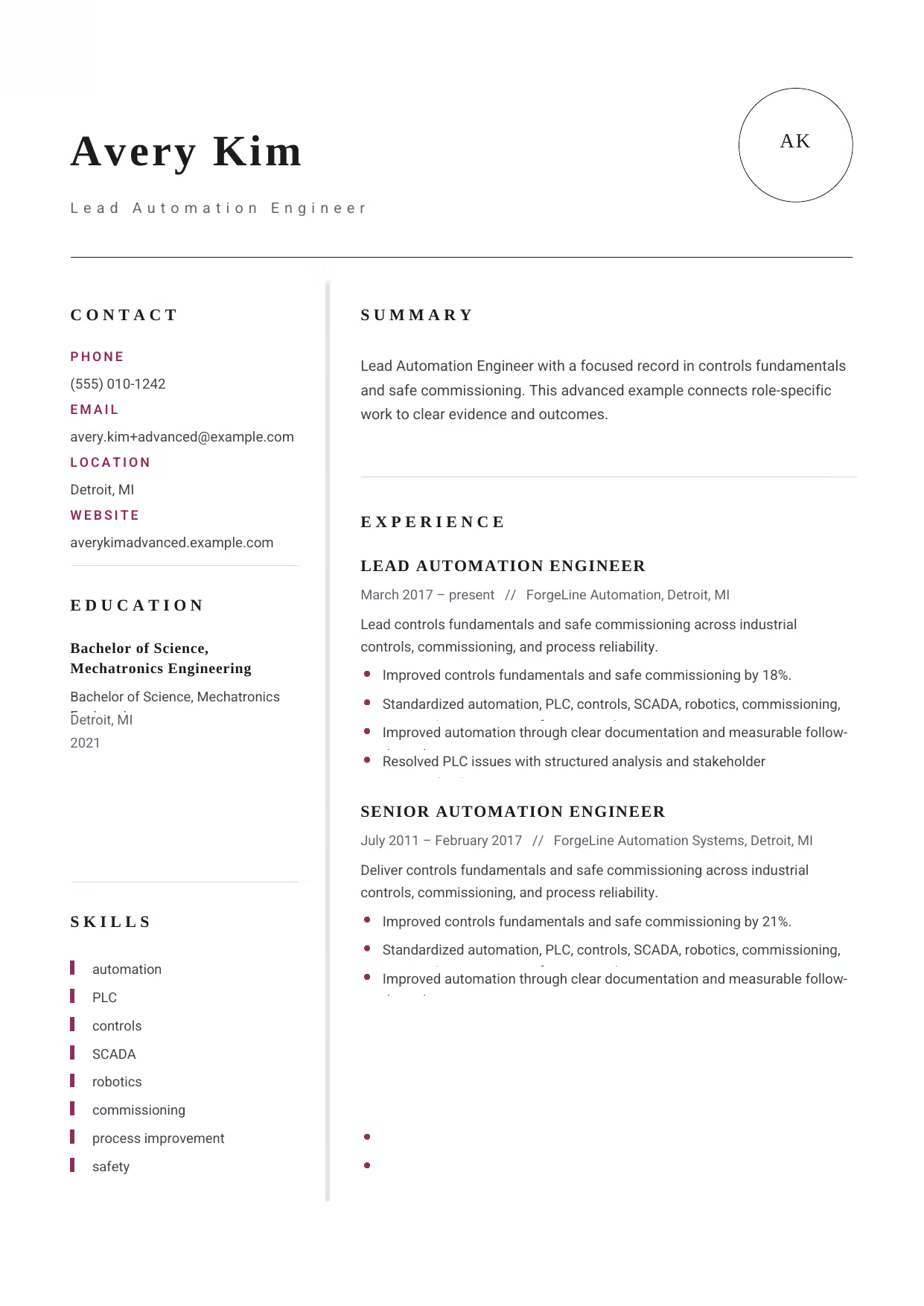
Lead Automation Engineer
A builder-ready advanced Automation Engineer example in the Grus template, showing stage-appropriate evidence in a focused, editable resume format.
- Editable role positioning in the Grus layout
- Role-specific evidence and delivery context
- Review the Grus structure with a clean visual hierarchy
View this resume
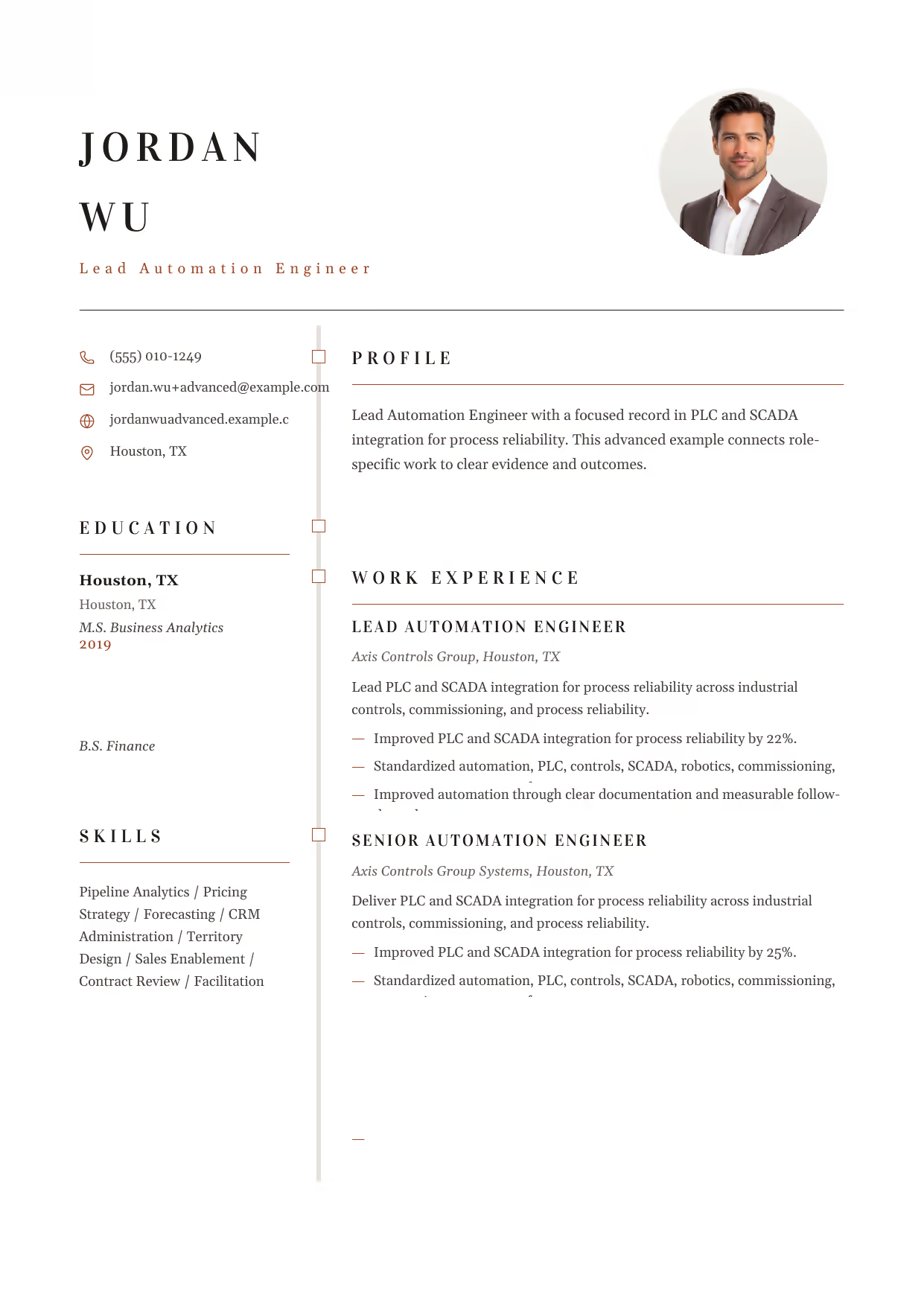
Lead Automation Engineer
A builder-ready advanced Automation Engineer example in the Draco template, showing stage-appropriate evidence in a focused, editable resume format.
- Editable role positioning in the Draco layout
- Role-specific evidence and delivery context
- Review the Draco structure with a clean visual hierarchy
View this resume

Lead Automation Engineer
A builder-ready advanced Automation Engineer example in the Pavo template, showing stage-appropriate evidence in a focused, editable resume format.
- Editable role positioning in the Pavo layout
- Role-specific evidence and delivery context
- Review the Pavo structure with a clean visual hierarchy
View this resume
How to Write a Automation Engineer Resume
The Resume Summary
The resume summary is your first chance to impress recruiters. It should be a concise and compelling overview of your skills and experience.
[Your Title] with [Number] years of experience in [Industry/Area of Expertise]. Proven ability to [Key Achievement 1] and [Key Achievement 2]. Expertise in [Skill 1], [Skill 2], and [Skill 3]. Seeking a [Job Title] role at [Company Name] to leverage my skills and contribute to [Company Goal].
Entry-Level Example: Entry-level Automation Engineer with a strong foundation in software testing and scripting. Eager to apply academic knowledge and develop practical skills in a dynamic environment.
Mid-Level Example: Results-oriented Automation Engineer with 5+ years of experience in developing and implementing automated testing solutions. Proven ability to reduce testing cycle time and improve software quality.
Senior Example: Highly experienced and strategic Senior Automation Engineer with 10+ years of experience in leading and managing automation teams. Proven ability to define and implement automation strategies that improve software quality and reduce costs.
Work Experience & Action Verbs
The work experience section is where you showcase your accomplishments and demonstrate your value to potential employers. Focus on achievements rather than just listing duties.
Duties describe *what* you did; Achievements describe *how well* you did it and what impact it had.
- Before: Responsible for writing test scripts. After: Developed and maintained automated test scripts using Selenium, reducing testing cycle time by 15%.
- Before: Assisted in the implementation of CI/CD pipelines. After: Implemented a Continuous Integration/Continuous Delivery (CI/CD) pipeline using Jenkins, improving deployment frequency by 30%.
- Before: Worked with developers to resolve software defects. After: Collaborated with developers and QA engineers to identify and resolve software defects, reducing defect density by 15%.
- Before: Conducted performance tests. After: Designed and executed performance tests using JMeter, ensuring application scalability and stability for 10,000+ concurrent users.
- Before: Provided support to junior engineers. After: Mentored junior automation engineers, providing guidance and support in test automation best practices, resulting in a 20% improvement in their productivity.
Top Skills for Automation Engineers
Highlighting the right skills is crucial for getting past ATS and catching the attention of recruiters.
Hard Skills:
- Test Automation
- Scripting
- CI/CD
- Performance Testing
- Software Development Life Cycle (SDLC)
Soft Skills:
- Problem-solving
- Communication
- Teamwork
- Attention to Detail
- Analytical Skills
Tools/Software:
- Selenium
- Jenkins
- JMeter
- TestNG
- Git
- Docker
- Kubernetes
Education & Certifications
List your education and certifications in reverse chronological order. For entry-level candidates, education should be more prominent. For experienced candidates, focus on relevant certifications.
Required or Recommended Certifications:
- ISTQB Certified Tester Foundation Level
- ISTQB Certified Tester Advanced Level
- Certified Software Test Automation Specialist (CSTAS)
10 Common Automation Engineer Resume Mistakes
- Generic Summary Statements: Using a vague summary that doesn’t highlight your specific achievements or skills fails to capture the recruiter’s attention. Replace it with a concise summary that showcases your key accomplishments and expertise in automation engineering, such as reducing testing cycle time or improving software quality. This shows that you understand the core value of Automation Engineering.
- Listing Duties Instead of Impact: Simply listing your responsibilities doesn’t demonstrate your value. Instead, quantify your achievements with metrics, such as reducing testing costs by 20% or improving deployment frequency by 30%. This showcases the tangible impact of your work as an Automation Engineer, which is key to landing an interview.
- Ignoring Keywords: Failing to include relevant keywords from the job description can cause your resume to be overlooked by ATS. Carefully review the job posting and incorporate keywords related to programming languages, automation tools, and testing methodologies to ensure your resume is properly indexed.
- Poor Formatting: A cluttered or poorly formatted resume can be difficult to read and may turn off recruiters. Use a clean, ATS-friendly format with clear headings and bullet points to make your resume easy to scan. Prioritize readability and ensure that your key accomplishments stand out.
- Grammar and Spelling Errors: Typos and grammatical errors can make you appear unprofessional and careless. Proofread your resume carefully before submitting it, or ask a friend or colleague to review it for you. Even minor errors can create a negative impression and hurt your chances of landing an interview.
- Lack of Quantifiable Metrics: Failing to quantify your achievements with numbers makes it difficult for recruiters to assess your impact. Use metrics to showcase the results of your work, such as reducing defect density by 15% or improving test coverage by 25%. This provides concrete evidence of your skills and accomplishments as an Automation Engineer.
- Irrelevant Information: Including irrelevant information, such as hobbies or unrelated work experience, can distract from your qualifications. Focus on highlighting your skills and experience that are directly relevant to the Automation Engineer role. Keep your resume concise and focused on your most valuable assets.
- Overusing Jargon: While it’s important to use industry-specific terminology, overusing jargon can make your resume difficult to understand. Use clear and concise language that is accessible to a wide audience, including recruiters who may not be technical experts. Explain complex concepts in a way that is easy to grasp.
- Inconsistent Verb Tense: Using inconsistent verb tense can make your resume appear unprofessional and disorganized. Use past tense to describe your accomplishments in previous roles and present tense to describe your current responsibilities. Maintain consistency throughout your resume to ensure a polished and professional appearance.
- Neglecting Soft Skills: While technical skills are important, soft skills such as communication, teamwork, and problem-solving are also highly valued by employers. Highlight your soft skills by providing examples of how you have used them to achieve success in your previous roles. Demonstrate your ability to collaborate effectively with others and solve complex problems as an Automation Engineer.
Frequently Asked Questions (Automation Engineer)
- What should a Automation Engineer resume emphasize first? Lead with the scope of controls fundamentals and safe commissioning, then connect your contribution to a clear outcome, tool, or decision.
- Which skills deserve priority on a Automation Engineer resume? Prioritize automation, PLC, and controls when they match the role and can be supported by evidence.
- How can a Automation Engineer show project scope and impact? Name the environment, scale, constraints, and result; PLC/SCADA integration and process reliability becomes more credible when the context is concrete.
- How should a Automation Engineer describe tools and technical decisions? Describe why you selected a method, how you implemented it, and what changed afterward in the Automation Engineer role.
- Which achievements matter most for a Automation Engineer application? Use outcome-led bullets that show automation architecture, optimization, and team leadership through delivery quality, measurable scope, or stakeholder value.
- How long should a Automation Engineer resume be? Use the shortest length that proves fit; a focused page can work early-career, while broader Automation Engineer scope may need more room.
- How can a Automation Engineer explain progression between career stages? Group examples by increasing ownership, moving from controls fundamentals and safe commissioning toward automation architecture, optimization, and team leadership as responsibility grows.
- Which keywords should a Automation Engineer include for screening systems? Mirror truthful language from the posting, especially SCADA, without stuffing unrelated terms.
- How should a Automation Engineer present reliability, quality, or safety work? Show how you protected outcomes through robotics and explain the evidence a hiring team can verify.
- What format makes a Automation Engineer resume easy for hiring teams to scan? Use clear headings, readable bullets, and consistent dates so a hiring manager can evaluate Automation Engineer fit quickly.
Crafting a compelling Automation Engineer resume requires careful attention to detail and a strategic approach. By following the tips and examples in this guide, you can create a resume that showcases your skills, experience, and achievements, and helps you stand out from the competition.
Ready to take the next step? Search more Automation Engineer resources to further refine your job search strategy.
Editorial review: RockStarCV Editorial Team reviewed this Automation Engineer guide for source fidelity, role-specific usefulness, accessibility, builder examples, and question completeness.