Asset Management Analyst Resume Examples & Guide
Landing an Asset Management Analyst position can be tough. Applicant Tracking Systems (ATS) filter out many qualified candidates, and the competition is fierce. This guide provides tailored resume examples for entry-level, mid-level, and senior-level professionals, helping you stand out.
- Quantify Achievements: Use numbers and percentages to showcase the impact of your work.
- Highlight Relevant Skills: Emphasize skills like financial modeling, portfolio analysis, and risk management.
- Tailor to Job Description: Customize your resume for each application, matching keywords and requirements.
- Optimize for ATS: Use a clean, ATS-friendly format and incorporate relevant keywords throughout your resume.
- Use Action Verbs: Start your bullet points with strong action verbs to describe your accomplishments.
Let’s explore some Asset Management Analyst resume examples to help you craft a compelling application.
Explore editable Asset Management Analyst resume examples by career stage. Each sample opens in the RockStarCV builder so you can study the structure and make your own version.
Entry-Level Asset Management Analyst Resume (0-2 Years Experience)
Use these entry-level examples to compare the scope, evidence, and language expected for Asset Management Analyst roles at this stage.

Asset Management Analyst
A builder-ready entry-level Asset Management Analyst example in the Pegasus template, showing stage-appropriate evidence in a focused, editable resume format.
- Editable role positioning in the Pegasus layout
- Role-specific evidence and delivery context
- Review the Pegasus structure with a clean visual hierarchy
View this resume
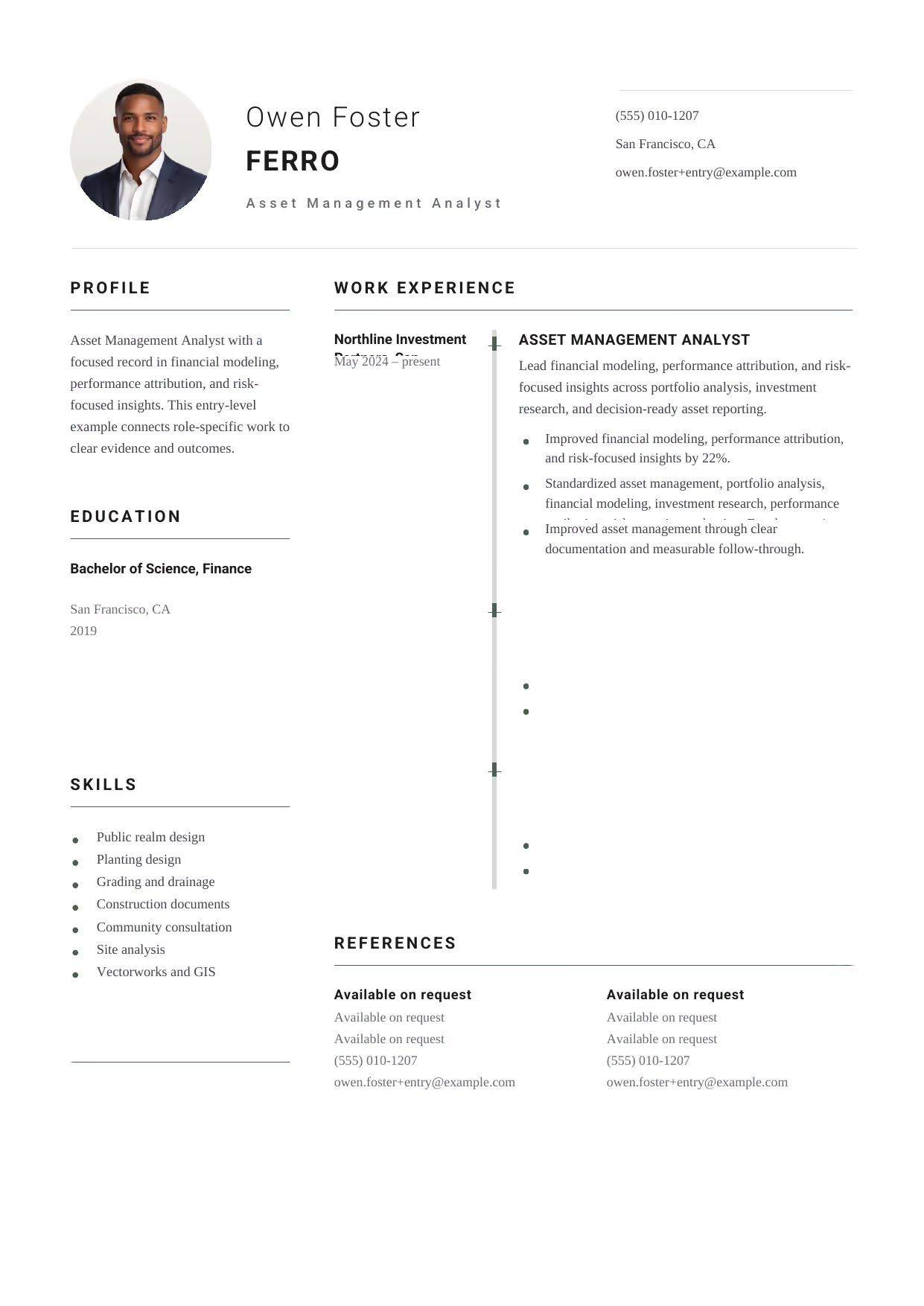
Asset Management Analyst
A builder-ready entry-level Asset Management Analyst example in the Puppis template, showing stage-appropriate evidence in a focused, editable resume format.
- Editable role positioning in the Puppis layout
- Role-specific evidence and delivery context
- Review the Puppis structure with a clean visual hierarchy
View this resume
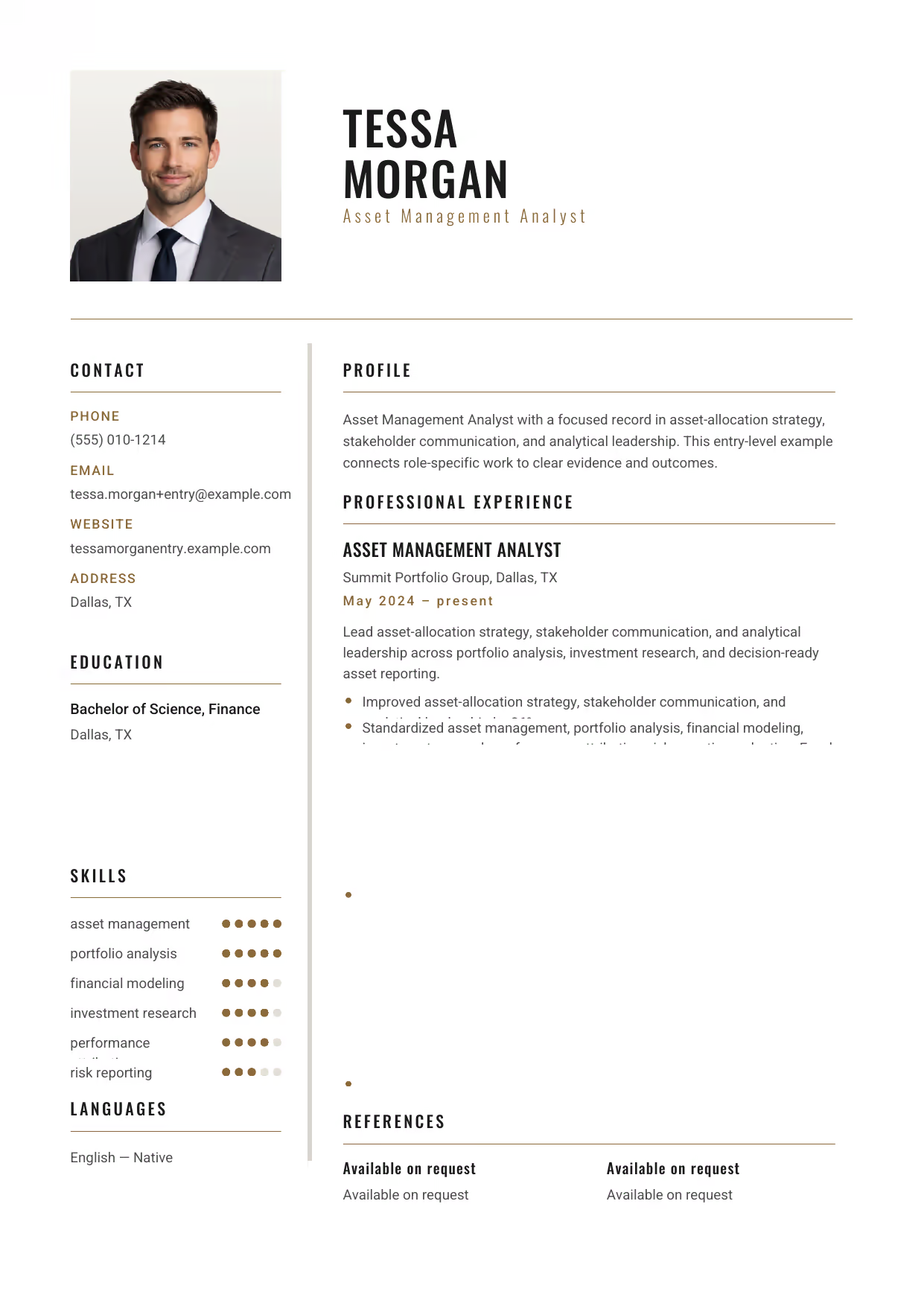
Asset Management Analyst
A builder-ready entry-level Asset Management Analyst example in the Acamar template, showing stage-appropriate evidence in a focused, editable resume format.
- Editable role positioning in the Acamar layout
- Role-specific evidence and delivery context
- Review the Acamar structure with a clean visual hierarchy
View this resume
Mid-Level Asset Management Analyst Resume (3-7 Years Experience)
Use these mid-level examples to compare the scope, evidence, and language expected for Asset Management Analyst roles at this stage.
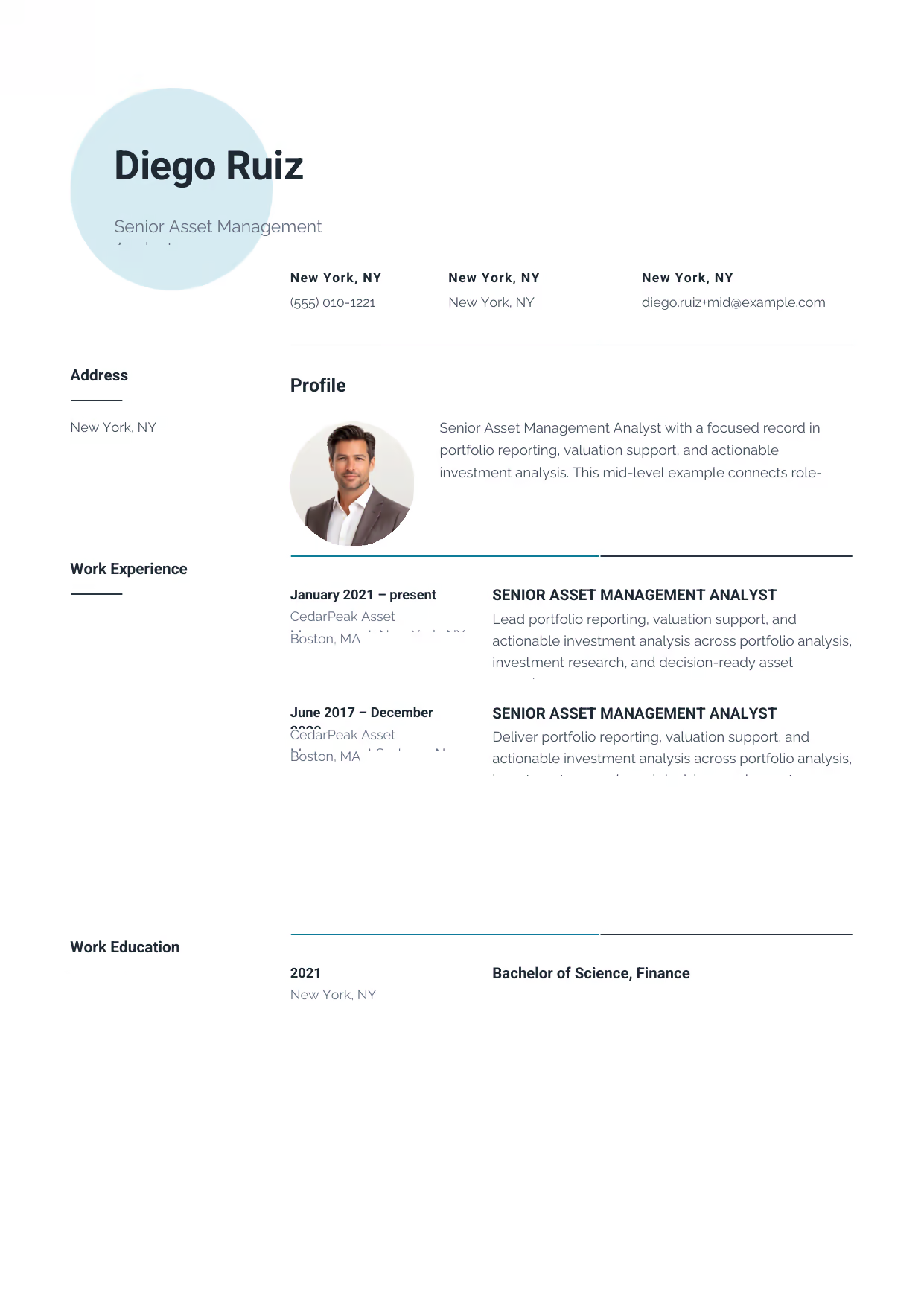
Senior Asset Management Analyst
A builder-ready mid-level Asset Management Analyst example in the Pavo template, showing stage-appropriate evidence in a focused, editable resume format.
- Editable role positioning in the Pavo layout
- Role-specific evidence and delivery context
- Review the Pavo structure with a clean visual hierarchy
View this resume

Senior Asset Management Analyst
A builder-ready mid-level Asset Management Analyst example in the Indus template, showing stage-appropriate evidence in a focused, editable resume format.
- Editable role positioning in the Indus layout
- Role-specific evidence and delivery context
- Review the Indus structure with a clean visual hierarchy
View this resume
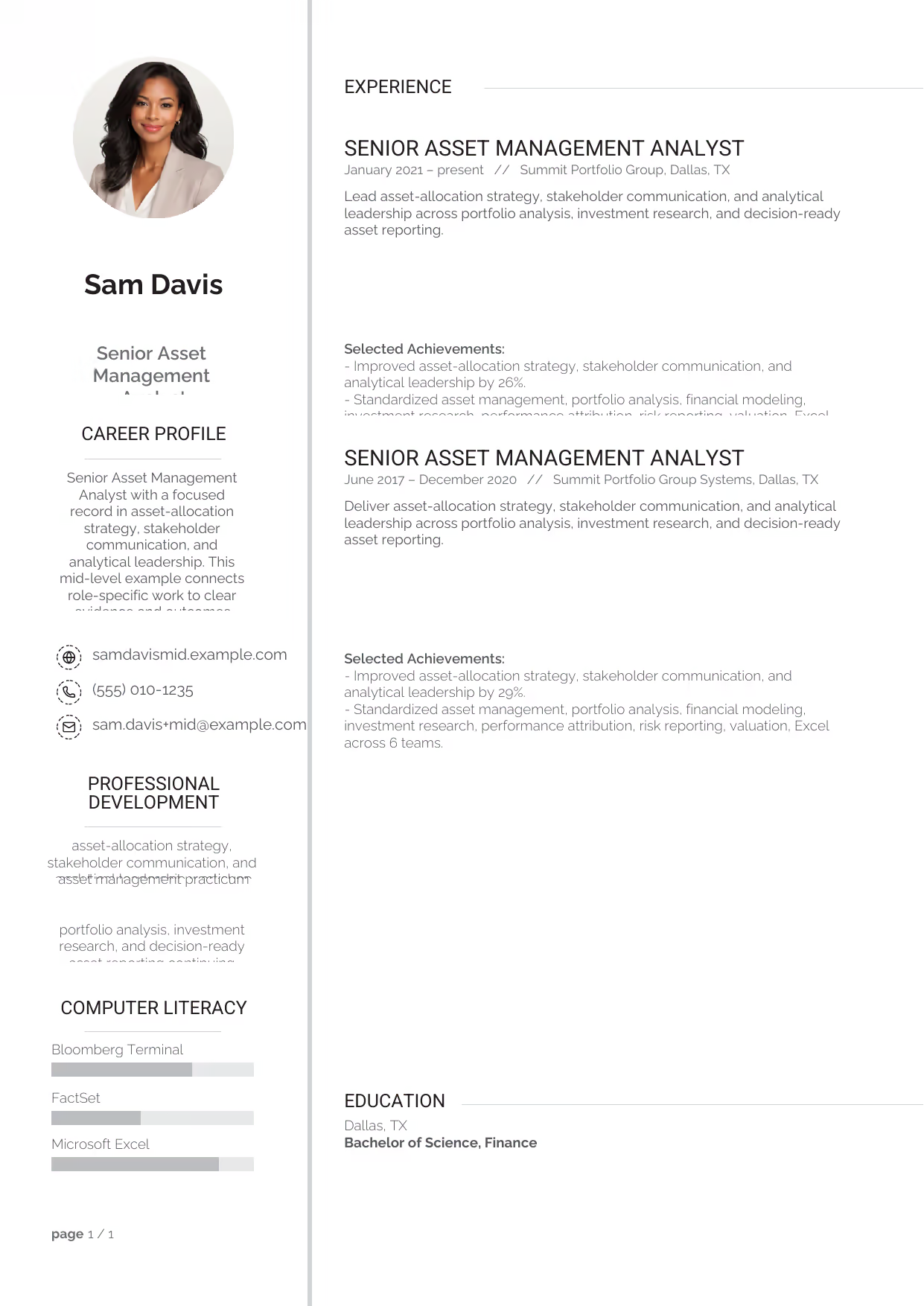
Senior Asset Management Analyst
A builder-ready mid-level Asset Management Analyst example in the Synnove template, showing stage-appropriate evidence in a focused, editable resume format.
- Editable role positioning in the Synnove layout
- Role-specific evidence and delivery context
- Review the Synnove structure with a clean visual hierarchy
View this resume
Senior Asset Management Analyst Resume (8+ Years / Management)
Use these advanced examples to compare the scope, evidence, and language expected for Asset Management Analyst roles at this stage.

Portfolio Strategy Manager
A builder-ready advanced Asset Management Analyst example in the Andromeda template, showing stage-appropriate evidence in a focused, editable resume format.
- Editable role positioning in the Andromeda layout
- Role-specific evidence and delivery context
- Review the Andromeda structure with a clean visual hierarchy
View this resume
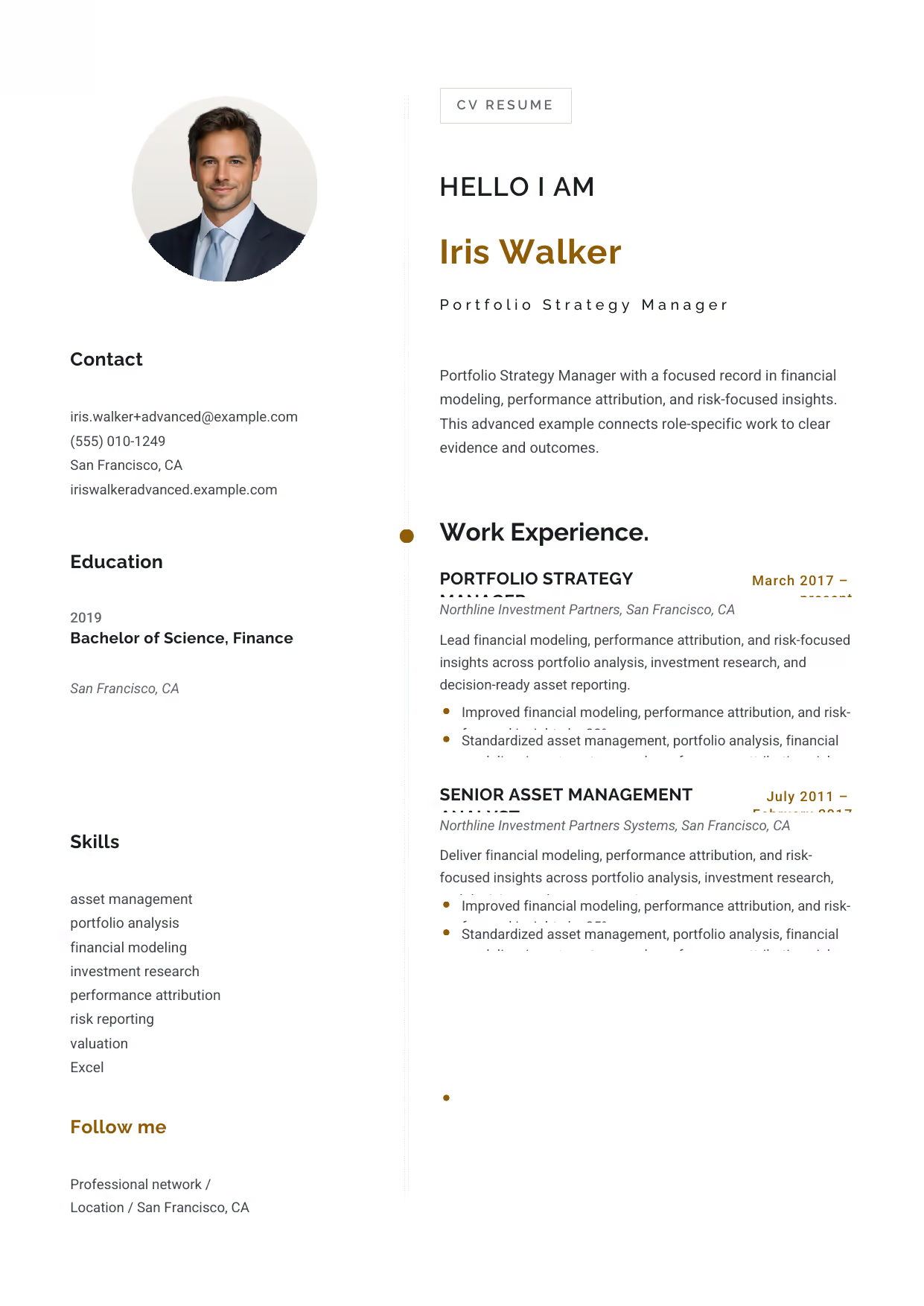
Portfolio Strategy Manager
A builder-ready advanced Asset Management Analyst example in the Eridanus template, showing stage-appropriate evidence in a focused, editable resume format.
- Editable role positioning in the Eridanus layout
- Role-specific evidence and delivery context
- Review the Eridanus structure with a clean visual hierarchy
View this resume
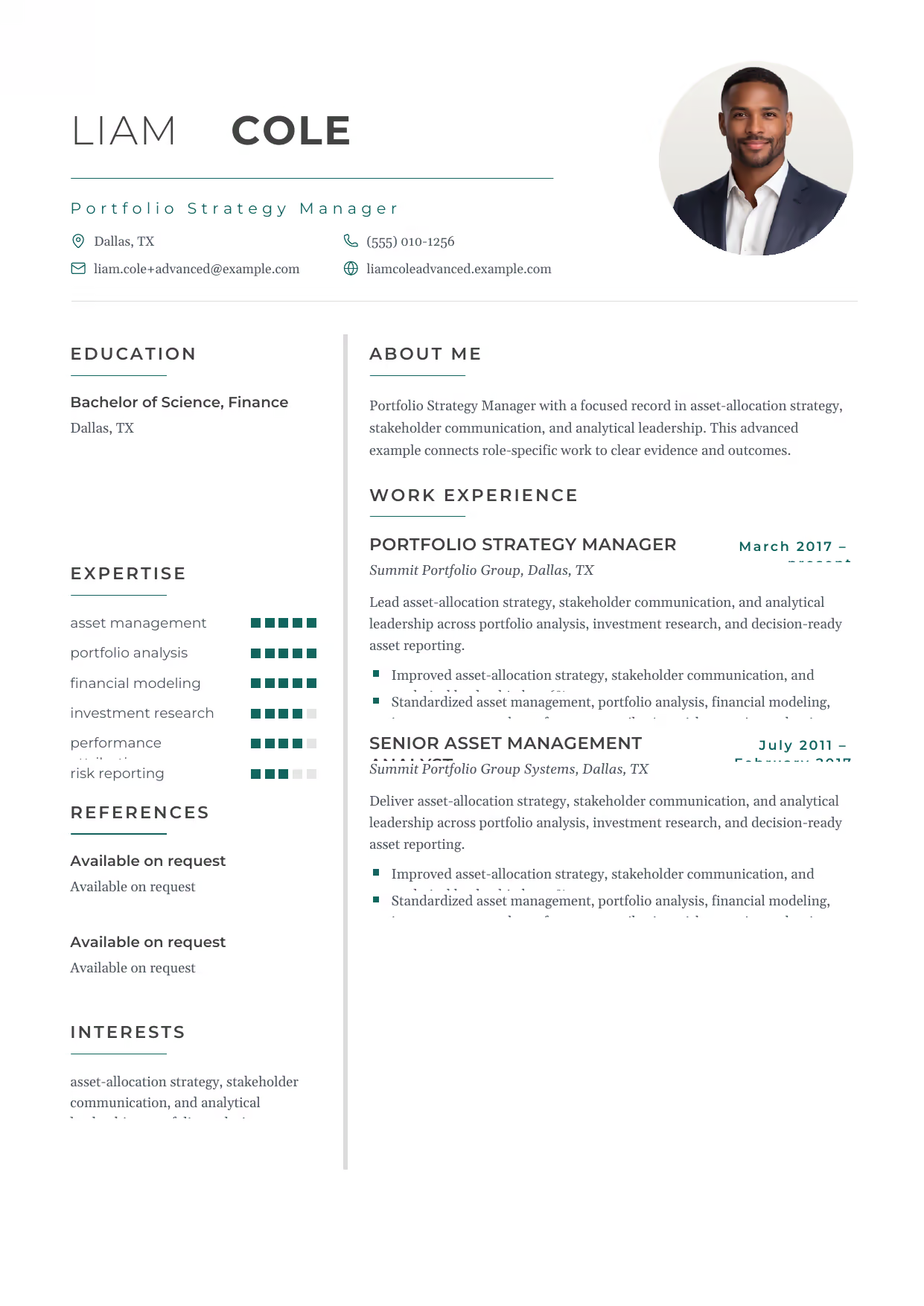
Portfolio Strategy Manager
A builder-ready advanced Asset Management Analyst example in the Achernar template, showing stage-appropriate evidence in a focused, editable resume format.
- Editable role positioning in the Achernar layout
- Role-specific evidence and delivery context
- Review the Achernar structure with a clean visual hierarchy
View this resume
How to Write a Asset Management Analyst Resume
The Resume Summary
The resume summary is your first impression. It should be a concise overview of your skills and experience, tailored to the specific Asset Management Analyst role you’re applying for.
Formula: [Years of Experience] + [Key Skills] + [Key Achievement] + [Target Role]
Entry-Level Example: Recent Finance graduate with strong analytical skills and coursework in financial modeling, seeking an entry-level Asset Management Analyst position.
Mid-Level Example: Results-oriented Asset Management Analyst with 5+ years of experience in portfolio management, increasing portfolio returns by 15%, seeking a challenging role at a leading investment firm.
Senior-Level Example: Strategic Asset Management Leader with 10+ years of experience managing large teams and overseeing $500M+ budgets, seeking a Director-level position to drive growth and innovation.
Work Experience & Action Verbs
Focus on achievements, not just duties. Recruiters know what an Asset Management Analyst does; they want to know how well you did it. Use action verbs to start each bullet point and quantify your accomplishments whenever possible.
- Before: Responsible for conducting financial analysis.
After: Conducted financial analysis of investment opportunities, resulting in a 10% increase in portfolio returns. - Before: Managed client portfolios.
After: Managed client portfolios totaling $20 million, achieving an average annual return of 12%. - Before: Assisted with risk management activities.
After: Developed and implemented risk mitigation strategies, reducing portfolio volatility by 15%. - Before: Created financial models.
After: Created financial models to evaluate investment opportunities, resulting in the identification of three high-potential investments. - Before: Prepared investment reports.
After: Prepared monthly investment reports for clients, providing clear and concise summaries of portfolio performance.
Top Skills for Asset Management Analysts
Here are some top skills to include on your Asset Management Analyst resume:
- Hard Skills:
- Financial Analysis
- Portfolio Management
- Risk Management
- Financial Modeling
- Investment Analysis
- Data Analysis
- Soft Skills:
- Communication Skills
- Problem-Solving
- Analytical Skills
- Critical Thinking
- Teamwork
- Attention to Detail
- Tools/Software:
- Bloomberg Terminal
- FactSet
- Microsoft Excel
- Morningstar Direct
- Capital IQ
Education & Certifications
List your education in reverse chronological order, starting with your most recent degree. For entry-level candidates, include relevant coursework. For mid-level and senior-level candidates, focus on certifications and advanced degrees.
Recommended certifications for Asset Management Analysts include:
- Chartered Financial Analyst (CFA)
- Certified Financial Planner (CFP)
- Chartered Alternative Investment Analyst (CAIA)
10 Common Asset Management Analyst Resume Mistakes
- Generic Summary Statement: A vague summary fails to capture attention. Instead, tailor your summary to the specific role, highlighting key skills and achievements relevant to Asset Management Analyst positions. Quick Fix: Replace generic statements with a concise, targeted summary showcasing your unique value proposition.
- Listing Duties Instead of Impact: Recruiters know what an Asset Management Analyst does; they want to know how well you did it. Replace passive phrases like ‘Responsible for portfolio analysis’ with quantified wins like ‘Improved portfolio performance by 18% through rigorous quantitative analysis’. Quick Fix: Focus on quantifiable results to demonstrate your impact.
- Neglecting Key Skills: Failing to showcase essential skills like financial modeling, risk assessment, and portfolio management can hurt your chances. ATS systems scan for these keywords. Quick Fix: Integrate relevant skills throughout your resume, especially in the skills section and work experience descriptions.
- Poor Formatting: A cluttered or difficult-to-read resume can be instantly rejected. Recruiters spend very little time reviewing each resume. Quick Fix: Use a clean, ATS-friendly format with clear headings and bullet points.
- Grammar Errors and Typos: Even minor errors can undermine your credibility and suggest a lack of attention to detail. This is critical in the world of Asset Management. Quick Fix: Proofread your resume carefully and ask someone else to review it as well.
- Not Tailoring to the Job Description: A generic resume demonstrates a lack of interest and effort. Tailoring your resume to match keywords and requirements is crucial. Quick Fix: Customize your resume for each application, highlighting the skills and experience most relevant to the specific role.
- Omitting Quantifiable Achievements: Numbers speak volumes. Failing to quantify your accomplishments makes it difficult for recruiters to assess your impact. Quick Fix: Use numbers and percentages to showcase your achievements whenever possible (e.g., increased portfolio returns by X%, reduced risk by Y%).
- Ignoring ATS Optimization: Many companies use Applicant Tracking Systems (ATS) to screen resumes. Failing to optimize your resume for ATS can result in it being overlooked. Quick Fix: Use relevant keywords, a clean format, and avoid graphics or tables that may not be read correctly by ATS.
- Lack of Action Verbs: Using weak or passive verbs can make your accomplishments seem less impressive. Start each bullet point with a strong action verb to highlight your contributions. Quick Fix: Replace passive verbs with action verbs like ‘Analyzed’, ‘Managed’, ‘Developed’, ‘Implemented’, and ‘Improved’.
- Inconsistent Information: Discrepancies between your resume and LinkedIn profile or other sources can raise red flags. Maintain consistency across all platforms. Quick Fix: Double-check all information on your resume and ensure it aligns with your LinkedIn profile and other professional profiles.
Frequently Asked Questions (Asset Management Analyst)
- What should a Asset Management Analyst resume emphasize first? Lead with the scope of portfolio reporting, valuation support, and actionable investment analysis, then connect your contribution to a clear outcome, tool, or decision.
- Which skills deserve priority on a Asset Management Analyst resume? Prioritize asset management, portfolio analysis, and financial modeling when they match the role and can be supported by evidence.
- How can a Asset Management Analyst show project scope and impact? Name the environment, scale, constraints, and result; financial modeling, performance attribution, and risk-focused insights becomes more credible when the context is concrete.
- How should a Asset Management Analyst describe tools and technical decisions? Describe why you selected a method, how you implemented it, and what changed afterward in the Asset Management Analyst role.
- Which achievements matter most for a Asset Management Analyst application? Use outcome-led bullets that show asset-allocation strategy, stakeholder communication, and analytical leadership through delivery quality, measurable scope, or stakeholder value.
- How long should a Asset Management Analyst resume be? Use the shortest length that proves fit; a focused page can work early-career, while broader Asset Management Analyst scope may need more room.
- How can a Asset Management Analyst explain progression between career stages? Group examples by increasing ownership, moving from portfolio reporting, valuation support, and actionable investment analysis toward asset-allocation strategy, stakeholder communication, and analytical leadership as responsibility grows.
- Which keywords should a Asset Management Analyst include for screening systems? Mirror truthful language from the posting, especially investment research, without stuffing unrelated terms.
- How should a Asset Management Analyst present reliability, quality, or safety work? Show how you protected outcomes through performance attribution and explain the evidence a hiring team can verify.
- What format makes a Asset Management Analyst resume easy for hiring teams to scan? Use clear headings, readable bullets, and consistent dates so a hiring manager can evaluate Asset Management Analyst fit quickly.
Crafting a compelling Asset Management Analyst resume requires a strategic approach, focusing on quantifiable achievements, relevant skills, and industry-specific expertise. By following the examples and tips outlined in this guide, you can create a resume that stands out and lands you more interviews.
To discover more tips and resources, Search more Asset Management Analyst resources on our website.
Editorial review: RockStarCV Editorial Team reviewed this Asset Management Analyst guide for source fidelity, role-specific usefulness, accessibility, builder examples, and question completeness.