
Accountant Resume Examples & Guide
Landing an Accountant job can be tough. You’re up against fierce competition, and Applicant Tracking Systems (ATS) are the first hurdle. This guide provides Accountant resume examples for every experience level, from students to seasoned professionals, helping you stand out and get noticed.
- Quantify Achievements: Use numbers to demonstrate the impact of your work. For example, ‘Reduced expenses by 15%’ is more impactful than ‘Managed expenses.’
- Highlight Relevant Skills: Showcase skills like financial reporting, budgeting, auditing, and proficiency in accounting software.
- Tailor to the Job Description: Customize your resume for each application, emphasizing the skills and experience that match the specific requirements.
- Optimize for ATS: Use keywords from the job description and a simple, ATS-friendly format.
- Use Action Verbs: Start your bullet points with strong action verbs to describe your accomplishments. Examples include ‘Analyzed,’ ‘Managed,’ and ‘Developed.’
Let’s dive into some Accountant resume examples to see these tips in action.
Explore editable Accountant resume examples by career stage. Each sample opens in the RockStarCV builder so you can study the structure and make your own version. Every example includes role-relevant education, skills, credentials, and work history—not just a matching headline. As you compare them, look for truthful evidence of financial statements, audit support, and internal controls at the seniority level shown.
Entry-Level Accountant Resume (0-2 Years Experience)
Use these entry-level examples to compare the scope, evidence, and language expected for Accountant roles at this stage.
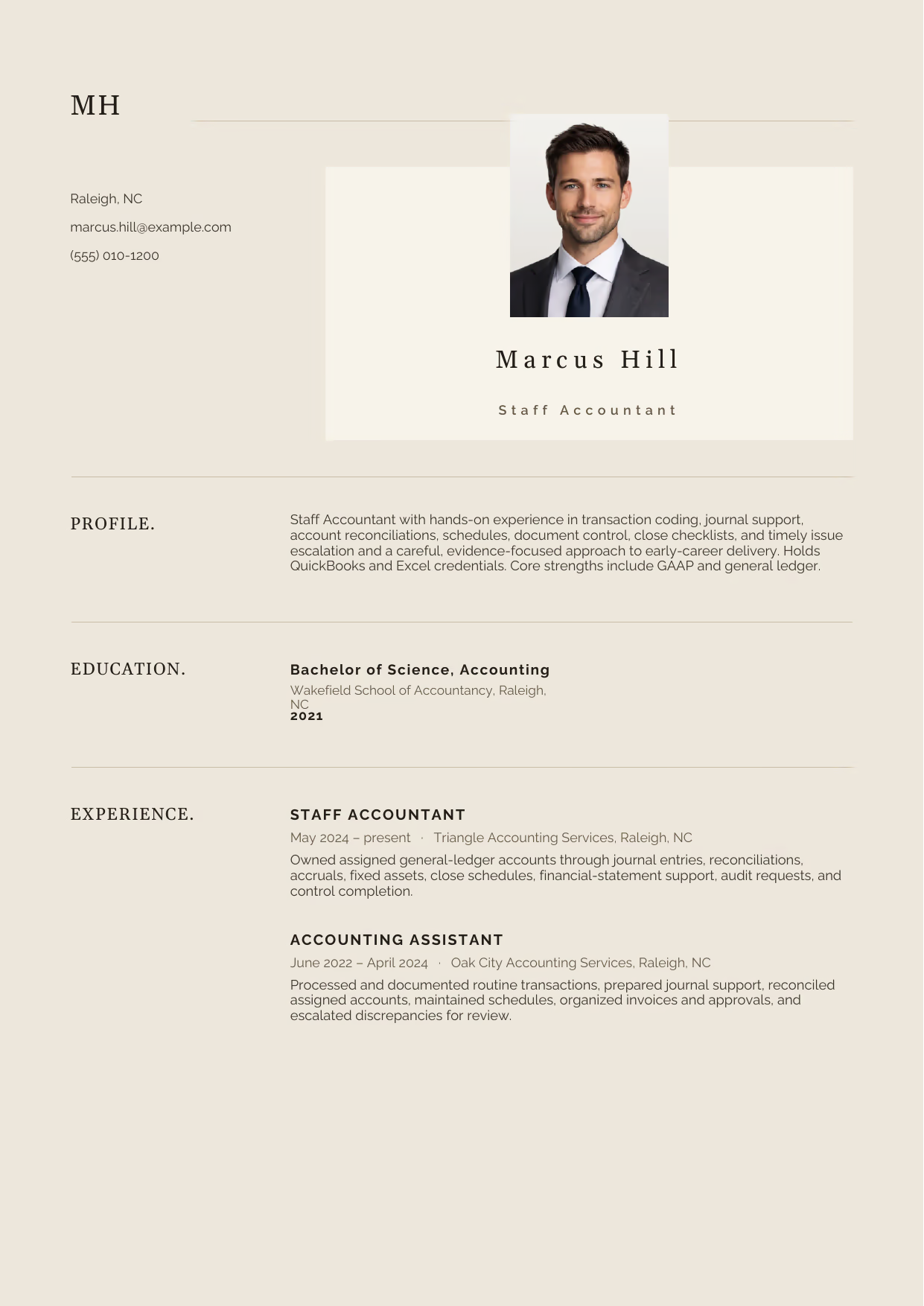
Staff Accountant
A builder-ready entry-level Accountant example in the Norma template, showing stage-appropriate evidence in a focused, editable resume format.
- Editable role positioning in the Norma layout
- Role-specific evidence and delivery context
- Review the Norma structure with a clean visual hierarchy
View this resume

Staff Accountant
A builder-ready entry-level Accountant example in the Puppis template, showing stage-appropriate evidence in a focused, editable resume format.
- Editable role positioning in the Puppis layout
- Role-specific evidence and delivery context
- Review the Puppis structure with a clean visual hierarchy
View this resume

Staff Accountant
A builder-ready entry-level Accountant example in the Hydra template, showing stage-appropriate evidence in a focused, editable resume format.
- Editable role positioning in the Hydra layout
- Role-specific evidence and delivery context
- Review the Hydra structure with a clean visual hierarchy
View this resume
Mid-Level Accountant Resume (3-7 Years Experience)
Use these mid-level examples to compare the scope, evidence, and language expected for Accountant roles at this stage.
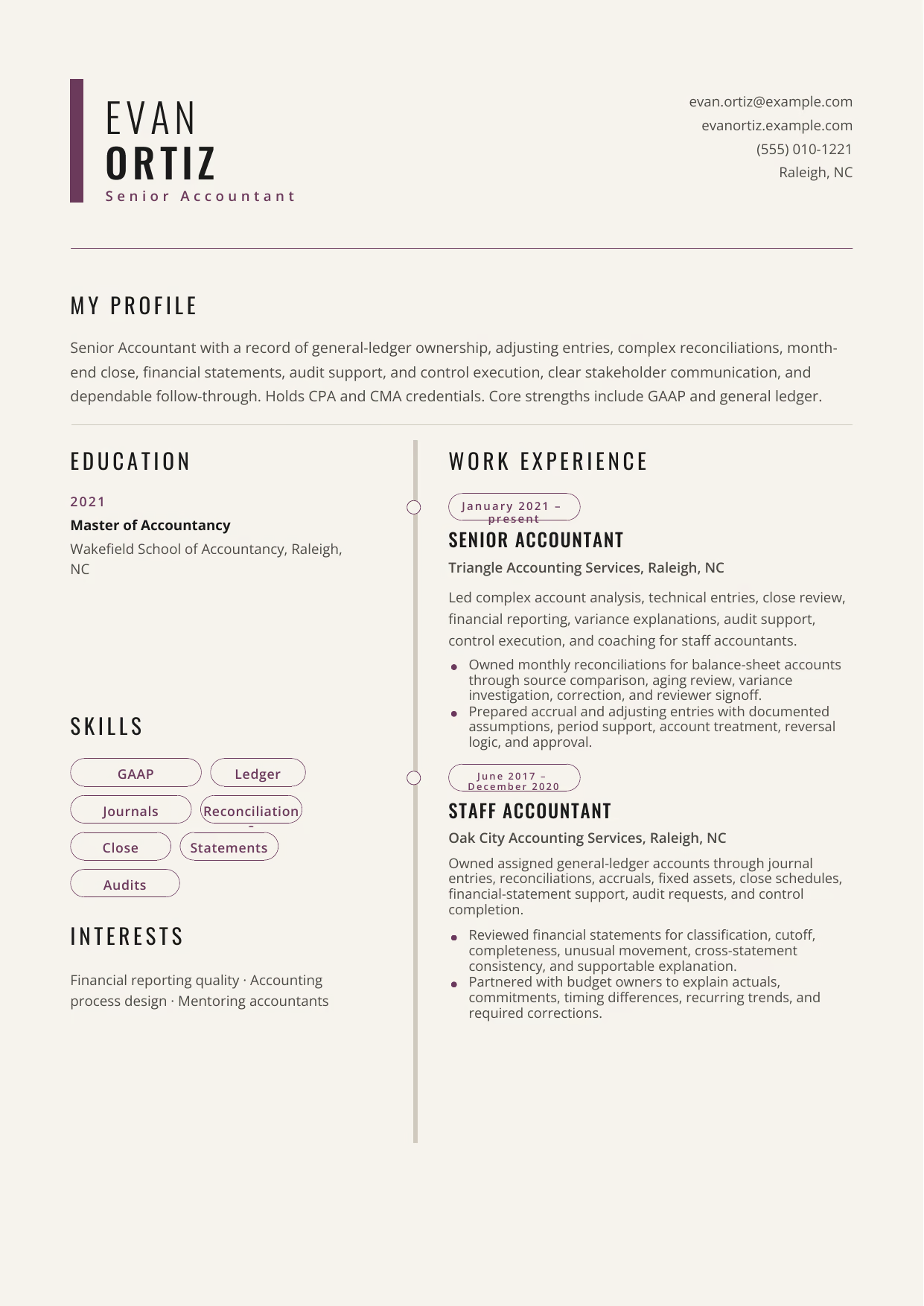
Senior Accountant
A builder-ready mid-level Accountant example in the Caelum template, showing stage-appropriate evidence in a focused, editable resume format.
- Editable role positioning in the Caelum layout
- Role-specific evidence and delivery context
- Review the Caelum structure with a clean visual hierarchy
View this resume
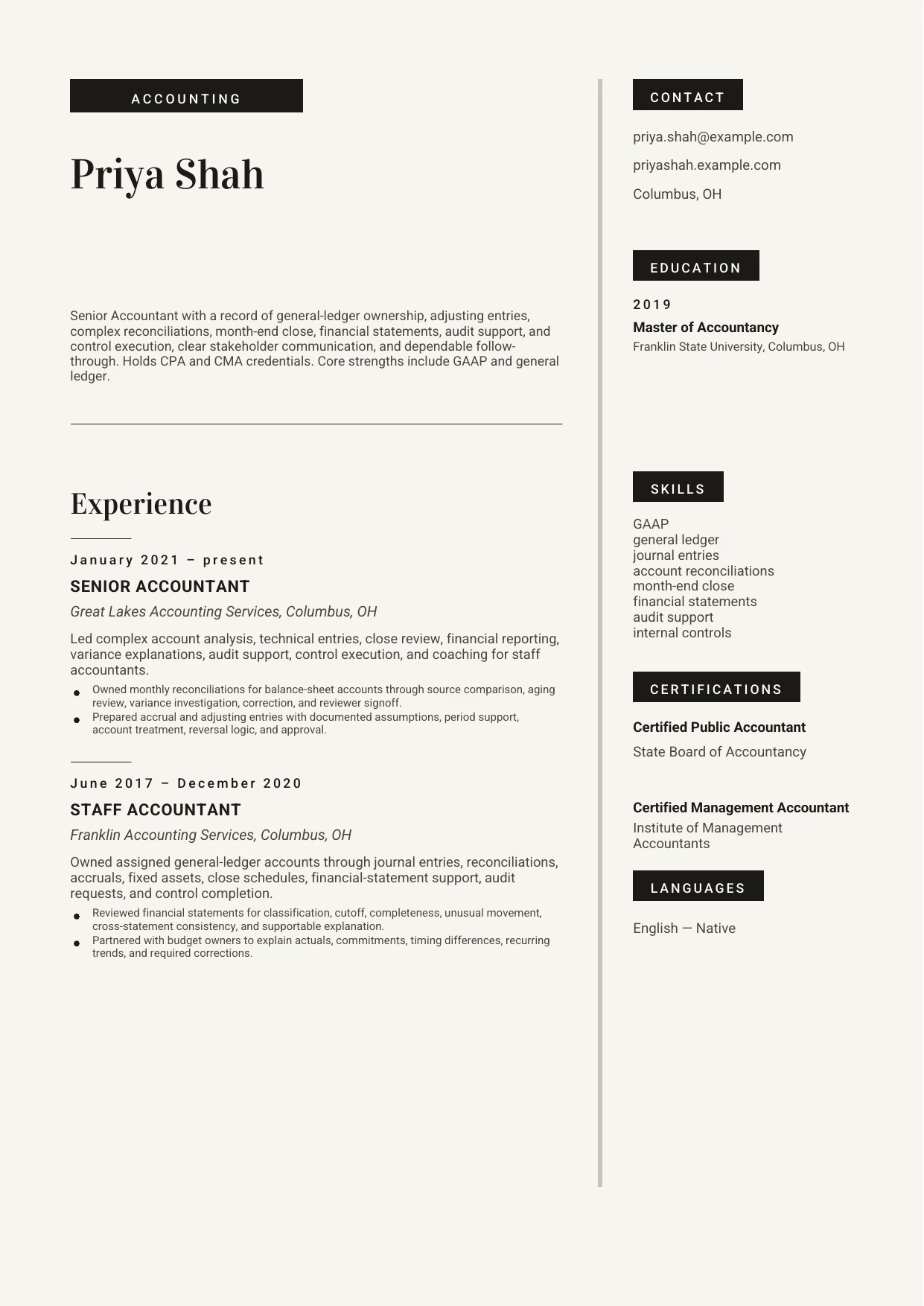
Senior Accountant
A builder-ready mid-level Accountant example in the Aquila template, showing stage-appropriate evidence in a focused, editable resume format.
- Editable role positioning in the Aquila layout
- Role-specific evidence and delivery context
- Review the Aquila structure with a clean visual hierarchy
View this resume
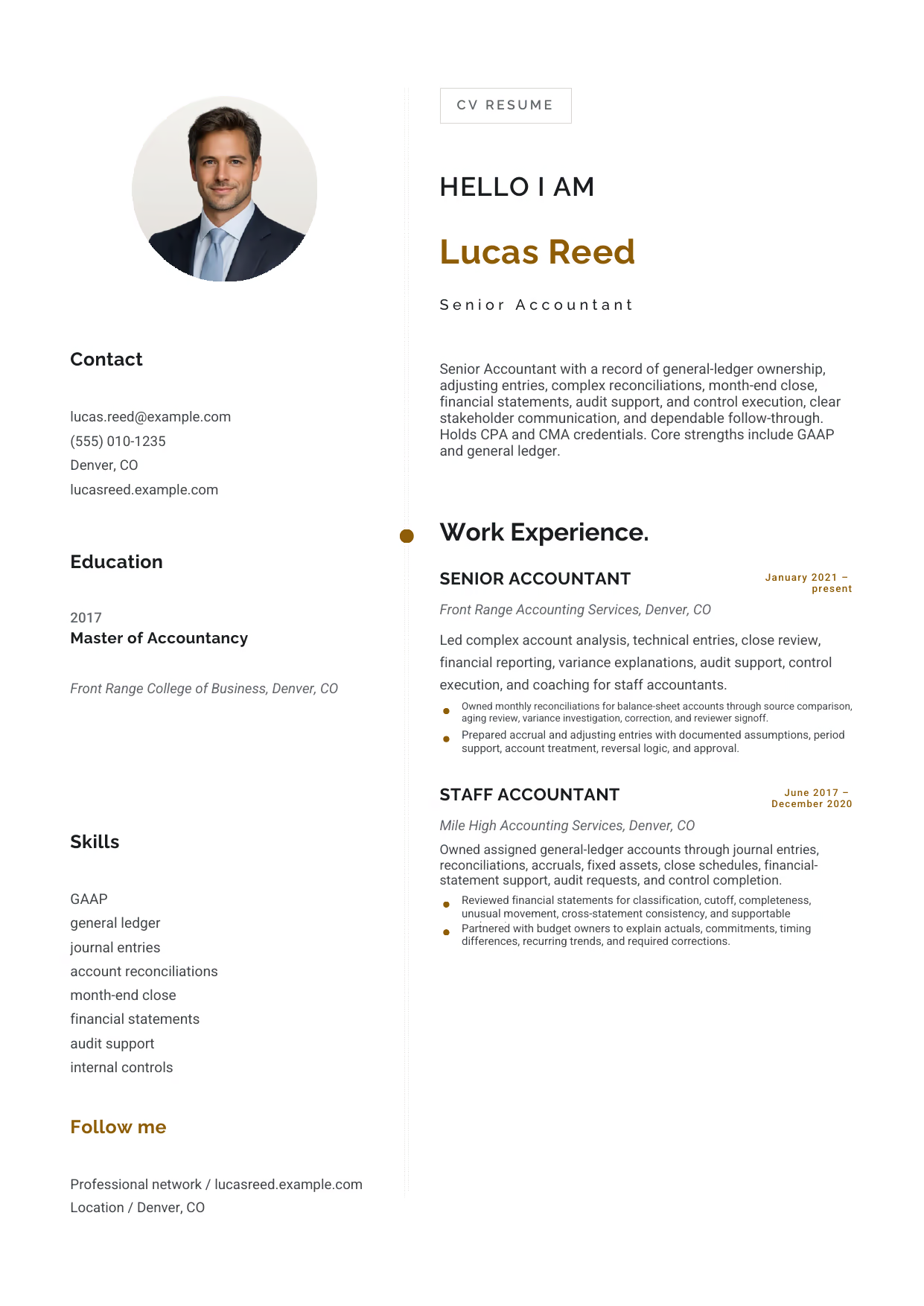
Senior Accountant
A builder-ready mid-level Accountant example in the Eridanus template, showing stage-appropriate evidence in a focused, editable resume format.
- Editable role positioning in the Eridanus layout
- Role-specific evidence and delivery context
- Review the Eridanus structure with a clean visual hierarchy
View this resume
Senior Accountant Resume (8+ Years / Management)
Use these advanced examples to compare the scope, evidence, and language expected for Accountant roles at this stage.

Controller
A builder-ready advanced Accountant example in the Delphinus template, showing stage-appropriate evidence in a focused, editable resume format.
- Editable role positioning in the Delphinus layout
- Role-specific evidence and delivery context
- Review the Delphinus structure with a clean visual hierarchy
View this resume
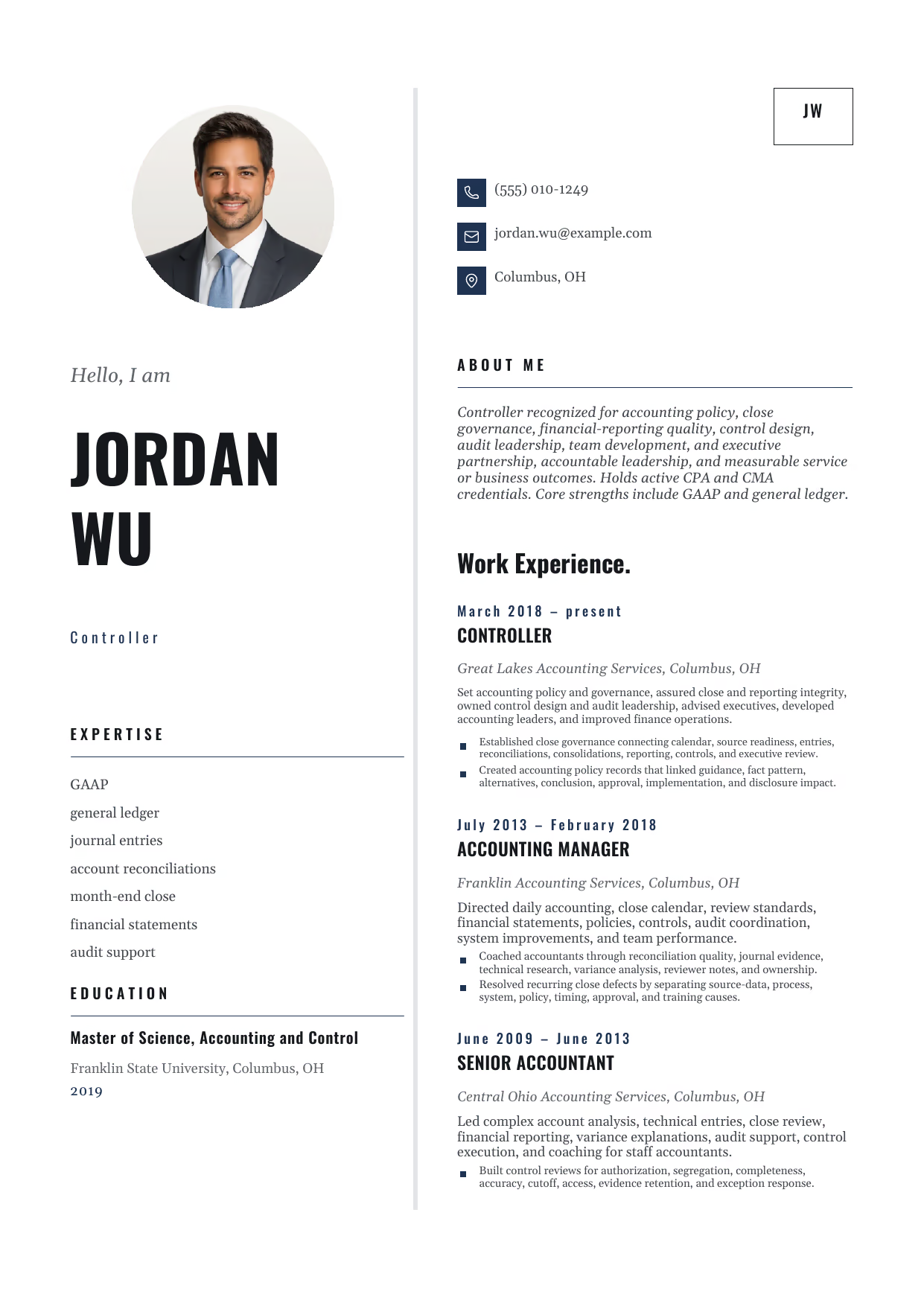
Controller
A builder-ready advanced Accountant example in the Equuleus template, showing stage-appropriate evidence in a focused, editable resume format.
- Editable role positioning in the Equuleus layout
- Role-specific evidence and delivery context
- Review the Equuleus structure with a clean visual hierarchy
View this resume

Controller
A builder-ready advanced Accountant example in the Dorado template, showing stage-appropriate evidence in a focused, editable resume format.
- Editable role positioning in the Dorado layout
- Role-specific evidence and delivery context
- Review the Dorado structure with a clean visual hierarchy
View this resume
Accountant Resume Examples by Specialty
Choose the Accountant path closest to the job you want. Each guide highlights the work, preparation, and evidence hiring teams expect for that specialty.
Cost Accountant Resume Examples
- Resume focus:
- product cost, inventory, standards, variances, close, and operational insight;
- Credentials:
- accounting or management-accounting credentials when held;
- Evidence to include:
- cost model, inventory scope, variance causes, controls, close support, and decisions;
Forensic Accountant Resume Examples
- Resume focus:
- financial investigation, transaction tracing, evidence, loss analysis, and defensible reporting;
- Credentials:
- CPA, fraud, valuation, or forensic credentials when current;
- Evidence to include:
- case scope, sources, methodology, evidence chain, findings, limitations, and resolution;
Senior Tax Accountant Resume Examples
- Resume focus:
- tax provision, compliance, research, workpapers, review, and authority correspondence;
- Credentials:
- CPA, enrolled-agent, or tax-specialty credentials;
- Evidence to include:
- entity scope, jurisdictions, provisions, filings, research, controls, and audit support;
Management Accountant Resume Examples
- Resume focus:
- management reporting, cost analysis, budgeting, forecasting, controls, and business partnership;
- Credentials:
- CMA, CPA, or relevant finance credential;
- Evidence to include:
- reporting scope, analysis, assumptions, controls, recommendations, and business decisions;
Accountant Licenses and Certifications
List only current education, licenses, or certifications that apply to the target role. Give the credential name and issuing organization, and leave private identifier numbers off a public resume.
Accounting credentials
- CPA, CMA, or other current accounting credential;
- Issuing body, jurisdiction when applicable, and active status;
Systems and analysis
- ERP, spreadsheet, close-management, or reporting credential;
- Only training relevant to the target accounting environment;
Accountant Skills and ATS Keywords by Category
Use language that truthfully matches your Accountant experience and the job posting. Pair important terms with a work example instead of presenting an unsupported keyword list.
Skills by category
Core accounting
- General ledger, journal entries, reconciliations, and close;
- GAAP, financial statements, accruals, and account analysis;
Controls and partnership
- Internal controls, audit support, policies, and documentation;
- ERP systems, variance explanations, and business communication;
ATS keywords by category
Accounting keywords
- GAAP, general ledger, journal entries, account reconciliations;
- Month-end close, financial statements, accruals, fixed assets;
Control keywords
- Audit support, internal controls, technical accounting;
- ERP, account analysis, variance analysis, financial reporting;
How to Write an Accountant Resume
The Resume Summary
The resume summary is your chance to make a strong first impression. It should highlight your key skills and experience and demonstrate your value to potential employers.
Formula: [Years of Experience] + [Relevant Title] + with expertise in [Key Skill 1] and [Key Skill 2] + Seeking to leverage skills to [Desired Outcome].
Entry-Level Example: Recent Accounting graduate with expertise in financial statement preparation and account reconciliation. Seeking to leverage analytical skills to contribute to a company’s financial success.
Mid-Level Example: Experienced Accountant with expertise in budgeting and financial analysis. Seeking to leverage skills to improve financial performance and drive cost savings.
Senior Example: Strategic Senior Accountant with expertise in financial management and team leadership. Seeking to leverage skills to develop and implement financial strategies and drive profitability.
Work Experience & Action Verbs
The work experience section is where you showcase your accomplishments and demonstrate your value to potential employers. Focus on achievements rather than just duties.
Duties describe what you were responsible for, while Achievements highlight what you accomplished and the impact you made.
- Before: Responsible for preparing financial statements.
After: Prepared monthly financial statements, ensuring accuracy and compliance with GAAP. - Before: Assisted with budget preparation.
After: Assisted with the preparation of the annual budget, resulting in a 5% reduction in expenses. - Before: Performed account reconciliations.
After: Performed monthly account reconciliations, resolving discrepancies and ensuring accuracy. - Before: Managed accounts payable.
After: Managed accounts payable, processing invoices and ensuring timely payments. - Before: Assisted with audits.
After: Assisted with internal and external audits, ensuring compliance with regulations.
Top Skills for Accountants
Highlighting the right skills is crucial for attracting the attention of recruiters and passing ATS scans.
Hard Skills
- Financial Accounting
- Financial Reporting
- Budgeting
- Auditing
- Taxation
- GAAP
- IFRS
- Account Reconciliation
- Financial Analysis
Soft Skills
- Analytical Skills
- Problem-Solving
- Communication Skills
- Attention to Detail
- Time Management
- Organization
- Critical Thinking
- Teamwork
Tools/Software
- SAP
- Oracle
- NetSuite
- QuickBooks
- Microsoft Excel
- CCH ProSystem fx
- Xero
Education & Certifications
Your education and certifications demonstrate your qualifications and expertise in accounting.
For entry-level positions, emphasize your education and relevant coursework. For mid-level and senior positions, highlight your certifications and advanced degrees.
Required or Recommended Certifications:
- Certified Public Accountant (CPA)
- Certified Management Accountant (CMA)
- Chartered Global Management Accountant (CGMA)
- Certified Internal Auditor (CIA)
10 Common Accountant Resume Mistakes
- Generic Resume: Sending the same resume for every Accountant job application. Tailor your resume to each specific job description, highlighting the skills and experience that match the requirements. This shows you’ve taken the time to understand the role and are genuinely interested.
- Listing Duties Instead of Impact: Recruiters know what an Accountant does; they want to know how well you did it. Replace passive phrases like ‘Responsible for preparing financial statements’ with quantified wins like ‘Prepared accurate and timely financial statements, reducing reporting errors by 15%’.
- Ignoring Keywords: Failing to include relevant keywords from the job description. Applicant Tracking Systems (ATS) scan resumes for specific keywords. Use industry-specific terms like ‘GAAP’, ‘IFRS’, ‘SOX compliance’, and ‘budgeting’ to increase your chances of getting noticed.
- Poor Formatting: Using a cluttered or difficult-to-read format. Recruiters often spend only a few seconds reviewing each resume. Use a clean, professional format with clear headings and bullet points to make it easy to scan and highlight your key qualifications.
- Grammar Errors: Misspelling Core Industry Terminology: Typos in general are bad, but misspelling critical tools or certifications (like ‘GAAP’, ‘CPA’, or ‘NetSuite’) acts as an immediate red flag regarding your attention to detail. Always proofread carefully.
- Lack of Quantifiable Results: Failing to quantify your achievements. Use numbers to demonstrate the impact of your work. For example, ‘Reduced expenses by 10%’, ‘Increased revenue by 15%’, or ‘Improved efficiency by 20%’.
- Omitting Relevant Skills: Not including all relevant skills, both hard and soft. List your technical skills (e.g., accounting software, financial analysis) and soft skills (e.g., communication, problem-solving, teamwork). Tailor your skills list to the specific requirements of the job.
- Too Much Irrelevant Information: Including irrelevant information that doesn’t support your application. Focus on your accounting skills and experience, and avoid including hobbies or personal interests that are not relevant to the job.
- Inconsistent Dates: Having gaps in your employment history or inconsistent dates. Explain any gaps in your employment history and ensure that your dates are accurate and consistent.
- Weak Summary Statement: Failing to write a compelling summary statement. Your summary statement should highlight your key skills and experience and demonstrate your value to potential employers. Make it concise, engaging, and tailored to the specific job you are applying for.
Frequently Asked Questions (Accountant)
- What should an Accountant resume emphasize first? Lead with the scope of transaction coding, journal support, account reconciliations, schedules, document control, close checklists, and timely issue escalation, then connect your contribution to a clear outcome, tool, or decision.
- Which skills deserve priority on an Accountant resume? Prioritize GAAP, general ledger, and journal entries when they match the role and can be supported by evidence.
- How can an Accountant show project scope and impact? Name the environment, scale, constraints, and result; general-ledger ownership, adjusting entries, complex reconciliations, month-end close, financial statements, audit support, and control execution becomes more credible when the context is concrete.
- How should an Accountant describe tools and technical decisions? Describe why you selected a method, how you implemented it, and what changed afterward in the Accountant role.
- Which achievements matter most for an Accountant application? Use outcome-led bullets that show accounting policy, close governance, financial-reporting quality, control design, audit leadership, team development, and executive partnership through delivery quality, measurable scope, or stakeholder value.
- How long should an Accountant resume be? Use the shortest length that proves fit; a focused page can work early-career, while broader Accountant scope may need more room.
- How can an Accountant explain progression between career stages? Group examples by increasing ownership, moving from transaction coding, journal support, account reconciliations, schedules, document control, close checklists, and timely issue escalation toward accounting policy, close governance, financial-reporting quality, control design, audit leadership, team development, and executive partnership as responsibility grows.
- Which keywords should an Accountant include for screening systems? Mirror truthful language from the posting, especially account reconciliations, without stuffing unrelated terms.
- How should an Accountant present reliability, quality, or safety work? Show how you protected outcomes through month-end close and explain the evidence a hiring team can verify.
- What format makes an Accountant resume easy for hiring teams to scan? Use clear headings, readable bullets, and consistent dates so a hiring manager can evaluate Accountant fit quickly.
Crafting a compelling Accountant resume is essential for landing your dream job. By following the tips and examples in this guide, you can create a resume that showcases your skills, experience, and value to potential employers.
Ready to take the next step? Search more Accountant resources on our site to find templates and additional advice!
RockStarCV Editorial Team